
A case can turn on evidence missing from the initial file. An NYC law firm litigation support investigator can help develop the factual record through focused research, surveillance, video evidence, computer forensics, and review of overlooked details. This work supports counsel’s fact-finding; it does not replace legal analysis or advocacy.
Law firms and insurers may need a clearer factual record to assess a claim, test an account, or decide which evidence warrants closer review. This article explains how an NYC law firm litigation support investigator can contribute, which investigative methods and forensic capabilities may matter, and how to scope an assignment. It also covers support for litigation and insurance matters, from locating relevant video to identifying inconsistencies across records.
Key Takeaways
- Assess an investigator’s forensic and investigative experience against the evidence questions the case needs to resolve.
- Use targeted investigations to develop facts relevant to a law firm’s or insurer’s review, rather than treating evidence gathering as a one-size-fits-all task.
- Organize background and computer-assisted research around specific leads, then evaluate how each finding connects to the matter.
- Search systematically for video and overlooked evidence by mapping potential sources and documenting relevant material.
- Define the assignment’s objectives, scope, and reporting needs at the outset to keep investigator work aligned with the case.
Forensics and litigation support qualifications
Useful qualifications connect investigative methods to the evidence question, rather than relying on a title alone. For attorneys, the key is whether the investigator can document a clear process, preserve context, and explain findings precisely.
Investigator Credentials and References
Review the investigator’s identity, professional history, relevant training, and experience with comparable assignments. Ask for references from prior legal or corporate work, where appropriate, and review a sample report for source attribution, chronology, and a clear distinction between observation and conclusion. Computer forensics requires different experience from employee interviews or video surveillance, so match qualifications to the task.
New York City’s Department of Investigation provides a concrete example of complex investigative work. Lesley Brovner and Mark Peters served as Commissioner and First Deputy Commissioner from 2014 through 2018. During that period, they issued over 50 reports into City agencies and authorities and investigated hundreds regulatory matters. Their work illustrates why an investigator’s ability to assess records, interview people, and present findings matters alongside formal qualifications.
For digital forensics, first define the relevant device, account, or files. The investigator should document the source, collection and handling steps, and analysis performed so another reviewer can follow the process. A focused review might compare document metadata with a stated timeline or identify differences among versions of an internal report. Computer-assisted analysis can organize material, but the investigator should explain how the findings relate to the case question.
Forensic investigations may also include employee interviews. Set a clear purpose, prepare topics tied to specific records, and document responses without presenting an interviewee’s account as independently verified fact. Reviewing emails, access records, or business documents separately can identify points for follow-up. In matters involving accounting records, forensic accountants can trace transactions and compare entries with supporting documents; investigators can add context through interviews and records research.
Conduct, Surveillance, and Evidence Rules
Investigative conduct, surveillance, and evidence gathering in New York must respect applicable privacy, access, recording, and evidence-handling requirements. Before fieldwork, attorneys should define permitted methods and boundaries, then document the assignment and any material change in scope. An investigative objective is not permission to use every available method.
Privacy and ethical risks include collecting unrelated personal information, exposing confidential material, or creating a misleading record of an employee interview. Limit collection to the case purpose, protect sensitive files, and distinguish direct observation from inference in reports. Digital surveillance also needs a defined scope and documented handling process.
New York City’s Department of Investigation had jurisdiction to investigate every City agency, officer, elected official, and employee, along with people and entities doing business with or receiving benefits from the City. That public mandate differs from a private assignment, where attorneys should specify the relevant people, records, and evidence locations. When witnesses or evidence are in New York City, define the relevant borough, court venue, and locations in the assignment.
Private investigations for law firms and insurance carriers
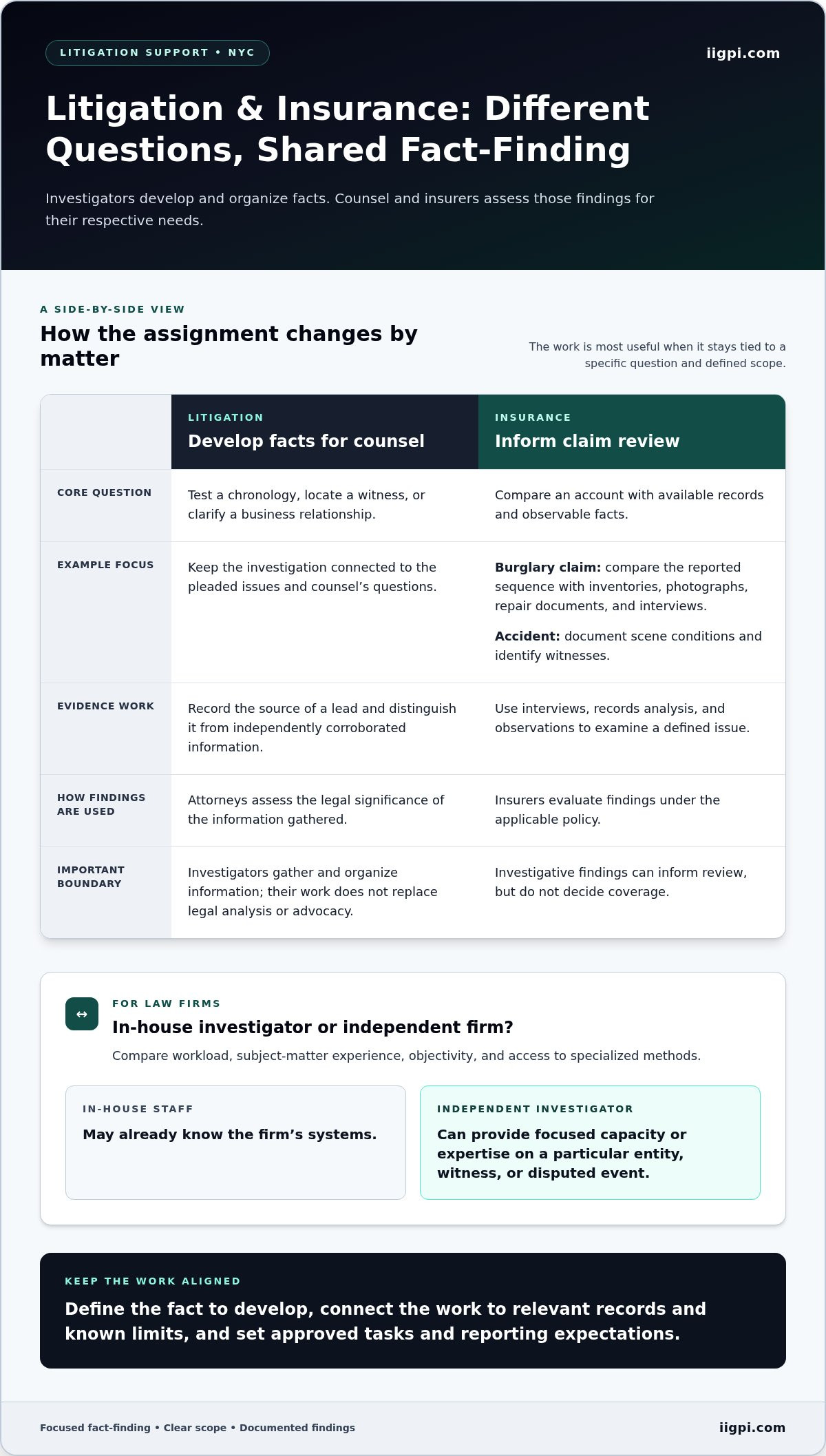
Investigative work helps counsel and insurers develop facts that records alone may not establish. A claim involving suspected theft, disputed property damage, or inconsistent billing, for example, may call for interviews, records analysis, and observations focused on a defined issue. The investigator gathers and organizes information; attorneys assess its legal significance, while insurers evaluate it under the applicable policy.
Law firms weighing in-house investigators against independent firms can compare workload, subject-matter experience, objectivity, and access to specialized methods. Internal staff may already know the firm’s systems, while an independent investigator can provide focused capacity or expertise on a particular entity, witness, or disputed event.
For insurance matters, investigators can compare an account with available records and observable facts. In a disputed burglary claim, for example, an assignment might examine the reported sequence alongside inventories, photographs, repair documents, and interviews. An accident investigation could document scene conditions and identify witnesses whose accounts clarify what happened. Findings can inform the carrier’s review, but do not decide coverage or replace counsel’s analysis.
In litigation, a defense team may need to test a chronology, locate a witness, or clarify a business relationship. Keep the investigation tied to the pleaded issues and counsel’s questions. If an interview produces a lead, record its source and distinguish it from independently corroborated information. This makes later review more precise and helps prevent assumptions from being presented as established facts.
Engaging an investigator in NYC works best when counsel sets a clear sequence:
- Define the question. State what fact needs development, such as who controlled a document or where an incident occurred.
- Identify available material. Provide relevant records, dates, names, and known limitations, while separating confirmed details from allegations.
- Set the scope. Describe approved investigative tasks, interview subjects, locations, reporting format, and communication expectations.
- Review emerging findings. Assess whether new information supports the original question or requires a documented change in direction.
- Receive and assess the report. Check that observations, sources, and conclusions are distinguishable, then determine how the findings inform the legal or insurance review.
A written scope gives the investigator a defined purpose and counsel a practical basis for reviewing conduct, evidence, and progress. It also helps a carrier distinguish fact development from claim evaluation and preserves a clear record of why each investigative step was taken.
Ruskin Moscou Faltischek, P.C. reports investigating a medical practice office manager for theft, followed by a referral to law enforcement and an arrest.
Background and computer-assisted research
Background research helps attorneys test a specific account against records and relationships. Start with the subject’s name, known aliases, relevant organizations, and the question the case needs to resolve. A disputed vendor relationship, for example, may call for comparing corporate affiliations, public filings, and transaction documents. The investigator should record each source and distinguish documented facts from leads.
Computer-assisted research can organize information across documents, names, dates, and entities. Searching a company name may reveal spelling variations or related entities that a manual review could miss. Investigators can compare results with the matter’s records, identify gaps, and prioritize follow-up. Search tools can reveal patterns, but do not establish that a person or entity acted improperly.
A focused review may begin with government filings and other accessible records relevant to the assignment. For a company, an investigator can map officers, addresses, and connected entities, then compare those details with contracts or correspondence supplied for review. In a federal matter, define which federal records or proceedings may be relevant. Each result needs context, source details, and a clear connection to the case.
Computer forensics addresses a different question: what information exists on a digital device or within a data set, and how does it relate to the matter? A defined assignment might examine whether a document’s metadata aligns with its stated creation history. The investigator records the source, collection method, and analytical steps, then reports what the material supports. This helps counsel assess evidence without confusing search results with conclusions.
To move research forward, structure the assignment around a sequence of decisions:
- Set the issue. Identify the fact to test, such as whether a supplier had a connection to a named business.
- Choose source categories. Specify relevant filings, business records, correspondence, or digital material.
- Search and compare. Track names and entity variations, then compare results against the documents already available.
- Record findings. Preserve source descriptions and separate confirmed details from leads requiring further work.
- Report implications. Explain what the research may clarify for the case, including unresolved inconsistencies.
Counsel’s role also shapes the research plan. Counsel can identify the issue, relevant parties, and intended use of the findings, while the investigator conducts the factual inquiry and documents the methods. A background investigation concerning a prospective witness, for example, should focus on information relevant to that person’s role, not unrelated personal details. The final report should let attorneys trace each key statement to its underlying record or interview.
The strongest computer-assisted work pairs targeted searches with human review. Software may flag a matching name, but an investigator must distinguish people with similar names and assess whether an entity is genuinely connected. This verification helps reduce mistaken identification and gives counsel a more traceable basis for evaluating the evidence.
Finding video and overlooked evidence
Video can clarify a disputed sequence, but a clip rarely answers every question on its own. In a parking-lot collision, for example, one camera may show vehicle movement while a nearby storefront camera captures the approach. Lawyers can build a stronger factual picture by identifying likely recording locations and relevant time windows, then checking what the images show against other evidence.
Start with a location-based search. Map the incident site, nearby entrances, businesses, residential buildings, and vehicle routes, then identify who controls each recording. A camera facing a doorway might capture arrivals but miss activity inside. A delivery receipt, access log, or witness account can help establish which location matters and whether another source could fill a gap.
For each lead, record the source, custodian, relevant period, and retrieval status. Seek footage covering the event and its surrounding context, rather than isolating a single moment. Recordings may use different clock settings, so compare visible events with independent markers, such as a transaction receipt or a vehicle entering the scene. Document apparent time discrepancies before drawing conclusions.
A disciplined evidence review can proceed through these steps:
- Define the event. Write down the disputed action, location, and approximate sequence using the case materials.
- Map potential sources. Identify cameras, vehicle systems, building records, and people who may have relevant observations.
- Preserve what is obtained. Retain the received file in its original form and document its source and transfer.
- Review the recording. Note visible events, gaps, camera perspective, and details that need corroboration.
- Compare independent evidence. Check the video against records, photographs, interviews, or physical observations.
Forensic review should distinguish what a recording shows from what a viewer infers. A partial view of a person carrying a package does not establish its contents or ownership. A timestamp may also need comparison with another documented event. Record observations precisely, note limitations in camera angle or image quality, and identify what evidence could test an interpretation.
Overlooked evidence may be ordinary: a maintenance log could show that a camera was unavailable, while a receipt could establish the sequence of transactions. In a workplace dispute, entry records, schedules, and internal correspondence may help clarify who was present. In a criminal matter, lawyers may assess whether a recording supports or contradicts an account, keeping investigative observations separate from legal conclusions.
Computer forensics can complement video review when relevant digital files or devices need examination. Comparing file properties, available metadata, and documented transfer history may help explain how a recording reached the case file. Clear collection and review records let attorneys assess context, identify unanswered questions, and decide which evidence should guide the next investigative step.
How do NYC law firms hire or work with litigation support investigators?
Law firms should begin by identifying the unresolved fact that calls for outside investigative work. In a contract dispute, counsel may need to locate a former employee or establish a vendor’s connection to a transaction. A defined question helps determine whether the assignment needs interviews, records research, observation, or digital evidence review. It also gives the investigator a clear basis for reporting relevant findings. An NYC law firm litigation support investigator can then be matched to the specific task.
Before work begins, counsel can prepare a concise assignment brief identifying the matter, relevant parties, known evidence, investigative objective, and expected report format. For example, an assignment about a missing company asset could identify the asset, its last documented location, and people with direct knowledge. The brief should distinguish allegations from facts already supported by records.
A practical engagement sequence keeps the work aligned with the case:
- Set the objective. Describe the fact to establish or test, such as a witness’s role in a business transaction.
- Share relevant materials. Provide records, names, dates, and known investigative leads, with context for each item.
- Define boundaries. Specify approved methods, locations, interview subjects, communications, and any limits on information collection.
- Agree on reporting. Identify how observations, sources, supporting records, and unresolved questions should appear in updates.
- Review progress. Compare interim findings with the original question and document any change in scope.
During the assignment, a single point of contact can manage instructions and clarify priorities. If an interview identifies another relevant witness, counsel and investigator can assess whether that lead fits the scope. Document any change in writing to preserve a clear record of the decision. Updates should distinguish completed steps from proposed follow-up, so counsel can focus resources on material issues.
At delivery, review the report for source attribution, chronology, and a clear distinction between direct observation and interpretation. In a workplace investigation, for example, an interview account should remain distinct from a personnel record that independently supports a date. For an NYC law firm litigation support investigator, presenting these distinctions clearly makes the report easier for attorneys to assess. Counsel can then decide whether further inquiry is useful, records need comparison, or the findings answer the original question.
Discuss confidentiality and handling procedures at the outset. Identify sensitive documents, designate secure communication channels, and limit distribution to people involved in the matter. If the assignment includes digital files, define how materials will be transferred and tracked. These practical steps help preserve context and make later review more orderly.
For a matter requiring investigative support from International Investigative Group, discuss the assignment’s scope and the evidence questions counsel needs addressed.
International Investigative Group: Corporate Investigations
International Investigative Group conducts Corporate Investigations for organizations seeking independent fact-finding about internal conduct, business relationships, or disputed events. For law firms and insurers, an assignment can address a defined question, such as whether records align with an account or where relevant evidence may be found. Insurance Investigations and Surveillance Services can also support matters involving claims or questions about observed activity.
Before work begins, counsel can outline the issue, relevant people, known records, and the findings needed for review. This scope helps align investigative steps with the matter while keeping legal analysis with the attorneys. To discuss an investigative assignment, contact International Investigative Group or visit iigpi.com.
Turn the Evidence Question Into a Defined Next Step
The next step is to turn an unresolved issue into a clear investigative objective. Identify what decision the evidence should inform, which records or observations could address it, and how findings should be documented for review. A well-scoped assignment helps attorneys assess the work against the case’s needs while keeping investigative fact-finding separate from legal judgment.
For firms considering an NYC law firm litigation support investigator, the right scope depends on the matter’s factual questions. International Investigative Group offers Corporate Investigations and Insurance Investigations, as well as Security and Armed Guards. These services can help when a business matter, insurance claim, or security concern calls for investigative support.
Share the issue you need investigated and the evidence questions you want addressed. Contact International Investigative Group to discuss a suitable next step. A focused plan can give your team a clearer foundation for moving forward.
Frequently Asked Questions
What does a litigation support investigator do at a New York City law firm?
A litigation support investigator develops factual material to help attorneys assess a case, such as locating a witness, documenting observations, or examining relevant records. In a business dispute, for example, an investigator might trace a company’s connections to a named individual and compare the findings with contracts supplied by counsel. A useful report identifies its sources and separates documented information from leads, without making legal decisions.
What qualifications and licenses are required for investigators in New York City?
For private investigative work in New York, verify that the investigator holds the applicable state license; technical credentials and experience are separate considerations. Assess relevant casework, training, report-writing ability, and references. For digital assignments, ask how collection and analysis are documented and how findings are distinguished from assumptions. A license addresses authorization, while demonstrated forensic competence addresses the task’s technical demands.
What services do litigation support investigators provide, such as witness interviews and evidence collection?
Investigative services may include locating and interviewing witnesses, researching relevant records, conducting surveillance, and collecting or organizing evidence. In a workplace dispute, for example, an investigator could interview a former employee and compare the account with schedules or business records provided for review. Digital work may include examining relevant files. Reports should identify information sources and distinguish an interview account from independently documented evidence.