
A costly repair or a property’s history of problems does not, by itself, make a damage claim suspicious. Investigating suspicious property damage claims in NYC means comparing the claimed loss with possible financial incentives, the property’s earlier condition, nearby construction, and the timing and records of repairs. The strongest assessment is based on a consistent account supported by documented evidence.
It is reasonable to question a claim when the reported damage, timing, or repair estimate conflicts with property records. A careful review helps distinguish discrepancies that warrant further investigation from damage that has a credible explanation.
This article explains how possible financial motives may inform an assessment, which photographs and records can help establish what happened, and how construction activity and repair history can clarify competing explanations. It also describes how insurers may review suspected fraud, helping property owners and businesses understand which evidence matters and why.
Key Takeaways
- Compare the claimed loss with the property’s financial and repair history to identify inconsistencies that may warrant closer review.
- Build a clear chronology with photographs, estimates, invoices, and records of prior conditions and repairs.
- Document nearby construction activity and distinguish evidence of a possible cause from evidence that establishes the full damage claim.
- Understand how insurers may assess claim details, inspect damaged property, and review supporting records when investigating suspected fraud.
1. Property owner insurance claims and financial motives
Financial pressure can provide context for a property claim, but it does not establish fraud. Investigators compare the claimed loss with prior claims, maintenance history, repair records, and the property’s condition before the incident. For example, one Queens owner allegedly filed seven claims for the same graffiti-covered wall over three years and collected more than $20,000. Such discrepancies call for evidence-based review, not an automatic conclusion.
What are the penalties for insurance fraud in New York State? Penalties depend on the offense and proven conduct, including whether a statement was knowingly false and the loss involved. A disputed estimate alone does not establish fraud.
Filing begins with prompt notice to the insurer and a clear account of the loss. Owners should preserve photographs, identify when and how damage was discovered, and collect estimates, invoices, and relevant maintenance records. For flood claims under the National Flood Insurance Program, policyholders generally must submit a signed Proof of Loss within 60 days of a flood unless the Federal Emergency Management Agency formally extends the deadline for the event. Insurers must acknowledge a claim within 15 business days under New York Regulation 64.
Insurance subrogation may apply when another party caused the damage. After paying a covered loss, an insurer may seek recovery from the party allegedly responsible. That process can take place alongside an owner’s separate civil claim, so records should distinguish insured losses from additional losses. Keep copies of communications and note which repairs relate to each claim.
If a settlement offer seems low, compare its scope with itemized estimates, invoices, photographs, and the policy’s coverage terms. Ask the insurer to explain disputed items in writing, then respond with records that address those specific gaps. In complex or disputed cases, policyholders may turn to claim advocacy from Integrity Adjusters & Associates to help compile and substantiate thorough claim documentation. Many New York fire policies contain an appraisal clause, which allows each side to hire an appraiser and submit the dispute to a neutral umpire. Support each requested amount with documentation of the damage and repair work.
2. Documenting conditions, chronology, construction activity, and repairs
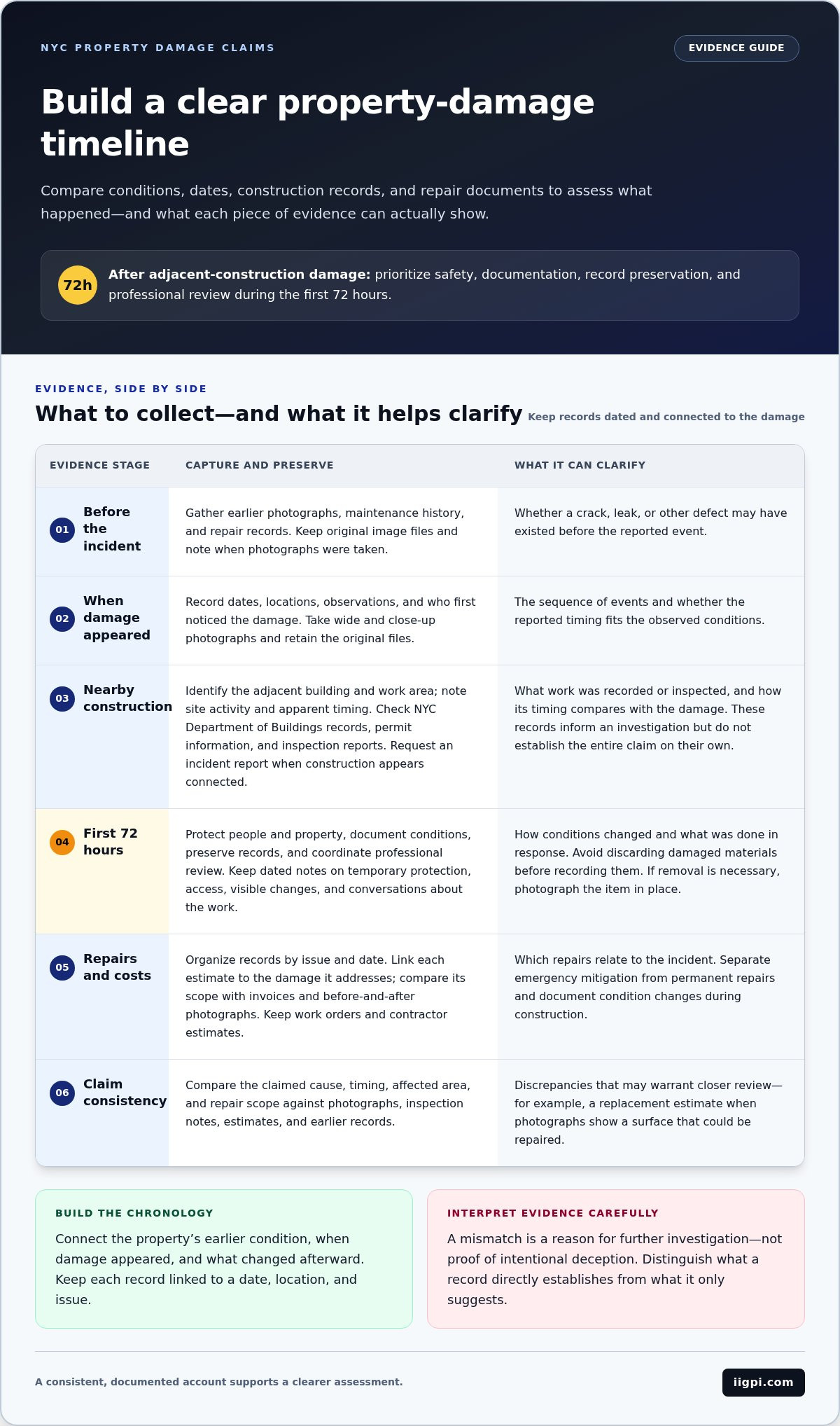
Organize the evidence chronologically: the property’s condition before the incident, when the damage appeared, and what changed afterward. Record dates, locations, observations, and who first noticed each condition. Take wide and close-up photographs, retain the original files, and note when each image was taken. For example, a dated photograph of a ceiling before neighboring excavation may help distinguish an existing crack from later movement. In New York City, a clear timeline helps insurers and other reviewers assess whether the alleged cause fits the observed damage.
For nearby construction, document site activity, identify the adjacent building and work area, and note the apparent timing. New York City Department of Buildings records, permit information, and inspection reports may help establish what work was recorded or inspected. Request the department’s incident report when construction appears connected to the damage. These records inform an investigation, but do not establish the entire claim on their own. Compare them with photographs, observed conditions, and repair documents.
During the first 72 hours after adjacent-construction damage, prioritize protecting people and property, documenting conditions, preserving records, and coordinating professional review. Keep dated notes of temporary protection, access, visible changes, and conversations about the work. Avoid discarding damaged materials before recording their condition. If removal is necessary for safety or repairs, photograph the item in place and preserve related invoices, work orders, and contractor estimates.
Organize repair records by issue and date. Link each estimate to the damage it addresses, then compare its scope with invoices and photographs taken before and after the work. Separate emergency mitigation from permanent repairs, and document changes in the property’s condition during construction. The New York City Comptroller’s Office may request photographs, bills, invoices, estimates, and insurance information; it may also arrange an inspection of the damaged property. If settlement discussions or a lawsuit follow, an indexed file helps connect each claimed repair to the incident and its supporting evidence.
3. What counts as suspicious property damage in an NYC insurance claim?
Suspicion arises when parts of a claim conflict, not simply because the damage is extensive. In an NYC building, an estimate may describe replacement while photographs show a surface that could be repaired. A reported incident may also conflict with maintenance records showing that the defect existed beforehand. Review the claimed cause, timing, affected area, and repair scope together. A mismatch is a reason for further investigation, not proof of intentional deception.
Look for patterns across documents and physical conditions. A claim may describe sudden water damage, for example, while dated records show earlier leaks in the same room. An invoice might cover work beyond the area shown in photographs. Distinguish what each record directly establishes from what it only suggests. Compare original images, inspection notes, contractor estimates, and earlier repair records before drawing conclusions about the loss.
Construction activity can complicate questions of cause and responsibility in New York City. Cracks appearing near an excavation could relate to nearby work, an older structural condition, or another cause. Compare the reported onset with construction records, inspection findings, and photographs taken before and after the change. Department of Buildings information can help establish recorded activity, but does not independently prove the extent or cause of damage. A consistent timeline matters.
Investigators assess whether the claimed loss appears duplicated, unsupported, or inconsistent with the property’s condition. Check whether the same damage appears in earlier claims, whether invoices correspond to completed work, and whether estimates address the observed damage. Missing records may need explanation, but do not establish fraud on their own. When investigating suspicious property damage claims in NYC, weigh multiple independent details and consider reasonable alternative causes before characterizing a claim as suspicious.
For adjacent-construction damage disputes in New York City, written access terms can specify who may enter, the purpose of entry, professional attendance, testing, photographs, removed materials, temporary protection, permanent repairs, insurance, indemnity, and completion standards. Owners should coordinate insurance notice with repair strategy and notify their insurer within 24-48 hours of a loss. Property owners are advised to insure property for at least 80 % of its replacement cost to avoid potential coinsurance penalties.
4. How do NYC insurers investigate suspected property damage fraud?
An insurer’s review commonly begins by comparing the reported incident with the policy, claim documents, and physical damage. Investigators assess whether the described cause fits the damage’s location and pattern. They may inspect the property, review repair estimates, and seek explanations for material inconsistencies. A cracked wall beside active excavation, for example, calls for consideration of the reported timing and other plausible causes. A discrepancy prompts inquiry, but does not by itself establish fraud.
Records relevant to a dispute may extend beyond the current claim. Discovery demands may seek five years of insurance claims, contractor relationships, previous repair invoices, and property tax assessments. These materials can help show whether damage was previously reported, whether repairs correspond to invoices, and whether a current estimate addresses new or older conditions. Investigators can compare dates, descriptions, contractors, and property records to identify conflicts that need clarification. Keeping explanations and supporting documents organized makes these distinctions easier to see.
Time-sensitive evidence matters. Many surveillance systems automatically delete footage after 30 days, so relevant recordings may no longer exist if preservation is delayed. Investigators can compare available video with the reported sequence of events, photographs, and inspection findings. The New York City Comptroller’s Office may contact a claimant to arrange an inspection of damaged property. An inspection provides an opportunity to examine the condition directly and compare observed damage with the claim’s description.
A sound review tests evidence from multiple sources rather than relying on one inconsistency. Investigators can separate confirmed observations from assumptions, assess whether documents support the claimed scope, and record explanations for apparent conflicts. For property owners, retain communications and respond to specific requests with records tied to the disputed point. If a complex insurance claim requires independent scrutiny, request an independent claim review to assess relevant evidence and records.
Owners dealing with damage from adjacent construction should coordinate insurance notice with their repair plans. Keeping the insurer informed as plans develop can help align inspection and documentation with the work needed to address the damage. Clearly describe the proposed repairs and the condition they address to help distinguish necessary work from changes made during repairs.
International Investigative Group: Corporate Investigations
International Investigative Group conducts Corporate Investigations and Insurance Investigations for organizations examining disputed property losses. When repair records, claim details, and the reported cause conflict, an investigation can assess the available information and clarify which issues need further scrutiny.
This support may suit a business whose internal review leaves material questions about the timeline, prior damage, or supporting documents. The goal is to develop a clearer, evidence-based account, not to treat an inconsistency alone as proof of fraud. Organized records and a clearly defined question help focus the investigation.
To discuss an investigation related to a corporate property damage claim, visit International Investigative Group.
Move from uncertainty to a clear next step
A disciplined approach to investigating suspicious property damage claims in NYC helps decision-makers separate documented facts from unresolved questions. Define what remains unclear: whether the damage predates the reported incident, whether repair records match observed conditions, or whether another party’s actions need closer examination. A focused review keeps attention on the evidence and supports informed decisions about next steps.
International Investigative Group offers Corporate Investigations and Insurance Investigations for organizations assessing complex claims. Security and Armed Guards are also available when a property’s security needs require attention. The appropriate investigative scope depends on the question being examined and the records or conditions relevant to it.
If an independent investigation could help clarify a property damage matter, contact International Investigative Group to discuss the next step. A well-defined question can provide a constructive starting point.
Frequently Asked Questions
What can cause an NYC property damage claim to be denied or delayed?
A claim may be delayed or denied if the loss falls outside policy coverage, essential information is missing, or the insurer cannot reconcile the reported cause with the available evidence. A water-damage claim, for example, may raise questions if the policy excludes the source of water or records point to a long-standing leak. Respond promptly to specific requests, identify disputed issues, and keep copies of communications and submitted documents.