
What if the most credible response to an executive allegation is not an immediate conclusion, but a disciplined examination of what the evidence can establish? Investigating executive misconduct and conflicts of interest requires care: a disclosed or perceived conflict does not, by itself, prove wrongdoing. Allegations can be difficult to separate from documented facts, and internal relationships may undermine confidence in an inquiry if they are not addressed. A poorly scoped investigation can add risk by damaging reputations and disrupting operations.
Organizations need a factual record and a process proportionate to the concern. This guide explains how to define an inquiry’s scope, distinguish a conflict from substantiated misconduct, and choose methods such as records review, interviews, computer forensics, or surveillance to answer specific questions. It also explains how independent fact-finding can help decision-makers assess next steps without confusing investigative findings with legal advice or organizational judgments. International Investigative Group, Ltd. is a Licensed, Bonded, Insured private investigative firm that conducts corporate investigations.
Key Takeaways
- Distinguish a potential conflict of interest from proven misconduct by assessing evidence in context rather than treating an allegation as a conclusion.
- Use warning signs to identify questions for review, not as standalone proof of wrongdoing.
- Match records review, interviews, computer forensics, and surveillance to the evidence question, and account for each method’s limits.
- Before reviewing evidence, define the inquiry’s scope, relevant period, key questions, and intended reporting audience.
- Investigating executive misconduct and conflicts of interest through independent fact-finding can give decision-makers a clearer basis for next steps.
What Does Investigating Executive Misconduct and Conflicts of Interest Mean?
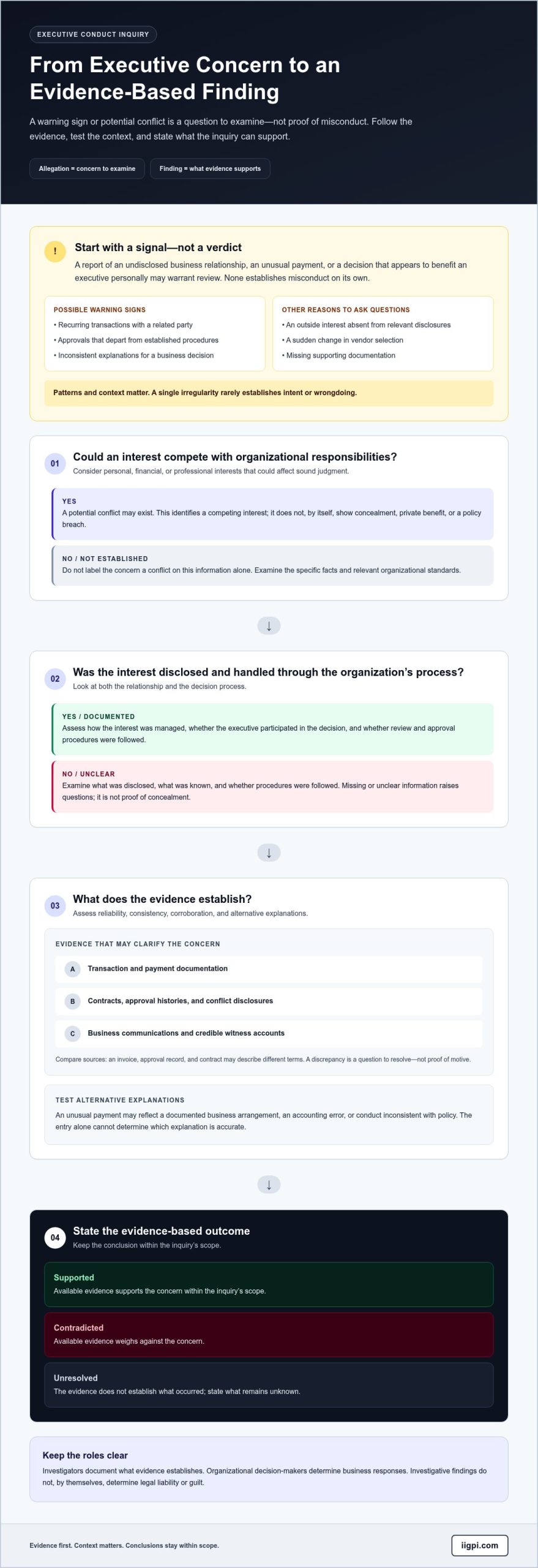
Investigating executive misconduct and conflicts of interest starts with a distinction that shapes the entire inquiry: an allegation identifies a concern to examine, while a finding reflects what the available evidence supports. A report of an undisclosed business relationship, an unusual payment, or a decision that appears to benefit an executive personally may warrant review. None establishes misconduct on its own. The task is to identify relevant facts, assess their reliability, and determine whether the evidence supports, contradicts, or leaves the concern unresolved.
A conflict of interest exists when personal, financial, or professional interests could compete with an individual’s responsibility to exercise sound judgment for an organization. Depending on the circumstances and organizational policies, a conflict may be disclosed and managed. The competing interest is distinct from evidence that an executive concealed it, used authority for private benefit, or breached an internal rule. Background on fiduciary conflicts of interest can help frame the general concept, but an inquiry must assess the specific facts and relevant organizational standards.
An investigative finding is an evidence-based account of facts established within the inquiry’s scope, not a conclusion beyond what the evidence can support. An investigator can document what records, interviews, or other evidence establish. Organizational decision-makers determine appropriate business responses. Investigative findings do not, by themselves, determine legal liability or guilt.
How can a business conflict of interest arise?
A competing interest may arise when an executive participates in selecting a supplier owned by a family member, has a financial interest in a company seeking a contract, or holds an outside professional role that could affect business decisions. These circumstances raise practical questions: Was the interest disclosed? Did the executive take part in the decision? Were the organization’s review and approval procedures followed? A potential conflict alone does not show that a decision was improper or that the executive acted for personal gain.
Context distinguishes an apparent concern from a substantiated one. A related-party transaction, for example, may have been disclosed and reviewed through established processes. The same type of transaction may warrant closer examination if relevant information was withheld or approval procedures were bypassed. Investigators assess both the relationship and the decision process, rather than treating the relationship itself as proof.
What counts as an allegation versus a finding?
An allegation is a report, anomaly, or suspicion that identifies something to examine. A finding requires assessment of the underlying information, including its source, consistency, and corroboration. A transaction entry may raise a question. Related contracts, communications, approvals, and credible witness accounts can help establish what occurred and who knew about it.
Reliable analysis also tests alternative explanations. An unusual payment may reflect a documented business arrangement, an accounting error, or conduct inconsistent with policy. The entry alone cannot determine which explanation is accurate. The inquiry should state what is supported, what is contradicted, and what remains unresolved, without presenting suspicion as fact or exceeding its investigative role.
Which Warning Signs Merit a Closer Look at Executive Conduct?
Warning signs are reasons to ask focused questions, not verdicts about an executive’s conduct. In investigating executive misconduct and conflicts of interest, patterns and context matter more than an isolated anomaly. An unusual transaction may have a routine explanation, while repeated exceptions or incomplete disclosures may justify closer examination. Identify what needs clarification, then test the concern against relevant records and reliable accounts.
Indicators that may merit review include recurring transactions with a related party, approvals that depart from established procedures, inconsistent explanations for a business decision, or an outside interest that does not appear in relevant disclosures. A sudden change in vendor selection or missing supporting documentation may also prompt questions, particularly when similar transactions are ordinarily documented. None of these indicators establishes concealment or improper intent on its own.
A single irregularity rarely establishes intent or wrongdoing; its significance depends on the surrounding evidence and circumstances. Consider whether the exception was authorized, whether comparable decisions were treated similarly, and whether available records account for the difference. A pattern may strengthen the basis for inquiry, but investigators should still examine explanations that support or weaken the initial concern.
What records can help clarify a potential conflict?
Relevant records may include transaction and payment documentation, contracts, approval histories, conflict disclosures, and business communications related to the decision. Comparing these materials can show whether approvals were recorded, disclosures were updated, and explanations align across sources. For example, an invoice, approval record, and contract may describe different terms. That discrepancy creates a question to resolve, not proof of motive.
Bound the review by the issue under examination. Identify the relevant transactions, decisions, and time period, then compare like with like. A documented exception may have a different meaning from one that recurs without a clear record. No single document necessarily establishes why a decision was made.
How should reports and anomalies be assessed?
Assess each concern by its origin, specificity, and internal consistency. A first-hand account with identifiable dates and decisions may offer testable leads. A vague or second-hand report may need corroboration before it can support a firm conclusion. Neither source should be accepted or dismissed solely because of who raised it. Examine what can be independently checked.
Compare plausible explanations against the evidence. If a report describes preferential treatment, review the relevant approvals and transaction records, then consider whether documented business reasons account for the decision. Corroboration can strengthen an initial account, expose inconsistencies, or point to another explanation. Documenting what supports, challenges, and remains unresolved helps decision-makers assess next steps without overstating what the inquiry established.
When a concern calls for independent fact-finding, professional corporate investigations by firms such as the International Investigative Group can help assess relevant evidence and clarify the factual record.
How Investigators Match Methods to Executive Misconduct
The right investigative method depends on the question and the evidence available. A concern about an approval process may call for records review. Questions about what an executive communicated or did may require interviews, computer forensics, or observation. These methods are not interchangeable: each can illuminate particular facts, and each has limits. The broader principles of a corporate fraud investigation may be relevant, but an executive inquiry should select methods according to its specific evidence questions.
Records review can compare transactions, contracts, disclosures, and approval documentation to identify gaps or inconsistencies. Its value depends on what records are available and whether they provide enough context. A missing document does not, by itself, establish why it is missing. Interviews can clarify decision-making, roles, and explanations, but recollections may differ and should be assessed alongside other evidence. Neither method should be treated as conclusive in isolation.
- Records review examines documented decisions and transactions, but depends on the completeness and context of the material.
- Interviews provide accounts and explanations, which may require corroboration.
- Computer forensics examines relevant digital data, but findings must be interpreted within the limits of the available material.
- Surveillance can document specific observable conduct, but cannot independently explain intent or establish the meaning of every action.
When can computer forensics contribute?
Computer forensics may help when an inquiry raises questions about relevant digital information, including communications or files associated with a business decision. International Investigative Group, Ltd. provides computer forensic services, including e-discovery and smartphone forensics. Its services cover Windows, iOS, Android, and Ubuntu platforms, and include data extraction, recovery, undeleting files, penetration testing, and network security design. The relevant examination depends on the inquiry’s questions and the material available. A digital item does not automatically establish who created or understood it. The computer forensics guide provides further technical context.
When might surveillance or interviews be relevant?
Interviews may clarify what participants knew, how a decision was reached, or why a process differed from expectations. Surveillance may be relevant when a defined concern calls for observation of specific conduct. IIGPI conducts human surveillance locally and internationally and can collect photographic and video evidence. Its surveillance capabilities include unmanned drones for electronic surveillance and Activity Monitoring with GPS Satellite Tracking Systems. Any collected material should be assessed for what it directly depicts and how it relates to other information. A professional surveillance guide offers additional context on this method.
Method selection is only part of a sound inquiry. Investigators should distinguish collection from interpretation, document how evidence relates to the questions, and limit conclusions to verifiable information. A digital record, interview account, or image may support or challenge a working explanation, but its significance depends on context and corroboration. Organizations seeking independent corporate fact-finding can learn about IIGPI’s investigative work.
How Can an Organization Manage an Executive Misconduct Inquiry Carefully?
A carefully managed inquiry begins with a defined purpose, not an assumption about what happened. Before reviewing evidence, identify the concern, the relevant period, the questions the inquiry must address, and who needs to receive its findings. A clear scope keeps investigative work focused, reduces unnecessary disruption, and helps distinguish fact-finding from later business decisions or legal advice.
For sensitive matters, investigating executive misconduct and conflicts of interest also requires attention to who directs the inquiry and who may have a personal or professional connection to the subject. Investigators gather and assess information; organizational leaders determine business responses, while legal questions belong with counsel. Keeping those responsibilities distinct supports a more objective record without treating investigative findings as a final organizational or legal determination.
- Define the scope. State the concern, relevant time period, central questions, and intended reporting audience. Identify what falls outside the inquiry to prevent scope from expanding without a clear reason.
- Establish responsibility. Designate appropriate decision-makers and investigative personnel, taking potential conflicts among participants into account.
- Identify relevant evidence. Determine which records, communications, interviews, or other information could address the questions, and document the basis for that selection.
- Review and assess. Examine evidence systematically, compare relevant accounts and records, and consider explanations that may support or challenge the initial concern.
- Report the results. Present established facts, unresolved issues, and evidence limitations clearly to the intended audience.
How can impartiality and confidentiality be supported?
Limit participation to people with a legitimate role in oversight, investigation, or decision-making, and avoid circulating allegations more broadly than necessary. Careful handling can reduce unnecessary reputational harm, but confidentiality should not be described as absolute. Record the inquiry’s scope, material decisions, and significant changes so the process remains traceable. Restrained communication also helps prevent unverified claims from being repeated as established facts.
How should findings be reported without overstating them?
A useful report distinguishes verified facts from unresolved questions and information that could not be corroborated. For each material finding, explain the evidence supporting it and any relevant limitations, such as incomplete records or conflicting accounts. Avoid language that implies certainty beyond the evidence. The report should inform decision-makers, not prescribe a legal conclusion: counsel addresses legal questions, and authorized organizational leaders determine any business response.
For independent fact-finding on a sensitive corporate concern, contact IIGPI to discuss a corporate investigation.
How Can IIGPI Support an Executive Misconduct or Conflict-of-Interest Inquiry?
International Investigative Group, Ltd. (IIGPI) is a New York City-based private investigation firm with an international network of agents. For organizations assessing sensitive executive concerns, its corporate and business investigations provide fact-finding focused on the questions and evidence relevant to the inquiry. IIGPI is Licensed, Bonded, Insured, and its team brings former law-enforcement experience. Investigative findings can inform organizational decision-makers, but they are not legal advice or a substitute for decisions made by the organization or its counsel.
Investigating executive misconduct and conflicts of interest can involve different evidence questions, from whether a business transaction warrants further examination to whether digital material or observed conduct can clarify the facts. The scope should guide the methods used. Not every inquiry requires every investigative capability, and collected information must be interpreted in context rather than treated as a conclusion on its own.
What investigative capabilities may support a corporate inquiry?
IIGPI conducts corporate investigations addressing matters such as business fraud, due diligence, and litigation support. Its computer forensic services include computer forensics, e-discovery, and smartphone forensics, which may contribute when relevant digital information is part of the inquiry. Surveillance investigations can include human surveillance locally and internationally, where observation is relevant to a defined concern. The method should fit the evidence question, and findings should remain tied to what the investigative material establishes.
These capabilities support evidence gathering, not legal representation or organizational decision-making. A digital examination may identify relevant material, while surveillance may document observable activity. Neither method alone necessarily explains intent or establishes whether a policy was breached. A focused inquiry considers how each item relates to the question under review and whether other information supports or challenges its significance.
What should decision-makers expect from an initial discussion?
Decision-makers can prepare by describing the concern, the facts already known, the relevant period, and the specific questions an investigation needs to address. Distinguishing firsthand information from assumptions or unresolved concerns helps define a useful scope. It also gives investigators a clearer basis for considering relevant methods, while leaving legal questions and organizational responses with the appropriate professionals.
IIGPI offers highly customized packages, with clients billed only for the services they require. The scope and selected services can be aligned with the concern rather than assumed in advance. No investigative approach can guarantee a particular finding or outcome; the purpose is to develop an objective factual record within the inquiry’s defined limits.
To discuss an investigative concern and the fact-finding that may help clarify it, Discuss an investigative concern with IIGPI.
Move Forward With Evidence and Clarity
Turn a concern into a focused investigative question. Identify what decision-makers need to understand, what information is available, and what remains uncertain. This gives the inquiry a practical direction while preserving the distinction between evidence gathering, legal advice, and organizational action. Investigating executive misconduct and conflicts of interest is most useful when its scope is clear and its conclusions remain anchored to established facts.
International Investigative Group, Ltd. is Licensed, Bonded, Insured, with former law-enforcement experience across the team, an international network of agents, and 10,000+ Cases Solved. These credentials support its role as a private investigative firm conducting fact-finding, not as a substitute for counsel or the organization’s decision-makers.
If your organization is considering an inquiry, identify the concern and the questions that need objective examination. Arrange an evidence-focused discussion with IIGPI to discuss an appropriate investigative approach.
Frequently Asked Questions
Is a conflict of interest automatically executive misconduct?
No. A competing interest can exist without improper conduct, particularly when it is disclosed and managed through the organization’s established process. Decision-makers can examine whether the executive was excluded from a decision, whether required approvals were obtained, and whether the final choice followed documented procedures. A disclosed outside interest followed by a documented review presents different questions from an interest omitted from relevant disclosures. The circumstances, not the label, matter.
Can a private investigator investigate suspected executive misconduct?
Yes. A private investigation firm can conduct fact-finding relevant to a corporate concern, using methods suited to the questions, such as reviewing evidence, conducting interviews, computer forensics, or surveillance. International Investigative Group provides corporate investigations and related investigative services. Its role is to gather and assess information, not to act as law enforcement or provide legal representation. The organization retains responsibility for business decisions, and counsel should address legal questions.
What evidence may help clarify an executive conflict of interest?
Relevant evidence depends on the question being examined. For a disputed approval, a dated decision record may help establish the sequence of events. For an outside relationship, disclosure materials and relevant business communications may clarify what was known. Investigators can compare records from different sources and note discrepancies for follow-up. They should also consider how each item was obtained and whether it relates directly to the concern rather than merely appearing suspicious.
How can an organization protect confidentiality during an investigation?
Organizations can reduce unnecessary disclosure by assigning clear access roles, using established channels to share investigative material, and avoiding informal discussion of allegations. They should distinguish a need-to-know update from a finding that is ready to circulate. Confidentiality is a controlled practice, not an absolute promise, since information may need to reach appropriate decision-makers or counsel. Careful handling helps limit reputational harm while allowing relevant questions to be assessed.
What is the difference between a conflict of interest and fraud?
A conflict concerns competing interests that could affect judgment; it does not necessarily involve deception, financial loss, or a policy breach. Fraud generally involves deceptive conduct, but whether specific facts meet a legal definition requires legal analysis. An investigation can establish what transactions or communications occurred, identify inconsistencies, and describe evidentiary limits. It should not turn those facts into a legal conclusion. Counsel can assess legal questions using the relevant evidence and circumstances.
Does an investigation prove that an executive committed misconduct?
No. Investigating executive misconduct and conflicts of interest examines defined questions using available evidence, but it cannot guarantee a particular conclusion. A report may substantiate part of an allegation, leave other points unresolved, or find insufficient support for a claim. An unresolved issue is not automatically proof of misconduct or proof that nothing happened. Decision-makers should consider the scope and limitations of the inquiry before determining what organizational action, if any, is appropriate.
When should an organization consider an independent investigation?
An organization may consider independent fact-finding when a concern involves senior leadership, internal relationships could affect confidence in the review, or key accounts are contested. If people responsible for routine review are connected to the decision under examination, an independent inquiry may help establish a clearer factual record. The scope should reflect the unresolved questions and intended audience for findings. Legal advice and management decisions remain separate responsibilities.