
The suspicion of corporate or institutional fraud initiates a period of profound uncertainty, characterized by significant operational risk and potential legal exposure. For decision-makers, navigating this landscape is fraught with critical questions: what is the appropriate first step, how can one ensure that collected evidence will be legally admissible, and how can the selection of a qualified professional be distinguished from an inadequate one? These concerns, compounded by anxieties over the cost and duration of an investigation, can impede a timely and effective response, allowing financial and reputational damage to escalate.
This guide serves as an authoritative framework for demystifying the engagement of a professional fraud investigator. We will meticulously dissect the entire investigative lifecycle, from the strategic considerations of the initial consultation and the methodical processes of evidence collection to the formulation of a final, actionable report. By elucidating these stages, this analysis empowers corporate leadership and legal counsel with the necessary knowledge to stop ongoing malfeasance, understand the options for legal recourse and recovery, and make an informed, strategic decision when hiring the right investigative firm.
Key Takeaways
- Understand how the initial consultation establishes the strategic scope and mandate for the investigation, ensuring absolute confidentiality and alignment from the outset.
- A professional fraud investigator employs sophisticated methodologies, from forensic financial analysis to digital forensics, while maintaining a strict chain of custody to ensure all evidence is legally admissible.
- Recognize the final investigative report not merely as a summary of findings, but as a critical instrument of actionable intelligence designed to inform strategic decisions and legal recourse.
- Discern the essential credentials and specialized competencies that distinguish an elite investigative firm, ensuring you engage experts capable of navigating complex financial and corporate fraud.
The Initial Consultation: Defining the Scope of the Investigation
The initial consultation with a professional fraud investigator represents the foundational phase upon which the entire subsequent inquiry is constructed. This meeting is not merely a preliminary discussion but a strategic session conducted under the strictest principles of confidentiality and discretion. Its purpose is to meticulously define the parameters of the suspected malfeasance, understand the complex legal and financial implications-often starting with a clear definition of What is Fraud? in a legal context-and establish a trusted framework for the engagement. The success of any investigation is contingent upon the clarity and precision achieved during this critical first interaction.
Preparing for the First Meeting
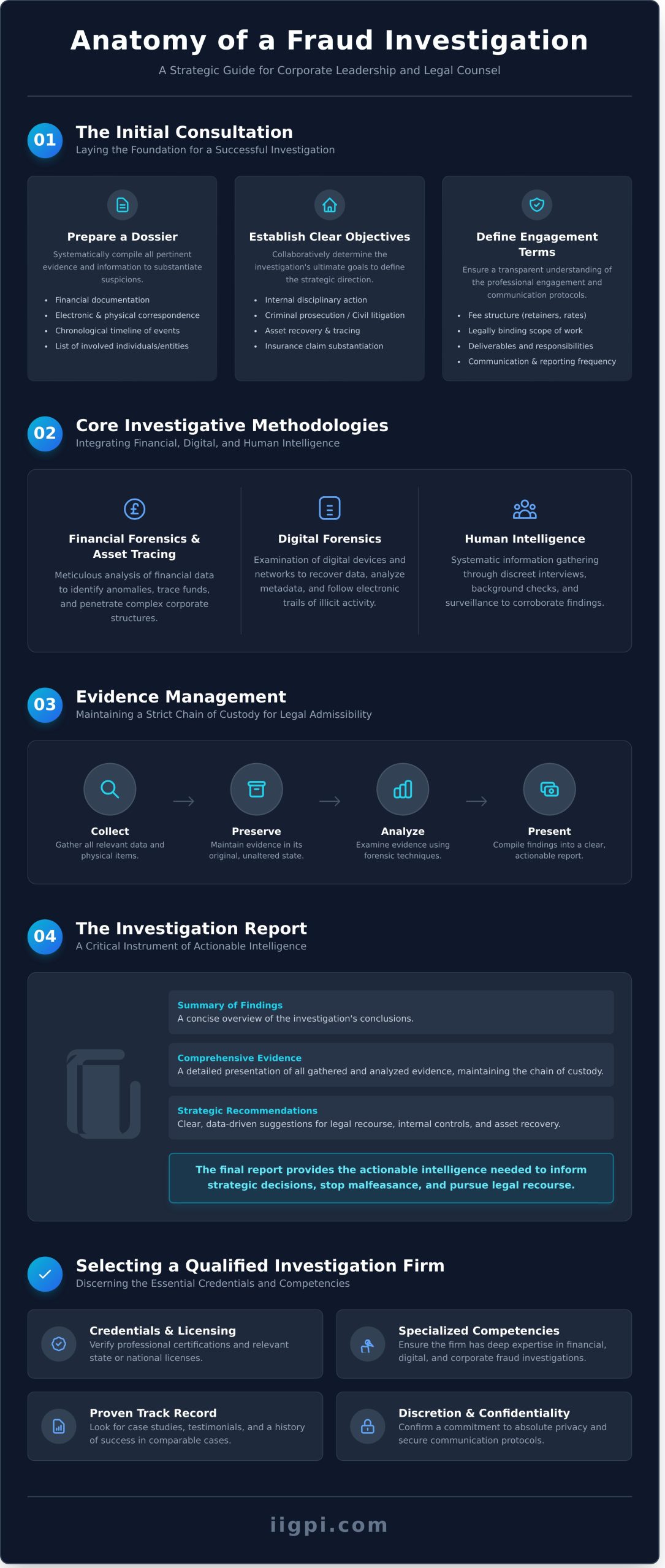
To facilitate a productive and efficient assessment, the client must undertake thorough preparation. This involves the systematic compilation of all pertinent evidence and information that substantiates the initial suspicion of fraudulent activity. A comprehensive dossier should be assembled prior to the meeting, including:
- All relevant financial documentation, such as bank statements, invoices, and transaction records.
- Electronic and physical correspondence, including emails, internal memos, and signed contracts.
- A detailed chronological timeline outlining the sequence of suspicious events and discoveries.
- A complete list of all individuals, corporate entities, and third parties believed to be involved.
Establishing Clear Objectives and Strategy
A central component of the initial consultation is the collaborative determination of the investigation’s ultimate objectives. The client and the fraud investigator must align on the desired outcome, which dictates the strategic direction and methodological approach. The primary goal may range from gathering sufficient evidence for internal disciplinary action or employee termination to compiling a robust evidentiary package for criminal prosecution or civil litigation. Further strategic considerations include asset recovery, the substantiation of an insurance claim, or providing specialized litigation support. This process culminates in an initial strategic outline, often segmented into distinct investigative phases.
Understanding the Fee Structure and Engagement
The final element of this foundational meeting involves a transparent and comprehensive discussion of the professional engagement terms. This includes a detailed review of the fee structure, which may encompass retainers, established hourly rates, and a projection of potential ancillary expenses such as travel or specialized forensic analysis. The service agreement or engagement letter, a legally binding document, will be meticulously examined to ensure mutual understanding of the scope of work, deliverables, and responsibilities. Furthermore, clear communication protocols and the frequency of progress reporting are formally established to ensure continuous alignment throughout the investigation.
Core Investigative Methodologies: How Fraud is Uncovered
The successful resolution of complex fraud cases hinges upon a multi-disciplinary investigative framework that integrates financial, digital, and human intelligence. Elite practitioners do not rely on a single methodology; rather, they orchestrate a convergence of specialized techniques to deconstruct sophisticated schemes and produce irrefutable evidence. Understanding these core disciplines is essential to appreciating the meticulous process through which a professional fraud investigator dismantles elaborate financial deceptions and identifies the responsible parties.
Financial Forensics and Asset Tracing
At the heart of most fraud investigations lies the meticulous analysis of financial data. This process involves a deep forensic examination of bank records, accounting ledgers, and corporate financial statements to identify anomalies, inconsistencies, and red flags indicative of illicit activity. Investigators are adept at penetrating complex corporate structures, including the identification of shell corporations and opaque offshore accounts designed to obscure ownership. A critical component of this work involves navigating the complex regulatory frameworks established by governmental bodies such as the Financial Crimes Enforcement Network, which is essential when tracing the flow of misappropriated funds across multiple jurisdictions to their ultimate destination for potential recovery.
Digital Forensics and E-Discovery
In the contemporary corporate environment, nearly every transaction and communication leaves a digital footprint. A skilled fraud investigator leverages advanced digital forensic techniques to uncover this critical evidence. This discipline extends beyond simple data review to include the recovery of intentionally deleted files, emails, and internal communications from a wide array of devices. Furthermore, the analysis of metadata is paramount, as it can establish irrefutable timelines, user activities, and the provenance of key documents. Forensic examination of network servers and cloud-based data repositories often reveals the central architecture of a fraudulent scheme.
Surveillance and Human Intelligence (HUMINT)
While financial and digital analysis provides empirical data, human intelligence is often required to provide context, corroborate findings, and uncover motivations. This domain includes the use of discreet physical surveillance to verify the activities of key subjects or confirm a lifestyle inconsistent with their known financial resources. Comprehensive background checks are performed to identify undisclosed associations, prior misconduct, or conflicts of interest. Finally, the strategic execution of pretext calls and formal interviews with witnesses and subjects is a delicate but powerful tool used to gather admissions and secure testimonial evidence. In certain cases, to further test the veracity of claims, specialized services from firms like Morgan Polygraph may be utilized.
Evidence Management: Ensuring Legal Admissibility
In the context of a fraud examination, the discovery of evidence is merely the preliminary step; its ultimate value is entirely contingent upon its admissibility in potential legal or administrative proceedings. A professional fraud investigator recognizes that the methodology employed for evidence collection, preservation, and documentation is as critical as the substance of the evidence itself. Adherence to stringent legal and ethical protocols is not optional but foundational to constructing a case that can withstand rigorous judicial scrutiny. This disciplined approach ensures that findings are not only accurate but also legally defensible.
Maintaining the Chain of Custody
The chain of custody is a meticulous, chronological record documenting the lifecycle of each piece of evidence-from its initial identification and seizure to its final disposition. This process involves logging every individual who handles the evidence, the date and time of transfer, the location of storage, and the purpose of access. A breach in this chain, such as an undocumented transfer or improper storage, creates an opportunity to challenge the integrity of the evidence, which can lead a court to declare it inadmissible and thereby nullify its impact on the case.
Documentation and Reporting for Legal Proceedings
The culmination of an investigation is a formal report that transforms complex findings into a clear, objective, and defensible narrative. This documentation must be devoid of speculation, presenting only facts substantiated by the collected evidence. The meticulous standards for evidence handling and reporting, often guided by principles from leading bodies like the Association of Certified Fraud Examiners, ensure that every conclusion is defensible. An investigator’s findings are frequently formalized into sworn affidavits or declarations and organized systematically for legal counsel to integrate into motions, pleadings, and trial presentations.
Collaboration with Legal Counsel
Effective investigations often operate under the direction of an attorney, a structure that can shield the process and its findings under the attorney-client privilege or work-product doctrine. This collaboration ensures the investigation aligns with the legal strategy from its inception. Furthermore, the fraud investigator must be prepared to serve as an expert witness, providing clear, credible testimony in depositions or at trial to explain their methodology and conclusions under cross-examination. It is therefore imperative to engage a firm with a deep understanding of legal requirements.
The Investigation Report: From Findings to Actionable Intelligence
The culmination of a forensic inquiry is not merely a summary of activities but a strategic document designed to transform complex findings into actionable intelligence. A professional fraud investigator synthesizes vast amounts of data into a coherent, evidence-based narrative that serves as the foundation for critical organizational decisions. This report is the primary instrument through which an organization can comprehend the full scope of the misconduct, assess its impact, and formulate a strategic response.
Key Components of a Professional Report
A comprehensive investigative report is meticulously structured to provide clarity and substantiate its conclusions. While formats may vary, the core components remain consistent in their purpose to deliver a complete and defensible account of the investigation. Essential elements include:
- Executive Summary: A high-level overview articulating the investigation’s mandate, principal findings, and critical recommendations, designed for senior leadership and key stakeholders.
- Detailed Timeline: A chronological reconstruction of key events, from the inception of the fraudulent activity to the conclusion of the investigation, providing a clear sequence of actions.
- Exhibits Section: A methodical compilation of all supporting evidence, such as authenticated documents, digital forensic artifacts, interview transcripts, and financial analyses, which forms the evidentiary basis of the report.
Interpreting the Evidence Presented
The true value of an investigative report lies in its analytical depth. The fraud investigator’s role extends beyond data collection to the critical task of synthesis, connecting disparate pieces of information to construct a cohesive narrative of the events. This involves not only identifying the responsible parties but also quantifying the precise financial loss and systemic impact. Furthermore, the report provides a critical assessment of the evidence’s strength, offering an objective perspective on its viability for supporting potential legal action, whether civil or criminal.
Next Steps: Litigation, Recovery, and Prevention
Ultimately, the investigative report is a catalyst for action. Its findings provide the necessary evidentiary foundation for legal counsel to pursue litigation or refer matters to law enforcement. The detailed analysis directly informs asset recovery strategies, tracing illicitly obtained funds and identifying avenues for restitution. Perhaps most critically from a governance perspective, the report illuminates vulnerabilities in internal controls, enabling an organization to design and implement robust preventative measures. This strategic application of investigative intelligence is fundamental to strengthening institutional resilience and integrity. For further insights into corporate governance and risk management, explore the resources available at iigpi.com.
Selecting a Qualified Fraud Investigation Firm
The engagement of a fraud investigation firm represents a critical decision, demanding a rigorous due diligence process. The specialized skillset required to navigate complex financial malfeasance is distinct from general investigative work; consequently, not all investigators possess the necessary expertise. A comprehensive evaluation of a firm’s credentials, industry-specific experience, and professional standing is not merely advisable but essential for achieving a successful and legally defensible outcome.
Essential Credentials and Licensing
A fundamental prerequisite for any credible firm is the verification of its legal and professional standing. This includes confirming that the firm and its investigators hold all requisite state or national licenses, are fully bonded, and carry comprehensive professional liability insurance. Furthermore, premier qualifications such as the Certified Fraud Examiner (CFE) designation signify a deep, tested understanding of complex fraud schemes, financial transactions, and legal principles. A commitment to a stringent professional code of ethics is equally non-negotiable, ensuring all investigative activities are conducted with the utmost integrity.
Evaluating Case Experience and Specialization
Beyond foundational credentials, a firm’s practical experience is paramount. It is imperative to inquire about their history with cases analogous to your own, whether it involves corporate embezzlement, insurance fraud, or intellectual property theft. The financial magnitude of the case is another critical factor; a firm accustomed to seven-figure disputes possesses different resources and strategies than one that handles smaller matters. For enterprises with multinational operations, confirming the firm’s global reach and experience with cross-border investigations is essential to address any international dimensions of the case.
Key Questions to Ask Before Hiring
To finalize your assessment, a direct inquiry into a firm’s operational protocols and personnel is necessary. Consider posing the following critical questions before entering into an engagement:
- Who will be the designated lead fraud investigator on this case, and what are their specific qualifications?
- What is the firm’s and the lead investigator’s experience with providing expert testimony in court or arbitration proceedings?
- What specific protocols and technologies do you employ to ensure the absolute confidentiality of the investigation and all related data?
The answers to these questions will provide profound insight into the firm’s professionalism and suitability for your needs. Partner with investigators trusted by global corporations to ensure your case is managed with the requisite expertise and discretion.
Securing Your Assets Through Diligent Investigation
Engaging a professional to address suspected financial malfeasance is a structured, multi-faceted process. As delineated, this extends from the initial consultation and scope definition to the meticulous application of investigative methodologies and the preservation of legally admissible evidence. The selection of a qualified fraud investigator is therefore not merely a procedural step but a strategic decision, pivotal to transforming complex findings into actionable intelligence that can withstand legal and corporate scrutiny.
For organizations demanding the highest caliber of investigative rigor, International Investigative Group (IIG) offers unparalleled expertise. With over 30 years of dedicated experience and a proven record of success in complex, multi-million dollar fraud cases, our team is fully licensed, bonded, and insured in New York to manage sensitive matters with the utmost discretion and professionalism. We invite you to Contact IIG for a Confidential Consultation to discuss your specific requirements. By taking this decisive action, you can effectively safeguard your organization’s financial stability and uphold its operational integrity.
Frequently Asked Questions
How much does a fraud investigation cost?
The financial outlay for a fraud investigation is contingent upon a multitude of variables, including the case’s complexity, the required duration of investigative activities, and the specific expertise of the professionals engaged. Costs are typically structured on an hourly basis, with rates reflecting the investigator’s experience and the technological resources employed. A comprehensive retainer and a detailed statement of work are standard prerequisites, outlining the anticipated scope and associated expenditures before an engagement commences.
How long does a typical fraud investigation take?
The temporal scope of a fraud investigation is intrinsically linked to the intricacy of the fraudulent scheme and the accessibility of evidentiary materials. A straightforward internal inquiry might conclude within several weeks, whereas a complex, multi-jurisdictional case involving sophisticated concealment techniques could necessitate a protracted engagement spanning several months or longer. The timeline is dictated by factors such as digital forensic analysis, witness interviews, and the volume of financial records requiring meticulous examination.
Is my communication with a fraud investigator confidential and privileged?
Communications with a fraud investigator are held in the strictest confidence, governed by professional ethics and contractual non-disclosure agreements. However, this confidentiality does not typically extend to legal privilege. For communications to be protected by attorney-client privilege, the investigation must be directed by legal counsel. Therefore, engaging an investigator through an attorney is a critical strategic consideration for organizations seeking to shield investigative findings from disclosure in potential litigation.
What is the difference between a private fraud investigator and law enforcement?
The fundamental distinction lies in their mandate and authority. A private fraud investigator is retained by a private entity-a corporation or an individual-to act exclusively in the client’s interest, focusing on evidence gathering and asset recovery. Conversely, law enforcement agencies are governmental bodies responsible for enforcing public laws, with their investigations aimed at criminal prosecution. While private investigators possess specialized skills, they lack the legal powers of law enforcement, such as the authority to execute search warrants or make arrests.
Can a fraud investigator recover stolen money or assets?
While a fraud investigator cannot unilaterally seize assets, their role is pivotal in the recovery process. They employ sophisticated techniques, including forensic accounting and asset tracing, to identify and locate misappropriated funds or property, whether held domestically or in offshore jurisdictions. This evidence is then compiled into a comprehensive report that provides the necessary foundation for civil litigation or other legal proceedings, which are the formal mechanisms for compelling the restitution of assets.
What are the legal limits of what a fraud investigator can do?
A professional fraud investigator operates strictly within the confines of applicable statutes and regulations. Their activities are legally proscribed from including actions such as impersonating law enforcement officials, conducting illegal surveillance like wiretapping, or obtaining information through false pretenses, a practice known as pretexting. All evidence must be gathered through lawful means to ensure its admissibility in any subsequent legal or administrative proceedings, thereby maintaining the integrity of the investigation.
