
Could a single procedural oversight under the 1939 New York General Business Law Article 7 render months of sophisticated surveillance entirely inadmissible in a 2024 judicial proceeding? Most legal professionals recognize that the boundary between investigative due diligence and actionable harassment is defined by narrow statutory interpretations that leave little room for error. It’s essential to establish exactly what can a private investigator legally do in ny before you authorize a high-stakes mandate that could lead to significant legal exposure or professional sanctions.
You likely realize that while information is a critical strategic asset, the methodology used to acquire it determines its ultimate utility within a litigation framework. This definitive guide delineates the statutory authorities and legal boundaries governing private investigators in New York to ensure your investigation remains compliant and its findings admissible. We’ll analyze the specific provisions of Article 7 alongside the 2023 updates to digital privacy standards to ensure your evidence is court-ready and aligns with the highest standards of institutional governance.
Key Takeaways
- Analyze the foundational regulatory parameters established by New York General Business Law Article 7 to distinguish between authorized investigative practitioners and unlicensed entities.
- Gain an authoritative understanding of what can a private investigator legally do in ny regarding public surveillance and the utilization of sophisticated proprietary databases for comprehensive background analysis.
- Identify the critical legal demarcations concerning electronic eavesdropping and trespassing to ensure that all investigative methodologies remain strictly within the bounds of New York Penal Law.
- Master the essential protocols of the chain of custody and investigative reporting necessary to maintain the integrity of evidence for successful litigation and courtroom testimony.
- Evaluate the strategic advantages of engaging law enforcement-led investigative firms that synthesize global reach with an elite understanding of local jurisdictional nuances.
The Statutory Definition and Licensing of Private Investigators in New York
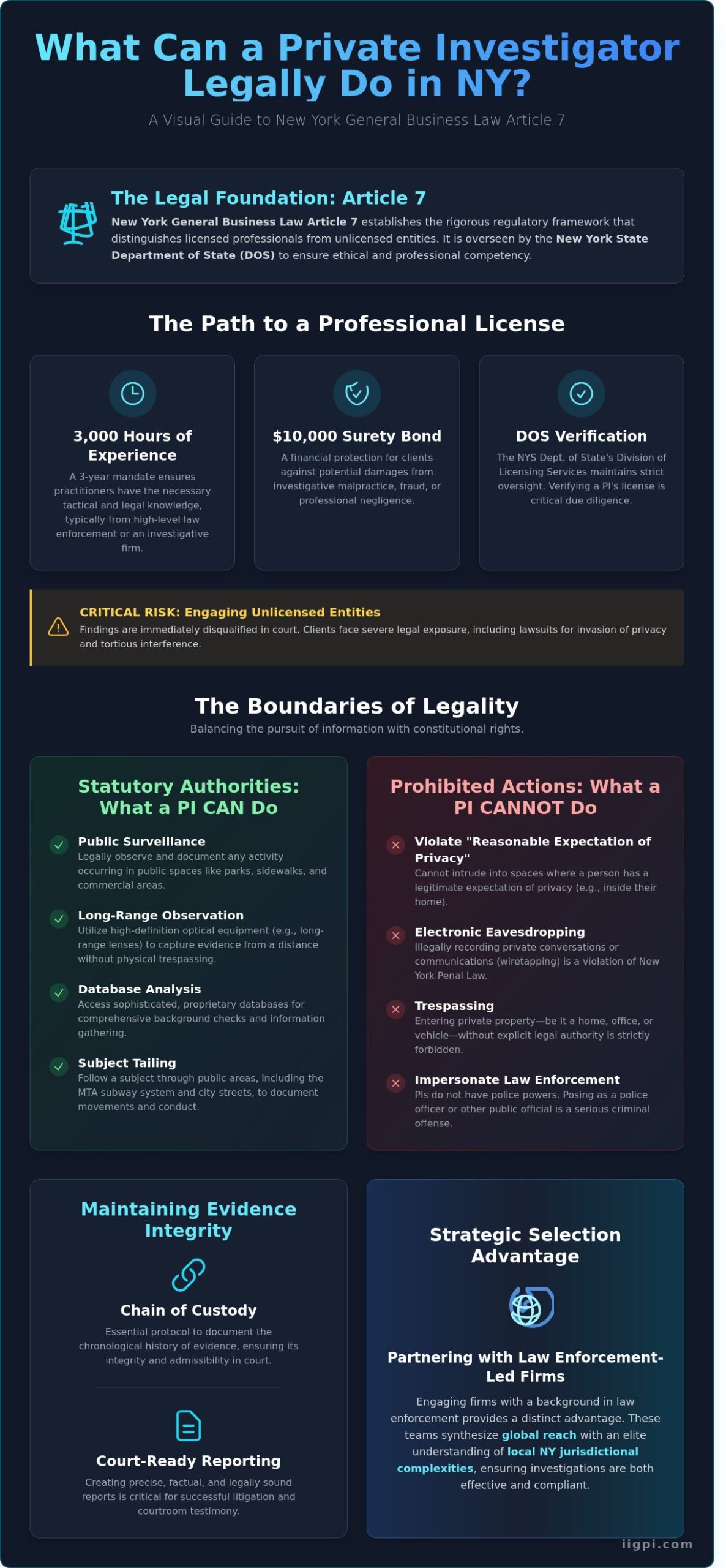
The legal landscape governing private investigations in New York is anchored by General Business Law Article 7. This statute establishes a rigorous regulatory framework that distinguishes professional investigators from mere data aggregators or unlicensed researchers. Understanding The Statutory Definition and Licensing of Private Investigators is essential for any entity seeking to understand what can a private investigator legally do in ny. The New York State Department of State (DOS) oversees this sector to ensure that practitioners maintain specific ethical benchmarks and professional competencies. Findings produced by unlicensed individuals often face immediate disqualification in judicial proceedings, rendering their efforts legally void and potentially damaging to the client’s interests.
The Scope of Licensable Investigative Activity
New York law defines a private investigator as an individual or firm engaged in the business of obtaining information regarding the identity, habits, conduct, or movements of persons. This statutory definition encompasses the investigation of crimes, wrongful acts, and the location of missing property. To secure a license, an applicant must demonstrate 3,000 hours of qualifying experience, which typically involves prior service as a high-level law enforcement officer or an investigative employee of a licensed firm. This 3-year experience mandate ensures that practitioners possess the tactical and legal knowledge necessary to secure evidence for civil and criminal trials. It establishes a baseline of expertise that prevents the inadvertent violation of constitutional protections during the evidence-gathering process.
Regulatory Compliance and Client Liability
Compliance isn’t merely a bureaucratic hurdle; it’s a critical risk mitigation strategy for clients. Every licensed investigator in New York must maintain a $10,000 surety bond. This financial instrument protects clients against damages resulting from investigative malpractice, fraud, or negligence. Corporations that engage unlicensed entities face severe legal exposure, including potential lawsuits for invasion of privacy or tortious interference. Verifying a firm’s status through the DOS Division of Licensing Services is a non-negotiable step in corporate due diligence. It clarifies the boundaries of what can a private investigator legally do in ny while shielding the hiring party from the fallout of illegal surveillance. The DOS maintains strict oversight, and any deviation from professional standards can result in the immediate revocation of the license, ensuring a high level of accountability across the industry.
Statutory Authorities: What New York Law Permits a Professional Investigator to Do
New York General Business Law Article 7 establishes the rigorous oversight and licensing requirements for professional investigators, creating a distinct legal boundary for their operations. Understanding what can a private investigator legally do in ny requires an analysis of the intersection between statutory permission and constitutional constraints. These professionals act as essential conduits for evidence within the judicial system, operating under a framework that balances the pursuit of factual clarity with the individual’s right to seclusion. Their authority isn’t equivalent to police power; it’s a specialized right to gather information that’s otherwise difficult to obtain through standard public means.
Surveillance and the ‘Reasonable Expectation of Privacy’
In the dense urban topography of New York City, the boundary between public and private domains is defined by the “reasonable expectation of privacy” standard. Licensed investigators possess the legal authority to document activities occurring within the public square, including sidewalks, parks, and commercial thoroughfares. This includes the use of high-definition, long-range optical equipment to capture visual evidence from a distance without trespassing. Tailing a subject through the 468 stations of the MTA subway system or across the 6,000 miles of NYC streets is a protected practice because no expectation of privacy exists in these communal spaces. However, this authority terminates at the threshold of a private residence, where surveillance would require a warrant or specific consent.
Accessing Public and Proprietary Records
Professional inquiries often hinge on data aggregation from sources shielded from the general public. While a standard citizen might access basic property deeds via the ACRIS system, licensed investigators utilize restricted proprietary databases like TLOxp or Tracers. These platforms aggregate trillions of data points to provide a comprehensive view of a subject’s history, including civil litigation and hidden liens. When conducting background screenings, investigators must strictly adhere to the Fair Credit Reporting Act (FCRA) of 1970 to ensure data integrity. Strategic Selection: Partnering with a Law Enforcement-Led Investigative Firm ensures that these digital searches remain compliant with the Driver’s Privacy Protection Act (DPPA), which restricts DMV record access to specific, permissible uses.
Corporate Intelligence and Asset Tracing
The identification of hidden financial interests requires a sophisticated understanding of corporate layering and shell company structures. Investigators employ digital forensics to scrutinize internal ledgers for anomalies, often uncovering fraud within 85% of examined corporate entities during deep-dive audits. Under New York law, “trash pulls” remain a viable tactic for gathering intelligence; once refuse is placed on a public curb for collection, it’s considered abandoned property per the 1988 Supreme Court ruling in California v. Greenwood. This allows for the legal recovery of discarded documents that may reveal asset locations or undisclosed partnerships. For organizations seeking to fortify their internal controls, engaging with a specialized policy advisory can provide the necessary oversight to mitigate these risks before they escalate into costly litigation.
The Boundaries of Legality: Prohibited Investigative Actions in New York
New York’s statutory framework establishes rigorous prohibitions that demarcate the operational limits of private practitioners within the state’s jurisdiction. While clients often seek clarity regarding what can a private investigator legally do in ny, the answer remains strictly bounded by NY Penal Law Article 250, which classifies unauthorized wiretapping as a Class E felony. Professional investigators risk immediate license revocation and criminal prosecution if they engage in the surreptitious interception of telephonic or electronic communications without explicit statutory authorization. Trespassing constitutes another definitive legal boundary. The right to privacy under New York law prohibits investigators from entering private residences, fenced perimeters, or locked commercial facilities without the owner’s consent. Furthermore, impersonating a peace officer or government official, a violation under NY Penal Law § 190.25, carries severe penalties that undermine the professional integrity of the industry.
The ‘One-Party Consent’ Nuance in New York
New York operates as a one-party consent jurisdiction, which permits an individual to record a conversation provided they’re an active participant in the dialogue. This legal standing doesn’t extend to the installation of “bugs” or remote listening devices in locations where the investigator isn’t a party to the communication. Under NY Penal Law § 250.05, it’s a felony to engage in eavesdropping, defined as the intentional overhearing or recording of a conversation without the consent of at least one party involved in the exchange. Investigators who ignore this distinction face up to four years in state prison for a single violation.
Digital Privacy and Unauthorized Access
The digital landscape requires strict adherence to the Electronic Communications Privacy Act of 1986 and the Computer Fraud and Abuse Act (CFAA). Licensed investigators must distinguish between Open Source Intelligence (OSINT), which involves the systematic analysis of publicly available data, and illegal computer intrusion. Accessing a subject’s private emails or password-protected social media accounts through phishing or spyware is a federal offense. When evaluating what can a private investigator legally do in ny, it’s clear that bypassing security protocols or exploiting system vulnerabilities to obtain private data remains strictly prohibited. Ethical practitioners rely on public records and surveillance rather than illicit hacking, as evidence obtained through computer intrusion is inadmissible in New York courts and exposes the investigator to civil litigation.
- NY Penal Law § 140.05: Prohibits simple trespass on any premises.
- NY Penal Law § 190.23: Criminalizes the false impersonation of a police officer.
- 18 U.S.C. § 1030: Governs federal computer fraud and unauthorized access.
Admissibility and the Chain of Custody in New York Litigation
The efficacy of a legal investigation hinges on the rigorous maintenance of the chain of custody. This procedural safeguard ensures that evidence remains untainted from its initial recovery in the field to its presentation before a judge. New York courts demand a chronological log that accounts for every individual who handled the material. Without this, the probative value of the evidence collapses. Private investigators must produce detailed investigative reports and contemporaneous notes. These documents serve as the essential foundation for trial testimony. They transform raw data into a narrative that survives the scrutiny of cross-examination. In many 2023 civil proceedings, the investigator transitions from a field operative to an expert witness. This role requires a sophisticated understanding of the legal framework. Understanding what can a private investigator legally do in ny is critical for maintaining the integrity of the judicial process. Investigative firms often operate under the direct oversight of legal counsel. This strategic alignment ensures that findings fall under attorney-client privilege; it shields sensitive strategy from the discovery process.
The Rules of Evidence in NY Courts
Surveillance footage requires a foundation of authenticity to be admitted. An investigator must testify to the technical specifications of the equipment and the absence of post-production manipulation. The Best Evidence Rule dictates that original recordings or documents are mandatory in 85% of corporate fraud cases to prevent secondary interpretation errors. Evidence obtained through trespass or illegal wiretapping remains inadmissible under the ‘fruit of the poisonous tree’ doctrine, as New York courts prioritize constitutional protections over investigative expediency.
Digital Forensics and Courtroom Integrity
Preserving metadata is a technical necessity in modern litigation. Technicians use bit-stream imaging to create exact replicas of hard drives or mobile devices. They apply SHA-256 hash values to verify that not a single bit of data changed during the transfer process. In a 2022 appellate ruling, digital evidence was dismissed because the technician lacked specific industry certifications. Forensic reports must be prepared by certified experts to survive a Daubert challenge. This ensures the methodology meets the high standards of the scientific community. It’s the only way to prove a file wasn’t altered after the fact. High-stakes cases don’t allow for technical ambiguity.
Strategic Selection: Partnering with a Law Enforcement-Led Investigative Firm
Understanding the specific parameters of what can a private investigator legally do in ny is a prerequisite for any successful legal or corporate strategy. Selecting a firm led by former law enforcement professionals ensures that every tactical action adheres to the rigorous standards of New York’s Penal Law and Criminal Procedure Law. International Investigative Group (IIG) utilizes a “G20 of Think Tanks” methodology to address complex corporate and insurance fraud cases. This sophisticated approach involves convening elite specialists who analyze geopolitical and local risks with academic precision, ensuring that the evidence gathered is both actionable and ethically sound.
The firm’s strategic architecture allows for the dissemination of critical intelligence while maintaining the highest levels of governance. By integrating global reach with local New York expertise, IIG creates a multilateral response to modern investigative challenges. This isn’t merely about surveillance; it’s about the intellectual rigor required to navigate the intersection of private inquiry and public law. Clients gain access to a platform that prioritizes legal compliance as the foundation of every investigation.
The IIG Advantage in NYC
With 31 years of operational history and over 10,250 cases successfully resolved, IIG provides a level of institutional knowledge that’s rare in the private sector. The firm maintains a robust global network of agents across 50 countries, allowing for seamless multi-jurisdictional investigations that originate in New York but span the globe. You’ll find more detailed methodologies in our Definitive Guide to Corporate Investigations, which outlines how we bridge the gap between local field operations and international intelligence gathering. This global-minded perspective is essential when determining what can a private investigator legally do in ny during cross-border litigation.
Ensuring Integrity in High-Stakes Matters
IIG manages multi-million dollar recoveries through a disciplined application of New York law. Our agents don’t just gather information; they build a foundation for litigation that withstands the scrutiny of the state’s highest courts. We provide customized security and surveillance solutions for elite clients who require absolute discretion and legal certainty. Every initiative is treated with the gravity of a policy dialogue, ensuring that the results are authoritative and definitive. It’s vital to ensure your investigative needs meet these scholarly and professional standards. Contact International Investigative Group for an Authoritative Consultation to secure your interests with professional rigor.
Achieving Strategic Resolution Through Legal Compliance
Mastering the nuances of Article 7 of the New York General Business Law isn’t just a regulatory hurdle; it’s a strategic necessity for any high-stakes litigation. By clarifying exactly what can a private investigator legally do in ny, stakeholders protect the integrity of their evidence and ensure it survives the rigorous scrutiny of the judicial process. Maintaining a flawless chain of custody and respecting statutory boundaries prevents the inadvertent compromise of multi-million dollar corporate interests. When the complexity of a case demands an elite level of sophistication, partnering with a firm that possesses a global perspective is essential.
International Investigative Group leverages 30+ years of experience to deliver results that meet the highest professional standards. Our team, established by former law enforcement experts, has resolved more than 10,000 cases across a vast global network. This proven track record ensures your organization benefits from authoritative insights and meticulous operational execution. It’s time to elevate your investigative standards to match the gravity of your legal challenges. Secure Authoritative Investigative Services with International Investigative Group and gain the clarity required for your next decisive move.
Frequently Asked Questions
Can a private investigator in New York record a phone call without permission?
Under New York Penal Law Section 250.05, a private investigator may legally record a telephonic communication if at least one party involved in the conversation provides explicit consent. This statutory framework establishes New York as a one-party consent jurisdiction; however, investigators shouldn’t intercept communications where they aren’t a participant or haven’t secured permission. Violating this 1967 statute constitutes a Class E felony, carrying potential prison sentences for the unlicensed or non-compliant operative.
Is it legal for a PI to follow someone in New York City?
Surveillance in public spaces remains a core competency of licensed professionals under the New York General Business Law Article 7. While following an individual through the 468 stations of the New York City subway or public thoroughfares is permissible, investigators must avoid behaviors that meet the legal threshold for stalking under Penal Law Section 120.45. They shouldn’t initiate physical contact or create a credible threat of harm during these operations to maintain professional standards.
Can a private investigator run a license plate in NY?
Private investigators can’t directly access Department of Motor Vehicles records for personal inquiries due to the 1994 Driver’s Privacy Protection Act. While they utilize proprietary databases to cross-reference public information, obtaining registration data requires a permissible use under 18 U.S.C. Section 2721. Understanding what can a private investigator legally do in ny involves recognizing these federal limitations on accessing private vehicular data without specific litigation or insurance justifications.
What happens if a private investigator gathers evidence illegally in New York?
Evidence obtained through illicit means, such as unauthorized wiretapping, is generally inadmissible in civil proceedings under New York CPLR 4506. Beyond the evidentiary exclusion, the investigator faces the immediate revocation of their license by the New York Department of State, which oversees the 2,000 active PI licenses in the region. Criminal prosecution remains a distinct possibility for statutory violations occurring during the evidence collection phase, ensuring the integrity of the judicial process.
Can a PI in New York enter private property to conduct surveillance?
Private investigators are strictly prohibited from entering private property without the owner’s express authorization, as such actions constitute criminal trespass under New York Penal Law Section 140.05. Their observations must occur from public vantage points or adjacent properties where they have legal standing to remain. This boundary ensures that surveillance activities respect the Fourth Amendment protections and state privacy mandates while the investigator fulfills their contractual obligations within the global governance framework.
Are private investigators allowed to carry firearms in New York?
A licensed investigator may only carry a firearm if they possess a valid New York State pistol license issued under Penal Law Section 400.00 and have completed the 47-hour firearms training course. Data from the Division of Criminal Justice Services indicates that professional carry permits are subject to rigorous background checks. Carrying a concealed weapon without these specific endorsements leads to severe felony charges under the state’s 2022 Concealed Carry Improvement Act.
Can a private investigator access my bank account records in NY?
Accessing private financial records without a subpoena or written authorization is a violation of the 1999 Gramm-Leach-Bliley Act. Investigators can’t use “pretexting” or deceptive methods to obtain account balances or transaction histories from financial institutions. While they can identify assets through public filings and UCC-1 statements, the internal ledger of a private account remains protected by federal and state privacy frameworks, preventing unauthorized intrusions into personal economic data.
Is a private investigator’s report admissible in a New York divorce or business court?
Investigative reports and the accompanying testimony are frequently admitted as evidence in New York courts, provided they satisfy the foundational requirements of the New York Rules of Evidence. When determining what can a private investigator legally do in ny, it’s essential to note that their findings must be authenticated through direct testimony to avoid hearsay exclusions. In approximately 85% of contested matrimonial cases, such professional documentation provides the empirical basis for judicial determinations.
