
A larger surveillance file is not necessarily a stronger custody case. If you’re considering a westchester county child custody surveillance expert, ask whether a focused, lawful investigation could document facts relevant to your child’s welfare.
It’s reasonable to wonder whether surveillance is proportionate, whether the findings will be reliable, and how to assess an investigator. Documentation may help clarify specific events, but it cannot establish the full context of a family’s circumstances or guarantee a particular court outcome.
This guide explains how to assess an investigator’s qualifications, review a proposed plan, and understand what surveillance can and cannot establish. It also covers how to evaluate findings and coordinate next steps with qualified legal counsel, keeping decisions measured and centered on the child.
Key Takeaways
- Surveillance may be appropriate when it can document a specific, observable concern relevant to custody, but it is not a solution for every disagreement.
- When evaluating a westchester county child custody surveillance expert, verify qualifications, confirm local service availability, and ask who will conduct and document the investigation.
- Compare proposed plans by their objectives, scope, reporting, and communication, not by how much surveillance they promise.
- Work with qualified legal counsel to define the concern and assess findings. Documentation cannot guarantee a court outcome.
- International Investigative Group is a New York City-based firm offering surveillance and child custody investigations. Confirm directly whether it currently accepts engagements in Westchester County.
When a Westchester County child custody surveillance expert may be appropriate
Custody concerns can feel urgent, particularly when a parent believes a child’s safety or established care arrangements may be affected. Surveillance is not appropriate for every disagreement, difficult exchange, or difference in parenting style. Before seeking a westchester county child custody surveillance expert, consider whether there is a specific, observable concern an investigation could clarify, and discuss its relevance with your family-law attorney.
A child custody surveillance expert is a licensed investigator who documents relevant, observable facts within lawful limits. The investigator’s role is fact-finding, not legal advice, a custody evaluation, or law enforcement. A report cannot guarantee that evidence will be accepted or that a court will change a custody arrangement. For general background on the profession and its varied roles, see this overview of the private investigator.
What can child custody surveillance document?
When an attorney identifies a relevant concern, an investigator may document observable activity, such as events in a public setting, without assuming in advance what observations will show. A well-organized record may include dates, times, locations, and observed conduct, depending on the methods used and the quality of the documentation. For example, a parent concerned about a recurring exchange might ask counsel whether observations near an exchange location in White Plains or Yonkers could clarify a specific factual question. This example does not confirm an investigator’s local availability.
Context matters. A single observation captures a limited moment. On its own, it does not establish a parent’s overall fitness, explain why an event occurred, or resolve a legal question. Counsel can help assess documented facts alongside the broader record.
When should a parent consider another step first?
If there is an immediate safety concern, contact appropriate emergency services or qualified legal counsel rather than relying on surveillance to respond. In other situations, speak with a family-law attorney before commissioning an investigation. Counsel can help determine whether fact-finding is proportionate, what question it should address, and whether another step may be more appropriate.
Once the concern is clear, review the firm’s child custody investigation services as one source of information about the work it offers. Confirm directly whether the provider currently serves the relevant Westchester County location and who would conduct the assignment. A careful decision starts with a defined concern, not simply a desire to collect more surveillance.
How to assess a Westchester County custody investigator’s methods and limits
Choose based on more than a polished website or broad claims of experience. A westchester county child custody surveillance expert should be able to explain the assignment’s objective, proposed methods, documentation process, and limits before work begins. A sound engagement defines the question, lawful scope, reporting method, and decision-maker in advance. Clarify who can authorize changes to the plan and how the investigator will communicate if circumstances differ from expectations.
Ask who will conduct the work, what experience that person has with relevant investigations, and how observations are recorded and reviewed. Find out what the final report typically includes, such as a factual narrative, dates and times, and any supporting materials collected lawfully. Ask how the investigator distinguishes direct observation from interpretation, and how gaps or limitations will be disclosed. A professional should explain the approach plainly rather than promise a particular finding or court result.
What qualifications and local experience should you verify?
Request the investigator’s current licensing details and verify applicable New York requirements through the New York State Department of State, Division of Licensing Services. Confirm directly whether the firm accepts Westchester County assignments and how travel, location, or scheduling considerations could affect the plan. Ask for specific examples of local familiarity rather than assuming it from a county name in advertising.
Distinguish firm-wide credentials from experience specific to child custody investigations. If a provider cites years in business or a total number of cases, ask what those figures represent and whether they relate to the proposed assignment. Look for clear, supportable answers about the investigator who would handle the work, not just general claims about the organization.
What ethical and privacy boundaries should guide the work?
Ask how the plan avoids intrusive or unlawful methods, and what safeguards apply if an observation would require entering private property, accessing a protected account, or contacting someone in a way that could be perceived as harassment. Don’t request trespassing, unauthorized access, or recording where prohibited. A responsible investigator should explain boundaries and discuss concerns before proceeding, rather than treating any method as acceptable if it might produce information.
Surveillance and privacy questions can depend on specific facts. Ask qualified legal counsel to assess legal questions, including whether a proposed method is appropriate and how information might be used. International Investigative Group is a New York City-based firm offering surveillance and child custody investigations. Confirm current Westchester County availability directly. Its surveillance and child custody investigation information can help you learn about the firm’s services, but it does not replace verifying qualifications or discussing the plan with counsel.
Compare custody surveillance plans for Westchester County cases
Compare plans by how well they address a defined question, not by the number of hours or observations promised. A focused assignment may be more proportionate than open-ended surveillance when it targets a specific concern and has clear limits. Ask a westchester county child custody surveillance expert for a written explanation of the objectives, scope, investigator qualifications, reporting, and communication before choosing a plan.
| Comparison area | Questions to ask |
|---|---|
| Objective | What specific concern are the observations meant to clarify? |
| Scope | What locations, time periods, or activities are included, and what falls outside the assignment? |
| Qualifications | Who will conduct the work, and what relevant experience can they substantiate? |
| Reporting | What will the report include, and how will limitations or gaps be described? |
| Communication | How will material developments be shared, and what marks the assignment’s conclusion? |
Scheduling should relate to the identified concern and known custody arrangements, while avoiding unnecessary disruption to the child’s routine. If the question concerns a recurring activity during a defined period, for example, ask how the plan could focus on that period rather than extend observation without a clear reason. Discuss relevant schedules with counsel and the investigator, and don’t assume that a location or arrangement has been verified.
Which questions reveal whether a proposed plan is well defined?
Ask what the observations are intended to clarify, which activities or locations are excluded, and how the investigator will respond if circumstances change. Confirm how you’ll receive material updates, who can authorize a change in scope, and what conditions end the assignment. Request a clear description of the report format and how collected information will be handled. Vague answers make it harder to assess whether the work will remain focused.
How should you evaluate reports and potential evidence?
Ask whether a report distinguishes direct observations from interpretation and records relevant dates, times, and context. If photographs, video, or other materials may be collected, ask what conditions govern their collection and how they relate to the stated objective. Documentation does not automatically establish the meaning of an event, prove a broader pattern, or determine its legal significance.
Don’t choose a provider based on unsupported success rates, court claims, or unverified accounts of local cases. Compare the clarity and proportionality of the proposed process, then ask qualified legal counsel to assess whether any resulting information is relevant, usable, or persuasive in your circumstances.
Plan a child-centered surveillance engagement in Westchester County
A careful process keeps an investigation focused on the concern instead of letting it expand without a clear purpose. The child’s privacy, routine, and safety should guide planning. If an exchange location, schedule, or other Westchester County detail is relevant, verify it with counsel and the investigator before including it in the assignment. Don’t assume a location or arrangement is accurate just because it appears in a report or account.
What information should you prepare before contacting an investigator?
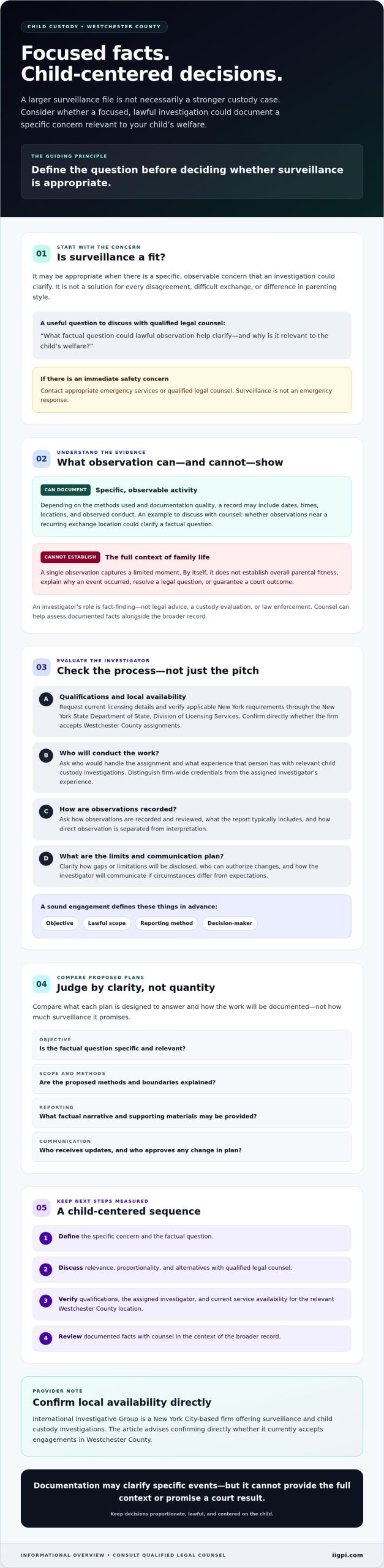
Use this four-step sequence to organize your decision:
- Consult counsel. Explain the concern to a qualified family-law attorney and ask whether an investigation is an appropriate next step.
- Define the concern. Identify the specific question, relevant dates, and what information could meaningfully clarify it.
- Assess the investigator. Confirm qualifications, availability for the relevant location, proposed scope, and reporting process before authorizing work.
- Review findings with counsel. Discuss the report, its limitations, and possible next steps before sharing or relying on it.
Before speaking with an investigator, prepare a concise factual timeline, the specific concern, relevant dates, and any existing documentation. Separate questions for your attorney, such as legal relevance or privacy, from logistical questions for the investigator, such as how the assignment would be scoped. Share custody schedules or exchange details only as needed, and use an appropriate secure channel rather than circulating sensitive information broadly.
Planning should minimize disruption. Any proposed observation period should relate to the defined concern and known arrangements, not intrude on the child’s ordinary activities without a clear reason. If you consult a professional surveillance guide, use it for general process context while assessing the specific plan with counsel and the investigator.
How should findings be reviewed and used?
Read the report carefully for factual accuracy. Distinguish recorded observations from assumptions, explanations, or conclusions. Note missing context or apparent discrepancies, then raise questions with the investigator and counsel rather than drawing an immediate conclusion. The report is one source of information, not a complete assessment of a parent or a substitute for legal advice.
Before sharing materials, discuss their relevance, privacy implications, and appropriate use with qualified legal counsel. Don’t confront another parent or change custody arrangements based solely on an investigator’s report. Seek legal guidance first, unless an immediate safety issue requires contacting appropriate emergency services. For information about the firm’s investigative services, visit International Investigative Group.
Choose a Westchester County child custody surveillance expert with a clear process
A careful hiring decision rests on verifiable details, not broad promises. Before selecting a westchester county child custody surveillance expert, confirm whether the provider accepts assignments in the relevant Westchester County location, verify the investigator’s qualifications, and assess whether the proposed scope, reporting method, and communication plan are clear. These checks help you decide whether the service fits the concern without presuming what an investigation will find.
International Investigative Group is a New York City-based private investigation firm offering surveillance and child custody investigations. The firm reports more than 30 years of experience and over 10,000 cases solved. These are firm-wide figures, not custody-specific outcomes, and do not establish experience relevant to an individual assignment. Confirm current local availability directly.
What should an initial conversation establish?
An initial discussion should clarify whether the firm accepts Westchester County assignments, who would conduct the work, and whether the concern fits the firm’s investigation services. Ask how the objective and scope would be defined, what privacy boundaries apply, how observations are reported, and how updates or changes would be communicated. The answers should give you and your attorney a clear picture of the proposed process.
Clarify the limits of the service, too. An investigator gathers information. The firm does not provide legal advice, decide custody arrangements, or guarantee that evidence will be admissible or produce a particular court result. Discuss legal strategy, admissibility, and custody decisions with your attorney. If a provider suggests otherwise, ask for clarification before proceeding.
What is a careful next step for Westchester County families?
Describe the concern in neutral, factual terms. Note relevant dates, identify what you personally know, and separate confirmed information from questions or assumptions. Discuss the issue with qualified legal counsel before contacting an investigator, then share only what is needed to assess whether an investigation may be appropriate. This preparation helps keep the initial discussion focused and reduces the risk that speculation shapes the assignment.
If you would like to explore whether an investigation may fit your circumstances, discuss a custody investigation with International Investigative Group and confirm Westchester County availability before proceeding. Ask how an inquiry is handled and what information is needed to assess your request. A measured first step preserves the distinction between investigative fact-finding and legal decisions made with your counsel.
Choose a measured next step
A sound custody investigation starts with a defined, relevant concern, not surveillance volume. Before hiring a westchester county child custody surveillance expert, verify qualifications and Westchester County availability, clarify the assignment’s scope and reporting process, and consider whether the plan respects the child’s privacy and routine.
Professional documentation may help record observable facts, but it cannot independently determine parenting fitness, guarantee admissibility, or predict a court’s decision. Discuss legal strategy, the significance of any findings, and custody decisions with qualified counsel before acting on investigative information.
International Investigative Group offers child custody investigations and surveillance. The firm reports more than 30 years of experience and over 10,000 cases solved. These firm-wide figures do not establish custody-specific outcomes. Confirm directly whether the firm accepts Westchester County assignments and what information it needs to assess your concern. Discuss a custody investigation as a first inquiry, then coordinate next steps with your attorney.
Frequently Asked Questions
Is surveillance appropriate in every Westchester County child custody dispute?
No. Surveillance may be considered when a specific, relevant concern needs factual clarification, but it isn’t a default response to disagreement or conflict. Discuss the concern and possible consequences with qualified legal counsel first. If an investigation is appropriate, define its purpose and scope in advance, respect applicable privacy boundaries, and protect the child’s routine and safety. Avoid any approach that places the child in the middle of parental conflict.
Can a private investigator help with a child custody case in Westchester County?
An investigator may be able to document relevant observations, depending on the assignment, lawful scope, and confirmed service availability in Westchester County. An investigator doesn’t decide custody, provide legal advice, or guarantee that findings will affect a case. Before proceeding, verify the provider’s qualifications and local coverage, then ask a family-law attorney whether the proposed fact-finding is appropriate and how to assess any resulting information.
How do I choose a child custody surveillance expert?
Ask about current licensing, relevant investigative experience, assignment scope, lawful methods, reporting practices, communication, and confirmed Westchester County availability. A westchester county child custody surveillance expert should explain what the investigator will and won’t do, how observations will be documented, and what limitations may apply. Verify New York licensing details with the Department of State, distinguish firm-wide claims from custody-specific experience, and consult your attorney about legal relevance.
What happens if surveillance does not document the concern?
An investigation may produce no relevant observations, and you should understand that possibility before work begins. Ask the investigator to explain the assignment’s limits, how findings will be reported, and how the investigation will conclude, without promising a particular result. A lack of observations does not prove that a concern is true or false. Review the outcome with qualified legal counsel before deciding whether another step is warranted.
Can surveillance footage be used in a New York custody case?
Whether particular footage or other material may be used, admitted, or considered depends on the circumstances and applicable law. The collection method, relevance, context, and privacy issues may all matter, and an investigator can’t guarantee a court outcome. Ask a New York family-law attorney to assess the specific material and its potential legal significance. Don’t rely on a provider’s general claims instead of advice about your case.
How long does a child custody surveillance investigation take?
There is no single timeline for every assignment. Duration may depend on the question being investigated, relevant dates or custody schedules, available information, and whether observations occur. Before authorizing work, ask how the investigator will define the scope, communicate progress, and address circumstances that could change the plan. A responsible provider should explain these variables rather than promise a particular finding, timeline, or outcome.
Should I contact an investigator or a family-law attorney first?
Consult a qualified family-law attorney first if you have questions about custody strategy, legal rights, privacy, or possible court use. Counsel can help clarify whether fact-finding is appropriate and identify questions an investigation might address. If you then contact a provider, verify qualifications and local availability, and discuss lawful scope, documentation, and communication before authorizing work. Investigators gather information; legal decisions belong with you and your attorney.