
A death during the first two years of a life insurance policy does not automatically mean the claim will be denied, but payment is not automatic either. Verifying cause of death for a contested insurance policy may involve reviewing the death certificate, medical and investigative records, and answers on the original application. The insurer’s findings and the policy’s exclusions can affect whether the benefit is payable.
It is understandable to expect a death benefit when a loved one had coverage, especially when the cause of death is disputed. This article explains what insurers may examine, how medical evidence and policy exclusions factor into a claim, and when a benefit may still be payable after two years. It also explains why the cause of death, application, and policy terms must be considered together.
Key Takeaways
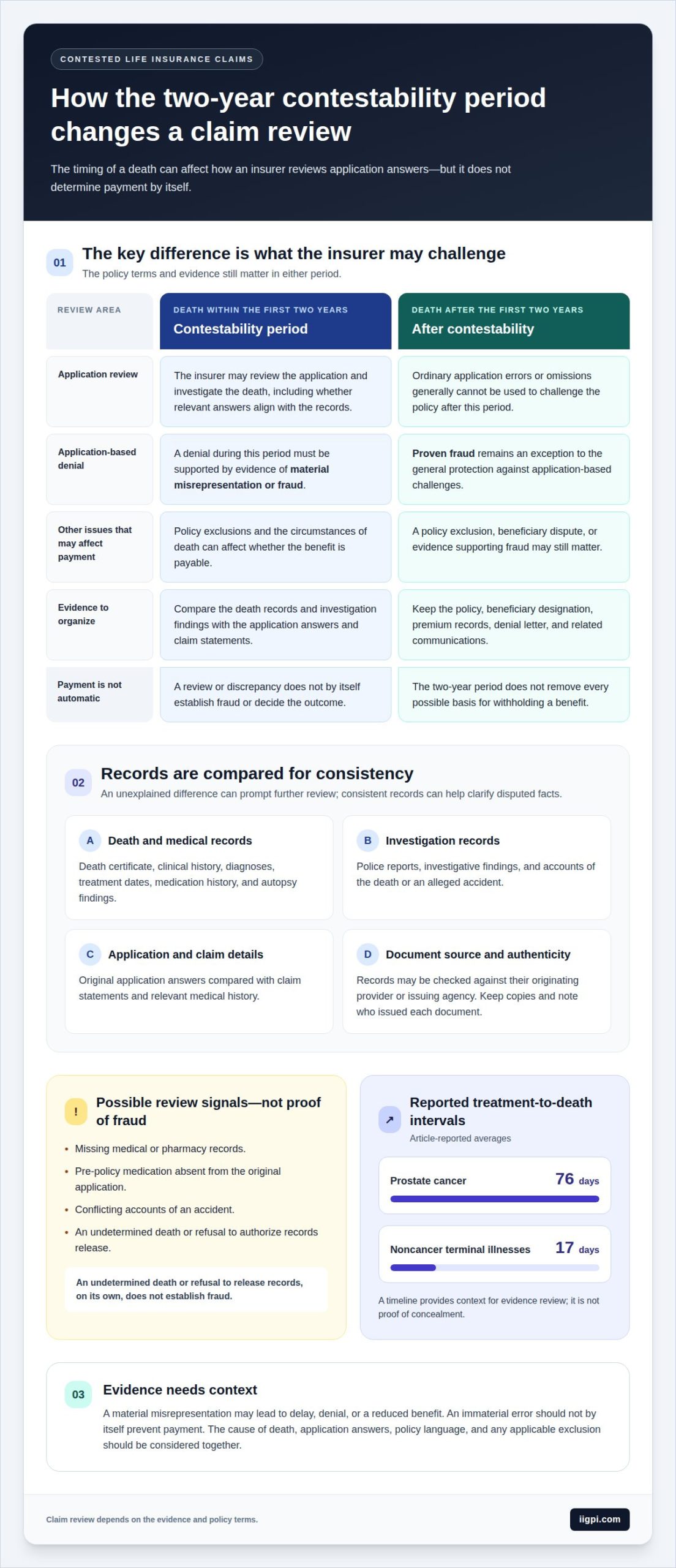
- Identify whether the death occurred within the policy’s generally two-year contestability period, when an insurer may review the application and claim evidence.
- Compare the death certificate with medical, autopsy, police, and investigative records to understand where discrepancies may affect the review.
- After the contestability period, application errors are generally treated differently, but proven fraud or a policy exclusion may still affect payment.
- Read the policy’s cause-of-death exclusions closely, since the circumstances of death and the terms of any rider can shape the benefit decision.
Medical records and autopsy reports in claim investigations
During the first two years after a life insurance policy takes effect, an insurer may review the application and investigate the death. Medical records and autopsy findings can help assess whether the stated cause and circumstances align with the application answers.
Medical and Autopsy Record Review
Record review compares clinical history and post-mortem findings with the death certificate, police reports, and claim statements. For example, an autopsy may identify a cause that differs from the initial report, prompting the insurer to examine related treatment records and application disclosures. This comparison matters because inconsistencies can affect the claim assessment, while records that support the stated history can clarify disputed facts. Medical records may include medication history, diagnoses, and treatment dates.
Fraud Warning Signs and Illness Timelines
Potential warning signs include missing medical records, pharmacy records showing pre-policy medication absent from the original application, or conflicting accounts of an accident. An undetermined death or refusal to authorize records release may also prompt closer review, but neither alone establishes fraud. Timelines can provide context: the reported average interval from first drug treatment to death is 76 days for prostate cancer and 17 days for noncancer terminal illnesses. A timeline is evidence to assess, not proof of concealment.
For a contested claim, the insurer may compare the cause or manner of death with lifestyle information and the applicant’s answers. A material misrepresentation may lead to delay, denial, or a reduced benefit; an immaterial error should not by itself prevent payment. During the contestability period, the insurer must support a denial with evidence of material misrepresentation or fraud.
The basic claim elements are that the policy was issued, the insured died, and required notice and proof of death were provided. State laws governing investigations and access to death records vary, and applicable rules can depend on the state and the records sought. An independent forensic pathologist’s fee depends on the assignment, records, and analysis required; there is no single amount that applies across the United States.
Exceptions to paying a death benefit after two years
After the contestability period, a life insurance policy generally cannot be challenged for ordinary application errors or omissions, except in cases of proven fraud. That does not eliminate every basis for withholding a death benefit: a policy exclusion, a beneficiary dispute, or evidence supporting fraud may still matter. Assess the reason for denial against both the policy language and the information provided.
Appeal deadlines for a life insurance claim denial are not uniform across the United States; they depend on the policy and applicable claim rules. Read the denial notice for the review process and deadline, and preserve the letter, policy, and related communications. Beneficiaries may appeal, request mediation, or pursue legal action.
Questions about who is entitled to the benefit can also delay payment after two years. If multiple people claim the benefit, or a beneficiary designation changed shortly before death, the insurer may investigate who should receive it. An insurer may ask a court to resolve competing claims through an interpleader action. Keep copies of the designation, policy history, premium records, and relevant correspondence to document the beneficiary’s position.
For a disputed claim in Florida, a claimant must prove the insured’s death by a preponderance of the evidence when the case presents a factual issue, as stated in Firemen’s Fund American Life Ins. Co. v. Wohl. A beneficiary can support an appeal with relevant medical records, police reports, or premium payment records. These materials can help address specific gaps or inconsistencies identified in the denial.
Keep the evidence organized by issue: the policy’s effective date, the insured’s death, the beneficiary designation, and the insurer’s stated reason for denying payment. After the contestability period, proven fraud remains an exception to the general protection against application-based challenges; an applicable cause-of-death exclusion is a separate contractual issue. Insurance investigation support can help gather and assess evidence relevant to a contested claim.
Death certificates, medical records, and autopsy reports
Insurers compare official death records with medical and investigative documents when assessing a disputed life insurance claim. A record’s source, consistency, and authentication can shape how the cause and circumstances of death are evaluated.
Verifying Medical and Death Records
Record verification means comparing documents from their originating sources for consistency and authenticity. An insurance company may compare a death certificate with medical records, an autopsy report, and a police report; an unexplained difference can prompt further review. For example, treatment notes may describe a condition that differs from information on the original application, raising a question about possible misrepresentation. Keep copies of each document and note its issuing provider.
Access to Death Investigation Records
Who can request a death certificate, autopsy report, or medical examiner records depends on the state and record type. A relative, beneficiary, or authorized representative may need to follow the issuing agency’s access and identification process. Ask which documents are available and what proof of authority is required; an attorney can help interpret access restrictions relevant to a claim.
Independent Autopsy and Toxicology Reviews
A family can seek an independent review of autopsy findings or toxicology evidence after a death. Whether a new examination or testing can be performed depends on the remains, retained samples, and access to existing records. A pathologist reviewing the file may compare the reported cause and manner of death with the available findings. Preserve reports and laboratory documents for the life insurance claim.
Amending Death Certificates During Disputes
Changing a death certificate during an insurance dispute can create questions about what changed, why, and when. A correction should be supported by relevant records and processed through the appropriate issuing authority, rather than treated as a substitute for medical or investigative evidence. In Florida probate proceedings, Fla. Stat. § 731.103(1) makes an authenticated death certificate prima facie evidence of specified death details. Preserve earlier and amended versions so reviewers can trace the record history.
Policy exclusions and causes of death
A death benefit depends on the policy’s coverage terms, not solely on whether death occurred during the contestability period. The cause and manner of death matter when a contract excludes particular circumstances or provides additional benefits for specified events. Verifying cause of death for a contested insurance policy means assessing whether the documented circumstances fit the insurer’s cited exclusion.
Suicide clauses typically apply within the first two policy years. If an insured dies by suicide before the contestability period ends, the policy may provide for a premium refund instead of the death benefit. This clause is distinct from an application investigation: one concerns a policy exclusion, while the other examines information supplied when coverage was issued.
Other policies may exclude death connected to war, criminal activity, dangerous activities, or a beneficiary murdering the insured. The policy terms and circumstances matter. For example, when assessing a death during a dangerous activity, the insurer must examine whether the policy actually excludes that activity and whether the evidence connects it to the death. An allegation alone does not establish that an exclusion applies.
An accidental death rider may add benefits when death results from an accident, but the rider’s conditions also matter. An insurer may withhold that additional benefit if records indicate natural causes, suicide, or another excluded event. Verifying cause of death for a contested insurance policy can help distinguish questions about the base benefit from disputes about an added accidental death benefit.
The end of the contestability period does not erase every exclusion. A life insurance company may still reject a claim after three years if the cause of death falls within an applicable policy exclusion. Keep the denial explanation, policy, rider, and relevant records together. Focus the dispute on the precise wording and whether the evidence supports the insurer’s interpretation.
For an evidence-focused review of an insurance dispute, request insurance investigation support.
International Investigative Group: Corporate Investigations
International Investigative Group conducts Insurance Investigations when a disputed death claim requires independent fact gathering. Investigators can organize available records, compare accounts of the death, and identify inconsistencies that may clarify the circumstances surrounding a claim. This work can help beneficiaries or insurers assess what the evidence supports, without replacing legal advice or the insurer’s policy decision.
When a claim involves several records or conflicting accounts, a structured investigation can help establish a clear chronology and distinguish documented facts from unresolved questions. The findings may inform further claim review, particularly when the reported cause of death differs from other evidence. For assistance with evidence gathering in an insurance matter, contact International Investigative Group.
Move the claim toward a clearer decision
The next step is to turn the evidence into a concise account of what remains disputed. A dated chronology can connect each concern raised in the claim to the relevant document, witness account, or policy provision, making unanswered questions easier to identify. This structure also helps beneficiaries communicate consistently as the review proceeds.
Verifying the cause of death for a contested insurance policy is not just a records exercise; it requires careful attention to how each piece of evidence relates to the insurer’s stated concern. International Investigative Group offers Insurance Investigations and Corporate Investigations, as well as Security and Armed Guards. Investigation findings can organize relevant facts, while the insurer determines coverage under the policy.
For assistance with an insurance matter, contact International Investigative Group to discuss an investigation. A well-organized record of the issues can help bring greater clarity to the next stage of the claim.
Frequently Asked Questions
Your loved one died during the life insurance contestability period – what now?
Notify the insurer and submit the claim materials required by the policy, including proof of death and beneficiary information. Keep a dated record of documents sent, insurer requests, and responses. Locate the policy’s effective date and any reinstatement paperwork, as these help establish the timeline under review. If the insurer raises concerns, organize the specific questions and supporting documents before responding.
Can a Claim Be Denied During the Contestability Period?
Yes. During the contestability period, an insurer may deny a claim if evidence supports material misrepresentation or fraud in the application. The review may consider an inaccurate answer even when the alleged error is unrelated to the cause of death. For example, an undisclosed medical history may be examined alongside application answers and claim records. An immaterial error should not, by itself, prevent payment.
Are There Any Exceptions After the Contestability Period Ends?
Yes. Proven fraud may remain a basis for challenging a claim after the contestability period, and a policy exclusion can apply independently of application errors. These are distinct grounds: one concerns fraudulent information, while the other concerns whether the circumstances of death fall within the contract language. Review the denial explanation to identify the ground the insurer relies on and the evidence it cites.
Does Contestability Apply if Death Is Accidental?
Yes. Contestability applies to accidental deaths as well as deaths from other causes. An accident does not, by itself, prevent an insurer from examining application information during the contestability period. Also distinguish the base life insurance benefit from an accidental death rider: the rider may add a benefit, subject to its own terms and any exclusions related to the event.
If someone dies in the contestability period, what happens to the payout?
The beneficiary’s payout is reviewed rather than automatically issued or denied. Depending on the policy and findings, the insurer may approve the full benefit, adjust it, pay only part, or deny the claim. Some policies also have waiting periods with different payment terms. Read the policy’s benefit provisions and the insurer’s written decision to understand how its stated findings affect payment.
How is cause of death determined and documented in the United States?
Cause of death is documented through official death records and may be supported by medical examiner or coroner findings, autopsy reports, and police records. The death certificate records the reported cause and other identifying details, while supporting documents can provide further context. During a claim review, differences between those records may prompt questions, particularly if the manner of death is listed as undetermined.