
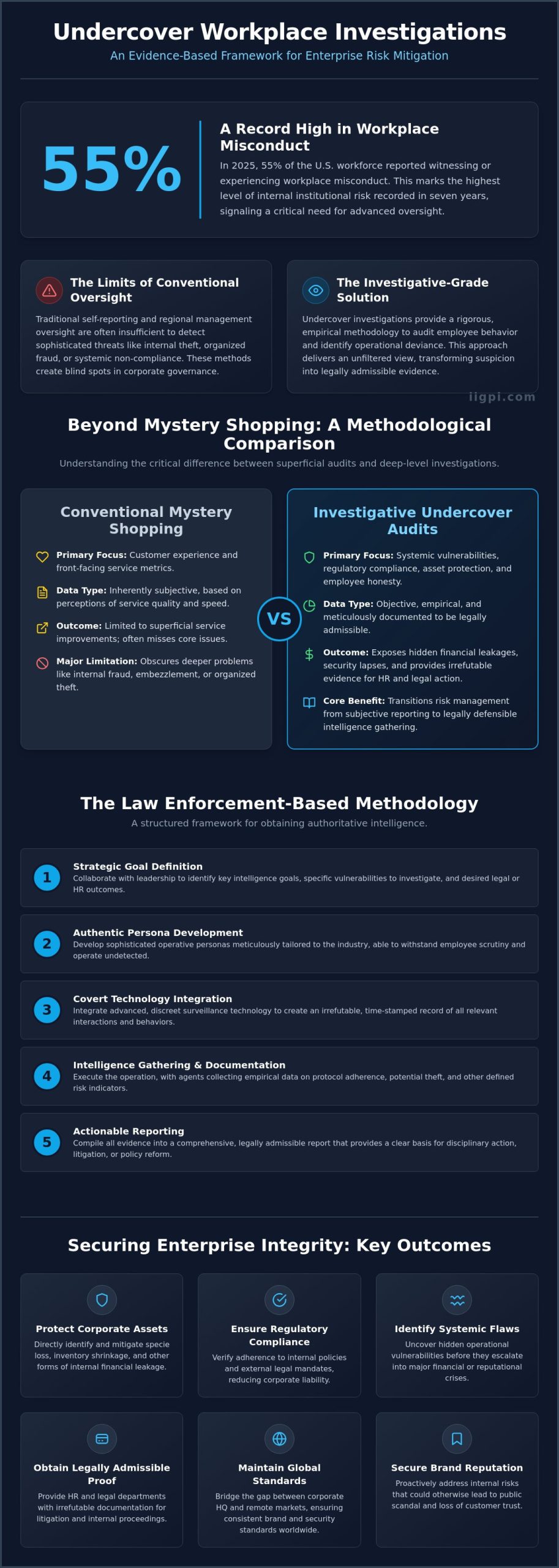
In 2025, 55% of the United States workforce reported witnessing or experiencing workplace misconduct, marking the highest level of internal institutional risk recorded in seven years. High-level decision-makers frequently recognize that conventional self-reporting and regional management oversight are often insufficient to detect sophisticated internal theft or systemic regulatory non-compliance. The implementation of undercover workplace investigations offers a rigorous, empirical methodology for auditing employee behavior and identifying operational deviance that remains invisible to standard corporate governance.
This analysis demonstrates how investigative-grade undercover operations serve as a critical instrument for identifying systemic vulnerabilities, ensuring regulatory compliance, and protecting corporate assets. By examining this framework, you will gain insights into the transition from subjective reporting to the acquisition of legally admissible documentation for HR and legal proceedings. We shall explore the strategic alignment of specialized surveillance with enterprise risk mitigation, providing a blueprint for securing global brand standards against increasingly complex internal threats.
Key Takeaways
- Distinguish between superficial mystery shopping and investigative-grade protocols to ensure objective, empirical data collection for corporate governance.
- Implement undercover workplace investigations as a sophisticated surveillance instrument to secure legally admissible evidence for complex HR and litigation requirements.
- Utilize law enforcement-based methodologies to develop authentic undercover personas and integrate advanced covert technology for irrefutable documentation of employee behavior.
- Execute a structured framework for risk mitigation that identifies strategic intelligence goals and addresses systemic vulnerabilities across global enterprise locations.
- Leverage thirty years of specialized expertise to mitigate specie loss and protect high-value corporate assets through authoritative, global-minded intelligence gathering.
The Strategic Utility of Undercover Workplace Investigations in Enterprise Risk Mitigation
The conceptualization of undercover workplace investigations within the architecture of Professional Surveillance Services represents a shift from superficial auditing to rigorous, evidence-based risk management. Traditional “mystery shopping” remains tethered to the subjective metrics of customer experience, yet investigative-grade operations prioritize the objective identification of systemic organizational vulnerabilities. These protocols function as an essential component of a comprehensive Corporate Fraud Investigation strategy. They provide an unfiltered perspective on internal operations that standard managerial reporting often fails to capture. By deploying highly trained specialists into the operational environment, enterprises can secure empirical data regarding employee honesty, adherence to regulatory mandates, and the protection of high-value assets. This methodology doesn’t just observe service quality; it dissects the operational framework to expose hidden financial leakages and security lapses that threaten the firm’s fiscal stability.
Beyond Customer Satisfaction: The Investigative Mandate
Traditional customer experience surveys are inherently limited by their focus on front-facing service metrics. This focus frequently obscures more profound issues of internal fraud, embezzlement, or organized theft. Professional investigators possess the specialized expertise required to identify nuanced red flags in employee conduct that an untrained observer would likely overlook. These indicators often include deviations from point-of-sale protocols, unauthorized inventory access, or subtle patterns of collusion. Establishing a baseline for operational integrity necessitates more than a cursory review of service speed. It requires an anonymous, authoritative audit of the underlying behaviors that dictate long-term enterprise health. These insights allow legal and HR departments to act on irrefutable evidence rather than suspicion.
Geopolitical and Global Scalability
For multinational entities, the discrepancy between corporate policy and regional execution often presents a significant liability. Managing covert operations on a global scale requires a network of agents who possess both the technical proficiency of law enforcement training and the localized cultural intelligence necessary to operate undetected. These undercover workplace investigations bridge the communicative gap between headquarters and remote markets. They ensure that brand standards and legal compliance aren’t diluted by geographic distance or regional indifference. This global scalability allows for the consistent application of risk mitigation strategies, regardless of the socioeconomic or regional dynamics at play. By utilizing agents who understand local dialects and social norms, an organization can maintain a standardized level of security and oversight across its entire international portfolio.
Methodological Rigor and the Standards of Evidence in Covert Operations
The efficacy of undercover workplace investigations depends upon the intellectual and technical sophistication of the investigative design. Successful covert operations aren’t merely about physical presence; they require the development of sophisticated “shopper” personas meticulously tailored to the specific industry environment. These personas must withstand intense scrutiny from employees who may already be engaging in deceptive practices. Professional investigators don’t merely observe; they document interactions within the framework established by the University of Miami School of Law on Compliant Workplace Investigations to ensure all findings remain legally viable. This level of rigor ensures that the transition from intelligence gathering to legal action is seamless, protecting the enterprise from claims of entrapment or procedural misconduct.
Modern investigative protocols often necessitate the integration of physical surveillance with digital discovery. Findings obtained during a site visit frequently serve as the catalyst for deeper Computer Forensics, where investigators can correlate behavioral anomalies with digital footprints of fraud or data exfiltration. By adhering to strict documentation standards, an organization ensures its findings are suitable for high-stakes legal review. Enterprises that prioritize these standards are better positioned to defend their interests during litigation or regulatory audits. If your organization requires this level of authoritative oversight, you should consider professional Corporate Investigations to address systemic risks.
Covert Surveillance and Documentation Protocols
Utilizing state-of-the-art audio and video recording equipment within specific legal jurisdictions is paramount for creating an irrefutable record of misconduct. Investigators must maintain a rigorous chain of custody and utilize time-stamped reporting to ensure that every piece of evidence is chronological and tamper-proof. The standard of evidence for corporate disciplinary actions must meet a threshold of clear and convincing proof that can withstand rigorous judicial or administrative scrutiny. This meticulous approach transforms subjective observations into objective, empirical data that can support decisive executive action.
Industry-Specific Investigative Scenarios
Different sectors present unique operational risks that require specialized undercover workplace investigations. In retail and hospitality, the focus often centers on detecting “sweethearting,” where employees provide unauthorized discounts to associates, or identifying complex inventory shrinkage patterns. Financial services require a different lens, specifically verifying that regional staff are strictly adhering to Anti-Money Laundering (AML) and Know Your Customer (KYC) protocols to avoid catastrophic regulatory penalties. Within the luxury goods sector, investigators target the unauthorized sale of counterfeit items or the diversion of inventory into parallel markets. For brands manufacturing in Asia, utilizing product inspection and quality control from the-inspection-company.com provides a critical first line of defense against such operational deviance. Each scenario demands a bespoke strategy that aligns with the specific legal and economic pressures of the industry.
Differentiating Investigative Undercover Audits from Conventional Mystery Shopping
The distinction between conventional mystery shopping and rigorous undercover workplace investigations lies in the fundamental objective of the engagement. While marketing-led programs seek to quantify customer satisfaction through the lens of consumer experience, investigative audits are designed to uncover systemic fraud and operational deviance. Casual evaluators typically lack the requisite training to distinguish between poor service and criminal intent, often focusing on subjective metrics that provide little value to risk management professionals. By contrast, an investigative approach prioritizes the collection of empirical data that can withstand the scrutiny of legal and regulatory bodies. Integrating Insurance Fraud Investigation Services into the corporate audit framework allows for a more robust vetting of employee honesty, ensuring that identified risks are addressed with the appropriate degree of professional skepticism.
The Limitations of Non-Professional Evaluators
The deployment of non-professional evaluators introduces a profound risk to the integrity of a corporate investigation, as these individuals typically lack the forensic acumen necessary to identify sophisticated indicators of internal fraud. This absence of professional training often results in “shopper bias,” where personal feelings regarding service speed or employee personality eclipse the objective measurement of legal and regulatory compliance. Furthermore, improperly conducted undercover workplace investigations by untrained individuals can lead to severe legal repercussions, including claims of privacy infringement or procedural errors that effectively invalidate findings during high-stakes HR disciplinary actions. A failure to utilize law enforcement-trained specialists can transform a strategic audit into a significant organizational liability.
Admissibility and Expert Testimony
Unlike the simple survey results provided by marketing firms, the reports generated by a professional Private Investigator are structured to meet the evidentiary standards of legal departments and judicial bodies. These documents provide a factual, chronological account of events that can be defended through expert testimony should a case proceed to litigation or formal arbitration. Professional investigators understand the nuances of the chain of custody and the necessity of maintaining impartial, objective documentation throughout the lifecycle of the operation. This level of rigor ensures that the findings support the specific requirements of both HR and legal departments, providing a foundation for decisive executive action that is both ethically sound and legally defensible.
The execution of undercover workplace investigations follows a rigorous five-phase architecture designed to ensure both operational security and the acquisition of high-fidelity intelligence. Precision is paramount. Phase I involves the identification of strategic intelligence goals and the delineation of systemic risks that require empirical verification. Phase II focuses on persona development and scenario engineering, ensuring that agents can integrate seamlessly into the targeted environment without compromising their objective status. The actual execution of undercover field operations constitutes Phase III, followed by the rigorous synthesis of empirical data and formal investigative reporting in Phase IV. Finally, Phase V involves the strategic implementation of these findings to drive operational reform and remediate identified institutional gaps.
Defining Investigative Objectives
Strategic success in these operations is defined by the collaborative alignment between investigative specialists and an enterprise’s internal legal and security divisions. Establishing specific metrics for success allows for a targeted approach, particularly when identifying employees or departments where deviance is suspected. Maintaining operational security requires the engineering of a robust cover story that accounts for the socioeconomic and regional dynamics of the workplace. It’s this intellectual preparation that ensures the investigation remains undetected while gathering the high-quality evidence necessary for formal disciplinary or legal actions.
Data Synthesis and Strategic Recommendations
Transforming raw field data into actionable corporate intelligence requires a sophisticated synthesis process that moves beyond simple observation. Rigorous documentation is mandatory. By integrating undercover data with established personal detective protocols, organizations can correlate behavioral findings with broader intelligence streams. This synthesis informs a comprehensive roadmap for remediating institutional vulnerabilities, allowing for the transition from reactive damage control to proactive risk mitigation. If your firm doesn’t have a structured approach to identifying internal threats, you should engage with our experts in Theft Investigations to secure your operational integrity.
International Investigative Group: Authoritative Intelligence for Global Enterprises
International Investigative Group represents the pinnacle of specialized intelligence, leveraging over 30 years of law enforcement-based expertise to address the most complex challenges facing the global elite. By conducting more than 10,000 successful investigations worldwide, the firm has established itself as an authoritative entity in the identification of systemic risks and the protection of high-value corporate assets. The organization’s global network of agents provides a unique advantage for multi-jurisdictional compliance audits, ensuring that institutional standards remain consistent across diverse regional dynamics. This commitment to intellectual rigor and empirical accuracy positions the group as an essential partner for entities operating within high-stakes environments where the margin for error is non-existent. Our methodology prioritizes the acquisition of irrefutable evidence while maintaining the highest standards of professional discretion.
Elite Investigative Standards
IIG remains the preferred choice for high-level decision-makers and global leaders who require more than superficial oversight. The firm’s specialized protocols in Fine Arts Loss Investigations and Jewelers Loss Investigations offer a level of protection that standard security firms cannot replicate. In one specific instance involving high-value specie loss, the deployment of undercover workplace investigations allowed for the identification of a sophisticated internal theft ring that had successfully bypassed conventional surveillance systems. The synergy between these covert operations and professional Security and Armed Guards creates a comprehensive defense architecture. This ensures that both physical and operational vulnerabilities are neutralized with absolute precision. We don’t merely observe. We secure the enterprise.
Initiating Your Strategic Investigation
The process of establishing a robust investigative program begins with a consultation with our former law enforcement professionals. These experts possess the necessary field experience to tailor solutions to specific organizational risks. Our onboarding protocol for global corporate intelligence operations is designed to be seamless, prioritizing the maintenance of operational security from the initial engagement. This structured approach ensures that every investigation is aligned with the client’s strategic objectives and legal requirements. High-level leaders are encouraged to contact International Investigative Group for a confidential briefing to discuss the implementation of undercover workplace investigations and other specialized surveillance services. Securing your assets requires an authoritative partner. Our team is prepared to provide the intelligence you need to mitigate risk effectively.
Securing the Future of Enterprise Operational Integrity
International Investigative Group offers the intellectual rigor and global reach necessary to navigate these complex multi-jurisdictional challenges. Founded by former law enforcement professionals with over 30 years of experience, the firm has a proven track record of resolving over 10,000 cases globally. Engage the Authority in Global Investigations at International Investigative Group to secure your organizational framework. Protecting the integrity of your global operations is achievable through authoritative intelligence and strategic foresight.
Frequently Asked Questions
What is the primary difference between a mystery shopping service and an investigative mystery shopping service?
The primary distinction lies in the objective and the caliber of the personnel involved in the operation. While traditional mystery shopping focuses on the subjective consumer experience and service metrics, an investigative audit is an empirical process designed to identify systemic fraud and operational deviance. These operations utilize law enforcement-trained specialists who understand the evidentiary standards required for high-stakes corporate governance and legal proceedings.
Are the results of an undercover workplace investigation legally admissible in a court of law?
Results obtained through professionally managed undercover workplace investigations are indeed legally admissible provided they adhere to the specific legal frameworks of the governing jurisdiction. Maintaining a rigorous chain of custody and utilizing time-stamped, objective reporting ensures that the evidence can withstand the scrutiny of judicial review or formal arbitration. This documentation is essential for supporting HR disciplinary actions or broader litigation involving internal theft or fraud.
How do professional investigators maintain their anonymity during a corporate investigation?
Anonymity is preserved through the rigorous application of persona development and scenario engineering tailored to the specific socioeconomic dynamics of the environment. Investigators leverage cultural intelligence and localized dialects to integrate seamlessly into the workforce without alerting participants to the surveillance protocol. This sophisticated approach ensures that the cover story remains resilient against the scrutiny of employees who may be engaging in deceptive behaviors.
In which industries is undercover workplace investigation most effective for preventing theft?
These investigations are particularly effective in customer-facing and high-value asset environments such as retail, hospitality, and financial services. Within the luxury goods and specie sectors, undercover workplace investigations are utilized to detect complex inventory shrinkage and unauthorized parallel market activity. Any industry characterized by decentralized management or high inventory turnover benefits from this authoritative oversight to identify hidden financial leakages.
Can undercover investigations be used to verify compliance with government regulations?
Undercover operations serve as a critical instrument for verifying adherence to complex government regulations, including Anti-Money Laundering (AML) and Know Your Customer (KYC) protocols. By observing regional staff in their natural operational state, enterprises can identify compliance gaps that standard internal audits often overlook. This proactive approach mitigates the risk of catastrophic regulatory penalties and protects the organization’s global reputation from institutional negligence.
How often should a corporation conduct undercover investigations to ensure operational integrity?
The frequency of these audits should be dictated by the organization’s specific risk profile and the geographic scale of its operations. Many global enterprises conduct these investigations on a cyclical basis or immediately following the identification of specific red flags, such as unexplained inventory loss or erratic financial reporting from regional management. Regular implementation ensures that operational integrity remains a constant institutional standard rather than a reactive measure.
What are the ethical considerations when conducting undercover investigations on employees?
Ethical considerations center on the balance between organizational security and the privacy rights of the individual within their professional capacity. Professional investigators operate under a mission-driven mandate that avoids entrapment and prioritizes the identification of actual misconduct over the solicitation of errors. Transparency with internal legal and HR departments is maintained throughout the process to ensure all actions align with the firm’s ethical guidelines and legal obligations.
Does International Investigative Group provide undercover workplace investigations on a global scale?
International Investigative Group maintains a robust global network of agents capable of executing multi-jurisdictional operations with absolute precision. Having solved over 10,000 cases globally, the firm possesses the localized expertise necessary to bridge the gap between corporate headquarters and international regional offices. This global reach ensures that undercover workplace investigations and risk mitigation strategies are applied consistently regardless of the geographic location of the subsidiary.