
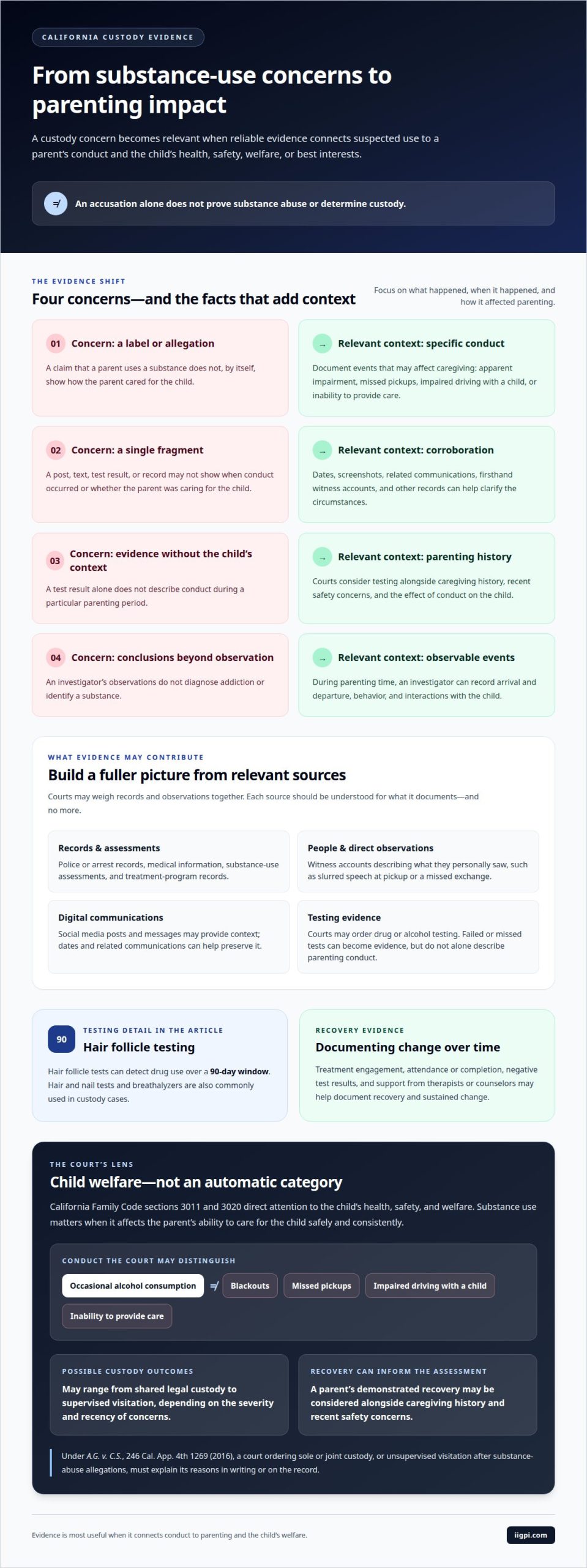
Substance use does not automatically cost a parent custody in California. The court considers whether it affects the child’s health, safety, welfare, and best interests. Uncovering hidden drug or alcohol abuse for a custody case can be relevant when reliable evidence connects suspected use to a parent’s ability to care for the child.
It is reasonable to take concerns seriously when a child may face impaired caregiving, missed responsibilities, or unsafe decisions. But an accusation alone does not establish substance abuse. Evidence should relate to circumstances that affect parenting.
This article explains how California courts assess substance-use concerns, which records and observations may be relevant, and how these concerns can affect custody or visitation. It also describes how a professional child custody investigation can document relevant facts for a dispute, without replacing legal advice or the court’s assessment.
Key Takeaways
- Understand why evidence of impaired caregiving can matter more than an accusation about substance use alone.
- Learn how California courts weigh a parent’s conduct against the child’s health, safety, welfare, and best interests.
- Identify how messages, witnesses, and treatment records may contribute to a fuller picture, and why covert testing or recording can create risks.
- See when a professional child custody investigation may help document concerns relevant to a custody dispute.
Can substance abuse cause a parent to lose custody in California?
Yes. California courts may limit custody or visitation if substance use affects a parent’s ability to care for a child. An accusation alone does not prove abuse. A private investigator can document observable conduct during parenting time, such as apparent impairment, missed pickups, or unsafe caregiving.
Evidence of Substance Use and Impaired Caregiving
Evidence is most relevant when it connects suspected substance use to specific parenting conduct. That connection matters because custody cases focus on the child’s welfare, not simply a label.
A focused approach to uncovering hidden drug or alcohol abuse for a custody case links an allegation to documented conduct rather than relying on suspicion. Relevant evidence may include police or arrest records, missed or failed tests, witness statements, medical records, social media content, and substance abuse assessments. For example, a witness might describe seeing a parent arrive impaired and drive with a child. Firsthand observations, dates, and context help distinguish direct evidence from rumor.
During parenting time, an investigator can document observable events, including a parent’s arrival and departure, behavior, and interactions with the child. The investigator records conduct rather than diagnosing addiction or identifying a substance. This distinction can clarify concerns about safety and caregiving.
Recovery and Testing Evidence
Evidence of recovery can document treatment engagement and signs of sustained change. It may be relevant when a parent seeks to preserve or modify custody or visitation.
When uncovering hidden drug or alcohol abuse for a custody case, testing evidence may address suspected use, while recovery records can show subsequent change. A California parent seeking modified custody may provide rehabilitation documentation, negative drug or alcohol test results, and support from therapists or counselors. Treatment-program records can document attendance or completion. Ongoing negative tests may support an account of recovery, but courts consider them alongside caregiving history and recent safety concerns.
Testing may also address current concerns. Hair follicle tests can detect drug use over a 90-day window. Hair and nail tests and breathalyzers are commonly used in custody cases. Courts may order drug or alcohol testing, and failed or missed tests can become evidence. A test result alone does not describe conduct during a particular parenting period.
How California courts assess substance use in custody cases
California courts assess substance use through its effect on the child’s best interests, not as an automatic custody category. Family Code sections 3011 and 3020 direct attention to the child’s health, safety, and welfare.
Identifying Possible Substance Use Concerns
Possible substance use concerns should be assessed through conduct, records, and circumstances that may affect parenting. Corroboration helps distinguish a documented concern from an unsupported allegation.
Courts may consider police records, medical information, witness accounts, testing, and substance abuse assessments. For example, a DUI record combined with evidence of impaired caregiving may provide more context than an unsupported accusation. In complex disputes, a court may order a substance abuse evaluation, testing, or Family Court Services involvement.
Effects on Child Safety and Parenting
Substance use matters when it compromises a parent’s ability to care for a child safely and consistently. The relevant circumstances include the conduct and its effect on the child.
A court may distinguish occasional alcohol consumption from use associated with blackouts, missed pickups, impaired driving with a child, or inability to provide care. These examples show why evidence should describe consequences for parenting, rather than rely only on a claim that a parent uses a substance. Records and firsthand observations can provide context about safety and routine.
Effects on Custody Decisions
Custody outcomes may range from shared legal custody to supervised visitation, depending on the severity and recency of the concerns. A parent’s demonstrated recovery can also inform the assessment.
Under A.G. v. C.S., 246 Cal. App. 4th 1269 (2016), a court ordering sole or joint custody, or unsupervised visitation after substance-abuse allegations, must explain its reasons in writing or on the record. This requirement makes the court’s reasoning part of the decision, rather than treating an allegation alone as determinative.
Attorneys can help present relevant records, address testing requests, and explain how evidence relates to parenting and recovery. Their legal analysis may clarify which facts support a requested custody arrangement. The court evaluates those facts in light of the child’s best interests.
Social media, messages, witnesses, and treatment records
In California custody disputes, courts may consider digital communications, witness accounts, and treatment records alongside other evidence. Their value depends on whether they reliably clarify a parent’s conduct and its effect on the child.
A social media post or text may provide context, such as a parent describing intoxication before scheduled parenting time. A post alone may not establish when an event occurred or whether the parent was caring for the child at the time. Screenshots, dates, and related communications can help preserve context for review.
Firsthand witnesses can describe what they observed, such as slurred speech at pickup or a missed exchange. Treatment and rehabilitation records may document participation, progress, or ongoing concerns. Medical information is sensitive, so its relevance and handling matter. A record should not be presented as proof beyond what it documents.
California Family Code section 3041.5 authorizes continued drug testing as a condition of visitation in applicable circumstances. In Heidi S. v. David H., 1 Cal. App. 5th 1150 (2016), the Court of Appeal held that this testing requirement’s duration is not subject to a temporal limit. A clear testing provision can define the test type and frequency, who pays, consequences for missed or failed tests, and chain-of-custody requirements.
Custody orders may set conditions related to treatment, sobriety, or relapse. For example, a court may require supervised visitation while a parent demonstrates continued sobriety. A parent seeking modification after recovery may present rehabilitation completion, negative tests, stable employment or housing, and regular counseling. Courts may modify custody orders when circumstances change, including after sustained recovery.
How much do court-ordered drug and alcohol tests cost, and who pays? Costs depend on the test and testing schedule, so there is no single amount or payer for every case. Testing provisions should specify who pays, making that responsibility clear in the order.
What are the risks of secretly testing or recording the other parent?
Secret testing or recording can weaken a custody argument if the evidence’s source, context, or reliability is unclear. A private test arranged without an agreed or court-ordered protocol may raise questions about whose sample was collected, how it was handled, and what the result measures.
For example, a result without documented identity and chain of custody may be harder to attribute confidently to the other parent. A single test also cannot establish whether someone was impaired while caring for a child at a particular time. California courts may order drug or alcohol testing in custody cases. A formal order can specify the test type, frequency, payment responsibility, and consequences for missed or failed tests.
Secret recordings carry different risks. A clip of a tense exchange may omit what happened before or afterward, while poor audio can make words or behavior difficult to interpret. Recording in a private setting can also raise privacy concerns. Incomplete footage may invite disputes about editing, timing, and context rather than provide a clear account.
Covert surveillance can intensify conflict between parents and expose children to adult disputes. For example, asking a child to collect evidence or discuss a recording can put the child in the middle of the custody conflict. Keep the focus on observable parenting and the child’s welfare, not confrontation or pressure.
Evidence gathering should be lawful, accurately documented, and limited to relevant concerns. A professional investigator can record observable events without making a medical diagnosis or claiming that one observation proves addiction. Polygraph testing does not replace clinical assessment, laboratory testing, or a court-ordered protocol, and should not be presented as proof of substance use.
If disputed statements are central to the situation, discuss whether polygraph testing is appropriate without treating it as a substitute for direct evidence. A court’s assessment remains focused on reliable information and its connection to parenting and child safety.
International Investigative Group: Child Custody Investigations
International Investigative Group conducts Child Custody Investigations when suspected substance use raises questions about a parent’s conduct during parenting time. Investigative findings can clarify observable behavior and relevant circumstances for a custody dispute, while legal decisions remain with the court.
An investigation may be appropriate when concerns involve recurring missed exchanges, apparent impairment, or inconsistent accounts of caregiving. The focus is to document relevant observations objectively, not diagnose addiction or substitute for court-ordered testing, treatment assessments, or legal advice. This keeps the investigation’s purpose aligned with the evidence a custody dispute may require.
Contact International Investigative Group to discuss a Child Custody Investigation related to your circumstances.
Choose a Clear, Evidence-Based Next Step
A careful approach to uncovering hidden drug or alcohol abuse for a custody case begins with a defined concern: what conduct needs clarification, and how does it relate to parenting? Keeping that focus can help prevent suspicion from escalating into confrontation and keep the child’s interests central.
International Investigative Group conducts Child Custody Investigations to document relevant observations. The firm also offers Corporate Investigations, Insurance Investigations, and Security and Armed Guards. For a custody matter, the next step is a conversation about the specific concerns, relevant circumstances, and what an investigation may help establish.
Evidence gathering cannot replace legal advice or a court’s evaluation, but objective documentation may help bring greater clarity to a difficult dispute. Contact International Investigative Group to discuss a Child Custody Investigation and determine a practical path forward.
Frequently Asked Questions
Can Addiction Affect Child Custody?
Yes, addiction can affect custody when evidence connects substance use to a child’s safety or a parent’s caregiving. The court may consider the severity and recency of the concern and how the parent’s conduct affects the child. For example, a pattern of disrupted care may have different significance from substance use with no demonstrated effect on parenting.
Can the Court Order Drug Testing or Supervised Visitation?
Yes, California courts may order drug or alcohol testing and may require supervised visitation in appropriate circumstances. A custody order can establish testing conditions, while supervision can limit exposure to safety concerns during parenting time. The court may also consider treatment requirements or continued testing. These measures address the circumstances before the court; they do not automatically determine the final custody arrangement.
How California Courts Actually Weigh Substance Use?
California courts weigh substance use as part of the child’s best interests, focusing on health, safety, welfare, and the parent’s ability to provide care. The same fact can carry different significance depending on context. For example, evidence of recovery may affect how the court views a past concern, while recent conduct affecting a child may raise a different question.
What Evidence Actually Moves The Needle?
Evidence is more informative when it reliably connects a parent’s conduct to the child’s circumstances. A dated observation, a corroborating witness, and a related record may establish a clearer sequence than an isolated allegation. Consistency also matters: conflicting accounts can make a timeline difficult to assess, while independent details may help explain what happened and how it affected caregiving.
What evidence of drug or alcohol abuse can be used in a child custody case?
Potential evidence includes police records, test results, witness accounts, relevant medical or treatment records, substance assessments, messages, and social media content. The usefulness of each item depends on what it actually establishes. A treatment record, for instance, may document participation, while a witness may describe a specific event. Considered together, different sources can add context without making any single item conclusive.
How can a private investigator legally document suspected substance abuse for a custody case?
A private investigator can document observable events relevant to parenting, such as exchanges, a parent’s conduct, and interactions with the child. Documentation should include dates, circumstances, and direct observations, without diagnosing substance use or presenting suspicion as fact. Methods must comply with applicable law and respect privacy. Evidence should not be obtained through unauthorized access to accounts, devices, or private property.