
What if a troubling business decision reflects poor communication rather than misconduct? In a family business, strained relationships can make ordinary disagreements feel consequential, while limited access to company records can make concerns difficult to assess. A search for “uncovering conflicts of interest in a family business brooklyn” often begins with a practical question: what can be verified, and what remains suspicion? The answer depends on evidence, not assumptions or family history.
This article explains how to distinguish a documented conflict from a tense but ordinary business dispute, and what conduct may merit impartial review. You’ll learn how to preserve relevant records, examine transactions and disclosures, and set a focused investigative scope. When appropriate and authorized, records analysis, surveillance, or computer forensics may help clarify specific questions. A careful, neutral process can protect business operations and family relationships while showing what the available evidence does, and does not, establish.
Key Takeaways
- Distinguish a personal-interest conflict from family tension by examining how a decision could affect the business.
- Compare available contracts, invoices, approvals, and corporate records over time to identify patterns that warrant closer review.
- When uncovering conflicts of interest in a family business brooklyn, define the concern, build a timeline, and corroborate records before drawing conclusions.
- Protect the inquiry by limiting access to relevant records, keeping a factual log, and avoiding public accusations or changes to original documents.
- Repeated unexplained transactions, missing records, or unresolved questions about decision-making may warrant impartial review. Prepare a chronology, authorized records, and specific questions.
What counts as a conflict of interest in a Brooklyn family business?
A conflict of interest arises when someone’s private or financial interests could improperly influence a decision made for the business. The interest may be direct, such as an owner approving a contract with a company they also own, or indirect, such as a close relative benefiting from a business decision. The basic concept is explained in Understanding Conflicts of Interest, but whether a particular decision raises a concern depends on its facts and context.
It helps to distinguish three situations. An actual conflict exists when personal interests and business responsibilities collide in a specific decision. A potential conflict could arise if circumstances change, such as when a relative’s company is considered as a supplier. An appearance of conflict occurs when available facts could reasonably raise questions about impartiality, even if improper influence has not been established. An appearance calls for careful review, not an automatic conclusion of wrongdoing.
That distinction is central to uncovering conflicts of interest in a family business brooklyn. A warning sign is a fact or pattern that merits examination. Substantiated evidence is information that supports a specific account after it has been checked against other evidence and plausible alternatives. Family ties, disagreement, or suspicion alone establish neither misconduct nor a conflict.
Why family ties can complicate Brooklyn business decisions
In a family-run Brooklyn retailer, property company, or professional practice, one person may be an owner, manager, employee, and relative. Those roles can overlap without creating a problem. But informal decision-making may leave unclear who proposed a transaction, who approved it, or whether anyone disclosed a personal interest. Reviewing the decision process helps separate governance questions from longstanding family tensions.
Common situations that may merit an impartial review
Examples include an undisclosed relationship with a vendor, repeated work awarded to a relative on unusual terms, or a leader pursuing an outside opportunity that may compete with the company’s interests. These are indicators to examine, not proof of misconduct. Price or contract differences may have legitimate explanations, and a competing interest may not have affected a particular decision.
Focus on what can be documented: the parties involved, the decision-maker, any stated disclosure, the approval process, and the apparent business impact. Compare the concern with available contracts, invoices, communications, or meeting records that you are authorized to access. A relative’s frustration, a rumor, or a disputed recollection may provide context, but should not be presented as established evidence without independent support.
A neutral assessment tests competing explanations rather than treating an allegation as a verdict. The aim is to clarify what the records show, what remains uncertain, and whether further review is proportionate, while protecting the company’s interests and family relationships.
Which records and conduct may reveal a family-business conflict?
Once a concern is defined, determine what the available records can establish. Review transactions, authority, disclosure, and business impact together instead of treating one unusual invoice or disputed decision as conclusive. Comparing contracts, invoices, approvals, and corporate records over time can show whether a transaction was isolated, repeated, authorized, or inconsistent with the company’s documented procedures. This evidence-centered approach helps assess concerns without assuming a family connection proves wrongdoing.
Transaction patterns and related-party dealings
Related-party transactions can serve legitimate business purposes, so a family connection alone does not establish impropriety. Consider the terms, rationale, approval, and any personal benefit. For example, recurring payments to a vendor associated with an owner may merit comparison with the underlying agreements, invoices, and approval records, particularly if the vendor or terms changed without an evident business explanation.
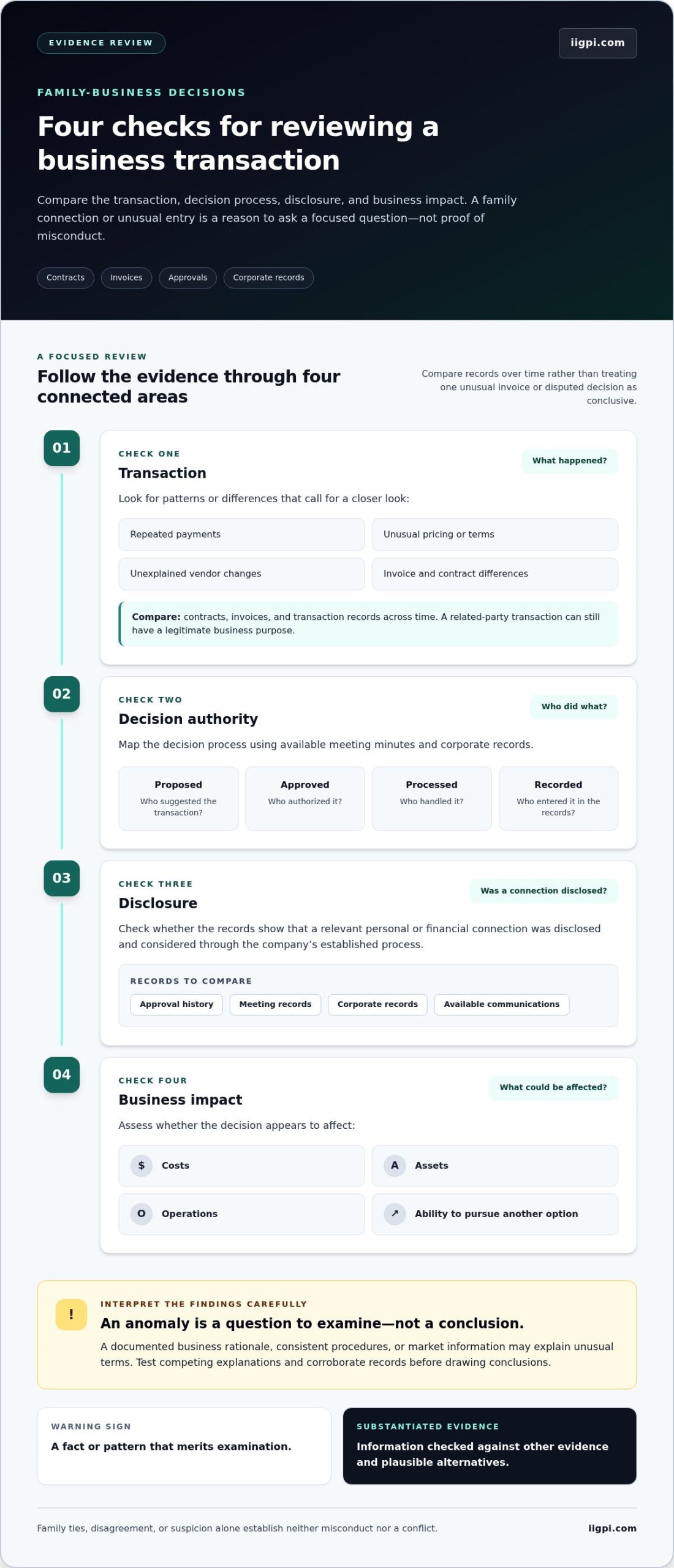
Examine evidence across four connected areas:
- Transaction: Look for repeated payments, unusual pricing or terms, unexplained vendor changes, and differences between invoices and contracts.
- Decision authority: Identify who proposed, approved, processed, and recorded each transaction, using meeting minutes or other available corporate records.
- Disclosure: Check whether records show that a relevant personal or financial connection was disclosed and considered through the company’s established process.
- Business impact: Assess whether the decision appears to affect costs, assets, operations, or the company’s ability to pursue another option.
An anomaly is a reason to ask a focused question, not proof of personal benefit or a policy breach. A documented business rationale, consistent procedures, or market information may explain unusual terms. For a broader framework for assessing suspected fraud-related concerns, the corporate fraud investigation guide offers related investigative context.
Digital and documentary evidence
Relevant evidence may include business email, accounting entries, approval histories, contracts, meeting records, and transaction logs. Limit any review to records you are authorized to access. Do not access private accounts, devices, or communications without proper authority. Preserve original files where possible, avoid editing source records, and note when, where, and by whom each item was obtained. A dated inventory helps distinguish contemporaneous documentation from later recollection.
Digital evidence may require analysis beyond opening a file or viewing a message. A careful review can consider metadata, file history, and the relationship between communications and recorded transactions, while documenting the methods used. The computer forensics guide discusses digital evidence analysis in corporate investigations.
Family businesses can also involve overlapping ownership, management, and personal roles, a dynamic explored in the Center for Family Enterprise Governance’s Conflict in Family Businesses. When records leave material questions unresolved, an impartial corporate investigation resource can help assess documented concerns without presuming a conclusion.
How can an investigation distinguish evidence from family-business suspicion?
A disciplined inquiry starts with a question that can be tested, not a conclusion someone must prove. Instead of asking whether a relative “has been favoring” a vendor, define the issue more precisely: did specified purchases involve an undisclosed interest, depart from established approval practices, or lack a documented business rationale? A sound finding connects verified evidence to a defined concern and separates established facts from unanswered questions.
A practical sequence keeps the inquiry focused:
- Define the concern. Identify the decision or transaction at issue and the possible conflict to be examined.
- Identify relevant records. Determine which authorized contracts, invoices, approvals, communications, or corporate records may clarify the matter.
- Establish a timeline. Arrange events by date, noting who acted and which records document each step.
- Corroborate key details. Compare sources and seek independent support for material claims instead of relying on one recollection or document.
- Assess competing explanations. Consider what the evidence supports, what it contradicts, and what remains unresolved.
This method does not presume that an inconsistency signals misconduct. A late approval, for instance, may reflect a recordkeeping gap, an established informal practice, or a decision that warrants closer examination. Test plausible explanations against the available information and record the basis for the assessment.
Establishing scope, timeline, and corroboration
Keep the scope proportionate by specifying the people, decisions, transactions, and period relevant to the concern. Build the chronology from dated records where possible, then use interviews to clarify gaps or conflicting accounts. Record discrepancies precisely, including which sources differ, but do not assign intent to an inconsistency without supporting evidence. Corroboration may come from separate records that independently confirm a date, approval, payment, or communication.
Using investigative methods proportionately
Records analysis is often a useful starting point. Interviews may clarify responsibilities, decision processes, or the context of a transaction. Consider surveillance only when it is relevant to a defined question and can be conducted with appropriate authorization, respect for privacy, and attention to applicable legal requirements. Surveillance should not replace documentary evidence or become a way to pursue unrelated personal information. The professional surveillance services guide provides additional context on this method.
Throughout the inquiry, document the sources reviewed, the steps taken, and the limits of what the evidence can establish. International Investigative Group conducts corporate investigations and offers surveillance services to support fact-finding within a defined scope. Business leaders can review corporate investigation services as one possible resource.
What safeguards should Brooklyn business leaders use during a conflict inquiry?
A conflict inquiry can affect business operations and family relationships, so the process should be controlled, impartial, and proportionate. Before reviewing records, identify who is responsible for fact-finding, what question the inquiry addresses, and who needs access to its materials. Keep a factual log of actions, dates, sources reviewed, and decisions about scope. Separate documented observations from assumptions, and note unresolved questions without treating them as established facts.
Avoid public accusations, retaliation against anyone who raises a concern or participates in an inquiry, and changes to original records. These actions can undermine trust and complicate the assessment. Keep fact-finding distinct from legal advice, disciplinary decisions, and family mediation. An investigation can establish and document relevant information; it does not, by itself, determine legal obligations, decide employment consequences, or resolve interpersonal disputes. Refer New York privacy, employment, and evidence questions to qualified counsel rather than treating them as settled by an internal process.
Confidentiality, preservation, and fair treatment
Preserve relevant materials through authorized processes, retain originals where practicable, and record how each item was obtained and handled. Limit access to people with a legitimate role, while avoiding promises of confidentiality beyond what the process can support. Apply the same standards to every participant, regardless of family relationship, ownership, or seniority. Consistency helps protect the integrity of the inquiry and reduces the risk that personal loyalties or rivalries shape how evidence is assessed.
When uncovering conflicts of interest in a family business brooklyn, practical safeguards include limiting the review to relevant business records, maintaining a dated log, and sharing findings through appropriate channels rather than through family or workplace rumor. If records may be subject to preservation, privacy, or employment requirements, seek legal guidance before taking action that could affect them.
When to involve counsel or an independent investigator
Involve counsel when leaders need legal interpretation, guidance about privilege, or advice concerning potential obligations. Counsel can help define those legal questions, while an investigator can independently gather and organize relevant facts within an authorized scope. The roles are distinct: an investigator should not be presented as providing legal advice, and the fact-finding process should not presume misconduct before the evidence is assessed.
An independent investigator may be useful when internal decision-makers have personal ties to the matter, when the concern involves senior leadership, or when neutral documentation would help the company evaluate competing accounts. Clear terms of reference, controlled access to records, and a defined reporting process support a focused inquiry without deciding disciplinary or family outcomes in advance.
An impartial fact-finding process can help clarify documented concerns and give decision-makers a more reliable basis for their next steps.
When should a Brooklyn family business engage an investigator?
An investigator may be appropriate when a credible concern remains unresolved after an initial review of available business records, particularly if there are repeated unexplained transactions, missing or inconsistent documentation, or uncertainty about who controlled or approved a consequential decision. These conditions do not establish misconduct. They may indicate that impartial fact-finding would help when internal relationships, divided authority, or incomplete records make a neutral assessment difficult.
Consider an independent inquiry when the concern is ongoing, involves a senior decision-maker, or could materially affect business assets or operations. A focused investigation can clarify which facts are documented, what remains uncertain, and whether competing explanations fit the evidence. This turns uncovering conflicts of interest in a family business brooklyn into a defined investigative question rather than an open-ended search for blame.
Preparing a focused investigative brief
A concise brief gives an inquiry a practical starting point. Organize what is known, identify unanswered questions, and distinguish direct observations from assumptions, hearsay, or family disagreement. Include relevant dates, people, decisions, and business records, sharing only materials the business is authorized to provide. The brief does not need to resolve the issue in advance. Its purpose is to describe the concern clearly enough to guide proportionate fact-finding.
- Known facts: Record what happened and identify the source supporting each point.
- Open questions: State what the business needs clarified, such as who approved a transaction or whether an interest was disclosed.
- Relevant records: Identify available contracts, invoices, approvals, communications, or other authorized materials.
- Decision after fact-finding: Clarify what the business expects to consider once the evidence has been assessed, without predetermining the result.
A well-scoped inquiry connects a defined concern to specific people, events, and records, then documents what the evidence can and cannot establish. This framing avoids an unnecessarily broad review and supports a more useful assessment.
What an experienced investigative firm contributes
International Investigative Group is a New York City firm with more than 30 years of experience and more than 10,000 cases solved. It serves corporate clients through corporate investigations, including inquiries involving financial fraud, due diligence, surveillance, and computer forensics. Depending on the defined question, authorized records analysis may be combined with other appropriate investigative methods. The purpose is to assess documented concerns impartially, not to presume misconduct or promise a particular finding.
Before an inquiry begins, leaders can define its scope, identify the records they are authorized to share, and establish who should receive the findings. If impartial fact-finding could help your business assess a documented concern, discuss your corporate investigation confidentially.
Take the Next Step with Clarity
When uncovering conflicts of interest in a family business brooklyn, a measured next step can protect decision-making without treating suspicion as a verdict. If an unresolved concern could affect the company, define the question that needs answering and consider whether impartial fact-finding would help leaders move forward with greater confidence.
International Investigative Group serves corporate clients in New York City and brings more than 30 years of experience and more than 10,000 cases solved to its investigative work. Its corporate investigation and computer forensic services can support a focused inquiry without guaranteeing a particular finding or outcome.
Take an evidence-centered approach to the issue at hand. Discuss a confidential corporate investigation with International Investigative Group to identify a responsible path toward clearer business decisions. A careful process can help address uncertainty while preserving the possibility of trust and stability.
Frequently Asked Questions
Is a conflict of interest illegal in New York?
Not necessarily. A conflict alone does not establish a crime or automatically invalidate a transaction. For New York corporations, Business Corporation Law § 713 addresses transactions involving interested directors. Disclosure and approval by disinterested directors or shareholders can affect how a transaction is treated. Without that process, the interested party may need to establish that the transaction was fair and reasonable to the corporation. The statute’s application depends on the entity and facts, so consult qualified New York counsel.
Can a private investigator access a family business owner’s personal email?
No, not without proper authority. An investigator should not access a personal email account simply because its owner is connected to the business. If relevant messages are in a company-managed account, preserve them and establish who is authorized to provide access before any review. Account ownership, privacy expectations, and collection methods can raise distinct questions, so consult counsel about permissions before collecting or examining communications.
Should I confront a family member before investigating a suspected conflict?
Not necessarily. A direct conversation may clarify an innocent misunderstanding, but raising an allegation before relevant information is secured can intensify family tensions or affect records and recollections. Before starting a review, consider whether the concern is defined, whether important materials need preservation, and whether an internal decision-maker has a personal connection to the issue. Counsel can help assess the timing and manner of any discussion.
How long does a family-business conflict investigation take?
There is no dependable fixed timeframe. Duration depends on the inquiry’s scope, the volume and condition of records, how quickly authorized materials can be obtained, and whether interviews or digital analysis are appropriate. A focused review of a limited set of transactions may differ substantially from an inquiry involving multiple decision-makers and scattered records. Define the questions and information sources at the outset so progress can be assessed against a clear scope.
What records should I preserve when I suspect a conflict of interest?
Preserve business materials that may help establish how a decision was made, including vendor setup or change logs, bank reconciliations, purchase approvals, board packets, and relevant business communications. Keep records in their original form where possible, and note where each item came from and when it was collected. Do not delete, annotate, or reorganize source files in a way that could obscure their history. Preserve only materials you are authorized to access.
Can an investigator guarantee that a family-business conflict will be proven?
No. An investigator cannot guarantee that evidence will substantiate an allegation or produce a particular finding. A careful inquiry may confirm some details, identify a reasonable alternative explanation, or leave questions unresolved because records are incomplete. Its value lies in assessing available information against a defined concern and documenting the basis and limits of the findings. Consider legal conclusions and business decisions separately with the appropriate advisers and decision-makers.