
The assumption that privacy remains a default state within the high-stakes corporate and legal corridors of Manhattan is a dangerous fallacy in an era defined by increasingly sophisticated technical surveillance. For executive leadership and legal counsel, the vulnerability of sensitive deliberations to corporate espionage represents a systemic risk that consumer-grade hardware is fundamentally incapable of mitigating. You likely recognize that as surveillance technology proliferates, the efficacy of amateur detection methods diminishes, leaving a vacuum of uncertainty regarding the actual integrity of your private environments. This analysis provides a rigorous examination of professional TSCM bug sweep services nyc, focusing on the specialized methodologies and intellectual rigor required to neutralize modern eavesdropping threats effectively. We will explore the necessary transition toward Cyber TSCM, the utilization of laboratory-grade equipment such as spectrum analyzers and non-linear junction detectors, and the critical role of formal technical reporting in establishing a robust defensive posture for legal or insurance purposes.
Key Takeaways
- Comprehend the critical evolution from rudimentary radio frequency monitoring to the detection of sophisticated “burst” and “store-and-forward” transmissions that bypass conventional security measures.
- Evaluate the fundamental limitations of consumer-grade hardware compared to the rigorous, multi-layered methodologies employed by professional TSCM bug sweep services nyc to secure high-density urban environments.
- Identify contemporary technical vulnerabilities, such as the miniaturization of optical surveillance and the exploitation of networked systems, which require a specialized “Cyber TSCM” approach for total neutralization.
- Formulate a proactive security strategy by recognizing specific “trigger events” and establishing an empirically-derived frequency for recurring technical inspections to maintain an enduring defensive posture.
The Evolution of Technical Surveillance Countermeasures (TSCM) in NYC
Technical Surveillance Countermeasures (TSCM) represents a sophisticated branch of Countersurveillance that transcends the mere physical discovery of illicit hardware. It is more accurately defined as a holistic technical security protocol designed to identify vulnerabilities in the electronic and physical infrastructure of an organization. Historically, the discipline relied upon rudimentary radio frequency (RF) detectors capable only of identifying continuous transmissions within narrow bands. However, the contemporary threat landscape has necessitated a transition toward laboratory-grade spectrum analysis. This shift reflects the increasing complexity of modern eavesdropping devices, which often employ advanced modulation techniques or “burst” transmissions to evade detection by legacy equipment. Within the context of corporate governance, the integration of TSCM bug sweep services nyc has become an essential component of comprehensive risk management strategies, ensuring that the sanctity of executive communications remains uncompromised by external or internal adversaries.
The High-Density RF Challenge in Manhattan
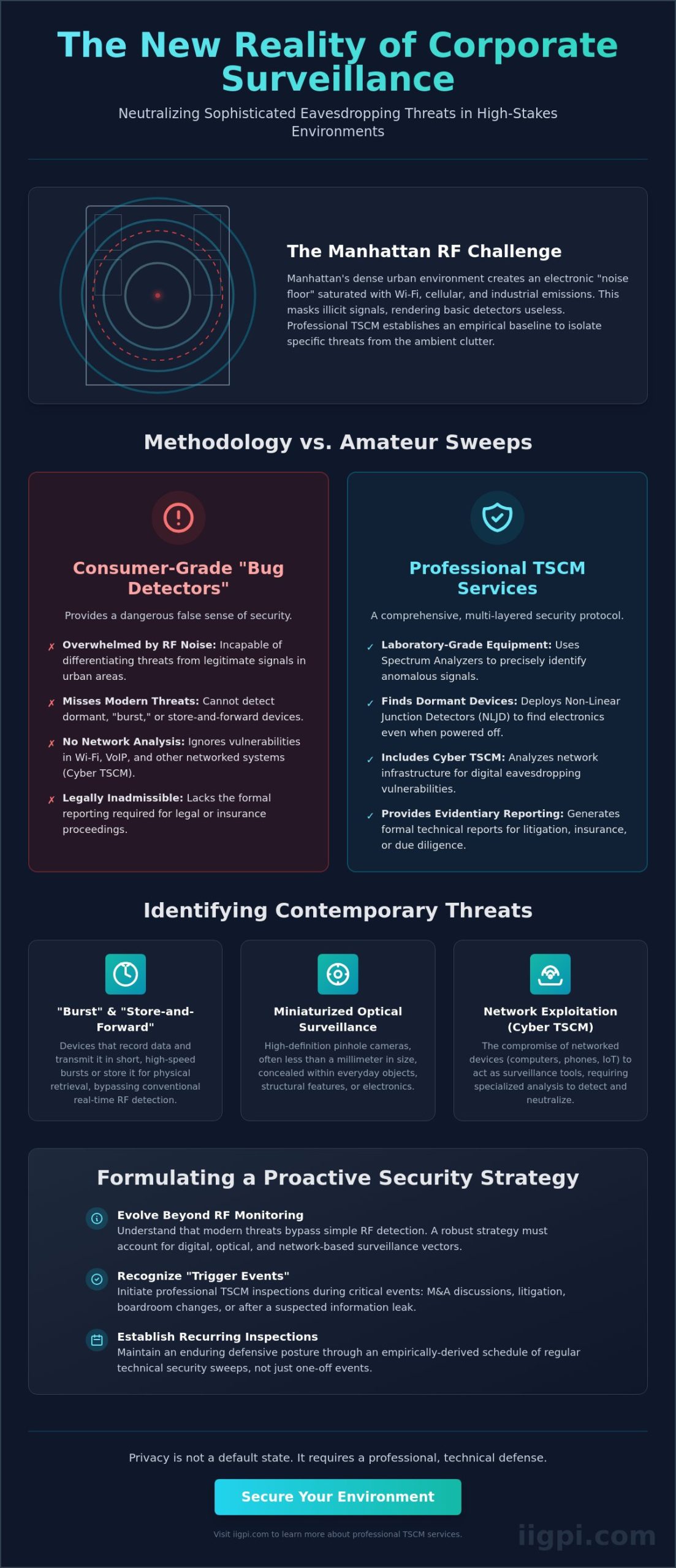
The commercial districts of Manhattan present an exceptionally hostile environment for precise signal isolation due to the sheer density of legitimate radio frequency traffic. In a high-rise environment, the “noise floor” is significantly elevated by a confluence of Wi-Fi networks, cellular towers, and industrial electronic emissions. This saturation creates a masking effect, where illicit low-power transmitters can easily blend into the background of urban electronic clutter. Standard consumer-grade detectors often prove useless in these settings, as they’re unable to differentiate between the ambient RF energy of a Midtown office building and the specific signature of a surreptitious bugging device. Effective detection in New York City requires professionals who can establish an empirical baseline of the local signal environment before identifying anomalies that indicate a security breach.
Regulatory and Legal Frameworks for NYC Bug Sweeps
The deployment of technical security measures must occur within a rigorous legal framework to ensure that any findings remain admissible in legal proceedings. In New York, the distinction between legal recording under one-party consent laws and illegal eavesdropping is a critical boundary that dictates the scope of a technical sweep. Engaging licensed professionals is not merely a matter of technical efficacy; it’s a legal necessity for organizations that may need to leverage TSCM findings within broader Corporate Fraud Investigations. A formal technical report, generated by a qualified investigator, provides the evidentiary foundation required for insurance claims or litigation. By adhering to these protocols, entities don’t just secure their immediate environment but also establish a defensible record of their due diligence in protecting sensitive intellectual property and proprietary information.
Modern Surveillance Vectors: Identifying Contemporary Threats
The transition from analog, continuous-wave transmitters to digital “burst” and “store-and-forward” devices represents a paradigm shift in illicit surveillance. Contemporary eavesdropping hardware doesn’t broadcast constantly; instead, it captures audio or video data and transmits it in high-speed, compressed bursts or stores it for later physical retrieval. This clandestine methodology aligns with the NIST definition of TSCM, which emphasizes the necessity of comprehensive detection techniques against sophisticated interception hardware. When engaging TSCM bug sweep services nyc, decision-makers must understand that identifying these dormant threats requires non-linear junction detectors (NLJD) capable of locating semi-conductor components even when the device is powered off or in a sleep cycle.
Optical surveillance has undergone a similar radical miniaturization, where pinhole camera technology now facilitates high-definition video capture through apertures as small as a millimetre. These devices are frequently concealed within structural elements or mundane office objects, rendering them invisible to the untrained eye. Passive eavesdropping also remains a significant vulnerability; hardwired microphones can utilize existing building infrastructure, such as ventilation ducts or decommissioned copper wiring, to transmit data without emitting any radio frequency signature. These structural vulnerabilities require a meticulous physical inspection that complements electronic scanning to ensure a truly sterile environment.
Cyber-TSCM and Network Vulnerabilities
The rise of the Internet of Things (IoT) has introduced a plethora of new listening posts into the executive suite. Smart televisions, networked thermostats, and voice-activated assistants provide ready-made platforms for exploitation by sophisticated actors. This technical evolution necessitates a convergence where physical inspections meet Computer Forensics to identify rogue access points or unauthorized network bridges. Modern TSCM bug sweep services nyc must now incorporate “Cyber TSCM” to address threats originating from Wi-Fi, Bluetooth, and cellular networks. A professional technical sweep identifies unauthorized devices that utilize legitimate network infrastructure to exfiltrate data, ensuring that smart office equipment hasn’t been repurposed as a surveillance node.
Vehicle and GPS Tracking Threats
Security protocols shouldn’t end at the office door, as high-net-worth individuals (HNWIs) are frequently targeted through their transportation assets. Clandestine GPS tracking units and integrated audio surveillance in executive vehicles represent a common vector for monitoring movement and private conversations. Identifying these units requires a physical and electronic inspection of the vehicle’s chassis, interior, and onboard diagnostic systems. For individuals operating in high-risk environments, this mobile security layer is as vital as the protection of their primary residence. Comprehensive mobile sweeps effectively neutralize the risk of physical stalking or the interception of sensitive discussions held in transit.
The Professional TSCM Protocol: Methodology vs. Amateur Sweeps
Professional counterintelligence requires a fundamental departure from the superficial searches conducted with consumer-grade hardware. While “bug detectors” available to the general public often provide a false sense of security by identifying only the most rudimentary analog transmitters, elite TSCM bug sweep services nyc employ a multi-layered protocol that integrates physical, electronic, and cyber-security disciplines. This methodological rigor ensures the identification of sophisticated threats that remain dormant or utilize advanced encryption to bypass standard detection. The process is characterized by absolute discretion and strict operational security, preventing the adversary from learning that a technical inspection is underway. By treating the sweep as a scientific investigation rather than a simple device search, practitioners can provide the intellectual depth required to secure elite environments.
Phase I: The Physical and Visual Inspection
The initial phase involves a systematic decomposition of the target environment to identify structural anomalies that may conceal surreptitious devices. Technicians utilize high-resolution thermal imaging to detect the minute heat signatures produced by energized electronics, even when those components are embedded within furniture or wall cavities. This stage includes a rigorous analysis of power distribution systems and telephone infrastructure to locate parasitic devices that utilize hardwired lines for both power and data exfiltration. Every physical element, from ventilation grilles to light fixtures, undergoes a forensic-level examination to ensure no clandestine hardware has been integrated into the building’s architecture.
Phase II: Electronic Spectrum Analysis
Electronic scanning represents the most technically demanding aspect of the protocol, requiring the use of laboratory-grade spectrum analyzers to monitor the RF environment from near-DC to microwave frequencies. Professionals utilize Non-Linear Junction Detectors (NLJD) to identify the presence of semiconductor junctions, allowing for the discovery of electronic devices regardless of whether they’re powered on or actively transmitting. This capability is essential for neutralizing “burst” transmitters that only activate during specific windows. During this phase, analysts specifically target several sophisticated signal types:
- Spread Spectrum Transmissions: Signals that are distributed across a wide frequency range to remain below the noise floor.
- Carrier Current Signals: Audio or video data transmitted over the building’s existing AC power lines.
- Sub-carrier Frequencies: Hidden signals embedded within legitimate radio or television broadcasts.
Phase III: Comprehensive Reporting and Remediation
The conclusion of a professional sweep is marked by the delivery of a formal investigative report that documents all technical findings and identifies specific vulnerabilities. This document serves as a critical asset for corporate counsel and insurance providers, establishing an empirical record of the organization’s defensive posture. Remediation involves providing actionable recommendations to harden the environment against future incursions, often intersecting with broader Surveillance Services to provide a 360-degree security solution. By establishing this rigorous technical baseline through TSCM bug sweep services nyc, organizations can maintain the integrity of their most sensitive deliberations with absolute confidence in their privacy.
Strategic Implementation for Corporate and Private Entities
Strategic implementation of technical security requires a shift from reactive remediation to a proactive defensive posture. Organizations must determine the optimal frequency for recurring inspections based on their specific risk profiles and the volatility of their intellectual property. While some entities opt for quarterly sweeps to maintain a sterile environment, others utilize specific catalysts for immediate deployment. These “trigger events” often include:
- Major executive or board-level personnel transitions.
- Office renovations or structural modifications by third-party contractors.
- Preparations for high-value mergers, acquisitions, or sensitive litigation.
- Suspected leaks of proprietary information or internal deliberations.
Integrating these technical protocols into a broader Private Investigator strategy allows for a comprehensive understanding of the threat actor’s motivations. A proactive cost-benefit analysis consistently reveals that the expense of professional TSCM bug sweep services nyc is negligible when compared to the catastrophic financial loss associated with a successful intelligence breach.
TSCM for Mergers, Acquisitions, and High-Stakes Litigation
During mergers, acquisitions, and high-stakes litigation, the boardroom becomes a primary target for competitive intelligence gathering. Securing these spaces during sensitive negotiation periods is paramount to protecting the structural integrity of the deal and the confidentiality of legal privilege. Law firm offices require rigorous technical sanitization to ensure that deliberations between counsel and client remain protected from unauthorized interception. Proactive sweeps during these critical windows prevent the exfiltration of trade secrets and strategic positioning data. This intellectual rigor in security planning ensures that the organization’s competitive advantages are not compromised by technical vulnerabilities.
Protecting the Private Residence and Family Office
The protection of high-net-worth individuals extends beyond the corporate perimeter into the private residence and family office. Domestic environments are increasingly vulnerable to “stalkerware” and sophisticated surveillance tools deployed by motivated adversaries or disgruntled associates. Specialized protocols for residential spaces focus on identifying clandestine hardware while maintaining the privacy of the inhabitants. Professional TSCM bug sweep services nyc applied to domestic settings provide the absolute confirmation of privacy required to manage sensitive family and financial affairs without fear of electronic intrusion. These technical measures are often complemented by Personal Detective services to address the human element of domestic intelligence threats. Organizations seeking to establish a definitive security baseline should request a professional technical security assessment to evaluate their current vulnerabilities.
The International Investigative Group Distinction in NYC TSCM
International Investigative Group occupies a unique position within the technical security landscape, characterized by three decades of specialized investigative experience within the New York City metropolitan area. Our practitioners are predominantly law enforcement-trained specialists who possess the intellectual depth required to identify and neutralize the most sophisticated surveillance threats. By utilizing laboratory-grade instrumentation that remains inaccessible to standard security firms, we provide TSCM bug sweep services nyc that adhere to the highest standards of professional rigor. This commitment to excellence ensures that our clients receive a definitive confirmation of their privacy, backed by the authority of an organization that operates at the nexus of global intelligence and strategic analysis.
A Legacy of Solving Complex NYC Cases
Our institutional history is defined by the successful resolution of over 10,000 cases, a metric that underscores our capacity to manage complex security challenges for an elite clientele. This extensive experience is augmented by a global network that allows us to address multi-jurisdictional threats which often originate far beyond the geographic boundaries of New York. We employ a multidisciplinary approach that synthesizes technical surveillance countermeasures with physical security and investigative protocols, ensuring that no vulnerability remains unaddressed. This holistic perspective is essential for identifying the human elements of espionage that often complement technical incursions, providing a 360-degree defensive posture for prestigious organizations and family offices.
Initiating Your Technical Security Protocol
The process of establishing a secure environment begins with a strictly confidential consultation and a comprehensive threat assessment to define the specific risks facing your organization. We customize our sweep protocols to align with your unique environmental risk profile, ensuring that our technical resources are deployed with maximum efficacy. For entities requiring immediate and discrete assistance, our New York City office provides a streamlined path toward technical sanitization. It’s imperative to recognize that maintaining privacy in a high-density urban environment is a continuous objective rather than a singular event. To secure your environment today, we invite you to consult with our TSCM experts and establish a robust framework for your technical security.
Establishing an Enduring Defensive Posture in Technical Security
The transition from analog monitoring to a sophisticated, multi-layered counterintelligence protocol is no longer optional for entities operating within the complex signal environment of New York City. This analysis has demonstrated how the evolution of “burst” transmissions and the exploitation of networked IoT systems necessitate a shift toward Cyber TSCM and laboratory-grade spectrum analysis. By prioritizing scientific methodology over consumer-grade detection, organizations effectively neutralize contemporary threats and maintain the absolute integrity of their private deliberations. International Investigative Group brings over 30 years of investigative excellence to this discipline, leveraging a foundation established by former law enforcement professionals who’ve successfully resolved over 10,000 cases globally. When you engage our TSCM bug sweep services nyc, you aren’t merely conducting a search; you’re implementing a rigorous defensive framework designed to withstand the most persistent surveillance efforts. You can take the definitive step toward securing your environment and protecting your intellectual capital today. Secure your communications with professional TSCM services from IIG and proceed with the confidence that your privacy is professionally managed.
Frequently Asked Questions
What is the difference between a bug sweep and TSCM?
Technical Surveillance Countermeasures (TSCM) represents a comprehensive security discipline that integrates physical inspections, electronic spectrum analysis, and cyber-security protocols to identify systemic vulnerabilities. In contrast, the term “bug sweep” is a colloquialism that typically refers to the singular act of searching for illicit hardware. Professional TSCM practitioners utilize laboratory-grade instrumentation to establish a baseline of the electronic environment, whereas a rudimentary sweep often relies on limited detection tools that lack scientific rigor.
How long does a professional TSCM sweep take in a standard NYC office?
The duration of a professional technical inspection varies significantly based on the square footage and the complexity of the electronic infrastructure within the environment. A standard executive suite in Manhattan typically requires between four and eight hours to complete a rigorous multi-phase assessment. This timeframe allows for the meticulous physical decomposition of structural elements and the exhaustive scanning of the radio frequency spectrum from near-DC to microwave levels to ensure no clandestine hardware remains.
Can TSCM services detect devices that are turned off?
Professional technicians can identify surreptitious devices regardless of their power state by utilizing Non-Linear Junction Detectors (NLJD). This specialized instrumentation transmits a signal that causes a harmonic response from the semiconductor junctions found in all modern electronics. By detecting these physical components, practitioners can locate dormant hardware, “burst” transmitters, or devices that have been remotely deactivated to evade traditional radio frequency scanning methods, ensuring a truly sterile environment for sensitive deliberations.
Is it possible to detect spyware on mobile phones during a sweep?
Detecting sophisticated spyware on mobile devices requires a specialized convergence of TSCM bug sweep services nyc and mobile forensics. While a physical sweep secures the environment, a technical analysis of the device’s operating system and network logs is necessary to identify unauthorized exfiltration of data. This process involves scrutinizing the device for rogue applications or persistent connections to command-and-control servers that indicate a compromised security posture, providing a holistic solution for high-net-worth individuals.
How often should a corporation conduct TSCM bug sweep services in NYC?
Corporations operating in high-stakes environments generally establish a quarterly schedule for technical inspections to maintain a consistent defensive baseline. However, the frequency of TSCM bug sweep services nyc should increase during volatile periods such as mergers, acquisitions, or high-profile litigation. Implementing a proactive schedule ensures that any technical vulnerabilities introduced through office renovations or personnel transitions are identified and neutralized before they result in a significant intelligence breach or the loss of proprietary data.
What should I do if I suspect my office is bugged?
If a security breach is suspected, you must immediately cease all sensitive deliberations within the compromised environment and refrain from discussing your suspicions on-site. It’s critical to contact a professional investigative firm from a secure, off-site location using a device that hasn’t been part of the suspected environment. Maintaining absolute operational security prevents the adversary from learning of the impending inspection, which could prompt them to remotely deactivate or remove the surveillance hardware before it’s identified.
Are the results of a TSCM sweep admissible in a New York court?
Technical findings and formal investigative reports generated by licensed private investigators are generally admissible as evidence in New York courts. These documents provide an empirical record of the technical environment and the specific vulnerabilities identified during the inspection. By adhering to rigorous evidentiary standards and maintaining a clear chain of custody for any recovered hardware, organizations can utilize TSCM results to support litigation, insurance claims, or internal disciplinary actions regarding corporate espionage or fraud.