
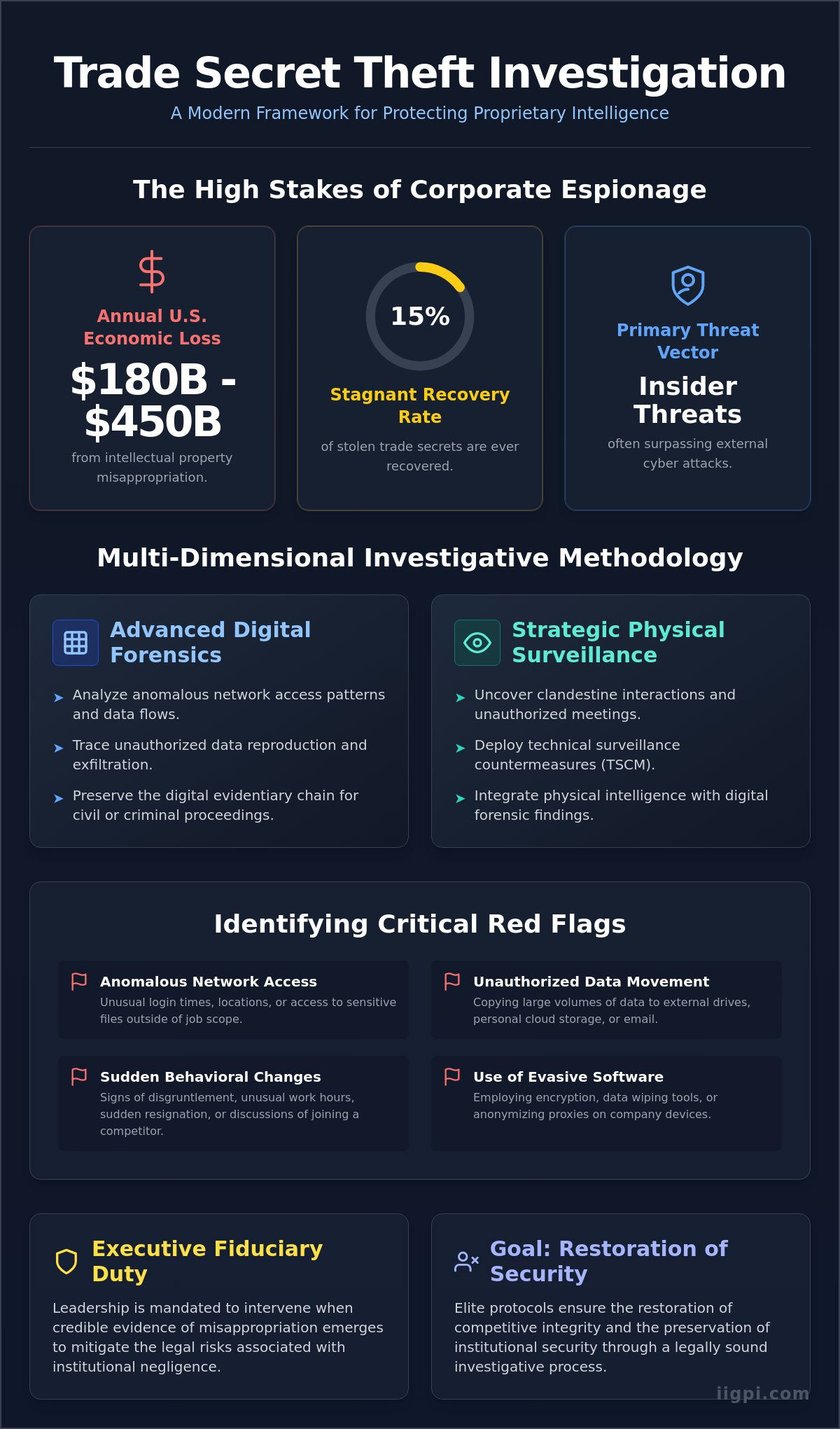
With U.S. enterprises losing an estimated $180 billion to $450 billion annually to the misappropriation of proprietary intelligence, the historical reliance on passive security measures has become a liability. You’re likely aware that the erosion of competitive advantage frequently originates from a confluence of employee mobility risks and sophisticated external incursions. This analysis presents a comprehensive methodology for a trade secret theft investigation, establishing the rigorous protocols necessary to identify perpetrators and preserve the evidentiary chain for civil or criminal proceedings. We’ll explore the integration of forensic technical analysis and strategic surveillance within the context of the 2026 regulatory shifts, such as China’s modernized Provisions on the Protection of Trade Secrets and the inaugural use of the Protecting American Intellectual Property Act. This framework serves to bridge the gap between technical discovery and legal fiduciary duty, ensuring the restoration of institutional security. Given that the recovery rate for stolen trade secrets currently stagnates at approximately 15%, a sophisticated and multidisciplinary response is no longer optional for global industry leaders.
Key Takeaways
- Recognize the fundamental shift in the global threat landscape where the misappropriation of proprietary intelligence is increasingly driven by sophisticated insider threats rather than external incursions alone.
- Execute a comprehensive trade secret theft investigation by synthesizing advanced digital forensics with strategic physical surveillance to construct an authoritative evidentiary profile for litigation.
- Identify critical technical and behavioral “Red Flags,” such as anomalous network access patterns and unauthorized data reproduction, to differentiate between disgruntled personnel and external espionage actors.
- Acknowledge the fiduciary imperatives that mandate executive intervention when credible evidence of misappropriation emerges, thereby mitigating the legal risks associated with institutional negligence.
- Leverage elite investigative protocols founded upon high-level law enforcement methodologies to ensure the restoration of competitive integrity and the preservation of institutional security.
The Paradigm of Trade Secret Misappropriation in the Global Economy
The contemporary global economy operates within a framework where the traditional boundaries of the firm have become increasingly porous, necessitating a total reevaluation of how proprietary intelligence is safeguarded. Trade secrets are categorized as information that derives specific economic utility from being generally unknown to the public, provided the holder implements rigorous secrecy protocols. While historical models of espionage prioritized the defense against external state-sponsored hacking, modern threats are frequently characterized by sophisticated insider misappropriation. A rigorous trade secret theft investigation is now an essential instrument for corporate governance, serving to identify the subtle transition from legitimate employee mobility to the unlawful extraction of strategic intelligence.
The transition toward a more aggressive investigative posture is supported by the legal imperatives established in the Economic Espionage Act and the Defend Trade Secrets Act (DTSA). These statutes provide the federal framework within which an inquiry must be conducted to ensure that findings are admissible in high-stakes litigation. By codifying the requirements for secrecy and the penalties for misappropriation, these laws have elevated the role of the investigator to that of a strategic advisor in the protection of global market interests. The systemic impact of these breaches is profound, as the theft of intellectual property can lead to the immediate devaluation of a firm’s market position and long-term viability.
The Legal Definition of Proprietary Intelligence
Defining the parameters of protected information requires a precise differentiation between the general professional skills of an employee and the specific, high-value assets of the corporation. Legal protections afforded by the DTSA are contingent upon the demonstration that the information was subject to affirmative security measures. In the current era of decentralized labor and cloud-based architecture, the burden of proof regarding “reasonable measures” has become significantly more complex for organizations to satisfy. For a scholarly overview of these legal classifications, one might consult What is a Trade Secret? to understand the global standards of protection. Ultimately, the modern trade secret is a dynamic asset requiring constant investigative vigilance to ensure its legal and economic viability remains intact.
The Economic Impact of Corporate Espionage
Intellectual property theft exerts a corrosive influence on the systemic stability of the U.S. economy, with annual losses estimated between $180 billion and $450 billion according to verified research. These figures don’t merely represent lost sales; they reflect the catastrophic erosion of competitive advantage that can jeopardize the very existence of a firm. When proprietary data is compromised, the impact on market valuation is immediate, often complicating mergers, acquisitions, and strategic joint ventures. This degradation of institutional value is frequently a component of larger systemic failures, as explored in our comprehensive guide on Corporate Fraud Investigation. Without a proactive stance and a commitment to trade secret theft investigation, companies risk the permanent loss of their most critical differentiators to competitors who operate outside the bounds of international law.
Multi-Dimensional Investigative Methodologies: Digital and Physical Intersection
A sophisticated trade secret theft investigation must transcend the traditional silos of corporate security by integrating digital forensics with physical intelligence gathering. While many organizations prioritize network monitoring, the most damaging instances of misappropriation often involve a confluence of cyber activity and clandestine physical interactions. Establishing a comprehensive threat profile necessitates the use of technical surveillance countermeasures (TSCM) to identify surreptitious exfiltration devices that bypass standard firewalls. Maintaining the element of surprise is paramount; therefore, a multidisciplinary approach ensures that the subject remains unaware of the inquiry until the evidentiary chain is fully secured. When investigating high-level executives or strategic partners, the implementation of covert operations becomes a legal and operational necessity to prevent the destruction of data. For organizations facing these complex challenges, professional Corporate Investigations provide the necessary rigor to protect institutional assets.
Advanced Computer Forensics in IP Theft
The digital component of an inquiry focuses on the granular analysis of unauthorized data transfers to personal cloud repositories or external storage media. Sophisticated actors frequently utilize “anti-forensic” techniques, including the use of encrypted containers and the intentional deletion of system logs, to obscure their activities. Modern investigators must move beyond surface-level metadata to recover deleted communications and reconstruct the timeline of the breach. These protocols are explored in depth within our analysis of Computer Forensics: A Guide for Corporate and Legal Investigations. By identifying the specific vectors of exfiltration, the investigation provides the technical foundation required for civil or criminal proceedings.
The Role of Physical Surveillance and HUMINT
Physical surveillance serves as the critical link between digital intent and tangible misappropriation. It’s during physical “hand-offs” of hardware or proprietary prototypes that the most damning evidence is often captured. Human intelligence (HUMINT) further supplements this by providing insight into the suspect’s motivations and external pressures, such as recruitment by a foreign competitor or financial distress. This perspective aligns with the FBI on Economic Espionage reports, which emphasize the intersection of human behavior and intellectual property theft. Utilizing specialized Surveillance Services allows a firm to establish the intent and conspiracy necessary to meet the high evidentiary standards of a modern trade secret theft investigation.
Analyzing the Anatomy of Insider Threats vs. External Espionage
Effective defense of proprietary intelligence requires a nuanced understanding of the perpetrator’s profile and methodology. While external actors often leverage technical vulnerabilities, the most insidious threats frequently emanate from within the organizational hierarchy. A professional trade secret theft investigation must differentiate between the “smash-and-grab” exfiltration typically associated with departing employees and the long-term “sleeper” operations favored by sophisticated competitor actors. While the former is characterized by a sudden, high-volume extraction of data, the latter involves incremental, low-profile harvesting designed to evade standard detection systems over several years. Social engineering remains a primary facilitator for external access, often tricking legitimate users into compromising the very systems they are paid to protect.
Specific behavioral and technical indicators, often referred to as “Red Flags,” provide the necessary triggers for institutional intervention. These include anomalous network login patterns, particularly during non-business hours, and the unauthorized reproduction of sensitive documentation via printing or cloud uploads. For organizations managing large-scale digital operations, maintaining secure entry points through providers like htcinc.com is essential for tracking these activities. Identifying these markers early is critical, as it allows investigators to establish a timeline of intent before the data leaves the corporate perimeter. When these signals emerge, a formal trade secret theft investigation becomes the primary mechanism for verifying the breach and identifying the extent of the exposure.
The Psychology of the Insider Threat
The transition from a trusted employee to a malicious actor is rarely instantaneous; it’s typically a process driven by the M.I.C.E. framework: Money, Ideology, Coercion, or Ego. Understanding these motivations allows investigators to narrow the field of suspects and predict future movements. Financial distress or a perceived lack of professional recognition can easily turn a high-level executive into a liability. It’s essential to remember that most trade secret theft begins with a breach of trust, not a breach of a firewall. This human element necessitates a strategy that combines behavioral analysis with technical oversight to ensure the integrity of the firm’s most valuable assets.
External Espionage and Competitor Intelligence
External threats often utilize front companies or third-party vendors to obscure their connection to the stolen data. These actors don’t just rely on hacking; they exploit the vulnerabilities inherent in international business travel and the potential for device compromise in foreign jurisdictions. Understanding the Legal Definition of a Trade Secret is paramount when differentiating between aggressive competitor intelligence gathering and illegal espionage. Tracking these stolen assets across borders requires a global investigative network capable of navigating disparate legal systems. Without this international reach, a firm’s ability to recover its intellectual property or seek restitution is severely diminished.
Fiduciary Responsibility and the Strategic Implementation of Investigations
Corporate Governance and the Duty to Protect
The establishment of a formal investigative protocol serves as a robust defense against claims of institutional negligence. An independent investigation is particularly vital for maintaining board-level neutrality, especially when the suspected breach involves high-level personnel or strategic partners. By outsourcing the inquiry to elite specialists, the organization demonstrates a commitment to objective truth that internal teams might struggle to provide. For a deeper analysis of these professional standards, leaders should review the comprehensive framework detailed in The Role and Function of a Private Investigator. This ensures that the board’s actions are codified as a diligent effort to preserve the corporation’s competitive integrity.
Maintaining Privilege and Confidentiality
Executing an inquiry requires a sophisticated understanding of the “Attorney-Client Privilege” umbrella to ensure that investigative findings remain confidential during the pre-litigation phase. Utilizing a “need-to-know” reporting structure is essential to prevent internal leaks that could alert the perpetrator or compromise the evidentiary chain. In certain scenarios involving domestic-related corporate risks, the integration of specialized Personal Detective protocols can provide the discretion necessary to navigate complex human dynamics without alerting the broader workforce. These measures collectively ensure that the investigation remains a controlled, surgical operation that protects the firm’s legal standing. To secure your proprietary intelligence and fulfill your fiduciary obligations, contact International Investigative Group to initiate a trade secret theft investigation conducted by elite forensic specialists.
The IIG Investigative Protocol: Securing Proprietary Intelligence
International Investigative Group (IIG) is established as the premier institution for high-stakes trade secret theft investigation within New York City and across the global economic landscape. The firm’s thirty-year legacy is anchored in elite law enforcement methodologies, providing a foundation of intellectual and operational rigor that’s unmatched in the private sector. By offering a “white-glove” approach to corporate intelligence and asset protection, IIG ensures that the most sensitive inquiries are handled with the gravitas they deserve. This global reach is facilitated by an extensive agent network that tracks misappropriated data across multiple jurisdictions, bridging the gap between domestic loss and international recovery. Every protocol is designed to satisfy the rigorous demands of high-level decision-makers and legal counsel alike.
The strategic implementation of our investigative framework allows for the identification of perpetrators while simultaneously securing the evidentiary chain. We understand that the misappropriation of proprietary corporate intelligence is often a precursor to broader systemic failures, making immediate intervention a necessity for maintaining competitive integrity. IIG’s methodology integrates the physical and digital domains to create a definitive record of the breach. Our agents operate with a global-minded perspective, ensuring that no geographic boundary hinders the pursuit of institutional justice.
Law Enforcement Pedigree and Investigative Rigor
The organizational pedigree of the firm ensures that every component of an inquiry is executed with a profound understanding of the evidentiary standards required for successful litigation. A law enforcement background isn’t merely a credential; it’s a commitment to gathering evidence that remains admissible and persuasive in a court of law. IIG has successfully resolved over 10,000 cases involving complex corporate fraud and theft, demonstrating a consistent ability to navigate the most intricate misappropriation schemes. This record of excellence confirms the firm’s position as a leading authority in the defense of proprietary corporate intelligence. We invite decision-makers to explore the IIG homepage for a comprehensive service overview.
Discretion and Forensic Excellence
Operational secrecy is the cornerstone of the IIG investigative protocol, as maintaining the element of surprise is vital when dealing with sophisticated actors. The firm utilizes “after-hours” digital imaging and clandestine surveillance to secure forensic artifacts without disrupting daily business operations or alerting the suspect. This level of discretion is matched by a commitment to forensic excellence, ensuring that all data exfiltration vectors are documented with surgical precision. Detailed reporting is structured specifically for board-level review and judicial scrutiny, providing a transparent and authoritative account of the breach. To restore your institutional security and initiate a confidential consultation with our senior investigators, contact International Investigative Group today to begin a formal trade secret theft investigation.
Strategic Imperatives for the Preservation of Global Competitive Integrity
The landscape of proprietary intelligence protection in 2026 requires a transition from reactive security to proactive investigative rigor. We’ve analyzed how the synthesis of advanced digital forensics and strategic physical surveillance creates a multidisciplinary shield against both insider threats and external espionage. A rigorous trade secret theft investigation serves as the ultimate fulfillment of fiduciary duty, ensuring that institutional value is preserved and that evidence meets the highest judicial standards. International Investigative Group brings over 30 years of experience to this complex discipline, having successfully resolved more than 10,000 cases across NYC and global markets. Led by former law enforcement professionals with extensive global expertise, our firm specializes in the restoration of competitive integrity through elite investigative protocols. It’s clear that restoring institutional security requires a partner capable of navigating the intersection of technical discovery and legal mandate. Contact the International Investigative Group for a Confidential Trade Secret Investigation Consultation today to ensure your strategic assets remain within your control. Your commitment to rigorous protection today defines your organization’s viability tomorrow.
Frequently Asked Questions
What constitutes a “trade secret” under the Defend Trade Secrets Act?
Under the Defend Trade Secrets Act (DTSA), a trade secret encompasses all forms of financial, business, scientific, technical, economic, or engineering information that the owner has taken reasonable measures to keep secret and which derives independent economic value from not being generally known. This statutory definition is deliberately broad, including everything from proprietary algorithms and source code to strategic customer lists and specialized manufacturing processes that provide a firm with a competitive advantage.
How long does a typical trade secret theft investigation take?
The duration of a trade secret theft investigation is contingent upon the complexity of the breach and the sophistication of the adversarial tactics employed by the perpetrator. While preliminary forensic imaging and initial surveillance can often produce actionable intelligence within several business days, more complex inquiries involving multi-jurisdictional data tracking or long-term insider threats may require several months of continuous oversight to ensure a comprehensive evidentiary profile is established.
Can an investigation be conducted without alerting the suspect?
Yes, professional inquiries are designed to maintain total operational secrecy to prevent the suspect from executing anti-forensic countermeasures or destroying critical evidence. By utilizing specialized after-hours digital imaging and discreet physical surveillance, investigators can reconstruct a timeline of misappropriation without alerting the perpetrator or disrupting the daily operations of the organization, thereby preserving the element of surprise for eventual legal action.
What is the difference between a trade secret investigation and a standard IT audit?
A trade secret theft investigation is an adversarial and forensic endeavor focused on identifying a specific breach and the actors responsible, whereas a standard IT audit is a compliance-based assessment of an organization’s general security posture. While an audit identifies systemic vulnerabilities, an investigation utilizes forensic methodologies to gather court-ready evidence of a specific act of misappropriation, ensuring that the findings are admissible in high-stakes litigation.
Are the findings of a private investigator admissible in a trade secret lawsuit?
Findings gathered by a private investigative firm are fully admissible in both civil and criminal proceedings provided they adhere to the highest standards of forensic integrity and legal protocol. By maintaining a meticulous chain of custody and utilizing elite law enforcement methodologies, IIG ensures that every piece of evidence, from digital artifacts to surveillance logs, is prepared to withstand the most rigorous judicial scrutiny.
What should a company do immediately upon discovering a potential IP breach?
An organization must immediately cease all internal, non-forensic attempts to access the suspect’s devices to avoid the corruption of critical metadata and system logs. The primary objective is the preservation of the digital environment in its current state while simultaneously engaging professional investigators who can establish a secure perimeter and initiate a formal inquiry before the perpetrator can obscure their activities.
How does IIG ensure the chain of custody for digital evidence?
IIG ensures the integrity of digital evidence through the implementation of rigorous forensic protocols, including the use of write-blocking hardware and bit-for-bit imaging techniques that prevent any alteration of the source data. Every evidentiary artifact is documented within a detailed log that tracks its movement from the point of seizure to its storage in a secure forensic lab, ensuring absolute accountability throughout the lifecycle of the inquiry.
Do I need to involve law enforcement in a trade secret theft case?
Involvement of law enforcement is not a legal prerequisite for pursuing a trade secret theft case, and many corporations prefer private investigations to maintain a higher degree of confidentiality and control over the inquiry. Private investigations allow a firm to resolve the matter discreetly without the risks of public disclosure often associated with official government proceedings, while still providing the rigorous evidence necessary for successful private litigation or restitution.