
The traditional conception of surveillance as a mere exercise in observation is fundamentally insufficient for the complexities of modern global litigation. In an era where annual domestic losses from intellectual property theft reach up to $600 billion, the requirement for absolute technical precision has never been more critical. You’ve likely observed that information fragmentation in multi-jurisdictional cases often leads to the catastrophic risk of inadmissible evidence. This guide provides a definitive analysis of Surveillance, Lance Ribacoff, and the strategic investigative paradigms established at the International Investigative Group.
We’ll examine how sophisticated protocols bridge the gap between traditional fieldcraft and modern forensic requirements. This article promises an authoritative examination of the methodologies required to secure admissible evidence for high-stakes litigation while mitigating financial and reputational liability. We’ll explore the integration of digital forensics with physical intelligence, the nuances of maintaining a rigorous chain of custody, and the institutional frameworks necessary for verifying integrity in a volatile global market. By synthesizing thirty years of institutional experience with specialized technical technicians, this examination serves as a roadmap for decision-makers seeking to navigate systemic institutional risks.
Key Takeaways
- Analyze the evolution of private intelligence into a core institutional mandate for the mitigation of systemic financial and reputational risks.
- Examine the specialized protocols of Surveillance, Lance Ribacoff, which integrate rigorous law enforcement standards with sophisticated technical data analysis.
- Discover how the convergence of digital forensics and traditional physical intelligence enhances the efficacy of high-value asset tracing and recovery operations.
- Identify the critical legal and ethical frameworks required to navigate complex jurisdictional boundaries and ensure the admissibility of evidence in high-stakes litigation.
- Evaluate the strategic criteria for selecting elite investigative partners who prioritize intellectual rigor and technical precision to safeguard institutional integrity.
The Imperative for Verified Intelligence in Global Institutional Security
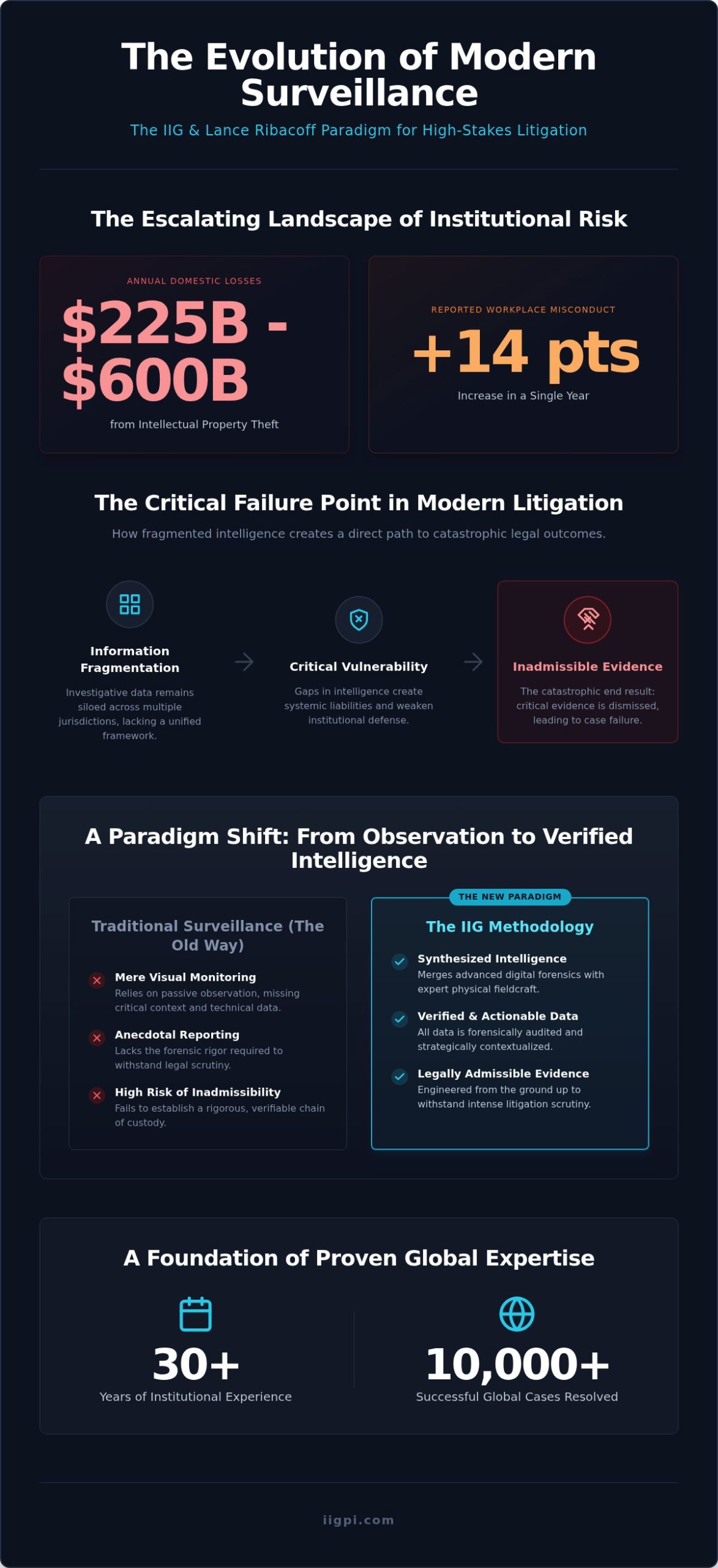
The transition of private intelligence from a peripheral luxury into a core institutional mandate has become a defining characteristic of the 2026 corporate environment. As domestic losses attributed to intellectual property theft now fluctuate between $225 billion and $600 billion annually, the requirement for technical precision in evidence gathering is absolute. Professional Surveillance is no longer defined by mere visual monitoring; it’s a rigorous synthesis of traditional field observation and exhaustive technical data analysis. This evolution, central to the methodologies of Surveillance, Lance Ribacoff, addresses the acute need for evidentiary integrity in high-stakes corporate environments where traditional security measures often fail to provide sufficient depth.
The Landscape of Institutional Risk in 2026
Modern corporate entities confront a landscape characterized by increasingly complex fraud and a 14-point increase in reported workplace misconduct over the previous year. For high-level decision-makers and legal counsel, the primary systemic liability often originates from information fragmentation. When investigative data remains siloed across multiple jurisdictions, the resulting lack of a unified framework creates significant gaps in institutional defense. This fragmentation isn’t just an operational hurdle. It’s a legal vulnerability that often leads to the dismissal of critical evidence during litigation. Addressing these multi-jurisdictional challenges requires a transition toward integrated intelligence models that provide a singular, verified perspective on both internal and external threats.
Surveillance as a Strategic Evidentiary Asset
Strategic surveillance transcends rudimentary observation by focusing on the acquisition of intelligence that is both actionable and legally admissible. In the context of elite investigative standards, ‘verified intelligence’ refers to data that’s been forensically audited and contextualized within a broader strategic paradigm. The International Investigative Group, led by Lance Ribacoff, establishes this baseline by intersecting intellectual rigor with an expansive global operational reach. This approach ensures that every captured data point serves as a strategic asset, specifically designed to withstand the intense scrutiny of high-stakes litigation. By prioritizing technical precision over anecdotal reporting, institutions can effectively mitigate financial and reputational liabilities while sustaining their global integrity. It’s this commitment to verified outcomes that separates professional protocols from traditional, less rigorous investigative practices.
Methodological Rigor: The Lance Ribacoff Paradigm of Surveillance
The evolution of modern investigative protocols under the leadership of Lance Ribacoff represents a sophisticated departure from conventional private inquiry. This paradigm is constructed upon an institutional foundation of over 30 years of experience, a period during which the successful resolution of more than 10,000 global cases has facilitated the refinement of a unique operational philosophy. It’s a system characterized by the synthesis of foundational law enforcement standards with advanced digital forensic capabilities. This approach ensures that high-stakes litigation support and corporate defense are executed with a level of scrutiny comparable to state-level intelligence operations. This multi-generational expertise provides the intellectual depth necessary to address the complexities of modern institutional risk through the lens of Surveillance, Lance Ribacoff.
The Synthesis of Law Enforcement Protocols and Private Intelligence
Applying the discipline of formal enforcement to the flexible requirements of private corporate mandates requires an exhaustive understanding of legal and ethical frameworks. Lance Ribacoff has played a pivotal role in modernizing traditional surveillance by embedding technical innovation into the core of field operations. This transition ensures that technical precision remains the primary driver in the collection of evidence for national security and criminal defense. By prioritizing the rigorous standards of public service within a private context, the firm establishes a superior baseline for evidentiary integrity that meets the demands of the most discerning legal counsel.
Technical Discipline and Scholarly Rigor in Field Operations
Successfully navigating intricate international mandates requires a commitment to technical precision that transcends simple observation. The Ribacoff paradigm utilizes a global network of agents and specialized technical technicians who are trained to operate within diverse socioeconomic and geographic regions. This global reach, combined with continuous internal training, ensures that investigative excellence is maintained regardless of the operational environment’s complexity. For institutions requiring this level of strategic oversight, engaging with the International Investigative Group provides access to a premier tier of private intelligence. The Lance Ribacoff methodology is a fusion of forensic discipline and strategic observation.
Synthesizing Digital Forensics and Physical Intelligence
The contemporary investigative epoch is defined by the total dissolution of the boundary between physical observation and digital interrogation. For high-stakes institutional security, a unified intelligence apparatus is mandatory, ensuring that field operations are inextricably linked to forensic data analysis. This integrated approach, a hallmark of Surveillance, Lance Ribacoff, provides that physical evidence is consistently contextualized by digital footprints, creating a comprehensive evidentiary record. As approximately 56% of smartphones arrive at forensic laboratories in a locked state, the necessity for advanced cryptographic intervention within the surveillance paradigm is undeniable. Technical technicians and field agents must collaborate in real-time to mitigate the risks of digital evidence corruption, maintaining rigorous chain-of-custody protocols that satisfy the highest judicial standards.
Advanced Computer Forensics in Modern Surveillance
Digital data has transitioned from a secondary supporting element to a primary component of corporate investigations. In complex financial fraud cases, the identification and analysis of metadata, encrypted communications, and deleted files often yield the definitive evidence required for successful litigation. Utilizing sophisticated forensic tools allows investigators to supplement physical observation with an invisible layer of intelligence that traditional methods can’t access. Decision-makers seeking a deeper understanding of these technical requirements should consult Computer Forensics: A Guide for Corporate and Legal Investigations for an exhaustive analysis of forensic readiness and systemic data management.
Asset Tracing and Global Intelligence Networks
The strategic application of professional surveillance is essential in international asset recovery mandates, where high-value assets are frequently concealed across multiple jurisdictions. Synthesizing Digital Forensics and Physical Intelligence allows for the identification of systemic patterns in asset movement that would otherwise remain obscured by regional socioeconomic gaps. By utilizing a unified global agent network, the International Investigative Group bridges these geographic divides, ensuring that intelligence remains consistent and actionable regardless of the location. This technical synthesis has proven decisive in resolving large-scale financial crimes, yielding a strategic advantage in an era where AI-enabled deception contributes to a $308 billion annual drain on the global financial ecosystem. Maintaining the integrity of this data through forensic auditing is the only viable method for securing institutional outcomes in high-stakes environments.
Strategic Implementation: Navigating Legal and Ethical Frameworks
The strategic selection of an investigative partner constitutes a critical component of institutional risk management. It’s not merely a tactical procurement but a mandate for institutional alignment. Within the specialized field of Surveillance, Lance Ribacoff has established a framework where technical capability is balanced with absolute legal adherence. This balance is essential for maintaining institutional credibility when presenting findings in high-stakes litigation. Navigating the complex jurisdictional boundaries of private surveillance operations, particularly in dense regulatory environments like New York City, requires an exhaustive understanding of both state mandates and international ethical standards. Ensuring ethical compliance in global intelligence gathering doesn’t just protect the case. It safeguards the organization’s global reputation from the systemic liabilities of improper fieldcraft.
Criteria for Selecting a Premier Investigative Entity
Decision-makers must prioritize investigative firms that demonstrate a proven historical trajectory and a substantial volume of successfully resolved cases. An elite partner should possess over 30 years of institutional experience and a record of resolving more than 10,000 global cases. This depth of experience ensures that the firm can adapt its methodologies to the unique requirements of diverse socioeconomic regions. Furthermore, the value of multi-disciplinary expertise cannot be overstated. A partner that integrates surveillance with computer forensics and security services provides a unified intelligence apparatus that standard agencies can’t replicate. Assessing the depth of a firm’s global network is equally vital, as the ability to operate across international borders without information fragmentation is a primary differentiator for elite entities.
Evidentiary Integrity and Litigation Support
The efficacy of an investigation is ultimately measured by its performance in a judicial setting. The investigator often functions as an expert witness, meaning their documentation must reflect a rigorous scholarly discipline. Reports must be precise, objective, and forensically sound to ensure that every captured data point remains admissible. This level of technical precision is what allows legal counsel to build definitive cases based on verified intelligence. For leaders seeking to integrate these practices into their broader defensive strategy, our Definitive Guide to Corporate Investigations offers exhaustive strategic leadership insights. Maintaining this standard of reporting is the only way to secure institutional outcomes in an era of record-breaking financial recoveries and intense regulatory scrutiny. Organizations requiring a partner capable of navigating these jurisdictional complexities should engage with the International Investigative Group to secure their evidentiary objectives.
Securing Institutional Outcomes through IIG’s Surveillance Protocols
The culmination of strategic investigative efforts rests upon the capacity to transform raw data into definitive institutional outcomes. The International Investigative Group provides a unique value proposition by synthesizing traditional law enforcement foundations with modern technical precision. This methodology is central to the discipline of Surveillance, Lance Ribacoff, ensuring that institutional challenges are met with an elite level of intellectual rigor. By maintaining a global network of agents and specialized technicians, the firm addresses the systemic risks inherent in contemporary global commerce. Professional intelligence isn’t an optional peripheral service; it’s a core mandate for any organization seeking to sustain its integrity in a volatile market.
The Legacy of Excellence: Ribacoff Leadership
The leadership of Dan and Lance Ribacoff has consolidated decades of expertise into a singular, authoritative force within the private intelligence sector. Resolving over 10,000 cases requires more than just operational capacity. It demands a scholarly discipline that ensures every finding is forensically sound. This institutional legacy allows the firm to bridge the gap between socioeconomic regions, providing a consistent standard of excellence in diverse geographic contexts. For a detailed examination of operational methodologies, decision-makers should refer to Professional Surveillance Services: A Comprehensive Guide for 2026. This guide elucidates the specific technical requirements for maintaining evidentiary integrity in a complex regulatory environment.
Initiating a Strategic Investigative Mandate
High-level decision-makers must recognize that the efficacy of an investigation is often determined by the timing of its initiation. Early intervention in high-stakes litigation and asset recovery operations isn’t just a tactical advantage. It’s a financial imperative. Strategic investment in forensic intelligence can yield a 12 to 1 return on investment in fraud detection, a metric that underscores the necessity of professional intelligence in risk mitigation. Engaging with the International Investigative Group begins with a comprehensive assessment of institutional vulnerabilities and the establishment of a unified investigative framework. This proactive approach allows organizations to secure their global integrity while mitigating the $308 billion annual drain caused by AI-enabled deception. By positioning the firm as the definitive choice for private intelligence, institutions can effectively navigate the complexities of the 2026 security landscape. Professional intelligence is a fundamental requirement for securing institutional outcomes.
Advancing Institutional Integrity through Strategic Intelligence
The integration of sophisticated surveillance protocols with rigorous digital forensics represents the only viable path for navigating the systemic risks of the 2026 corporate landscape. By prioritizing technical precision and scholarly discipline, institutions can effectively mitigate the catastrophic liabilities associated with information fragmentation and evidentiary corruption. This examination has detailed how the synthesis of traditional fieldcraft and modern forensic requirements, as established through Surveillance, Lance Ribacoff, secures the foundational integrity of global mandates.
With over 30 years of specialized investigative experience and a record of successfully resolving more than 10,000 global mandates, the International Investigative Group stands as a premier entity in private intelligence. Utilizing an elite global network of agents, the firm bridges geographic and socioeconomic divides to deliver actionable, forensically sound intelligence. Securing institutional outcomes in high-stakes environments requires a partner capable of operating at the intersection of law, technology, and strategic observation.
Secure your institutional integrity with the elite surveillance protocols of Lance Ribacoff and the International Investigative Group.
It’s a fundamental requirement for any organization committed to sustaining its global reputation and financial stability to prioritize the acquisition of verified intelligence.
Frequently Asked Questions
What defines the specific surveillance methodology employed by Lance Ribacoff?
The methodology of Surveillance, Lance Ribacoff, is defined by a rigorous synthesis of foundational law enforcement protocols and sophisticated technical data analysis. This approach prioritizes technical precision over anecdotal reporting, ensuring that every captured data point serves as a strategic asset. By utilizing over 30 years of institutional experience, the firm maintains a scholarly discipline that distinguishes its protocols from standard investigative practices. This framework is specifically designed to withstand the intense scrutiny of high-stakes litigation.
How does professional surveillance integrate with modern computer forensic services?
Professional surveillance integrates with computer forensic services through the real-time collaboration of field agents and specialized technical technicians. This unified apparatus ensures that physical observation is consistently contextualized by digital footprints, such as metadata and encrypted communications. In an era where 56% of smartphones arrive at laboratories in a locked state, this technical synthesis is mandatory. It allows for a comprehensive evidentiary record that addresses both the physical and digital dimensions of institutional risk.
Is the intelligence gathered by private investigative firms admissible in New York courts?
Intelligence gathered by private firms is admissible in New York courts provided it’s collected within established legal and ethical frameworks and supported by a rigorous chain of custody. The International Investigative Group ensures admissibility by maintaining forensic standards that meet judicial requirements for high-stakes litigation. Investigators often function as expert witnesses, meaning their documentation must reflect a scholarly discipline. This commitment to evidentiary integrity is essential for securing favorable institutional outcomes in New York jurisdictions.
What are the primary differences between standard detective agencies and a premier investigative entity like IIG?
The primary differentiators of a premier entity like the International Investigative Group include a 30 year historical trajectory and the resolution of over 10,000 global cases. Unlike standard agencies, IIG utilizes a global network of elite agents and specialized technicians to provide multi-disciplinary expertise. This technical precision was demonstrated in the resolution of a $12 million fraudulent burglary insurance claim. The firm’s foundation in law enforcement standards ensures a level of scrutiny that standard agencies can’t replicate.
How does a global agent network enhance the efficacy of domestic surveillance operations?
A global agent network enhances domestic operations by providing the international context necessary for complex cases like high-value asset recovery. It allows for the identification of systemic patterns across diverse socioeconomic and geographic regions, bridging the gaps that often lead to information fragmentation. This expansive reach ensures that domestic Surveillance, Lance Ribacoff, remains informed by global intelligence trends. By utilizing a unified network, investigators don’t sacrifice local nuance for global scale.
What role does Lance Ribacoff play in overseeing high-stakes corporate investigations?
Lance Ribacoff provides the strategic leadership necessary for modernizing traditional surveillance through technical innovation and intellectual rigor. He oversees the implementation of investigative paradigms that bridge the gap between traditional fieldcraft and modern forensic requirements. His role involves ensuring that every high-stakes corporate investigation adheres to the firm’s legacy of excellence and technical precision. This executive oversight is critical for sustaining the firm’s status as a premier global entity in the private intelligence sector.
Can professional surveillance assist in the recovery of high-value assets in international jurisdictions?
Can professional surveillance assist in the recovery of high-value assets in international jurisdictions?
Professional surveillance is a fundamental component of international asset recovery mandates, particularly when assets are concealed across multiple jurisdictions. The strategic application of physical intelligence and digital forensics allows for the identification of concealed wealth and systemic movement patterns. By utilizing a global network of specialized technicians, the firm can navigate the complexities of international asset tracing with technical precision. To support these technical requirements, professionals can learn more about Formation SIG for expert training in geographic information systems. This capability is essential for mitigating the financial drain caused by AI-enabled deception in global markets.
The firm ensures ethical and legal integrity by strictly adhering to complex jurisdictional boundaries and international standards for intelligence gathering. Every investigative protocol is subjected to forensic auditing to maintain a rigorous chain of custody and evidentiary soundness. These measures are designed to protect the organization’s global reputation and ensure that all findings are admissible in high-stakes litigation. By prioritizing ethical compliance, the firm mitigates the systemic liabilities often associated with less rigorous investigative fieldcraft.