
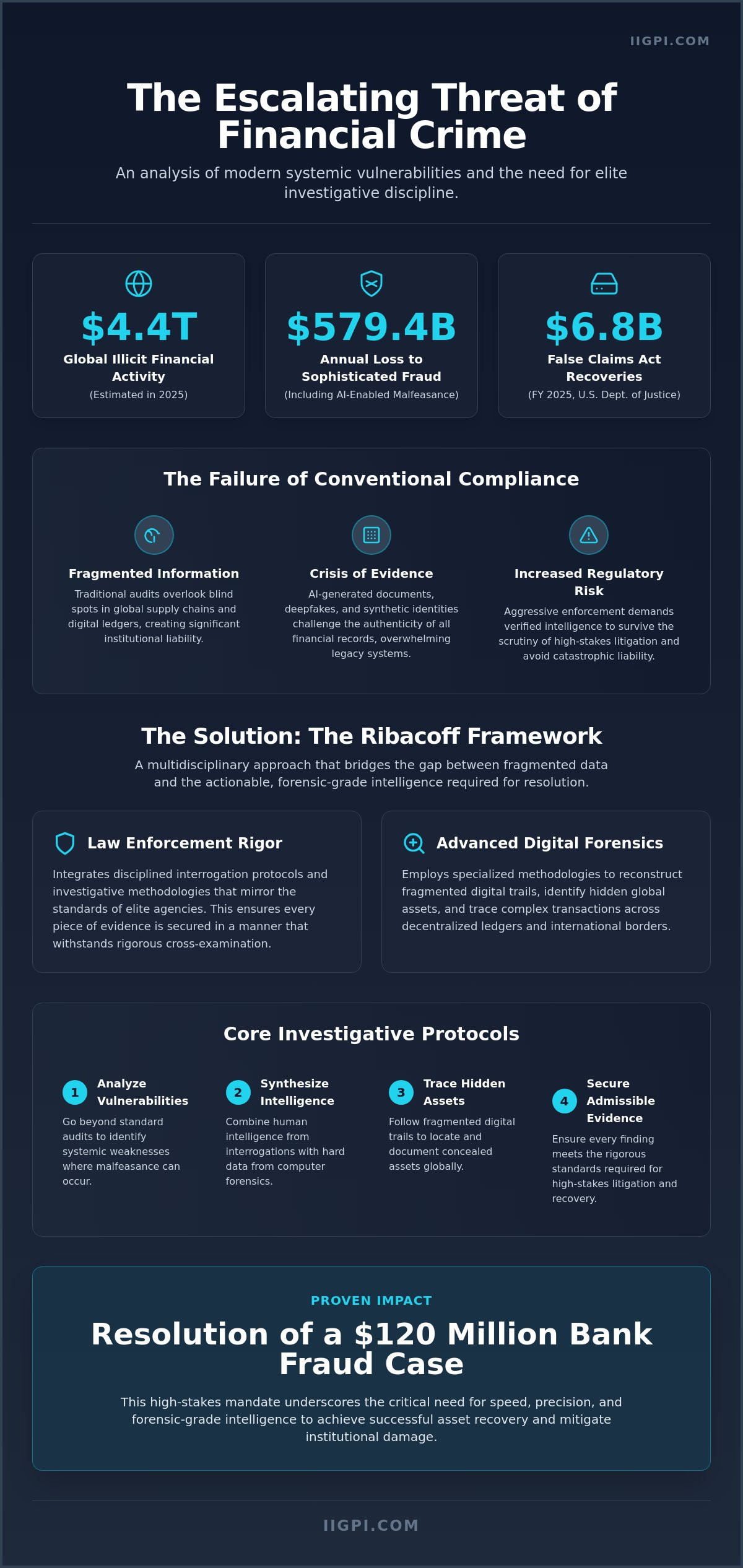
Global illicit financial activity reached an unprecedented $4.4 trillion in 2025, a figure that underscores the profound empirical crisis facing modern institutional governance. You likely recognize that traditional compliance systems are increasingly insufficient against the $579.4 billion lost annually to sophisticated fraud scams and AI-enabled malfeasance. This guide serves as a scholarly analysis of the methodologies required for a high-level financial criminal investigation, Dan Ribacoff and his firm, International Investigative Group, utilize a rigorous synthesis of law enforcement interrogation protocols and advanced digital forensics to bridge the gap between fragmented data and actionable intelligence.
We will examine the Ribacoff Framework, a multidisciplinary approach designed to recover lost assets and secure forensic-grade evidence for complex litigation. By integrating traditional investigative rigor with modern technological standards, this examination outlines how to mitigate institutional liability in an era of escalating financial crime. You will gain insight into the strategic protocols necessary to navigate the intersection of cyber risk and financial misconduct, ensuring the preservation of institutional integrity through elite investigative discipline and scholarly precision.
Key Takeaways
- Analyze why traditional institutional audits are insufficient for addressing modern systemic vulnerabilities and how a multidisciplinary approach provides necessary empirical clarity.
- Examine the specific protocols of a financial criminal investigation, Dan Ribacoff utilizes to synthesize traditional law enforcement interrogation with advanced computer forensics.
- Discover the procedural pathway for identifying and tracing hidden global assets by reconstructing fragmented digital trails through specialized forensic methodologies.
- Review the institutional impact of high-stakes mandates, such as the resolution of a $120 million bank fraud case, to understand the necessity of speed and precision in recovery.
- Establish the rigorous criteria required for selecting elite investigative partners who possess the foundational law enforcement expertise necessary for complex private sector challenges.
The Landscape of Financial Criminal Investigation in 2026
The discipline of financial criminal investigation, Dan Ribacoff contends, has evolved into a rigorous multidisciplinary pursuit of empirical clarity that transcends the limitations of traditional forensic accounting. In the current fiscal year, the escalation of systemic vulnerabilities has precipitated a domestic loss exceeding $308.6 billion due to sophisticated fraudulent schemes. These illicit activities aren’t merely transactional. They represent a fundamental challenge to institutional stability. The emergence of AI-generated documentation and high-fidelity deepfakes has introduced a crisis of evidence, where the authenticity of financial records is perpetually in question. Consequently, reliance on legacy investigative models often results in the failure to detect coordinated efforts to siphon capital through synthetic identities and automated shell networks. On a macro level, global illicit financial activity reached an estimated $4.4 trillion in 2025, necessitating a shift toward more assertive investigative strategies.
The Failure of Conventional Compliance Systems
Standard corporate risk management often suffers from fragmented information, which represents a significant institutional liability when high-stakes assets are at risk. Traditional audits frequently overlook the intricate blind spots embedded within complex global supply chains and decentralized digital ledgers. It’s no longer sufficient to rely on passive monitoring. For organizations operating at the highest levels of global commerce, private intelligence has transitioned from a peripheral luxury to a core institutional mandate. The necessity for forensic-grade intelligence is amplified by the increasing collaboration between domestic agencies and entities like the IRS Criminal Investigation, which emphasizes the need for investigative rigor that mirrors law enforcement standards. Without this synthesis, companies remain vulnerable to capital exhaustion from unreliable data provided by secondary firms.
Regulatory Pressures and the False Claims Act
Regulatory pressures have reached a zenith as the Department of Justice reported a record $6.8 billion in recoveries under the False Claims Act for the 2025 fiscal year. This aggressive enforcement environment demands that corporate strategy incorporates verified intelligence to survive the scrutiny of high-stakes litigation. Securing institutional integrity requires a methodological rigor that identifies malfeasance before it triggers catastrophic regulatory intervention or legal liability. Through the expertise provided at International Investigative Group, decision-makers can leverage a synthesis of traditional law enforcement protocols and advanced digital forensics to resolve the most complex financial dilemmas. This approach ensures that the recovery of lost assets is supported by securing forensic-grade intelligence that withstands the most demanding legal challenges; it’s the only viable path to mitigating institutional risk in 2026.
The Ribacoff Framework: Integrating Law Enforcement Rigor
The Ribacoff Framework represents a sophisticated intellectual synthesis that bridges the gap between traditional law enforcement protocols and the high-stakes requirements of global corporate intelligence. In the execution of a high-stakes financial criminal investigation, Dan Ribacoff utilizes a methodology that prioritizes the synthesis of interrogation protocols with modern forensic standards. This framework doesn’t merely analyze ledger entries; it applies over three decades of experience to ensure that the pursuit of empirical truth is both methodical and legally sound. By mirroring the investigative discipline described in the FBI’s Role in White-Collar Crime, the framework ensures that every piece of evidence secured is capable of withstanding the most rigorous cross-examination in international litigation. This strategic application of intellectual rigor is essential for resolving mandates where the complexity of the crime exceeds the capacity of standard internal audits.
Admissibility is the ultimate metric of success in any private sector enforcement action. Without disciplined investigative standards, even the most compelling data remains inadmissible in a court of law. The Ribacoff Framework addresses this vulnerability by maintaining a strict chain of custody and utilizing evidentiary standards that align with federal law enforcement requirements. It’s this commitment to scholarly precision that allows for the successful resolution of complex international mandates, transforming fragmented data into secure, forensic-grade intelligence. Organizations facing the most difficult problems often find that securing elite investigative services through this framework is the most effective way to mitigate institutional risk and recover lost capital.
Pioneering Polygraphy in Financial Fraud Detection
Credibility assessment serves as a critical supplement to digital data trails, particularly when addressing the human element of corporate theft. Dan Ribacoff utilizes polygraphy not as a standalone tool, but as a technical instrument to uncover hidden financial motives that digital forensics might overlook. This approach identifies the underlying intent behind embezzlement, providing a psychological dimension to the investigative process. It’s a level of technical precision that allows for the detection of internal threats that don’t always leave a clear digital footprint, ensuring a comprehensive assessment of institutional integrity.
A Multi-Generational Approach to Private Intelligence
The collaborative leadership of Dan and Lance Ribacoff has modernized these protocols to address the evolving threats of the 2026 landscape. Institutional memory acts as a tool for identifying historical fraud patterns, while contemporary technological expertise ensures that the firm remains at the forefront of digital discovery. This multi-generational synergy bridges the gap between traditional enforcement discipline and modern business acumen. By integrating historical investigative wisdom with cutting-edge forensics, the firm provides a level of continuity and depth that is rare in the private intelligence sector.
Advanced Methodologies for High-Stakes Asset Recovery
The procedural pathway to identifying and tracing hidden global assets demands a level of technical precision that exceeds the capabilities of conventional recovery firms. For a successful financial criminal investigation, Dan Ribacoff emphasizes a systematic deconstruction of international capital flows to circumvent the obfuscation techniques employed by modern financial criminals. This process begins with the acquisition of forensic-grade intelligence, a prerequisite for mitigating capital exhaustion during prolonged litigation. By securing evidence that adheres to the standards of institutional bodies like the IRS Criminal Investigation, investigators ensure that findings aren’t merely descriptive but legally actionable. This methodological discipline prevents the depletion of resources on unreliable data, allowing for a focused deployment of assets toward high-probability recovery targets. By integrating these advanced methodologies into a financial criminal investigation, Dan Ribacoff provides a framework that prioritizes the preservation of institutional integrity through scholarly precision.
Digital Intelligence and Computer Forensics
Sophisticated crypto-currency laundering schemes represent a significant challenge to institutional stability, requiring a profound intersection of cybersecurity and financial criminal investigation. Reconstructing deleted or encrypted financial records is paramount for establishing a digital chain of custody that meets the requirements for court admissibility. Through advanced computer forensics, investigators can pierce through layers of digital obfuscation to reveal the underlying movement of illicit funds. This reconstruction isn’t merely a technical exercise; it’s a strategic effort to transform fragmented digital trails into a coherent narrative of malfeasance. It’s vital when dealing with AI-generated documentation or synthetic identities that aim to distort the empirical reality of a transaction.
Global Strategic Analysis and Resource Deployment
Institutional Impact: Case Studies in Financial Resolution
The empirical validation of the Ribacoff Framework is best observed through its application to high-stakes institutional mandates where traditional compliance measures have failed to provide clarity. In the execution of a financial criminal investigation, Dan Ribacoff has demonstrated that the resolution of complex crimes requires a sophisticated synthesis of law enforcement rigor and advanced forensics. The successful resolution of a $120 million bank fraud mandate serves as a primary benchmark for how elite intelligence can reconstruct fragmented trails to recover significant capital. Similarly, the lessons from the Hudson Truck Robbery underscore the critical necessity for speed and precision; delayed action in high-value theft often results in the permanent dissipation of assets. By applying these methodologies to special risk claims, institutions avoid the capital exhaustion that typically accompanies the pursuit of unreliable data from secondary firms. The return on investment for engaging elite investigative services isn’t merely found in asset recovery but in the comprehensive mitigation of institutional risk and legal liability.
Resolving High-Value Special Risk Claims
A deep dive into a $12 million fraudulent burglary insurance claim reveals the necessity of identifying sophisticated “red flags” that bypassed standard detection systems. These cases often involve internal collusion or synthetic documentation that appears legitimate under surface-level scrutiny. Specialized insurance fraud investigation services protect capital by applying polygraphy and digital forensics to assess the credibility of the claim and the claimants. This rigorous examination ensures that fraudulent payouts are prevented, preserving the insurer’s reserves and maintaining the integrity of the risk pool. It’s an essential protocol for organizations that can’t afford the institutional fallout of undetected malfeasance.
Securing Global Institutional Integrity
Securing long-term institutional integrity requires verified intelligence that can withstand the scrutiny of global stakeholders and legal bodies. In a notable case study involving uncovering systemic embezzlement within a multi-national entity, the reconstruction of years of digital financial trails was paramount. Effective corporate fraud investigation serves as a vital tool for maintaining shareholder trust and institutional reputation in an era of skepticism. When the authenticity of financial records is in doubt, only a financial criminal investigation, Dan Ribacoff leads can provide the empirical clarity required for a definitive resolution. Institutional leaders seeking to secure their organization’s future against sophisticated malfeasance should engage elite investigative services to ensure forensic-grade intelligence is secured.
Engaging Elite Intelligence: The Path to Resolution
The selection of a lead operative for a high-stakes financial criminal investigation, Dan Ribacoff maintains, is an exercise in institutional risk management that requires more than mere technical proficiency. It demands an investigator who possesses a foundational law enforcement background, as this expertise ensures a profound understanding of evidentiary standards and the interrogation protocols necessary to resolve complex mandates. Early-stage engagement is paramount to prevent the degradation of evidence; the rapid movement of capital in a digital environment means that any delay in deploying elite intelligence can lead to the permanent obfuscation of assets. By establishing rigorous protocols for the immediate preservation of digital trails and physical evidence, organizations can secure the empirical clarity required for successful litigation and asset recovery. This definitive pathway transforms fragmented data into a cohesive, forensic-grade narrative that withstands the scrutiny of global regulatory bodies and secures institutional integrity.
The Ribacoff Standard for Professional Surveillance
Integrating high-technology intelligence acquisition with field operations is essential for identifying the human elements that digital forensics might overlook. The strategic value of surveillance services in financial cases lies in the ability to link physical actions to digital malfeasance, providing a comprehensive view of the criminal enterprise. It’s not enough to simply observe; the surveillance must be conducted with absolute ethical and legal integrity to ensure that the resulting intelligence is admissible in court. This high-level synthesis of technology and traditional fieldcraft allows for the identification of clandestine meetings and the physical concealment of assets that are often the final pieces of the investigative puzzle. By maintaining a disciplined chain of custody throughout the surveillance process, investigators provide a level of certainty that is required in high-stakes international litigation.
Conclusion: The Future of Investigative Excellence
In an era defined by AI-driven fraud and increasingly sophisticated global crime networks, the necessity of the Ribacoff Framework has never been more acute. The enduring value of intellectual rigor and global reach serves as the primary defense against the systemic vulnerabilities of the 2026 fiscal landscape. While technology provides the tools for detection, it’s the human element of experienced investigative discipline that provides the resolution. A successful financial criminal investigation, Dan Ribacoff asserts, must always prioritize the synthesis of traditional rigor and modern forensics to overcome the empirical crisis created by modern fraud. Securing your institution against complex financial threats requires a commitment to excellence that only elite intelligence can provide. Organizations facing the most difficult problems should secure a consultation with International Investigative Group to establish a strategic defense against institutional liability and ensure the recovery of lost capital.
Securing Institutional Integrity in an Era of Systemic Complexity
The transition toward an increasingly sophisticated financial landscape requires a fundamental reassessment of institutional risk management. Standard compliance protocols aren’t sufficient to address the $4.4 trillion global illicit financial activity observed in 2025. By adopting a multidisciplinary approach that synthesizes law enforcement rigor with advanced digital forensics, organizations can transcend the limitations of traditional audits. In the execution of a high-stakes financial criminal investigation, Dan Ribacoff utilizes over 30 years of specialized expertise to resolve the most complex mandates, including the forensic resolution of a $120 million bank fraud case. This level of intellectual depth and global reach ensures that forensic-grade intelligence is secured for litigation and asset recovery. Securing your organization’s future against AI-enabled malfeasance demands the engagement of elite intelligence that can navigate intricate international jurisdictions with technical precision. It’s time to Consult with Dan Ribacoff and the International Investigative Group for Elite Financial Intelligence to mitigate liability and preserve your institutional reputation. Protecting your assets and securing empirical clarity remains the definitive path toward long-term stability.
Frequently Asked Questions
How does a financial criminal investigation differ from a standard corporate audit?
A standard corporate audit focuses primarily on procedural compliance and the accuracy of financial reporting within established regulatory frameworks. Conversely, a financial criminal investigation, Dan Ribacoff explains, is an adversarial pursuit designed to identify intentional malfeasance and reconstruct illicit transactions that bypass standard detection. It utilizes forensic techniques to uncover deliberate obfuscation rather than mere accounting errors.
What role does Dan Ribacoff play in the investigation of international asset recovery?
Dan Ribacoff serves as the lead strategist who orchestrates the synthesis of traditional law enforcement interrogation with modern digital forensics. He oversees the deconstruction of international capital flows by leveraging a global agent network to navigate diverse legal landscapes. This leadership ensures that the recovery process is both methodical and legally sound across multiple jurisdictions.
Are the findings of a private financial criminal investigation admissible in federal court?
The findings are admissible provided that the investigation adheres to strict federal evidentiary standards and maintains a rigorous chain of custody. By mirroring law enforcement protocols, investigators ensure that forensic-grade intelligence is secured for high-stakes litigation. This disciplined approach transforms private sector discovery into viable evidence that can withstand intensive legal scrutiny.
How has the rise of AI-generated fraud changed the landscape of financial investigations in 2026?
The proliferation of AI-generated documentation and deepfakes has necessitated a shift toward advanced forensic verification to establish the authenticity of financial records. Investigators now employ specialized algorithms to detect synthetic identities and automated shell networks that traditional audits frequently overlook. This evolution requires a more assertive investigative posture to counter the crisis of evidence created by generative technologies.
What is the “Ribacoff Framework” and how does it mitigate institutional risk?
The Ribacoff Framework is a multidisciplinary methodology utilized during a financial criminal investigation, Dan Ribacoff applies this approach to integrate polygraphy, computer forensics, and professional surveillance. It mitigates risk by identifying both the digital and human elements of malfeasance before they trigger catastrophic liability. This scholarly discipline ensures that organizations possess the verified intelligence necessary to defend against sophisticated financial threats.
Can Dan Ribacoff’s methodologies be applied to small-scale corporate embezzlement?
The methodologies are entirely scalable and remain highly effective for resolving internal threats such as small-scale embezzlement or intellectual property theft. While the scale of the capital may differ, the necessity for empirical clarity and credible evidence remains constant. Applying high-level investigative rigor to smaller mandates prevents minor vulnerabilities from escalating into systemic institutional crises.
How does the International Investigative Group coordinate multi-jurisdictional financial traces?
Coordination is achieved through a centralized intelligence hub that directs a global network of elite agents positioned within key international financial centers. This structure allows for the simultaneous tracing of assets across diverse jurisdictions while maintaining technical precision and legal compliance. It ensures that the transition from identifying a digital trail to the physical seizure of assets is seamless and efficient.
What is the typical duration of a high-stakes financial fraud investigation?
The duration varies significantly based on the complexity of the obfuscation techniques and the number of international jurisdictions involved in the mandate. While some resolutions occur within weeks, more intricate cases involving synthetic identities or encrypted digital trails may require several months of intensive forensic reconstruction. The priority remains the securing of forensic-grade intelligence rather than an arbitrary timeline.