
Could a consumer detector’s silence settle a concern about hidden surveillance? Not necessarily. An electronic bug sweep is a scoped assessment, not a promise of certainty. Its findings can only speak to what the inspection was designed and equipped to assess. This guide to Electronic Bug Sweeps, Lance Ribacoff, and IIGPI explains how to weigh that distinction without treating suspicion as proof.
It’s reasonable to want clear answers while protecting confidentiality, minimizing disruption, and understanding what findings can demonstrate. A professional assessment differs from relying on a consumer detection device, but the provider’s scope, methods, reporting, and confidentiality terms should be clear before work begins. This article explains what a sweep can and cannot establish, what to ask when evaluating a provider, and how IIGPI, a New York City investigative firm that offers electronic bug sweeps, may fit into a discreet, evidence-led inquiry. It also outlines how to assess Lance Ribacoff and IIGPI without assuming an investigation can guarantee detection or resolve every concern.
Key Takeaways
- Understand what an electronic bug sweep is intended to assess and how the term technical surveillance countermeasures relates to the service.
- Clarify the assessment’s scope, process, findings, and possible next steps before authorizing work.
- Compare providers by asking for verifiable qualifications, clear confidentiality terms, defined deliverables, and realistic limits, not guaranteed outcomes.
- Prepare for a New York City assessment by organizing relevant context, site access, priorities, and communication expectations. Confirm availability for your location.
- Use this guide to evaluate Electronic Bug Sweeps, Lance Ribacoff, IIGPI, and identify which details about the firm and its approach to discuss before proceeding.
What Is an Electronic Bug Sweep and When Is It Needed?
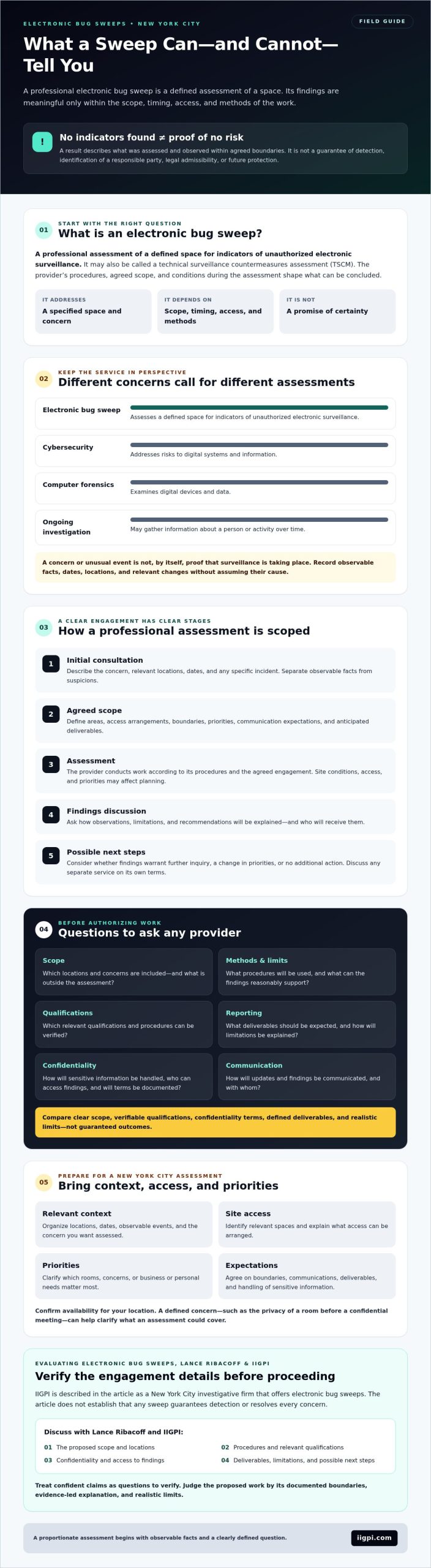
An electronic bug sweep is a professional assessment of a defined space for indicators of unauthorized electronic surveillance. It may also be called a technical surveillance countermeasures assessment, a term associated with the broader practice of Technical Surveillance Counter-measures. The inspection methods and conclusions depend on the provider’s procedures, the agreed scope, and conditions at the time of the assessment.
A sweep has a narrower purpose than general cybersecurity, which addresses risks to digital systems and information, or computer forensics, which examines digital devices and data. It is also distinct from an ongoing surveillance investigation, which may gather information about a person or activity over time. These services address different questions. The right approach depends on the concern you want assessed.
What concerns can lead someone to consider a sweep?
An organization may seek advice before confidential business discussions or after a specific incident raises questions about the privacy of a room or location. An individual may also have concerns. None of these circumstances, on its own, proves that surveillance is taking place. A proportionate first step is to record observable facts, dates, locations, and relevant changes without assuming their cause.
For example, a business preparing for a sensitive meeting might ask a provider what an assessment of a particular room could cover. Clear details help the provider understand the concern and help the client decide whether an assessment makes sense.
What an electronic bug sweep can and cannot establish
Findings are limited by the assessment’s scope, timing, access to the space, and methods used. A report may describe what the provider assessed and whether indicators were identified within those boundaries. Before authorizing work, ask which locations and concerns are included, what the findings can support, and how limitations will be explained.
A result that identifies no indicators is not a guarantee that no surveillance risk exists. Conditions can change, and an assessment should not be presented as universal detection, identification of whoever may be responsible, legal admissibility, or future protection without a verified basis. When researching Electronic Bug Sweeps, Lance Ribacoff, IIGPI, apply the same standard: ask about the proposed scope and verify relevant qualifications and procedures rather than relying on confident promises.
How a Professional Electronic Bug Sweep Is Scoped and Conducted
A professional assessment should start with clear boundaries, not assumptions about what will be found. Intelligence Community Directive on TSCM provides a government-context reference for the term, but it does not mean that every private engagement follows government procedures. Methods, access requirements, and deliverables vary by provider and assignment. Understand the proposed scope before work begins.
A useful high-level sequence is:
- Initial consultation: Describe the concern, relevant locations, dates, and any specific incident. Separate observable facts from suspicions.
- Agreed scope: Identify the areas to be assessed, access arrangements, boundaries, priorities, communication expectations, and anticipated deliverables.
- Assessment: The provider conducts work according to its procedures and the agreed engagement. Site conditions, access, and client priorities may affect planning.
- Findings discussion: Ask how observations, limitations, and recommendations will be explained, and who will receive them.
- Possible next steps: Consider whether the findings warrant further inquiry, a change in priorities, or no additional action. Discuss any separate service on its own terms.
What happens during the initial consultation?
Before the conversation, prepare a concise account of relevant places, dates, and events, along with the business or personal priorities that matter most. For example, an organization may need to identify the room relevant to an upcoming confidential meeting and explain what access can be arranged. Agree on the assessment’s boundaries, how communications will occur, what deliverables to expect, and how sensitive information will be handled. Ask who can access the findings and whether those terms will be documented.
These are questions to raise with any provider, not a description of a particular firm’s procedures. If you are considering Electronic Bug Sweeps, Lance Ribacoff, International Investigative Group, use them to clarify the proposed scope and confidentiality arrangements directly with the firm at https://www.iigpi.com.
What should the client expect from findings?
Depending on the engagement, a provider may discuss observations, limitations, recommendations, or that no indicators were identified within the agreed scope. Before authorizing work, ask how findings will be documented, whether they will be presented verbally or in writing, and how uncertainty will be described. Not every assessment produces the same kind of report.
Technical observations should not be confused with attribution. An assessment may identify an indicator, but that alone does not establish who is responsible or why it is present. To discuss the scope of electronic bug sweep services, ask the provider to explain its current process and engagement terms before proceeding.
How to Evaluate an Electronic Bug Sweep Provider Without Overlooking Its Limits
Start by seeking verifiable answers, not dramatic claims. Confirm who will perform the work, what the proposed engagement includes, how confidential information will be handled, and what the findings can reasonably establish. Ask for relevant qualifications or experience that can be documented. Don’t assume a particular credential is required unless you have independently confirmed that requirement.
Use this comparison framework when speaking with providers:
| Area | Questions to ask |
|---|---|
| Scope | Which locations and concerns are included? What is excluded, and what access must be arranged? |
| Relevant experience | Who will conduct the assessment? What comparable experience or qualifications can the provider document? |
| Confidentiality | How will sensitive information be handled, and who will have access to communications and findings? |
| Deliverables | Will findings be discussed verbally, documented in writing, or both? How will limitations be explained? |
| Follow-up | What questions can be addressed after the assessment, and what would require a separate engagement? |
Which questions should you ask before authorizing a sweep?
Request a clear description of the proposed work before agreeing to proceed. Ask how the provider’s methods relate to your concern, what conditions could limit the assessment, and how observations will be distinguished from conclusions. A consumer detection device may offer a preliminary indication, but it should not be assumed to provide the same scope, interpretation, or documentation as a professional service. If you are researching “Electronic Bug Sweeps, Lance Ribacoff, IIGPI,” these questions can help you assess the proposed engagement without presuming unverified credentials or procedures.
Government counterintelligence has a distinct institutional role, described by the National Counterintelligence and Security Center. That reference is not an endorsement of a private provider or evidence of any provider’s qualifications.
What a sweep should not be represented as doing
No provider should promise to find every possible device or identify who may be responsible. An electronic bug sweep is not legal advice, law enforcement action, or cybersecurity software. A technical observation alone does not establish attribution. Refer legal or evidentiary questions to qualified counsel.
A negative finding describes the assessment’s results within its defined scope. It is not proof that surveillance risk is zero. Evaluate providers by the clarity of their terms, the support for their claims, and their willingness to explain uncertainty.
How to Prepare for an Electronic Bug Sweep in New York City
Preparation starts with a clear account of the concern and a practical plan for access and communication. IIGPI is based in New York City, but its location alone does not confirm availability for a particular site. Ask whether the firm can assess your location and what access or site conditions it needs to consider.
What information should you organize beforehand?
A concise briefing helps define priorities without turning uncertainty into an assumed conclusion. Organize what you can verify and separate it from interpretations or suspicions.
- Timeline: Note dates, observable incidents, and relevant changes in the space.
- Locations: Identify the specific rooms or areas of concern and any access considerations.
- Priorities: Clarify the business or personal needs the assessment should address, such as preparing a particular meeting space.
- Authority and updates: Determine who can authorize access and who should receive communications and findings.
For example, if relevant, record that a confidential discussion took place in a particular room on a specific date. Avoid presenting an unverified explanation for how information may have been exposed as established fact. Clear distinctions help the provider understand the requested scope.
How can organizations protect confidentiality during the process?
Agree on scheduling, access arrangements, and appropriate points of contact before the assessment. Ask how sensitive materials and findings will be communicated and retained, who may receive them, and what instructions the provider recommends to avoid disrupting the agreed review. Follow those instructions rather than making uncoordinated changes to the space or process.
A sweep and an investigation involving ongoing observation address different questions. If the concern is about monitoring a person or activity over time, review how professional surveillance services differ from an assessment of a location for indicators of electronic surveillance. Neither service should be treated as a substitute for the other.
Questions about digital devices or data call for a separate discussion. Computer forensics guidance explains that distinct service area. Computer forensics is not a replacement for a physical or electronic sweep.
When researching Electronic Bug Sweeps, Lance Ribacoff, IIGPI, confirm the specific site’s availability and discuss scope, confidentiality, access, and communication arrangements before proceeding. To raise those questions with the firm, discuss an electronic bug sweep.
Electronic Bug Sweeps at IIGPI: What to Confirm With Lance Ribacoff
International Investigative Group (IIGPI) is a New York City private investigation firm that offers Electronic Bug Sweeps. The firm has more than 30 years of experience and has solved over 10,000 cases. These facts provide context for an inquiry, but they do not establish a particular assessment method, an individual’s qualifications, or availability for a specific site. Confirm those details when deciding whether the proposed engagement fits your needs.
What information about IIGPI is relevant to this decision?
IIGPI’s broad investigative experience does not, by itself, establish specific technical qualifications for electronic bug sweeps. Ask what relevant experience the person conducting the assessment can document, and how the firm defines the scope and limits of this service.
Company experience and individual credentials are separate questions. Before attributing a role or expertise to Lance Ribacoff, verify his current connection to the engagement and the qualifications relevant to the proposed work.
How to make an informed inquiry with Lance Ribacoff and IIGPI
A focused inquiry can clarify the proposed process without presuming what an assessment will find. Ask who would handle the engagement and what role, if any, Lance Ribacoff would have. Request an understandable explanation of the intended scope, the methods at an appropriate level of detail, how findings will be communicated, and what limitations may affect the assessment. Confirm confidentiality terms, who will receive any findings, and whether the firm can serve the specific location.
Describe the relevant site, the concern that prompted the inquiry, and your priorities. Keep documented observations distinct from assumptions. Ask what information the provider needs to determine whether the request is within scope and what deliverables are included in the proposed engagement. Clear answers let you compare the offer with your needs rather than rely on broad claims.
An initial conversation can help determine whether the provider may be a fit. It cannot establish whether surveillance indicators are present before an assessment takes place. Treat assurances about outcomes cautiously and seek clear explanations of uncertainty and boundaries.
If the proposed scope, confidentiality arrangements, and site availability meet your requirements, contact IIGPI to discuss an electronic bug sweep.
Make Your Next Step Evidence-Led
A careful electronic bug sweep begins with a proportionate concern and a clearly defined scope, not an assumption that surveillance is taking place. Findings reflect the locations, conditions, and methods included in the assessment. Even a result with no indicators identified cannot establish zero risk. Before proceeding, clarify who will conduct the work, how confidentiality will be handled, and what the assessment can and cannot demonstrate.
For readers considering Electronic Bug Sweeps, Lance Ribacoff, IIGPI, IIGPI is a New York City investigation firm that offers electronic bug sweeps. The firm has more than 30 years of experience. Ask directly about Lance Ribacoff’s role, relevant qualifications, the proposed scope, deliverables, and availability for your location.
A thoughtful inquiry can help determine whether the service fits your needs without presuming what an assessment will find. Clear questions are a practical foundation for deciding how to proceed.
Frequently Asked Questions
What is an electronic bug sweep?
An electronic bug sweep is a professional assessment of a defined space for indicators of unauthorized electronic surveillance. It may also be called a technical surveillance countermeasures assessment. Findings depend on the agreed scope, access to the location, conditions at the time, and methods used. A sweep is not a general cybersecurity review or a guarantee that every possible surveillance risk will be identified.
Can an electronic bug sweep guarantee that a room is free of listening devices?
No. A sweep cannot guarantee that a room is free of every listening device or other surveillance risk. It can only report findings within the assessment’s agreed scope and the conditions at the time of inspection. A result with no indicators identified does not establish that none exist outside that scope or that circumstances will not change. Ask the provider to explain limitations and how findings will be documented.
How does a professional bug sweep work?
A professional bug sweep generally starts with a discussion of the concern, relevant locations, priorities, access, confidentiality, and expected deliverables. The provider and client agree on the scope before the assessment, then discuss observations, limitations, and possible next steps. Procedures vary by provider and engagement, so ask what the proposed assessment covers rather than assuming every sweep follows the same process or produces a particular report.
Are consumer bug detector devices as effective as a professional sweep?
Consumer devices should not be assumed to provide the same assessment as a professional service. A device may offer a limited indication, but it does not necessarily provide the scope, interpretation, or documentation of a professional engagement. If you have a specific concern, record observable facts and discuss them with a provider. Ask what a professional assessment can address and what its limitations are before relying on either approach.
What should I ask before hiring an electronic bug sweep provider?
Ask which locations and concerns the assessment includes, what it excludes, who will conduct the work, and what relevant experience can be documented. Clarify confidentiality terms, who will receive findings, how observations and limitations will be communicated, and what follow-up is available. Confirm access requirements and whether the provider can serve your specific location. Prefer clear, verifiable answers over promises to find every device or eliminate all risk.
Does IIGPI offer electronic bug sweeps in New York City?
International Investigative Group is based in New York City and offers Electronic Bug Sweeps. Confirm directly whether the firm can assess your site, then clarify the proposed scope, procedures, confidentiality terms, and deliverables. If you are asking about Electronic Bug Sweeps, Lance Ribacoff, and IIGPI, verify Lance Ribacoff’s current role and relevant qualifications rather than assuming his participation or expertise in a particular engagement.
What is the difference between an electronic bug sweep and computer forensics?
An electronic bug sweep assesses a defined space for indicators of unauthorized electronic surveillance. Computer forensics is a separate service focused on digital devices or data. The two address different questions and should not be treated as substitutes: a room assessment does not analyze digital evidence, and a forensic examination does not establish that a space has been swept. Discuss the concern with a qualified provider to determine which service may fit the issue.
Contact IIGPI to discuss an electronic bug sweep and clarify the proposed engagement before making a decision.