
Can a standard inquiry truly penetrate the veil of an offshore trust or a decentralized ledger when the stakes involve millions in professionally concealed capital? In an era characterized by the rapid evolution of digital holdings and the increasing complexity of global corporate structures, the mere identification of visible wealth is no longer a sufficient metric for financial due diligence. It’s a reality that many institutions face when confronting sophisticated actors who utilize every available tool of obfuscation. When initiating a premier asset investigation, Dan Ribacoff utilizes a forensic reconstruction of financial behavior that transcends simple database queries to identify capital hidden behind layers of corporate shielding.
This guide serves as a comprehensive analysis of the sophisticated financial intelligence protocols and forensic methodologies utilized by Dan Ribacoff to uncover professionally concealed assets in 2026. By examining the rigorous law enforcement-based expertise that defines his approach, you’ll gain a deeper understanding of how to transform opaque financial data into legally actionable evidence. We’ll explore the strategic application of the New York LLC Transparency Act and modern legal frameworks to facilitate the recovery of hidden capital and the mitigation of future financial risk.
Key Takeaways
- Analyze the transition from traditional property inquiries to the forensic tracing of multi-jurisdictional digital footprints within the global financial architecture.
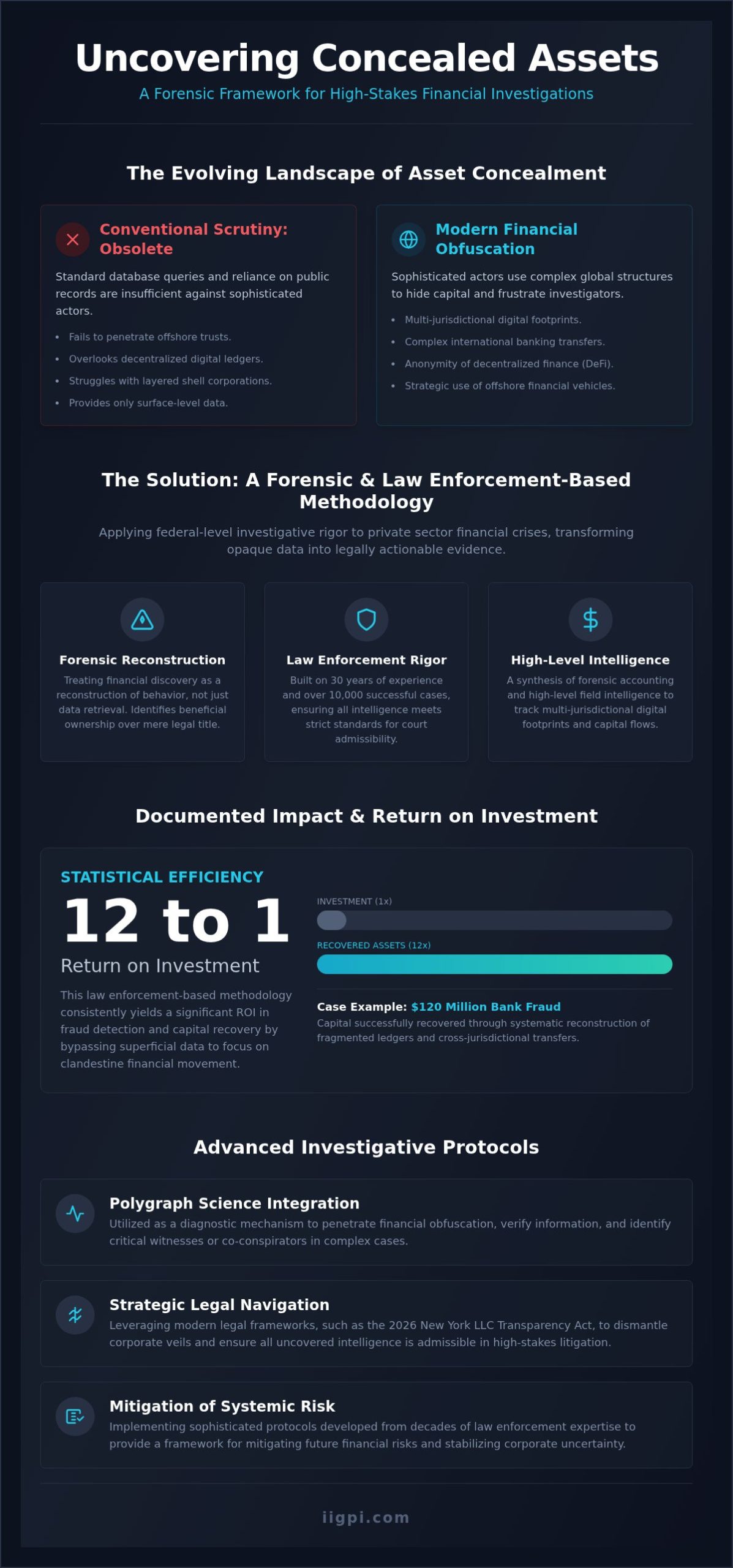
- Evaluate how the rigorous standards of a professional asset investigation, Dan Ribacoff, generate a documented 12 to 1 ROI through the identification of clandestine capital flows.
- Understand the integration of polygraph science as a diagnostic mechanism to penetrate financial obfuscation and identify critical witnesses or co-conspirators.
- Navigate the 2026 New York regulatory environment, specifically the LLC Transparency Act, to ensure that all intelligence remains admissible in high-stakes litigation.
- Leverage three decades of law enforcement-based expertise to implement sophisticated protocols; it’s the essential framework for mitigating systemic financial risk.
The Evolution of Asset Investigation in a Volatile Global Economy
The contemporary economic environment necessitates a significant paradigm shift in how clandestine capital is identified and recovered. Traditional methodologies, once reliant on localized public records and static property registries, have become largely obsolete in the face of decentralized finance and intricate cross-border corporate structures. The contemporary execution of a comprehensive asset investigation, Dan Ribacoff observes, necessitates a sophisticated synthesis of Forensic accounting and high-level field intelligence. This dual-pronged approach is essential for tracking multi-jurisdictional digital footprints that bypass conventional regulatory oversight. By treating financial discovery as a forensic reconstruction of behavior rather than a simple data retrieval exercise, investigators can stabilize the systemic uncertainty that often plagues corporate leadership during high-stakes disputes.
The Limitations of Conventional Financial Scrutiny
Standard automated database inquiries frequently prove inadequate when confronted with intentional financial malfeasance. Sophisticated actors utilize shell entities and offshore vehicles to create layers of separation between themselves and their capital, effectively shielding assets from surface-level scrutiny. These structural barriers are designed to frustrate unvetted investigators who rely on digitized public indices. Transitioning from these superficial checks to deep-dive investigative rigor requires a methodology that prioritizes the identification of beneficial ownership over mere legal title. It’s a process that demands an understanding of global financial systems and the specific mechanisms used to facilitate capital flight within emerging and established markets alike.
The Ribacoff Paradigm: Bridging Law Enforcement and Private Intelligence
The Ribacoff Standard applies federal-level investigative rigor to private sector financial crises, ensuring that every piece of intelligence gathered meets the stringent requirements for admissibility in state or federal courts. Within the framework of a global asset investigation, Dan Ribacoff utilizes a methodology built upon 30 years of experience and the successful resolution of over 10,000 cases. This foundation provides a unique perspective on anomalous financial patterns that automated systems often overlook. Intellectual integrity remains the cornerstone of this approach; it ensures that evidence is not only discovered but is also presented with the intellectual depth required to withstand intense legal scrutiny. By bridging the gap between traditional law enforcement foundations and private sector intelligence, the organization provides a decisive counter-strategy to professional asset concealment.
Advanced Financial Intelligence: Tracing Sophisticated Capital Flows
Empirical due diligence serves as the indispensable foundation for any high-value recovery operation, necessitating a perspective that views financial data not as static entries, but as a dynamic map of human intent. Within the framework of a professional asset investigation, Dan Ribacoff demonstrates that a rigorous, law enforcement-based methodology consistently yields a 12 to 1 ROI in fraud detection and capital recovery. This statistical efficiency is predicated on the ability to bypass the obfuscation of superficial data and focus on the primary vectors of clandestine financial movement. By implementing a strategy that prioritizes the forensic examination of international banking transfers and complex corporate layering, investigators can successfully navigate the systemic challenges inherent in high-stakes litigation. Achieving this level of resolution requires an intellectual depth that transforms fragmented intelligence into a cohesive narrative of financial misconduct.
Forensic Financial Reconstruction
In the landmark resolution of a $120 million bank fraud case, the successful recovery of capital was achieved through the systematic reconstruction of fragmented ledger entries and cross-jurisdictional transfers. This process frequently involves the identification of “lifestyle” assets, such as high-value real estate or luxury acquisitions, that exist in direct contradiction to a subject’s reported fiscal standing. By leveraging an extensive global network of agents, investigators can identify hidden assets across disparate geographic regions, ensuring that offshore vehicles do not provide permanent sanctuary for stolen funds. The efficacy of this approach is enhanced when engaging with an elite investigative institution that possesses the reach to verify physical assets in real-time, regardless of the jurisdiction.
Digital Forensics and the 2026 Crypto Landscape
The 2026 financial landscape is increasingly defined by the integration of traditional banking and decentralized ledgers, a shift that has been formalized by the New York UCC Revision Act regarding digital assets. The application of computer forensics is now a mandatory requirement for tracing blockchain-based assets and identifying the digital breadcrumbs left by sophisticated financial actors. Even when transactions are conducted through privacy-centric protocols, the metadata associated with encrypted communications or erased transactional records often remains accessible to specialized forensic analysts. Extracting these evidentiary fragments is essential for establishing a chain of custody that meets the stringent requirements of federal court admissibility, providing the intellectual rigor necessary to secure a favorable judicial outcome.
The Synthesis of Polygraph Science and Asset Discovery
While digital forensics provides a trail of breadcrumbs, the human element remains the most significant variable in the concealment of capital. Within a high-stakes asset investigation, Dan Ribacoff utilizes polygraph science as a diagnostic instrument to penetrate the psychological barriers of non-disclosure. This isn’t merely about detecting deception; it’s about the strategic verification of truth regarding the existence of offshore accounts or the identity of beneficial owners. By applying the American Polygraph Association’s evidence-based standards, which maintain an 89% accuracy rate for event-specific diagnostics, investigators can identify co-conspirators who facilitate the shielding of wealth. This intersection of physiological monitoring and financial intelligence creates a unique advantage in complex litigation, often leading to the legal process of Asset forfeiture to reclaim illicitly held funds.
Truth Verification as a Strategic Investigative Tool
Utilizing truth verification as a strategic investigative tool allows for the rapid narrowing of inquiry focus, significantly reducing the duration of multi-jurisdictional searches. Ethical application of these protocols within corporate environments provides a structured framework for determining the veracity of statements concerning asset locations. When a subject’s narrative contradicts the physiological data recorded during a validated examination, it provides a clear indicator of financial obfuscation that warrants deeper forensic scrutiny. This science-based questioning transcends traditional interrogation techniques by providing objective data points that can be synthesized with existing financial records to form a more complete picture of a subject’s economic activity. It’s a process that demands intellectual rigor and a commitment to the highest standards of professional conduct.
Case Study: Uncovering Fraudulent Claims
In a notable instance involving a $12 million fraudulent insurance claim, the integration of human behavior analysis and financial data proved decisive. The claimant had constructed a sophisticated facade of loss, yet the application of truth verification protocols revealed critical discrepancies in the reported timeline of events. This synthesis of polygraph science and forensic accounting allowed for the exposure of the fraud before the capital could be dispersed into untraceable offshore vehicles. Maintaining the highest levels of intellectual integrity throughout such sensitive inquiries ensures that the findings remain robust under the pressure of judicial review. This methodology underscores the importance of the Ribacoff Standard in bridging the gap between raw data and actionable intelligence, providing a decisive resolution for high-level decision-makers facing systemic financial threats.
Strategic Protocols for the New York Investigative Landscape
The New York investigative environment is defined by a unique intersection of high-density capital and rigorous regulatory frameworks that demand exceptional procedural fidelity. For legal firms operating within Manhattan or Nassau County, the successful execution of an asset investigation, Dan Ribacoff notes, requires a profound understanding of the New York LLC Transparency Act, which became effective on January 1, 2026. This legislation mandates the disclosure of beneficial owners, providing a critical avenue for identifying the true controllers of shielded capital. Simultaneously, the New York UCC Revision Act of June 3, 2026, has modernized the legal framework for digital assets, including cryptocurrencies and NFTs. For NYC legal firms, engaging in a comprehensive corporate fraud investigation is no longer an optional peripheral service; it’s a fundamental requirement for establishing the evidentiary basis for federal or state litigation.
Legal Admissibility and the Chain of Custody
Securing financial intelligence that withstands the scrutiny of judicial review necessitates a meticulous adherence to the chain of custody. The role of the private investigator within this context is to act as a specialized litigation support partner, ensuring that all findings are gathered within the strict boundaries of state and federal law. Utilizing unvetted or unlicensed investigative agents introduces significant liabilities that can jeopardize the admissibility of entire evidence sets. Expert testimony serves as the final validation of these findings, providing the court with an authoritative interpretation of complex financial patterns and the forensic methodologies used to uncover them. This intellectual rigor ensures that the transition from discovery to recovery is supported by a robust and defensible evidentiary record.
Engagement Protocols for Legal Counsel
Attorneys should integrate specialized investigative resources during the initial stages of discovery to maximize the strategic advantage in matrimonial or estate litigation. Early-stage asset searches provide a baseline of financial reality that informs settlement negotiations and trial strategies before capital can be further obscured. Coordinating between localized NYC efforts and global agent networks ensures that multi-jurisdictional capital flight is addressed with the same rigor as domestic holdings. This integrated approach allows legal counsel to mitigate future financial risk while pursuing the recovery of hidden funds with intellectual depth and precision. To secure the sophisticated intelligence required for high-stakes resolution, legal professionals should initiate a formal consultation with our investigative team to align on strategic objectives and jurisdictional requirements.
Securing Resolution: The International Investigative Group Advantage
The institution of the International Investigative Group represents the culmination of three decades of rigorous investigative practice and the successful resolution of over 10,000 complex cases. This extensive empirical foundation ensures that every asset investigation, Dan Ribacoff oversees, is executed with a level of intellectual depth and operational precision that is unparalleled in the private sector. Leadership in this field requires more than technical proficiency; it demands a strategic vision that can integrate disparate intelligence streams into a unified narrative of financial truth. By leveraging a global infrastructure of agents and sophisticated forensic protocols, the organization provides the decisive advantage necessary for high-stakes financial resolution in an increasingly opaque global economy. Resolution requires precision.
Expert Consultation and Case Evaluation
The engagement process begins with a comprehensive intake protocol designed to establish the precise scope of the asset search while identifying the specific jurisdictional challenges involved. Customizing investigative strategies for unique corporate or personal needs is essential, as the mechanisms of asset shielding vary significantly between multi-national entities and high-net-worth individuals. Throughout this evaluative phase, the organization maintains an absolute commitment to discretion and professional confidentiality, ensuring that the integrity of the investigation remains uncompromised by premature disclosure. This structured approach allows for the efficient allocation of specialized resources, focusing on the most likely vectors of capital flight and concealment. It’s a strategic necessity.
The Trajectory Toward Resolution
Transitioning from systemic financial uncertainty to definitive clarity requires the final verification of physical and digital holdings through advanced surveillance services. These services provide the ground-level intelligence necessary to confirm the existence of “lifestyle” assets or the physical location of beneficial owners, supplementing the digital and polygraph-based findings previously discussed. The peace of mind provided by a world-class investigative firm stems from the knowledge that every evidentiary lead has been exhausted with the highest level of professional rigor. To move beyond the limitations of unvetted inquiries and secure a professional resolution, high-level decision-makers should Contact Dan Ribacoff and the International Investigative Group for an elite consultation and case evaluation.
Establishing a Defensible Path toward Financial Restitution
The successful recovery of professionally concealed wealth requires a transition from surface-level scrutiny to a methodology defined by forensic rigor and intellectual depth. By integrating sophisticated digital forensics with the diagnostic power of polygraph science, investigators can penetrate the most complex layers of financial obfuscation. Within the context of a premier asset investigation, Dan Ribacoff utilizes these multi-jurisdictional protocols to transform opaque data into actionable intelligence that meets the stringent requirements of judicial review. This synthesis of field intelligence and forensic accounting ensures that every identified asset is supported by a robust chain of custody.
This commitment to investigative excellence is supported by over 30 years of experience and the successful resolution of more than 10,000 cases. Led by former law enforcement professionals, the International Investigative Group provides the strategic stability necessary to navigate the unique regulatory landscapes of New York and beyond. It’s the essential framework for high-level decision-makers who require definitive resolution rather than mere speculation. You’re invited to take the final step toward mitigating systemic risk and securing the restitution your organization requires. Secure an elite consultation with Dan Ribacoff and the International Investigative Group to initiate your recovery process today.
Frequently Asked Questions
What is the primary difference between a standard background check and a professional asset investigation?
A standard background check serves as a preliminary verification of an individual’s historical data, while a professional asset investigation, Dan Ribacoff emphasizes, constitutes a forensic reconstruction of systemic financial behavior. Background checks often fail to penetrate the layers of corporate shielding or offshore vehicles that sophisticated actors utilize to conceal capital. A comprehensive search necessitates the identification of beneficial ownership through the analysis of complex transactional patterns and multi-jurisdictional digital footprints.
How does Dan Ribacoff ensure that discovered assets are admissible in a court of law?
Ensuring the admissibility of evidence requires a meticulous adherence to the chain of custody and the implementation of federal-level investigative standards. The methodology prioritizes the collection of intelligence within strict legal boundaries to prevent the liabilities associated with unvetted agents. This procedural fidelity ensures that all findings are presented with the intellectual depth required to withstand the intense scrutiny of state or federal courts.
Can assets hidden in offshore accounts or cryptocurrency be effectively traced in 2026?
Clandestine wealth held in offshore accounts or decentralized ledgers remains traceable in 2026 due to the modernization of New York’s commercial laws regarding digital assets. The application of computer forensics allows for the identification of digital breadcrumbs even within privacy-centric protocols or encrypted communications. These sophisticated methodologies ensure that digital holdings are no longer a permanent sanctuary for capital intended to be shielded from legal recovery.
What is the typical return on investment for a corporate asset search according to IIGPI standards?
The International Investigative Group consistently achieves a 12 to 1 ROI in professional fraud detection and recovery by focusing on the most significant vectors of financial movement. This efficiency is the result of applying 30 years of law enforcement-based expertise to identify clandestine capital that automated systems overlook. By prioritizing high-value recovery, the organization ensures that the investment remains a strategically sound decision for corporate leadership.
How long does a comprehensive asset investigation typically take to complete?
The timeline for a comprehensive search is contingent upon the sophistication of the concealment strategies and the geographic reach of the capital flight. While initial assessments occur rapidly, the forensic reconstruction of fragmented ledger entries across multiple international jurisdictions demands a deliberate and measured rhythm. This structured approach ensures the accuracy and admissibility of the final findings, which are essential for securing a favorable judicial resolution.
Is polygraph testing a mandatory part of the asset discovery process?
Truth verification through polygraph testing is a strategic diagnostic tool rather than a mandatory procedural step in the discovery process. It’s particularly effective in identifying witnesses or co-conspirators who possess knowledge of hidden accounts or beneficial ownership structures. By applying evidence-based testing techniques, investigators can reduce inquiry timelines and break through the psychological barriers of financial obfuscation in complex litigation.
How does the International Investigative Group handle investigations involving multiple international jurisdictions?
Managing investigations across multiple international jurisdictions is facilitated by an elite global network of agents who provide ground-level intelligence in real-time. This infrastructure allows the organization to bridge the gaps between disparate geographic regions and socioeconomic systems during a high-stakes asset investigation. By coordinating these international efforts from a central strategic position, the firm ensures that cross-border capital flight is addressed with consistent rigor.
What information should a client prepare before their initial consultation with Dan Ribacoff?
Prospective clients should consolidate all existing financial records, suspected corporate affiliations, and documentation of anomalous transactions prior to the initial engagement. Providing a clear scope of the suspected financial misconduct allows for a more efficient intake process and the immediate customization of investigative protocols. This preparation is essential for establishing the baseline of intelligence required to move from systemic uncertainty toward definitive financial clarity.