
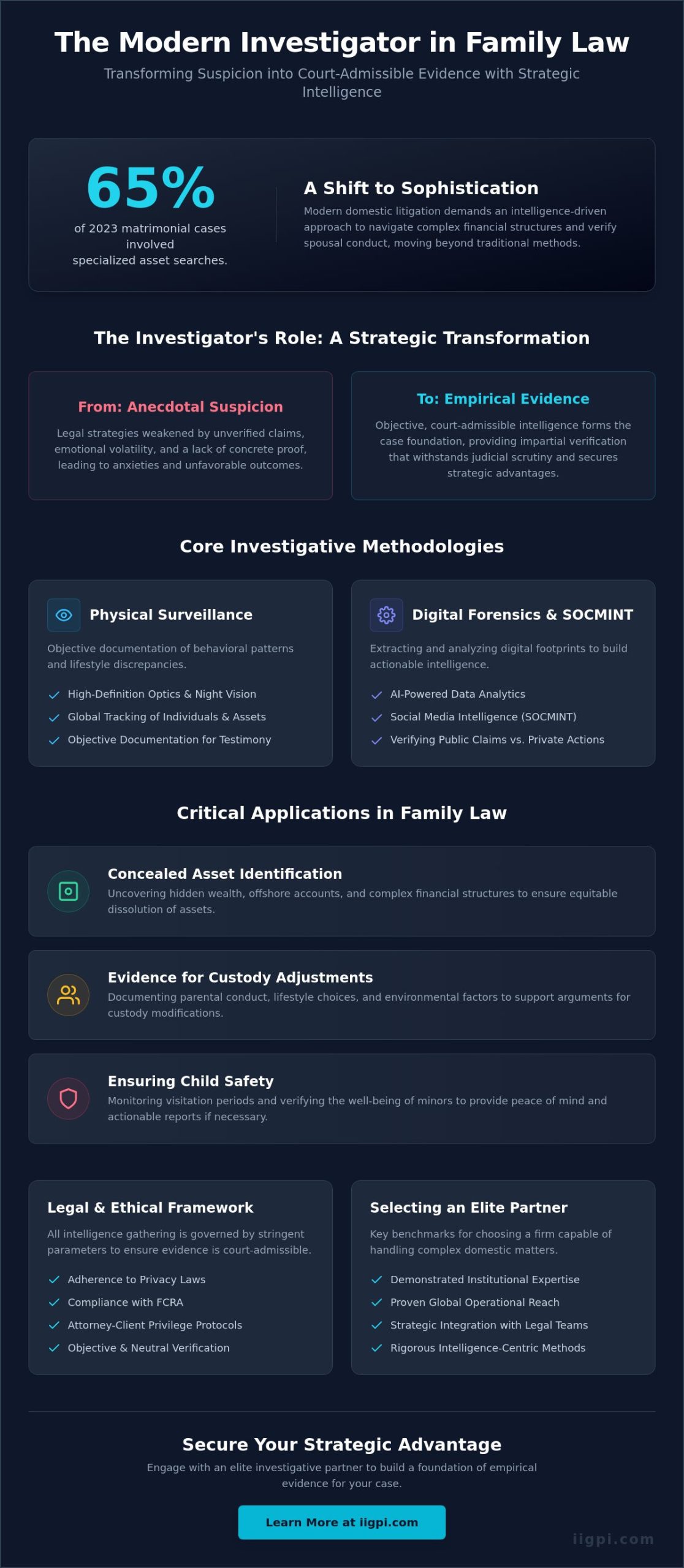
Did you know that in 2023, specialized asset searches were conducted by investigators in approximately 65% of the matrimonial dissolution cases they supported? This statistic underscores the increasingly sophisticated requirements for a private investigator for family law cases within the contemporary legal framework. The evolution of domestic litigation demands a rigorous, intelligence-driven approach to navigate the complexities of modern financial structures and interpersonal dynamics. It’s a fundamental shift in how domestic intelligence is gathered.
Legal professionals and high-level decision-makers often face significant challenges regarding the verification of spousal conduct or the identification of concealed wealth, which can lead to profound systemic anxieties. This article provides an authoritative analysis of how elite investigative intelligence serves as the strategic architect for securing favorable outcomes in complex domestic and matrimonial proceedings. We’ll examine the precise methodologies used to identify concealed financial assets, establish definitive evidence for custody adjustments, and ensure the fundamental safety of children during critical visitation periods.
Key Takeaways
- Learn how the strategic integration of a private investigator for family law cases transforms anecdotal suspicions into empirically verified, court-admissible evidence.
- Explore the sophisticated methodologies of intelligence, encompassing digital forensics and surveillance, that uncover concealed behavioral patterns and lifestyle discrepancies.
- Examine the critical functions of investigative intelligence in ensuring the well-being of minors and identifying concealed assets during complex matrimonial dissolution.
- Understand the stringent legal and ethical parameters, including privacy laws and the Fair Credit Reporting Act, that govern the collection of admissible evidence.
- Determine the benchmarks for selecting an elite investigative firm, focusing on institutional expertise and the capacity for global operational reach.
The Strategic Integration of Private Investigative Services in Family Law
The paradigm shift in matrimonial litigation has necessitated a transition from traditional investigative tactics to a more rigorous, intelligence-centric model. Within this framework, the role of a private investigator has evolved into that of a strategic consultant capable of synthesizing complex data into court-admissible evidence. This integration is essential for modern domestic disputes, where the stakes involve significant financial assets and the long-term well-being of minors. Engaging a private investigator for family law cases allows legal counsel to move beyond anecdotal suspicions, replacing them with empirically verified findings that withstand the scrutiny of judicial review.
Neutrality remains the cornerstone of professional investigative support. By maintaining an objective stance, investigators provide an impartial layer of verification that enhances the credibility of a legal team’s arguments. This objectivity is particularly vital in family court environments, where emotional volatility can often obscure the factual reality of a situation. Legal practitioners increasingly rely on these specialized services to provide the evidentiary foundation required for complex litigation, ensuring that every claim is supported by a documented trail of intelligence. It’s a method that prioritizes institutional rigor over mere observation.
The Evolution of Domestic Intelligence Protocols
The transition from the archaic “private eye” archetype to modern investigative protocols reflects the broader technological advancements of 2026. Contemporary methodologies utilize AI-powered data analytics and sophisticated surveillance techniques to bridge the gap between raw data and actionable legal intelligence. In an era where digital footprints are ubiquitous, the ability to extract and analyze information from diverse sources is paramount. These protocols don’t just gather information; they structure it within a systemic framework that prioritizes legal admissibility and relevance to specific case objectives. This evolution ensures that intelligence gathered is both comprehensive and strategically aligned with the requirements of the court.
Collaborative Dynamics Between Legal Counsel and Investigators
In high-stakes litigation, the private investigator for family law cases functions as the evidentiary arm of a legal team, operating under strict protocols to maintain the integrity of the process. It’s critical that these professionals understand the nuances of attorney-client privilege to ensure that all gathered intelligence remains protected until its strategic introduction into the litigation cycle. Timing is essential. Introducing findings at the optimal moment can pivot the direction of a case entirely. By aligning investigative efforts with the broader legal strategy, firms like IIG ensure that intelligence is not merely collected but strategically deployed to secure favorable judicial outcomes for their clients.
Methodologies of Intelligence: Surveillance and Digital Forensics
The efficacy of a private investigator for family law cases in 2026 is predicated upon the seamless integration of physical surveillance and sophisticated digital forensics. While traditional observation remains a fundamental component, it’s now augmented by high-definition optics and night-vision technology that allow for the documentation of behavioral patterns without compromising the integrity of the subject’s natural environment. This objective documentation is critical when identifying lifestyle discrepancies that may contradict sworn testimony in court. By employing global networks, elite firms can track individuals or assets across international jurisdictions, ensuring that no geographic boundary hinders the collection of vital intelligence. This macro-level perspective is essential for high-net-worth cases where assets are frequently distributed across multiple sovereign territories.
Modern field operations don’t exist in a vacuum; they’re informed by social media intelligence (SOCMINT). The synthesis of digital behavioral analysis and physical field operations allows investigators to anticipate movements and verify the authenticity of a subject’s public claims. To maintain the highest standards of legal validity, all operations must strictly adhere to state licensing requirements for private investigators, which ensures that the evidence gathered is not only accurate but also fully admissible within a judicial framework. For those requiring a comprehensive approach to behavioral documentation, engaging matrimonial investigative specialists can provide the necessary clarity.
Sophisticated Surveillance and Behavioral Documentation
Maintaining a low-profile presence is essential for ensuring that evidence remains untainted by the subject’s awareness of observation. Utilizing professional surveillance services allows for the application of elite-level protocols that prioritize discretion and technical precision. These methodologies involve the use of long-range HD optics and thermal imaging to document activities in environments where traditional photography would fail. The goal is to capture a subject’s natural behavior, providing a factual record of lifestyle choices, associations, and parenting practices that are relevant to the litigation at hand.
Digital Forensics and the Extraction of Electronic Evidence
Digital forensics represents a critical, yet often underutilized, frontier in domestic litigation. Expert computer forensics enables the extraction of hidden communications and deleted data that frequently hold the key to uncovering concealed assets or misconduct. It’s not merely about finding the data; it’s about maintaining a rigorous chain of custody to ensure its admissibility. By analyzing metadata, a private investigator for family law cases can establish precise timelines and geographic locations of specific activities, creating an irrefutable digital footprint that complements physical surveillance findings. This technical rigor ensures that every piece of electronic evidence is ready for the scrutiny of expert testimony.
Critical Applications: Child Custody, Alimony, and Asset Identification
The application of specialized intelligence within the domestic sphere extends far beyond simple observation; it’s a multi-faceted discipline designed to protect the integrity of the family unit and ensure the equitable distribution of resources. When engaging a private investigator for family law cases, the focus shifts toward the empirical documentation of parental fitness and the identification of concealed financial interests. This high-level analysis is essential for addressing the systemic complexities of matrimonial dissolution, where the safety of minors and the preservation of wealth are paramount. By providing a rigorous evidentiary foundation, investigators empower legal counsel to pursue adjustments to alimony or custody arrangements with the confidence of verified data.
Verifying cohabitation and lifestyle improvements remains a critical function for those seeking to facilitate spousal support adjustments. Often, individuals may intentionally obscure their improved financial status or the presence of a cohabitating partner to avoid legal obligations. Professional intelligence gathering uncovers these discrepancies through the systematic documentation of behavioral patterns and residential habits. It’s a process that transforms suspicion into actionable legal strategy, ensuring that court orders reflect the actual socioeconomic reality of the parties involved. This objective verification is vital in high-conflict environments where subjective claims often lack the necessary evidentiary weight for judicial consideration.
Child Custody and Protective Intelligence
Protecting the well-being of minors requires a proactive approach to intelligence gathering that prioritizes the identification of environmental hazards and dangerous associations. During parental visitation periods, an investigator’s role is to document any instances of neglect or substance abuse that could compromise a child’s safety. This protective intelligence often involves conducting comprehensive background checks on new partners introduced to the child’s environment, ensuring that no prior history of misconduct exists. By providing objective testimony, investigators serve as a neutral party whose primary focus is the best interests of the child, offering a factual counterpoint to the emotional narratives often presented in custody disputes.
Matrimonial Asset Identification and Recovery
In high-net-worth divorces, the identification of concealed wealth requires the application of sophisticated forensic accounting principles to trace diverted funds or offshore accounts. These investigations frequently reveal “lifestyle-income” discrepancies, where a subject’s reported earnings are significantly lower than their actual expenditures. By utilizing protocols established in corporate fraud investigation, elite firms can navigate complex financial structures to recover assets that have been strategically hidden. This level of technical expertise is what distinguishes a professional private investigator for family law cases from generalist agencies, providing the intellectual rigor necessary for successful asset recovery in international jurisdictions.
The Legal and Ethical Framework of Admissible Evidence
The efficacy of a private investigator for family law cases is fundamentally tied to the legal admissibility of the intelligence gathered. Without strict adherence to statutory frameworks, even the most revealing evidence becomes a significant liability rather than a strategic asset. Professional protocols must align precisely with the Fair Credit Reporting Act (FCRA) and various state-level privacy mandates to ensure that findings are beyond reproach during judicial review. This requires a sophisticated understanding of the “expectation of privacy” doctrine, ensuring that all surveillance occurs within legally permissible environments, such as public thoroughfares or shared communal spaces. It’s a discipline where technical precision meets legal compliance.
Detailed, chronological reporting serves as the evidentiary backbone for successful court testimony. It allows the court to trace the origin and acquisition of every data point with absolute clarity. By maintaining these rigorous standards, an investigator mitigates the risk of the “fruit of the poisonous tree” doctrine, where improperly obtained evidence can lead to the exclusion of all subsequent findings. It’s a systemic approach to integrity that protects the client’s legal standing in highly contentious environments. When the acquisition of intelligence is conducted with such institutional rigor, it provides a definitive advantage that withstands the most aggressive legal challenges.
Admissibility Standards in Family Court Proceedings
Professional investigators prepare evidence specifically for the rigors of cross-examination by opposing counsel. This preparation involves the establishment of a flawless chain of custody for both physical and digital exhibits, ensuring that no tampering or contamination has occurred. In many instances, the investigator transitions into the role of an expert witness, providing authoritative testimony that bridges the gap between raw data and judicial understanding. This specialized function is a hallmark of elite domestic litigation support, transforming raw observation into a structured narrative that the court can rely upon with confidence.
Ethical Considerations in Domestic Intelligence
Ethical integrity is the defining characteristic of a prestigious investigative firm. There’s a strict prohibition against illegal activities such as wiretapping, hacking, or trespassing, as these methods fundamentally compromise the integrity of the case. Navigating the delicate balance between aggressive intelligence gathering and legal compliance requires a high degree of professional maturity and deep expertise in global systems. Maintaining these standards doesn’t just protect the firm; it ensures the client’s interests are represented with the highest level of institutional credibility. To ensure your evidence meets these rigorous standards, consider the professional investigative protocols established by IIG.
Selecting an Elite Investigative Partner for Domestic Matters
Choosing a private investigator for family law cases necessitates a rigorous evaluation of institutional capacity and operational history. In high-stakes domestic litigation, the distinction between a generalist agency and an elite firm is defined by the depth of their methodological rigor and the sophistication of their intelligence-gathering protocols. This selection process should prioritize firms that demonstrate a profound understanding of complex case management and possess a background rooted in professional law enforcement. For families with international interests, the capability to operate across diverse jurisdictions is not a peripheral advantage but a fundamental requirement for securing equitable outcomes in a globalized legal environment. It’s an assessment of intellectual and technical resources that transcend basic observation.
The transition from suspicion to court-admissible evidence requires a partner capable of navigating the systemic complexities of modern law. Elite firms don’t just gather data; they synthesize it into a structured narrative that withstands the scrutiny of judicial review. When the stakes involve the long-term safety of minors or the preservation of multi-generational wealth, the pedigree of the investigative team becomes the primary determinant of success. It’s about ensuring that every finding is beyond reproach and that the strategy remains aligned with the broader objectives of the legal counsel. Selecting such a partner is the first strategic step toward reclaiming control over a volatile domestic situation.
The International Investigative Group Advantage
The International Investigative Group differentiates itself through a 30-year legacy of excellence, having successfully resolved over 10,000 diverse investigative cases since its inception. This institutional experience has facilitated the development of detailed protocols that ensure every finding is empirically verified and legally resilient. Founded by former law enforcement professionals, the firm leverages a global network of agents to execute seamless cross-border investigations, bridging the gap between localized disputes and international financial or personal interests. This elite-level reach ensures that intelligence remains consistent and authoritative, regardless of geographic complexity or the subject’s attempts to obscure their activities through jurisdictional arbitrage.
Securing Your Legal Position
Integrating professional intelligence into an existing legal strategy requires a collaborative dynamic where the investigator functions as a specialized extension of the legal team. This process ensures that every piece of evidence is strategically introduced to maximize its impact on the litigation cycle, providing the decisive advantage needed in family court. Initiating a confidential consultation is the first step toward securing authoritative support for sensitive matters, allowing for a tailored approach that addresses specific systemic challenges. To protect your domestic interests and ensure the most favorable judicial outcome, contact the International Investigative Group to engage their elite investigative services today. The commitment to discrete, professional, and authoritative support is the silent architect of success in modern matrimonial law.
Securing a Definitive Evidentiary Advantage in 2026
The evolution of domestic litigation necessitates a fundamental shift from speculative claims to empirically verified intelligence. Successfully navigating complex matrimonial or custodial disputes requires the technical precision of a private investigator for family law cases who understands the intricate synthesis of digital forensics and physical surveillance. By adhering to rigorous legal and ethical frameworks, professional investigators ensure that every gathered data point remains admissible and resilient under the most intense judicial scrutiny. This systemic approach transforms raw observation into a structured, authoritative narrative that serves the best interests of both the client and the court.
The International Investigative Group offers an unparalleled paradigm of investigative excellence, drawing upon over 30 years of specialized experience and an institutional foundation established by former law enforcement professionals. With a global network of agents, the firm provides the intellectual and operational depth required for high-stakes domestic matters across international jurisdictions. It’s time to transition from uncertainty to definitive clarity. Consult with the International Investigative Group for Elite Domestic Intelligence to secure your legal position today. Professional intelligence remains the most effective instrument for ensuring a just and equitable outcome.
Frequently Asked Questions
Is information gathered by a private investigator for family law cases admissible in court?
Information acquired by a private investigator for family law cases is generally admissible in court provided that the intelligence was acquired through legally compliant methodologies that respect statutory privacy protections. The court requires that all evidence, whether physical or digital, adheres to rigorous chain-of-custody protocols and occurs in environments where no reasonable “expectation of privacy” exists. Professional investigators often serve as expert witnesses to authenticate their findings, ensuring that the documentation provides an empirical foundation for judicial deliberation.
How much does a private investigator for family law cases typically cost?
The financial commitment required for investigative services is contingent upon the geographical scope and technical complexity of the specific case requirements. Most elite firms utilize a structured retainer model supplemented by hourly rates for field operations, forensic analysis, and reporting. While total expenditures vary significantly based on jurisdictional demands and the duration of surveillance, industry professionals report that comprehensive investigations involve a transparent fee structure detailed within a formal service contract to ensure institutional accountability.
Can a private investigator help in a child custody dispute?
A private investigator for family law cases provides critical support in child custody disputes by documenting empirical evidence of parental fitness and environmental safety. This process often includes the verification of cohabitating individuals through background investigations and the documentation of behavioral patterns that may compromise a minor’s well-being. By delivering objective, third-party observations, investigators assist the court in prioritizing the best interests of the child through factual reporting that transcends the emotional narratives of the parties involved.
What are the legal boundaries of surveillance in a divorce case?
Surveillance operations must be conducted within the parameters of public access and legal transparency to ensure the admissibility of the resulting intelligence. Investigators are strictly prohibited from engaging in trespassing, unauthorized wiretapping, or the installation of tracking devices without a specific legal mandate. The integrity of the investigation depends on maintaining observation from public thoroughfares where no reasonable expectation of privacy exists, thereby mitigating the risk of judicial exclusion under the “fruit of the poisonous tree” doctrine.
Can a private investigator find hidden assets during a divorce?
Professional investigators utilize forensic accounting and lifestyle-income analysis to identify assets that have been strategically concealed during matrimonial dissolution. This methodology involves tracing diverted funds through complex financial structures and identifying discrepancies between reported earnings and actual expenditures. By leveraging global intelligence networks, elite firms can uncover offshore accounts and real estate holdings that would otherwise remain hidden from traditional discovery processes, ensuring an equitable distribution of resources within the legal framework.
What is the difference between a private investigator and a police officer in domestic cases?
The distinction between a private investigator and a law enforcement officer lies primarily in their operational mandate and the nature of the proceedings they support. Police officers are state actors focused on the detection and prosecution of criminal offenses, whereas private investigators operate within civil and matrimonial legal frameworks to support private litigation. While both may possess backgrounds in professional law enforcement, the private investigator’s focus is the acquisition of intelligence specifically tailored to a client’s strategic legal objectives.
How do I choose the right private investigator for my family law matter?
Selecting a qualified investigative partner requires an assessment of the firm’s institutional experience, law enforcement pedigree, and technical capacity for global operations. It’s essential to verify that the firm maintains the necessary state licensing and operates with a sophisticated understanding of current privacy regulations. A prestigious firm will demonstrate a commitment to intellectual rigor and provide a transparent methodology for integrating their findings into a broader legal strategy, ensuring that the evidence remains beyond reproach.
Can a private investigator prove infidelity for alimony purposes?
Investigative intelligence can definitively establish patterns of infidelity or cohabitation when such behavioral documentation is relevant to alimony adjustments or spousal support litigation. While some jurisdictions utilize no-fault frameworks, evidence of misconduct or the financial support provided by a new partner can influence the equitable distribution of resources. Professional documentation provides the court with a factual basis for evaluating lifestyle improvements or cohabitation arrangements that directly impact the legal and financial obligations of the parties involved.