
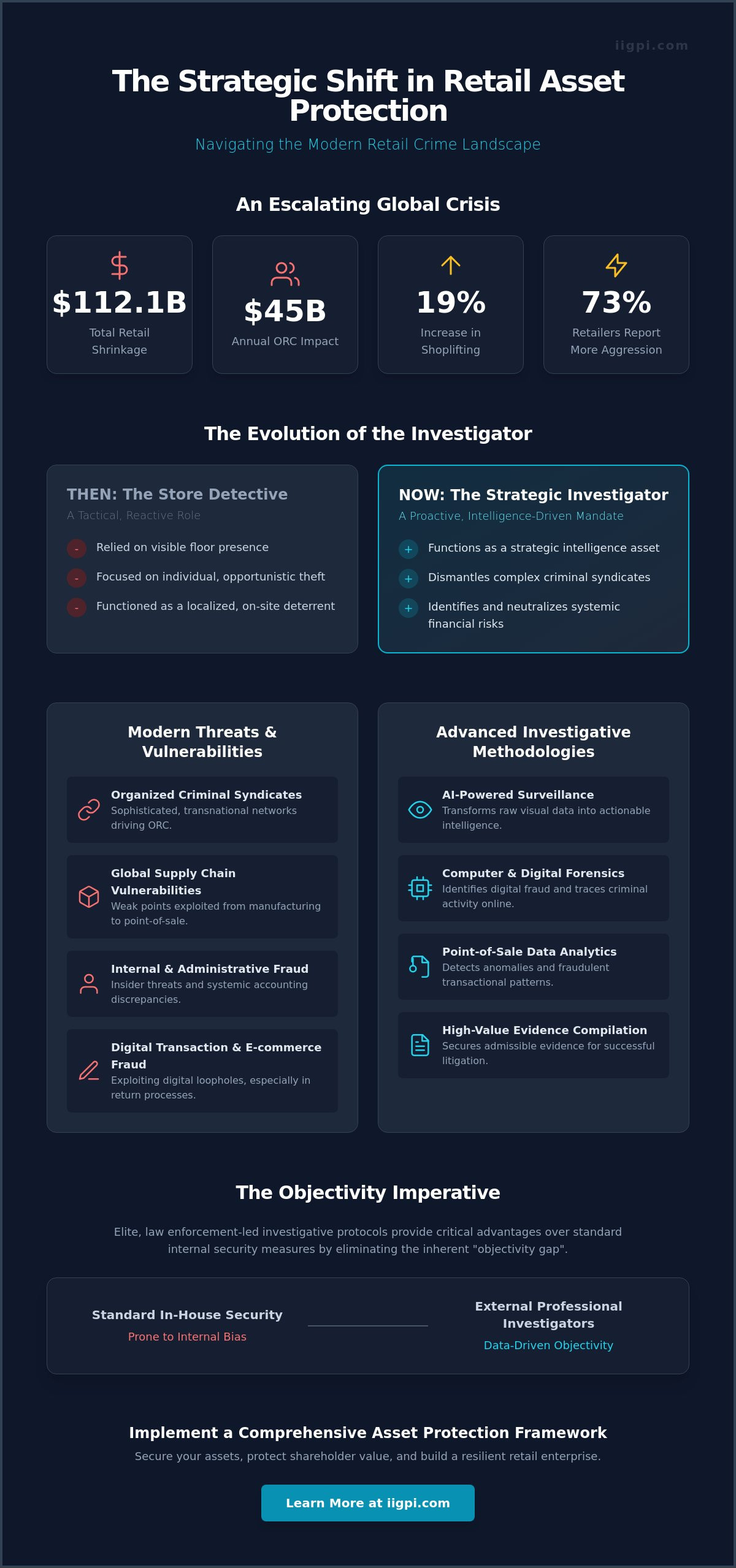
Could the traditional reliance on visible floor security be the very vulnerability that sophisticated criminal syndicates are currently exploiting? As retail shrinkage reached $112.1 billion and organized retail crime (ORC) evolved into a $45 billion annual crisis, the role of the retail loss prevention investigator has transitioned from a tactical necessity to a high-level strategic mandate. You likely recognize that standard security protocols are failing to address the 19% increase in shoplifting incidents observed since 2024 or the escalating aggression reported by 73% of retailers. It’s clear that the underreporting of crime, often due to a perceived lack of law enforcement response, necessitates a more robust internal capability. This article offers an authoritative analysis of the methodologies and systemic impacts of professional investigators within modern global commerce. We will present a systemic framework for asset protection that incorporates the 2026 Combating Organized Retail Crime Act and the shift toward AI-powered surveillance. By reviewing these advanced investigative strategies, executives can establish a pathway toward reducing global shrinkage rates and securing the admissible evidence required for successful high-value litigation.
Key Takeaways
- Understand the evolution of retail shrinkage from simple theft into a complex, systemic financial risk that demands a specialized, research-driven investigative approach.
- Discover how the integration of computer forensics and advanced surveillance services identifies digital transaction fraud and mitigates vulnerabilities within global supply chains.
- Examine the strategic mandate of the retail loss prevention investigator in dismantling the sophisticated criminal enterprises and transnational syndicates that drive organized retail crime.
- Evaluate the inherent “objectivity gap” in standard in-house security personnel and the advantages of employing elite, law enforcement-led investigative protocols.
- Learn to implement a comprehensive asset protection framework designed to secure high-value admissible evidence and improve long-term corporate governance.
The Strategic Mandate of the Retail Loss Prevention Investigator
The contemporary landscape of global retail necessitates a transition from reactionary security measures to a rigorous, intelligence-driven framework. A professional retail loss prevention investigator functions as a strategic asset protection specialist whose mandate is the preservation of institutional capital through the identification and neutralization of systemic risks. This sophisticated role is distinct from the historical, localized duties of a Store detective; it represents a specialized discipline that integrates forensic analysis with strategic oversight. By establishing a definitive nexus between operational integrity and corporate valuation, these investigators ensure that inventory assets are protected against multifaceted threats that jeopardize shareholder value.
Defining Systemic Shrinkage in 2026
Inventory loss in the current fiscal environment is no longer a series of isolated incidents but a systemic financial risk that requires a multi-dimensional analytical approach. Shrinkage has reached a staggering $112.1 billion globally, reflecting a complex interplay between administrative discrepancies, external theft, and escalating internal fraud. The evolution of shrinkage from simple, opportunistic theft to a sophisticated geopolitical and economic threat underscores the necessity of this strategic shift. As organized retail crime (ORC) accounts for an estimated $45 billion in annual losses, the investigator’s role in documenting and dismantling these networks becomes a prerequisite for corporate survival. It’s clear that the sophistication of modern commerce has introduced novel vulnerabilities, particularly through e-commerce return fraud, which leverages digital loopholes to undermine profitability, thereby necessitating a more analytical approach to asset protection.
The Investigator as a Strategic Intelligence Asset
Functioning as a vital intelligence node within the corporate hierarchy, the retail loss prevention investigator contributes to the development of long-term risk mitigation frameworks. By synthesizing raw investigative data into structured intelligence, these professionals enable high-level decision-makers to implement proactive governance measures. This strategic orientation ensures that loss prevention is recognized as a core component of corporate governance rather than a mere operational expense. Through the rigorous application of investigative protocols, such as those developed by International Investigative Group, organizations can secure their supply chains and enhance their competitive positioning in an increasingly volatile global market. The investigator’s ability to provide objective, data-driven insights is fundamental to maintaining the fiscal health and reputation of the modern retail enterprise. Ultimately, the integration of high-level investigative intelligence into executive strategy allows for the reduction of global shrinkage rates and the establishment of a robust framework for asset protection.
Advanced Methodologies: Surveillance, Forensics, and Data Intelligence
The efficacy of modern asset protection is predicated on the seamless integration of empirical data and sophisticated visual intelligence. A professional retail loss prevention investigator leverages high-resolution surveillance systems, often augmented by artificial intelligence, to transform raw visual data into actionable intelligence. This methodological shift is critical for establishing the rigorous evidentiary standards necessary for successful prosecution and high-value litigation. By moving beyond basic observation, these investigators apply a scholarly rigor to the identification of systemic vulnerabilities within the retail environment. It’s a paradigm where visual evidence must be indisputable and technologically beyond reproach.
The application of Point-of-Sale (POS) data analytics represents a significant advancement in anomaly detection, facilitating the identification of transactional variances that signify fraudulent activity. This analytical depth is a hallmark of contemporary retail loss prevention careers, which now demand a sophisticated understanding of both physical security and data science. Organizations that neglect these advanced diagnostics often find themselves unable to address the root causes of shrinkage. By synthesizing transactional data with physical observations, investigators can create a comprehensive risk profile that informs executive decision-making.
The Role of Professional Surveillance Services
Covert surveillance operations are essential for dismantling internal theft rings that operate beneath the threshold of standard security measures. The deployment of professional surveillance services provides the technical precision required for capturing admissible video and photographic evidence. These protocols ensure that every frame of intelligence adheres to strict legal standards, including verified time-stamping and secure chain-of-custody procedures. In high-stakes retail environments, the difference between a successful recovery and a legal liability often rests on the professional quality of the surveillance conducted. For executives seeking to fortify their defensive posture, engaging with a specialized investigative firm ensures that surveillance efforts are both legally sound and strategically effective.
Digital Forensics in the Retail Supply Chain
As retail operations become increasingly digitized, the application of computer forensics is now a mandatory component of the investigative toolkit. A retail loss prevention investigator is frequently tasked with uncovering sophisticated cyber-enabled fraud. This includes database manipulation and the falsification of inventory records. These techniques allow for the recovery of deleted digital footprints, providing a clear audit trail in complex fraud cases that span multiple jurisdictions. By analyzing the intersection of physical inventory and digital records, investigators can expose the sophisticated schemes used by organized criminal enterprises to exploit supply chain vulnerabilities. This forensic approach ensures that even the most well-concealed digital manipulations are brought to light, providing a robust foundation for corporate litigation.
Addressing Organized Retail Crime (ORC) and Systemic Vulnerabilities
Organized Retail Crime (ORC) has transcended the boundaries of localized petty theft, evolving into a sophisticated geopolitical and economic threat that challenges the stability of global supply chains. In 2025, the involvement of transnational ORC groups was reported by 66% of retailers, signaling a paradigm shift toward coordinated criminal enterprise. Unlike opportunistic shoplifting, these operations are characterized by meticulous planning, logistical precision, and the exploitation of jurisdictional gaps. The retail loss prevention investigator is central to neutralizing these threats by mapping the intricate structures of these syndicates. Their work aligns with the core Retail Loss Prevention Specialist duties, which include the synthesis of field intelligence and data-driven pattern recognition to dismantle criminal hierarchies.
Retailers don’t merely lose inventory through these schemes; they suffer profound erosion of employee safety and brand reputation. During 2024, 73% of retailers observed increased aggression among shoplifters, while acts of violence rose by 17% in the same period. These statistics represent a systemic failure that can destroy consumer trust if left unaddressed. A proactive investigative strategy is essential to mitigate these risks and preserve the integrity of the retail environment. By positioning the investigation as a core business function, organizations can defend their physical and reputational assets against increasingly violent criminal elements.
Mapping Criminal Networks and Resale Channels
Investigators trace stolen merchandise through secondary online marketplaces, which serve as the primary liquidity channels for criminal networks. This process requires a sophisticated understanding of e-commerce fraud and the ability to collaborate with federal law enforcement agencies under frameworks like the Combating Organized Retail Crime Act, passed in May 2026. By identifying key nodes in distribution chains, such as “boosters” and “fences,” a retail loss prevention investigator disrupts the financial incentives that drive ORC. This methodology relies on the identification of high-velocity theft patterns and the strategic use of RFID technology to track the movement of illicit goods across state lines.
Mitigating Internal Threats and Executive Fraud
Internal vulnerabilities often present a more insidious risk than external threats, particularly when involving high-level management or executive-level fraud. The sensitive nature of a corporate fraud investigation within retail management requires a level of discretion and objectivity that in-house departments often lack. Protocols for investigating high-value embezzlement or kickback schemes must be rigorous to ensure that evidence remains admissible in high-stakes litigation. Engaging an impartial, third-party investigator through a firm like International Investigative Group provides the necessary distance to investigate long-term employees without the bias of internal corporate politics. This objectivity is vital for maintaining institutional integrity and ensuring that the recovery of assets is conducted within a strict legal and ethical framework.
Internal vs. External Investigative Protocols: An Analytical Comparison
Evaluating the structural efficacy of an asset protection framework requires a critical examination of the inherent limitations found within in-house loss prevention departments. While internal teams possess intimate knowledge of organizational culture, they frequently suffer from an “objectivity gap” that compromises the integrity of investigations involving long-term personnel or senior management. A professional retail loss prevention investigator sourced from an elite external firm operates with a degree of impartiality that is unattainable for internal employees. This external orientation is essential for maintaining institutional integrity and ensuring that investigative outcomes are predicated on empirical evidence rather than internal corporate dynamics. By engaging external expertise, organizations adopt a superior risk-management strategy that prioritizes the preservation of capital over the preservation of internal relationships.
The Objectivity and Expertise of the Private Investigator
The unique perspective of a private investigator in a retail setting provides a level of specialized oversight that standard security personnel cannot match. External firms are uniquely equipped to handle multi-jurisdictional investigations, a critical capability given that 66% of retailers now report the involvement of transnational criminal groups in their operations. These professional investigators possess advanced training in surveillance and digital forensics, allowing them to bridge the gap between physical security and complex financial analysis. This high-level oversight is not merely a tactical addition but a strategic imperative for organizations operating across diverse geographic and socioeconomic regions. The ability to coordinate with various legal frameworks and law enforcement entities across state lines ensures that the investigative process remains robust and legally defensible.
Cost-Benefit Analysis of External Engagement
A rigorous cost-benefit analysis reveals that the return on investment for hiring elite investigators far outweighs the nominal costs of engagement. While initial fees may appear significant, they represent a fraction of the compounding costs associated with unaddressed shrinkage and systemic internal fraud. Utilizing professional investigative protocols significantly reduces corporate liability by ensuring that all evidence is gathered in accordance with the highest legal standards. This proactive approach prevents the escalation of million-dollar losses and protects the organization from the reputational damage associated with high-profile security failures. For leadership seeking to fortify their defensive posture, the decision to engage professional investigative services is a definitive step toward securing long-term fiscal health and operational stability. Beyond investigation, securing your business with the right coverage is a vital defensive layer, and we recommend you visit Henrich Insurance Group LLC to explore comprehensive insurance options tailored to your specific industry needs. Ultimately, the transition from reactive internal monitoring to proactive external intelligence is the hallmark of a resilient modern retail enterprise.
The International Investigative Group Framework for Asset Protection
The International Investigative Group maintains a proprietary framework for asset protection that transcends traditional security paradigms, positioning the firm as a premier authority in global risk mitigation. With a distinguished 30-year history rooted in a law enforcement-led investigative heritage, the organization operates as a significant player in the identification and neutralization of systemic supply chain vulnerabilities. A professional retail loss prevention investigator within this ecosystem is trained to apply rigorous analytical methodologies that dismantle the sophisticated criminal networks previously discussed. By leveraging an international network of intelligence assets, the firm addresses retail loss as a macro-level challenge, providing stakeholders with the intellectual depth required to protect institutional interests in an increasingly volatile global economy. This high-level orientation ensures that asset protection is treated as a core component of corporate governance rather than a localized operational function.
Proven Results in Complex Corporate Loss
The efficacy of this methodology is evidenced by a historical record of resolving more than 10,000 cases characterized by high-stakes outcomes and complex financial implications. Such extensive experience facilitates the seamless integration of surveillance services and armed guards for the protection of high-value properties and inventory. Every retail mandate is executed with an unwavering commitment to confidentiality and intellectual rigor, ensuring that sensitive internal investigations remain protected from public or competitor scrutiny. This approach positions the organization as an elite partner for global leaders who require definitive results in the face of systemic financial risks. It’s a research-driven entity that prioritizes the delivery of objective, admissible evidence for use in high-value litigation and corporate recovery efforts.
Initiating a Professional Loss Prevention Engagement
The process of establishing a robust defensive posture begins with a comprehensive initial consultation and a detailed risk assessment conducted by senior investigative leads. These evaluations aren’t generic; they’re customized to the specific socioeconomic and geographic dynamics of the retail sector in question, bridging the gap between regional challenges and global standards. The strategic mandate of a retail loss prevention investigator is best realized through a customized plan that aligns with the organization’s broader corporate governance objectives. Decision-makers are invited to secure their assets through research-driven intelligence by contacting the International Investigative Group for a formal evaluation of their current asset protection protocols. This engagement provides a definitive pathway for reducing global shrinkage rates and establishing a resilient framework for institutional survival in the coming fiscal years.
Securing the Future of Global Retail Integrity
The transition from localized security to a systemic asset protection framework is no longer optional for organizations addressing the complexities of 2026. By integrating advanced digital forensics and high-resolution surveillance, the modern retail loss prevention investigator serves as a vital architect of corporate stability. These professionals bridge the gap between operational vulnerabilities and high-level strategic oversight, ensuring that evidence remains admissible for high-stakes litigation. It’s imperative that leadership recognizes the “objectivity gap” inherent in internal teams and seeks the specialized rigor of external experts to dismantle transnational criminal networks. To fortify your organization against these escalating threats, Engage the Elite Investigative Expertise of International Investigative Group. With over 30 years of elite experience and a foundation established by former law enforcement professionals, our global network of agents across NYC and beyond provides the research-driven intelligence necessary for institutional success. Protecting your global supply chain is a mission of paramount importance, and the right strategic partnership ensures your enterprise remains resilient.
Frequently Asked Questions
What distinguishes a retail loss prevention investigator from a standard security guard?
A retail loss prevention investigator is distinguished by their analytical and forensic orientation, whereas standard security personnel primarily provide visible physical deterrence. While guards focus on immediate perimeter control, the investigator utilizes data intelligence and surveillance services to identify systemic financial risks. This role requires sophisticated training in evidence collection and risk mitigation frameworks, allowing for the development of long-term asset protection strategies.
How does organized retail crime (ORC) differ from traditional shoplifting?
Organized retail crime is defined by its coordinated, professional structure and often transnational reach, contrasting with the opportunistic nature of traditional shoplifting. These criminal enterprises utilize sophisticated logistical networks to liquidate stolen merchandise through secondary marketplaces. In 2025, over half of retailers reported increases in fraud linked to these structured groups, highlighting the shift from simple theft to complex, geopolitical financial threats.
Can a retail loss prevention investigator help with internal employee embezzlement?
Yes, a retail loss prevention investigator is essential for neutralizing internal embezzlement through the application of computer forensics and polygraph testing. They bridge the objectivity gap that often hinders in-house security when investigating long-term management or executive-level fraud. Furthermore, implementing preventative vetting through HubHound allows organizations to identify high-risk hires before they can exploit corporate systems. This process ensures that internal investigations are conducted with the intellectual rigor required for corporate governance, facilitating the recovery of assets within a strict legal framework.
What digital tools are essential for modern retail loss investigations in 2026?
Essential digital tools for modern investigations include AI-powered surveillance systems, RFID data analytics, and integrated Point-of-Sale (POS) anomaly detection software. These technologies allow investigators to move from reactive monitoring to real-time behavioral analysis and predictive deterrence. Such tools are critical for identifying high-velocity theft events across multiple jurisdictions, providing the data-driven insights necessary for executive decision-making in a volatile global market.
Is the evidence gathered by a private investigator admissible in a retail theft court case?
Evidence gathered by professional investigators is fully admissible in court, provided it adheres to strict legal protocols and chain-of-custody requirements. Professional firms prioritize the technical precision of video and photographic evidence to meet evidentiary standards for high-value litigation. This ensures that investigative findings are legally defensible during criminal forfeitures or civil proceedings, providing a robust foundation for the prosecution of organized criminal syndicates.
How does a third-party investigative firm maintain objectivity during internal audits?
Third-party firms maintain objectivity by operating independently of internal corporate politics and personal relationships within the organization. This external perspective allows for an impartial analysis of administrative errors and internal fraud without the bias inherent in in-house departments. Their mandate is strictly predicated on empirical findings and the preservation of institutional capital, ensuring that audits reflect the true state of operational integrity.
What are the primary indicators that a retail business requires external investigative intervention?
Primary indicators for external intervention include escalating global shrinkage rates, increased violence against retail workers, and suspicions of executive-level fraud. If internal security teams fail to report more than half of theft incidents, a professional audit is likely necessary. External investigators provide the specialized resources and global reach required to address these systemic vulnerabilities effectively, offering a level of oversight that transcends standard floor-level security operations.
How does computer forensics assist in identifying retail inventory discrepancies?
Computer forensics assist by identifying database manipulations and the falsification of inventory records that conceal illicit activity. Investigators utilize digital forensics to recover deleted footprints and establish a clear audit trail for supply chain discrepancies. This forensic approach exposes cyber-enabled fraud that traditional manual audits often overlook, securing the digital perimeter of the retail supply chain against sophisticated internal and external threats.