
The traditional paradigm of static site monitoring has become an obsolete defense against the sophisticated syndicates currently targeting the multibillion-dollar Willets Point development and other high-value Queens infrastructure projects. Developers recognize that escalating material theft and the complexities of NYC Department of Buildings Chapter 33 compliance have transformed security from a secondary operational cost into a primary risk-management mandate. Establishing a robust queens construction site security plan isn’t merely an exercise in perimeter fortification; it’s a strategic necessity to counter asymmetric threats like internal pilferage and insurance fraud.
The current regulatory environment, specifically regarding the wage parity mandates of Local Law 61 and the stringent safety protocols of NYC DOB Chapter 33, has significantly elevated the fiscal and operational stakes of site safety. This guide offers a definitive framework and checklist to mitigate these liabilities while safeguarding high-value assets across the Queens landscape. We’ll explore the integration of elite investigative intelligence with physical protection to ensure project timelines remain uninterrupted by criminal interference or regulatory citations.
Key Takeaways
- Understand the socioeconomic drivers and specific asset vulnerabilities that necessitate a sophisticated, multi-layered defensive architecture for modern Queens developments.
- Synthesize physical fortifications with advanced electronic surveillance to establish a comprehensive Queens construction site security plan that addresses both criminal threats and regulatory mandates.
- Determine the tactical superiority of security personnel with law enforcement backgrounds in preempting asymmetric threats such as internal theft and fraudulent liability claims.
- Access a systematic framework for phased site protection, encompassing rigorous pre-construction risk assessments and the implementation of stringent access control protocols.
- Recognize the institutional advantages of partnering with investigative professionals to ensure intellectual rigor in asset protection and uninterrupted project continuity.
Analyzing the Security Landscape of Queens Construction Projects
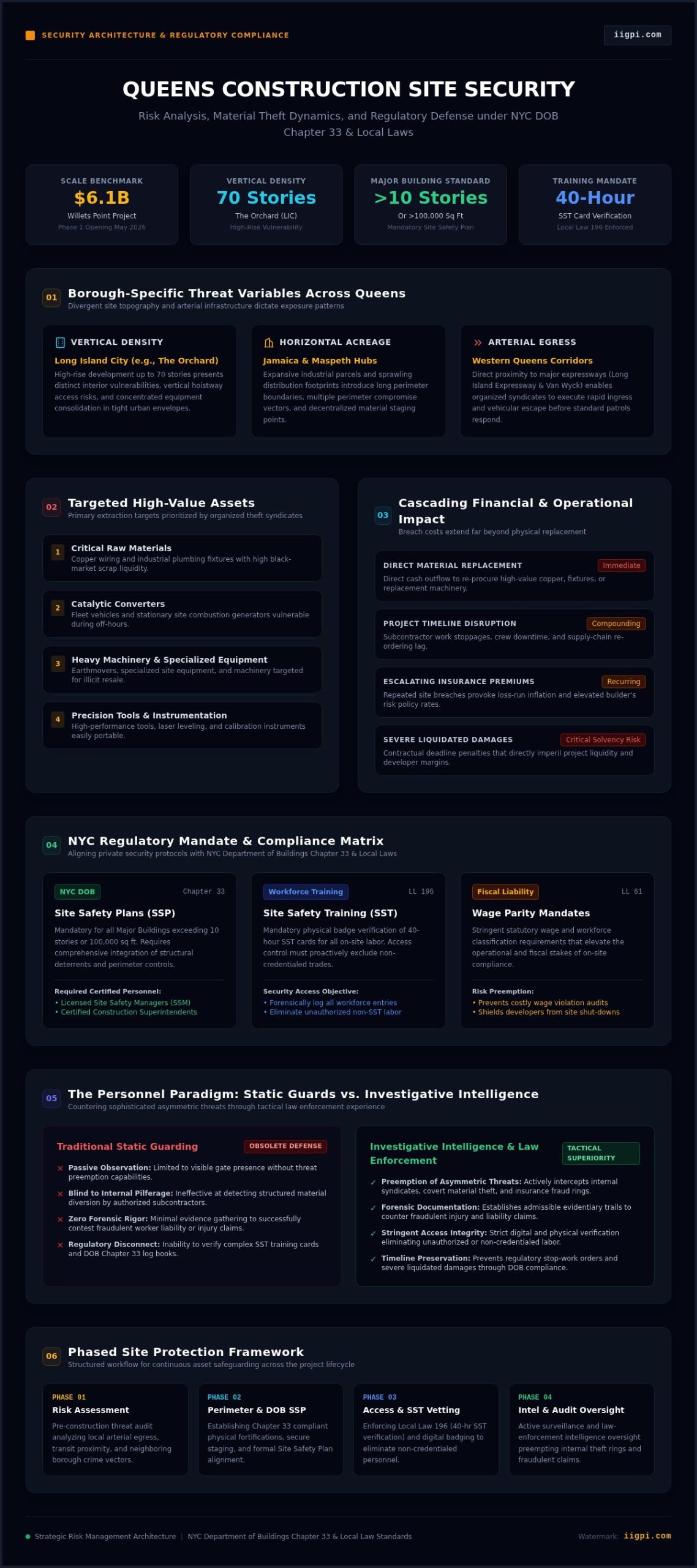
The socioeconomic impetus driving the current development surge in Queens, exemplified by the $6.1 billion Willets Point transformation where Phase 1 opened in May 2026, has established a high-density environment of capital assets that necessitates a sophisticated queens construction site security plan. As developers capitalize on the borough’s expansive industrial pockets and waterfront opportunities, they simultaneously expose high-value inventories to organized theft rings that specialize in the extraction of copper, catalytic converters, and heavy machinery. The intersection of geographic accessibility and criminal opportunity is particularly acute in Western Queens; proximity to major arterial expressways like the Long Island Expressway and the Van Wyck allows for rapid egress following a site breach. Quantifying the financial impact of these security failures extends beyond the immediate replacement cost of stolen materials. It encompasses the systemic disruption of project timelines, the escalation of insurance premiums, and the potential for severe liquidated damages that can threaten the solvency of a project.
Organized theft rings typically prioritize the following high-value assets:
- Critical raw materials, specifically copper wiring and industrial plumbing fixtures.
- Heavy machinery and specialized site equipment.
- High-performance tools and precision instrumentation.
Borough-Specific Risk Variables
Risk profiles across Queens exhibit significant variance, requiring a nuanced understanding of local dynamics to preempt organized material theft. The vertical density of Long Island City, characterized by high-rise developments like the 70-story Orchard, presents different vulnerabilities than the sprawling horizontal acreage found in Jamaica or the Maspeth distribution hubs. Effective protection strategies must integrate layered physical security principles with local intelligence to address these specific regional threats. Sites situated near major transportation hubs face heightened exposure to transient criminal elements. This reality necessitates a more rigorous approach to perimeter integrity and surveillance than projects in more isolated residential zones.
Regulatory Imperatives and Compliance
Adherence to the NYC Department of Buildings (DOB) Chapter 33 regulatory standards is a core component of a professional asset protection strategy. For Major Buildings exceeding ten stories or 100,000 square feet, the mandate for a formal Site Safety Plan (SSP) requires the integration of licensed Site Safety Managers and certified Construction Superintendents. Aligning a private queens construction site security plan with these DOB requirements ensures that developers mitigate liability while maintaining compliance with Local Law 196 safety training mandates, including the verification of 40-hour Site Safety Training (SST) cards. It doesn’t merely reduce risk; it preserves the structural integrity of the project timeline. By integrating professional oversight from established entities like the International Investigative Group, project managers can effectively reduce the risk of regulatory citations and the subsequent work stoppages that jeopardize project continuity.
Core Components of a Robust Site Security Framework
A sophisticated queens construction site security plan transcends the elementary installation of physical barriers, functioning instead as a multi-layered defensive architecture designed to neutralize both external intrusion and internal pilferage. This framework necessitates the seamless integration of structural deterrents with advanced electronic monitoring to ensure comprehensive compliance with NYC Department of Buildings construction safety regulations, which mandate specific safeguards for high-density urban job sites. By establishing strict access control protocols for personnel and logistics, developers can effectively eliminate the unauthorized entry of non-credentialed labor while maintaining a definitive record of site activity. This systematic approach doesn’t only deter criminal intent; it provides the forensic documentation necessary to mitigate liability and satisfy the rigorous evidentiary standards of insurance underwriters.
Perimeter Integrity and Physical Deterrence
The first echelon of a defensive stratagem involves the strategic deployment of 8-foot solid fencing, as required by NYC Building Code Section 3307.7, which must be accompanied by high-intensity illumination to eliminate concealment opportunities. Signage serves a dual purpose as both a psychological deterrent and a legal prerequisite, establishing clear boundary definitions that are essential for successful trespassing prosecutions. While temporary barriers are often utilized for logistical flexibility, the efficacy of permanent, reinforced fencing in urban settings like Long Island City is superior for long-term asset protection. Developers must evaluate the structural integrity of these barriers against the specific geographic vulnerabilities of the site to prevent breaches from organized theft rings.
Technological Surveillance Systems
Modern security frameworks increasingly rely on AI-driven motion detection and thermal imaging to provide 24/7 visibility in environments where human observation may be compromised by environmental factors or site topography. Remote monitoring protocols allow for real-time intervention, ensuring that security personnel can respond to anomalies before they escalate into significant losses. The admissibility of digital evidence in potential legal proceedings is paramount. Therefore, surveillance systems must maintain high-resolution standards and secure data-logging practices to support specialized surveillance services and subsequent investigations. This technological layer ensures that every movement within the site perimeter is quantified and recorded, providing an indisputable audit trail for project managers and investigative teams.
The successful execution of these components requires a level of expertise that only established risk-management professionals can provide. Engaging with an elite entity like the International Investigative Group ensures that your security architecture is led by former law enforcement professionals who understand the nuances of urban asset protection. By prioritizing a multi-layered approach, developers can safeguard their capital investments and maintain the continuity of their project timelines in the competitive Queens market.
The Personnel Paradigm: Armed Guards vs. Investigative Intelligence
The transition from passive observation to active, intelligence-led protection represents a critical evolution in asset preservation. While unarmed guards fulfill basic deterrent functions, a comprehensive queens construction site security plan for high-valuation developments necessitates a more rigorous personnel paradigm. The strategic utility of armed versus unarmed personnel isn’t a binary choice but a calibrated response to the asymmetric threats present in the Queens development sector. By utilizing personnel with deep law enforcement backgrounds, developers gain an investigative advantage that extends far beyond simple perimeter monitoring. These professionals possess the cognitive frameworks required to identify the subtle indicators of systemic loss that standard security details often overlook.
Elite Armed Guard Services
Determining when a project’s valuation necessitates armed intervention is a function of total capital exposure and the presence of high-value, portable assets. In the New York jurisdiction, armed personnel must adhere to stringent regulatory requirements, including the possession of a valid NYS concealed carry permit and completion of the mandatory 47-hour firearms training course. The presence of elite security provides a tactical ceiling that effectively deters organized criminal syndicates targeting critical infrastructure. This elite presence ensures adherence to OSHA construction industry standards by maintaining a secure environment where hazardous materials and specialized machinery are protected from unauthorized tampering. It’s a psychological and tactical stratagem that signals a zero-tolerance threshold for site breaches.
Investigative Synergy in Site Security
Mitigating internal theft requires a sophisticated integration of background investigations and real-time intelligence. Because a significant portion of construction losses stems from internal pilferage, ghost deliveries, or subcontractor fraud, a defensive posture must look inward as well as outward. Leveraging Professional Surveillance Services allows project managers to detect sophisticated insurance fraud and inflated labor claims that can silently erode a project’s profitability. Undercover surveillance and forensic audits of inventory logs are essential for identifying systemic pilferage within the supply chain. This investigative approach ensures that the security plan isn’t just a barrier, but a proactive mechanism for financial recovery and risk mitigation. By securing the supply chain through rigorous due diligence, developers can ensure that every dollar of capital expenditure is accounted for and protected.
The Essential Queens Construction Site Security Checklist
A rigorous queens construction site security plan requires a phased implementation strategy to ensure that all vulnerabilities are systematically identified and neutralized. This framework moves beyond reactive measures, establishing a proactive defensive posture that aligns with institutional risk-management standards. By adhering to a structured architectural approach, developers can ensure that their site protection measures remain both compliant and effective throughout the project lifecycle. This systematic process provides the intellectual rigor necessary to safeguard high-value capital investments in the competitive Queens development sector.
- Phase 1: Pre-Construction Risk Assessment and Site Survey. Conduct an exhaustive analysis of the local geographic variables and socioeconomic factors influencing the Queens landscape.
- Phase 2: Perimeter and Access Control Implementation. Install solid 8-foot fencing and high-intensity illumination as mandated by NYC DOB regulations to establish a primary defensive line.
- Phase 3: Surveillance and Remote Monitoring Integration. Deploy AI-enabled CCTV towers and thermal sensors to provide continuous oversight of high-value asset clusters.
- Phase 4: Personnel Deployment and Tactical Protocol Establishment. Station elite guards with law enforcement backgrounds to manage gate control and emergency response functions.
- Phase 5: Continuous Audit and Investigative Review. Maintain an iterative loop of site inspections and forensic log audits to adapt to evolving threats.
Immediate Deployment Protocols
The initialization of site safety begins with the verification of perimeter lighting and the elimination of blind spots that offer concealment for unauthorized entrants. A centralized visitor management and credentialing system must be established immediately to verify the SST credentials of all personnel entering the site. Testing communication redundancies between on-site personnel and remote command centers is a critical prerequisite for operational readiness. These steps ensure that the site is fortified against intrusion from the moment equipment is staged. Rapid deployment of these protocols is essential for maintaining the structural integrity of the project timeline.
Long-Term Risk Mitigation Strategies
Sustained asset protection requires the integration of corporate fraud investigation protocols into the overarching project management framework. This allows for the detection of sophisticated internal threats such as ghost deliveries or inflated subcontractor claims. Periodic site audits must be scheduled to identify vulnerabilities that emerge as the project transitions through different construction phases. Establishing a formal protocol for incident response and legal evidence collection ensures that any breach results in an actionable forensic record for insurance recovery. To ensure your development adheres to these elite standards, consult with our investigative experts to finalize your security architecture.
Partnering with International Investigative Group for Elite Protection
The successful execution of a definitive queens construction site security plan requires an institutional partner possessing both tactical proficiency and investigative depth. International Investigative Group represents the pinnacle of this synthesis, leveraging over 30 years of elite experience to safeguard high-value developments against the specific threats inherent to the Queens construction landscape. Unlike standard security vendors, our methodology is rooted in proactive risk management and asset recovery, ensuring that project managers aren’t merely observers of loss but active participants in its prevention. By customizing security frameworks to the unique socioeconomic dynamics of the borough, we neutralize asymmetric threats before they escalate into significant liquidated damages or project delays.
The International Investigative Group Institutional Pedigree
International Investigative Group’s institutional pedigree is defined by a record of over 10,000 complex cases solved with professional precision, a metric that underscores our status as a leading authority in global risk mitigation. Our leadership, comprised of former law enforcement professionals, provides the intellectual rigor necessary to manage a global network of intelligence agents. This network allows for localized security solutions that are informed by macro-level intelligence, providing a strategic advantage in the deployment of Security and Armed Guard Services. This elite presence ensures that every site breach is met with an immediate, forensic-grade response suitable for criminal prosecution and insurance recovery, thereby protecting the developer’s reputation and financial interests.
Strategic Engagement and Implementation
The consultative approach to construction site safety planning involves a rigorous analysis of a project’s specific vulnerabilities, ensuring seamless integration with corporate legal and insurance departments. We facilitate a defensive architecture that prioritizes the admissibility of evidence and the mitigation of long-term liability through documented protocols. By establishing clear procedures for incident response and forensic log audits, we protect the structural integrity of the project’s financial projections against internal pilferage and fraudulent claims. This strategic engagement ensures that developers can navigate the complexities of NYC regulatory mandates without compromising on asset protection or project continuity. To ensure your development adheres to these elite standards, secure your project’s future with a definitive security audit from our elite investigative team.
Fortifying the Future of Queens Development
The transition from basic deterrence to a sophisticated queens construction site security plan is no longer optional in an environment of escalating asset values and complex regulatory mandates. Establishing a multi-layered architecture that integrates physical barriers with investigative intelligence ensures that project managers can mitigate both external intrusion and internal pilferage effectively. By prioritizing personnel with law enforcement backgrounds and adopting a rigorous, phased implementation strategy, developers safeguard their capital investments. It’s the only way to maintain the continuity of project timelines against asymmetric threats that standard security models often overlook.
International Investigative Group brings over 30 years of professional experience to this critical discipline. Led by former law enforcement professionals, our institution has successfully solved over 10,000 cases, providing the intellectual rigor and tactical precision required for elite asset protection. We invite you to Consult with the Elite Security Experts at IIGPI to ensure your next project operates within a definitive framework of safety and institutional excellence. Securing your development today ensures a resilient and uninterrupted path toward completion.
Frequently Asked Questions
What are the legal requirements for a construction site security plan in Queens?
Legal mandates for a construction site in Queens are primarily codified under NYC Building Code Chapter 33. This requires a formal Site Safety Plan for Major Buildings, defined as those exceeding ten stories or 100,000 square feet. Additionally, perimeter fencing must be at least 8 feet in height and access must be strictly controlled. All personnel are required to possess valid 40-hour Site Safety Training cards to ensure compliance with Local Law 196.
How can professional surveillance reduce insurance premiums for construction projects?
Professional surveillance establishes a forensic record of site activity that significantly reduces liability exposure for developers. By implementing a robust queens construction site security plan that includes 24/7 AI-enabled monitoring, project managers provide insurance underwriters with definitive evidence to dismiss fraudulent claims. This documented risk-mitigation strategy often leads to lower premiums as it demonstrates a commitment to preventing specie loss and accidental liability, thereby improving the project’s overall risk profile.
When is it necessary to deploy armed guards versus unarmed personnel on a site?
Deployment of armed guards is strategically necessary when project valuations involve high-risk asset transfers or ultra-valuable equipment staging in vulnerable geographic zones. While unarmed personnel manage day-to-day access control, armed professionals provide a tactical ceiling against organized criminal syndicates. This decision is based on a thorough risk assessment of the site’s socioeconomic landscape. Armed guards in New York must hold valid NYS concealed carry permits and specialized registration endorsements.
What role does background checking play in construction site security?
Background investigations are a critical component in neutralizing internal pilferage and subcontractor fraud. Because up to 40% of construction losses stem from internal employee theft or ghost deliveries, vetting labor and logistics partners is essential for supply chain integrity. By performing due diligence on all personnel with site access, developers preemptively identify individuals with histories of financial fraud or criminal activity. This intelligence-led approach secures the site from within.
How does the NYC Department of Buildings (DOB) influence site security protocols?
The NYC Department of Buildings establishes the regulatory baseline through Chapter 33 of the Construction Codes. These mandates dictate everything from perimeter fencing height to the requirement for licensed Site Safety Managers on specific developments. Failure to align your queens construction site security plan with these DOB standards can result in severe financial penalties or stop-work orders. Professional oversight ensures that all safety protocols meet these evolving municipal requirements to maintain project continuity.
What are the most common security vulnerabilities on high-rise developments in Queens?
High-rise developments in Queens face unique vulnerabilities, specifically regarding vertical access control and the difficulty of monitoring multiple floors simultaneously. Internal theft by subcontractors remains a significant threat, as does the unauthorized entry of non-credentialed labor. Large-acreage vertical projects often have blind spots that necessitate a combination of mobile patrols and remote surveillance towers. These systemic weaknesses require a multi-layered defensive architecture to prevent organized theft and insurance fraud.
How can investigative services assist in recovering stolen construction equipment?
Investigative services utilize forensic audits and undercover surveillance to identify the mechanisms of theft and track stolen assets. When heavy machinery or high-value materials are extracted from a site, elite investigators leverage global networks to locate these items and identify the responsible parties. This process often involves auditing inventory logs and performing supply-chain forensic audits to uncover organized internal syndicates. Professional investigators provide the evidentiary standards required for successful financial recovery.
What is the ROI of implementing a high-level security plan early in the project?
The ROI of a high-level security plan is quantified through the prevention of liquidated damages caused by project delays and the reduction of insurance premiums. By implementing sophisticated surveillance and investigative oversight early, developers avoid the massive costs associated with major material theft or site breaches. This proactive investment preserves the structural integrity of the project’s budget. It ensures that capital expenditure remains focused on construction rather than loss mitigation or legal defense.