
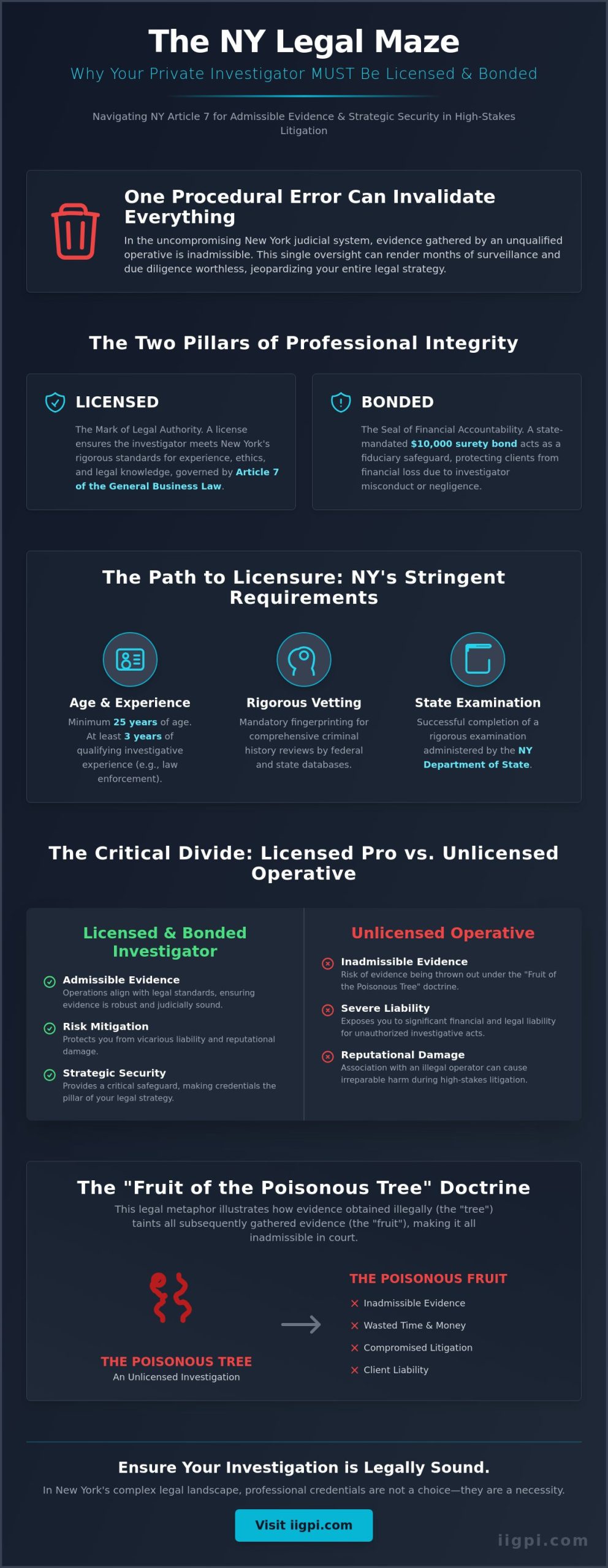
The evidentiary threshold within the New York judicial system is uncompromising; a single procedural oversight by an unqualified operative can render months of sophisticated surveillance or corporate due diligence entirely inadmissible. You recognize that in high-stakes litigation, the provenance of information is as critical as the data itself. Engaging a licensed and bonded private investigator ny represents a strategic commitment to legal integrity and risk mitigation. This decision moves beyond mere compliance, serving as a necessary safeguard against the profound financial and reputational liabilities associated with unauthorized investigative acts.
This authoritative analysis explores the statutory frameworks of NY Article 7 and the rigorous standards maintained by the Department of State, Division of Licensing Services. We’ll examine how the mandated $10,000 surety bond functions as a vital fiduciary instrument, protecting clients from potential misconduct or regulatory failure. By the conclusion of this discourse, you’ll understand the systemic necessity of professional licensure for ensuring that evidence gathered during matrimonial investigations, insurance inquiries, or complex background checks remains a robust tool for judicial success. It’s clear that in the New York investigative landscape, professional credentials aren’t just bureaucratic markers; they’re the pillars of legal admissibility and strategic security.
Key Takeaways
- Comprehending the statutory mandates of Article 7 of the General Business Law is essential for maintaining the legal integrity of investigative operations within the New York jurisdiction.
- It’s imperative to recognize the $10,000 surety bond as a vital fiduciary instrument that provides financial indemnity against professional malpractice or investigative oversight.
- Engaging a licensed and bonded private investigator ny effectively mitigates the risk of evidence being deemed inadmissible under the “fruit of the poisonous tree” doctrine during judicial proceedings.
- Discerning the distinction between statutory compliance and investigative excellence requires an assessment of an agency’s law enforcement lineage and the sophistication of its global intelligence apparatus.
- Prioritizing professional licensure serves as a critical strategic barrier against vicarious liability and the potential for severe reputational damage during high-stakes corporate or personal litigation.
The Legal Framework of Private Investigation in New York State
The regulatory architecture governing investigative services in New York is characterized by its profound complexity and unyielding commitment to public safety. The New York Department of State, acting through the Division of Licensing Services, serves as the primary arbiter of professional standards within this sector. This body enforces the mandates of Article 7 of the General Business Law, a comprehensive statute that delineates the prerequisites for any individual seeking to operate as a private investigator. These mandates aren’t merely administrative formalities; they represent a critical systemic barrier against the infiltration of unqualified or unethical actors who might jeopardize the integrity of judicial proceedings.
Under New York law, the criteria for initial licensure are among the most demanding in the nation. An applicant must be at least 25 years old and possess a high school diploma or its equivalent. Crucially, the statute requires a minimum of three years of qualifying investigative experience, which is frequently derived from a substantive background in law enforcement or as a registered operative within a licensed firm. This rigorous experiential requirement ensures that a licensed and bonded private investigator ny possesses the requisite intellectual and operational maturity to handle sensitive data without compromising the legal standing of their clients. The distinction between regulated investigative acts and unauthorized data collection is defined by this expertise, as licensed professionals operate within a framework of constitutional and statutory constraints.
Regulatory Oversight and Public Safety
The Division of Licensing Services maintains the integrity of the profession through a rigorous examination process and exhaustive background verification. Every prospective investigator must undergo mandatory fingerprinting, involving a $88.50 fee, which facilitates a comprehensive criminal history review through federal and state databases. This level of scrutiny ensures that those granted authority to conduct private investigations don’t have histories of moral turpitude or legal non-compliance. New York’s licensure process is widely recognized as one of the most stringent in the United States, creating a professional environment where intellectual rigor and ethical adherence are the baseline for operation. It’s this oversight that provides the public with a necessary layer of protection against fraudulent or predatory actors.
Defining the Scope of Licensed Activity
Article 7 provides precise legal definitions for regulated investigative acts, including surveillance services, missing person recovery, and character assessment for matrimonial or child custody investigations. These definitions create a sharp distinction between authorized professional activity and prohibited conduct such as stalking or harassment. Engaging a licensed and bonded private investigator ny ensures that the methodology employed during AOE/COE investigations or product liability inquiries aligns with the highest evidentiary standards. This legal framework protects the public interest by ensuring that investigative efforts don’t devolve into unauthorized data collection or privacy violations. It’s this adherence to statutory boundaries that distinguishes an elite firm from an uncertified entity that might expose its clients to significant vicarious liability.
Decoding the ‘Bonded’ Requirement: Fiduciary Safeguards for the Client
While licensure establishes the legal authority to operate, the “bonded” designation provides the financial mechanism that underwrites that authority. In the context of a licensed and bonded private investigator ny, this refers specifically to the $10,000 surety bond mandated by Form DOS-1536. Unlike professional liability insurance, which primarily protects the investigator from claims of negligence, a surety bond is a tripartite agreement designed specifically to indemnify the client. It functions as a specialized credit instrument where the surety company guarantees the investigator’s faithful performance and adherence to state regulations. For corporate entities and legal counsel, this bond isn’t a mere administrative checkbox; it’s a non-negotiable prerequisite that ensures a baseline of fiscal accountability and professional transparency.
Financial Protections for the Principal
The mechanism of indemnity within a surety bond provides a direct path for client compensation in the event of investigative misconduct or financial malfeasance. When a surety company issues a bond, it performs a rigorous assessment of the investigator’s financial stability and professional reputation. This vetting process serves as an external validation of the agency’s operational health. In high-stakes scenarios, such as complex financial fraud inquiries or jewelers loss investigations, the presence of a bond ensures that the principal has immediate recourse should the operative fail to comply with the stringent requirements of a New York State private investigator license. This financial guarantee acts as a buffer against the potential economic fallout of procedural errors or ethical breaches.
Bonding as a Proxy for Professional Accountability
Bonding requirements effectively filter the market by excluding under-capitalized or high-risk entities that cannot secure institutional backing. It creates a relationship of accountability where the investigator’s continued operation is contingent upon their ability to maintain this financial guarantee. Scenarios involving electronic bug sweeps or sensitive matrimonial inquiries require a high degree of trust; the bond provides a tangible layer of security for that trust. For those seeking a licensed and bonded private investigator ny, the bond serves as a critical proxy for professional reliability and institutional permanence. Organizations requiring comprehensive due diligence or corporate investigations should view the bond as a primary indicator of an agency’s commitment to ethical intelligence gathering. By insisting on these safeguards, clients protect their interests from the inherent risks of unregulated or unbonded investigative acts.
Evaluative Criteria for Selecting an Elite Investigative Firm in NYC
The selection of a licensed and bonded private investigator ny requires a strategic framework that transcends mere statutory compliance. While the regulatory floor established by the Department of State ensures a baseline of legality, elite investigative performance is predicated on institutional pedigree and the sophistication of an agency’s intelligence apparatus. High-level decision-makers must evaluate the depth of an operative’s law enforcement lineage. This background often dictates the efficacy of surveillance services and the management of high-stakes corporate inquiries. Pedigree matters. It informs the methodology used to secure admissible evidence in complex judicial environments.
Operational success in the New York landscape frequently depends on the breadth of an agency’s global network. Localized investigations, such as those involving specie loss or fine arts loss, often involve international actors and cross-border financial flows. An elite firm functions as a bridge between regional dynamics and global intelligence, ensuring that a Manhattan-based inquiry is supported by a macro-level perspective. This international reach is essential for comprehensive due diligence and the recovery of assets in multi-million dollar fraud cases. By prioritizing firms with these expansive capabilities, clients mitigate the risks associated with parochial investigative approaches.
Institutional Pedigree and Investigative Success
A firm’s longevity, particularly an organization with over 30 years of operational history, serves as a critical metric for navigating New York’s intricate legal complexities. This extensive experience allows for a nuanced understanding of local judicial expectations, which is vital for managing matrimonial investigations and child custody matters. Former law enforcement professionals bring a disciplined methodology to surveillance and background investigations. They possess the intellectual rigor necessary to handle sensitive data without compromising the legal standing of the principal. Reviewing a firm’s track record in high-stakes recovery is essential for establishing its credibility as a leading authority in the field.
Technological Infrastructure and Forensic Capabilities
Modern investigative success is increasingly reliant on the integration of traditional surveillance with sophisticated digital forensics. An elite firm maintains a dedicated capacity for computer forensic services, recognizing that digital intelligence is the cornerstone of contemporary corporate fraud investigations. This infrastructure allows for the meticulous analysis of data during due diligence and background investigations, providing a comprehensive view of a subject’s activities. The necessity of digital intelligence in insurance investigations and polygraph testing cannot be overstated. It ensures that the evidence gathered is both accurate and resilient under cross-examination. Elite firms don’t just collect information; they synthesize it through advanced technological frameworks to provide actionable strategic analysis.
The Risks of Utilizing Unlicensed or Non-Compliant Investigative Entities
Bypassing statutory requirements for investigative services introduces profound legal risks that can compromise the most robust litigation strategy. The “fruit of the poisonous tree” doctrine, typically associated with criminal law, has significant parallels in civil litigation within the New York court system. If an operative gathers surveillance footage or data through illegal means or without a licensed and bonded private investigator ny credential, that evidence is likely to be suppressed. NY courts maintain a low tolerance for procedural non-compliance. Association with an unlicensed entity doesn’t just jeopardize the current case; it can result in a permanent taint on the principal’s legal standing.
Legal and Evidentiary Consequences
New York General Business Law Section 70 explicitly prohibits the unlicensed practice of private investigation, categorizing such acts as a misdemeanor. When an unlicensed entity conducts surveillance services or matrimonial investigations, they operate entirely outside the protective framework of state law. This lack of legal standing often results in the automatic exclusion of findings during the discovery phase or trial. Mistrials or case dismissals are tangible risks when the provenance of evidence is challenged by opposing counsel. The principal may face direct judicial sanctions for utilizing a non-compliant operative. Legal teams must recognize that an uncertified investigator often becomes the most significant liability in a courtroom setting.
Financial and Reputational Vulnerabilities
Engaging an unlicensed individual results in the complete absence of the $10,000 surety bond protection mandated for every licensed and bonded private investigator ny. There’s no financial recourse through a surety company if the operative commits malpractice or financial theft. Principals also face the specter of vicarious liability for the investigator’s actions. This doctrine of respondeat superior often extends to the hiring of independent contractors when the activity is considered inherently dangerous or involves a non-delegable duty. If an unlicensed person commits trespass or an invasion of privacy while conducting an insurance investigation, the hiring party is frequently held legally responsible for those torts. Institutional clients, such as insurance firms or corporate boards, face severe reputational damage when these unauthorized practices are exposed in public filings. The risk is systemic. It’s why sophisticated entities prioritize regulatory compliance over marginal cost-savings. For those requiring legally resilient intelligence, it’s vital to hire a premier licensed and bonded investigative firm to secure your strategic interests.
International Investigative Group: Surpassing the Statutory Minimums
International Investigative Group (IIG) represents the definitive paradigm of professional standards, operating as a premier licensed and bonded private investigator ny for over three decades. While the statutory requirements of Article 7 provide a necessary regulatory floor, IIG’s operational model is specifically engineered to surpass these minimums through a sophisticated synthesis of law enforcement pedigree and advanced corporate intelligence. This institutional depth ensures that every inquiry, ranging from jewelers loss investigations to complex due diligence, is executed with an intellectual rigor that uncertified entities are fundamentally incapable of replicating. Pedigree matters. It’s the primary differentiator in a field where procedural precision is the only safeguard against legal liability.
A Global Perspective on Local Intelligence
IIG effectively bridges the divide between NYC jurisdictional expertise and an expansive international reach, a capability that’s indispensable for modern corporate fraud investigations where assets frequently traverse multiple geographic and socioeconomic regions. The agency’s capacity to apply elite protocols across international borders was notably demonstrated in its successful management of a $120 million bank fraud case involving sophisticated asset recovery and cross-jurisdictional cooperation. By leveraging this macro-level perspective, IIG ensures that localized New York investigations benefit from a global intelligence apparatus, thereby providing a decisive strategic advantage in high-stakes financial and legal matters. This international infrastructure allows the firm to navigate regional dynamics with the confidence of a global leader.
Comprehensive Solutions for High-Stakes Matters
The modernization of the investigative process necessitates the seamless integration of traditional methodologies with advanced technological infrastructure. IIG utilizes professional surveillance services to address the complexities of insurance inquiries and personal cases, ensuring that all gathered evidence adheres to the highest judicial standards of admissibility. This approach is further reinforced by the rigorous application of computer forensics, which facilitates the meticulous extraction and analysis of digital intelligence in a landscape where data serves as the primary evidentiary currency. Such technological sophistication is essential for maintaining the integrity of polygraph testing and electronic bug sweeps.
Securing authoritative intelligence within the New York jurisdiction requires a partner that possesses a profound understanding of the legal, fiduciary, and strategic necessity of professional licensure and bonding. For decision-makers seeking to mitigate reputational risk and ensure the uncompromising admissibility of evidence, the selection of a premier firm is the only viable path. You’re encouraged to engage with the International Investigative Group to secure the elite expertise required for your most sensitive and significant investigative requirements. It’s time to elevate your investigative strategy beyond the statutory minimums.
Securing Strategic Integrity in the New York Investigative Landscape
The preservation of judicial integrity and the mitigation of vicarious liability necessitate a rigorous adherence to the statutory frameworks of New York State. You’ve seen that the distinction between a standard operative and an elite licensed and bonded private investigator ny lies in the synthesis of legal compliance and a sophisticated intelligence apparatus. By prioritizing agencies that provide the fiduciary security of a surety bond while maintaining a pedigree of law enforcement expertise, you ensure that your investigative findings remain resilient under the most intense legal scrutiny.
International Investigative Group embodies this commitment to excellence, offering an institutional legacy of over 30 years and a record of solving more than 10,000 global cases. Founded by former law enforcement professionals, our organization provides the intellectual rigor and technological infrastructure required for high-stakes corporate and personal inquiries. We invite you to engage the elite investigative services of International Investigative Group today to secure the authoritative intelligence your litigation strategy demands. Your pursuit of truth deserves the protection of a premier institution.
Frequently Asked Questions
What is the difference between a licensed and an unlicensed private investigator in NY?
A licensed operative has met the rigorous experiential and ethical mandates of the New York Department of State; conversely, an unlicensed individual operates without statutory authority. This distinction is critical because a licensed and bonded private investigator ny provides a level of accountability and professional vetting that uncertified actors fundamentally can’t offer. Engaging an unlicensed entity exposes the principal to severe vicarious liability and the potential for significant judicial sanctions.
Why is it mandatory for a New York private investigator to be bonded?
Bonding is mandatory to establish a financial guarantee that protects the public from investigative malpractice or procedural non-compliance. The $10,000 surety bond serves as a fiduciary instrument, ensuring that the investigator remains accountable to the state’s regulatory standards. It provides a tangible mechanism for client recourse; it effectively filters out under-capitalized entities that present a higher risk of operational instability.
Can evidence from an unlicensed investigator be used in a New York court?
Evidence gathered by an unlicensed investigator is typically deemed inadmissible in New York courts due to the lack of procedural provenance. The judiciary maintains a stringent threshold for the admission of surveillance or forensic data, often suppressing information obtained through unauthorized investigative acts. Utilizing a non-compliant operative risks the summary dismissal of evidence, which can compromise the entirety of a complex legal strategy.
How much does a licensed and bonded private investigator cost in NYC?
The cost of engaging professional services in NYC is influenced by the state’s rigorous regulatory fees and the high complexity of the urban environment. While specific service rates vary by firm, the total cost for an investigator’s initial licensure and biennial renewal reflects the specialized nature of the profession. Market data indicates that investigative rates in New York City are approximately 25% to 40% higher than national averages.
What are the specific bonding requirements for NY private investigators in 2026?
Current statutory requirements for 2026 mandate that every investigative agency maintain a $10,000 surety bond to remain in good standing. This bond must be renewed every two years alongside the professional license to ensure continuous compliance with the Department of State. This requirement provides a consistent baseline of financial indemnity, ensuring that all licensed and bonded private investigator ny operations are backed by institutional credit.
How can I verify if a private investigator is currently licensed in New York State?
Verification of an investigator’s professional standing can be conducted through the New York Department of State, Division of Licensing Services public database. This portal allows principals to confirm the current status of a license and the presence of the required surety bond. It’s an essential step in due diligence; it ensures that the operative possesses the legal authority to conduct sensitive inquiries.
What happens if a bonded investigator commits misconduct during my case?
If a bonded investigator commits misconduct, the principal has the legal right to file a claim against the $10,000 surety bond for financial restitution. The surety company acts as the guarantor, providing indemnity for losses resulting from the investigator’s failure to comply with state regulations. This mechanism ensures that the client isn’t left without recourse in the event of professional malfeasance or ethical breaches.
Does a NY private investigator license allow for international operations?
A New York private investigator license provides jurisdictional authority within the state but doesn’t inherently grant the right to operate internationally. Elite firms manage global inquiries by leveraging an extensive network of specialized agents and intelligence partners across various geographic regions. This collaborative approach allows for the gathering of intelligence in foreign jurisdictions while maintaining the evidentiary standards required by New York courts.