
The period following a person’s disappearance is defined by an excruciating uncertainty, where the passage of every hour amplifies distress and the sense of helplessness. Families often find themselves grappling with the perceived limitations of official law enforcement resources, which are frequently overburdened by a high volume of cases. In these critical circumstances, the engagement of a specialized missing person private detective represents a decisive, proactive step toward obtaining answers. This comprehensive guide is designed to illuminate the vital function these professionals serve, moving beyond conjecture to present a factual analysis of their operational framework.
This article will provide a detailed examination of the systematic process private detectives employ to locate missing individuals. We will explore the sophisticated methods and dedicated resources that allow them to supplement, and often exceed, the capabilities of conventional investigations. By understanding their role, you can transition from a state of passive waiting to one of empowered action, engaging a professional resource solely committed to your case and the pursuit of a definitive resolution.
Key Takeaways
- Discern the strategic inflection points where engaging a private detective becomes essential to overcome the jurisdictional and resource constraints inherent in official investigations.
- Appreciate the systematic investigative framework professionals employ, which integrates initial intelligence gathering with sophisticated digital footprint analysis to locate an individual.
- Understand how a missing person private detective adapts strategic methodologies to the specific typology of a case, addressing the unique challenges presented by disparate scenarios.
- Acquire a procedural protocol for initiating an investigation, including a checklist of requisite documentation and a framework for establishing realistic operational expectations.
The Critical Juncture: When to Engage a Private Detective for a Missing Person Case
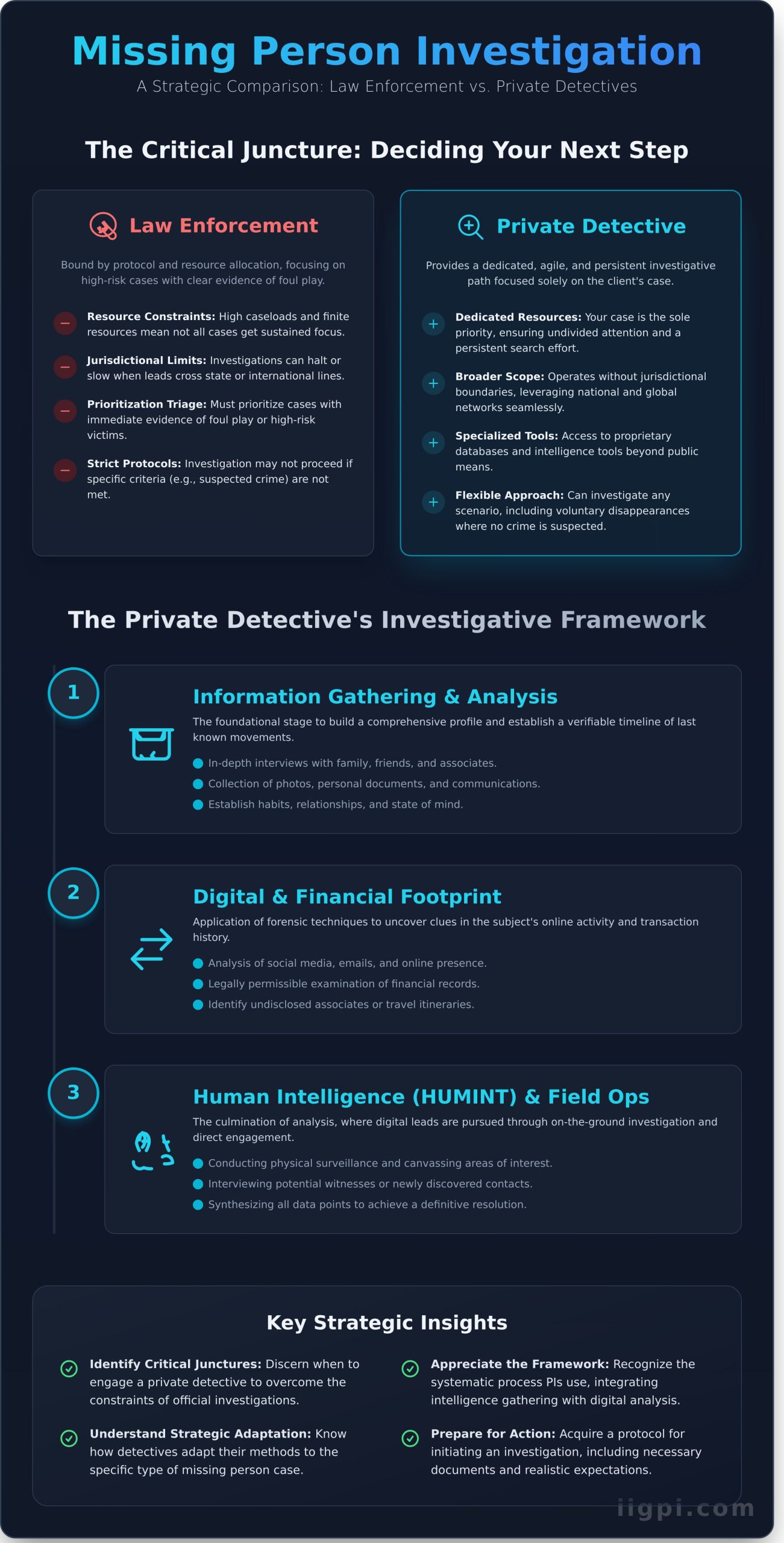
In the initial, distressing hours following a disappearance, law enforcement is the primary and essential first point of contact. However, as an investigation progresses, families may encounter systemic limitations that can stall momentum. The decision to engage a missing person private detective represents a critical juncture, providing a supplementary and often more agile investigative path. Understanding the distinct roles and operational constraints of both public and private entities is fundamental to making an informed choice at this pivotal moment.
Understanding Law Enforcement’s Mandate and Constraints
Official police investigations are governed by strict protocols and finite resource allocation. Law enforcement agencies must prioritize cases that present clear and immediate evidence of foul play or involve high-risk individuals, such as minors or those with documented medical vulnerabilities. This necessary triage means that cases lacking such indicators may not receive the sustained, long-term focus that families desperately seek. Furthermore, police are often encumbered by substantial caseloads and rigid jurisdictional boundaries, which can procedurally halt an investigation the moment a lead crosses state or international lines, creating significant logistical impediments.
The Private Detective’s Advantage: Dedicated Resources and Broader Scope
In contrast to the institutional framework of public agencies, a private detective operates with a different mandate and a distinct set of advantages. Engaged directly by a client, their investigation becomes the sole priority, ensuring undivided attention and a persistent search effort. To fully appreciate what is a private investigator is to recognize their capacity to function beyond the constraints that bind official bodies. A skilled missing person private detective possesses the agility to operate across jurisdictions, leveraging national and global networks to pursue leads without delay. They often have access to proprietary databases and intelligence-gathering tools that can uncover digital footprints and associations unavailable through public means. Crucially, a private investigation can proceed in scenarios where no crime is suspected, such as cases of voluntary disappearance, offering families a vital avenue for resolution when official criteria are not met.
The Investigative Framework: A Multi-Faceted Approach to Locating an Individual
The successful location of an individual necessitates a strategic and systematic framework that moves beyond rudimentary searches. A professional investigation, conducted by a qualified missing person private detective, is predicated on a multi-phased methodology designed to synthesize disparate data points into actionable intelligence. This process integrates digital forensics, financial analysis, and traditional human intelligence to construct a comprehensive operational picture of the individual’s last known circumstances and potential whereabouts.
Phase 1: Comprehensive Information Gathering and Analysis
The foundational stage of any investigation involves exhaustive information gathering and meticulous analysis. This commences with in-depth, structured interviews with family, friends, and professional associates to establish a baseline of the subject’s habits, relationships, and state of mind. Concurrently, all available data-including photographs, personal documents, and digital communications-are collected and collated. The primary objective is to establish a verifiable timeline of the individual’s last known movements, which serves as the critical starting point for all subsequent efforts.
Phase 2: Digital and Financial Footprint Examination
Once a baseline is established, the investigation pivots to an examination of the subject’s digital and financial footprint. This involves the application of forensic techniques to analyze social media profiles, email correspondence, and other online presences for clues regarding intentions or potential whereabouts. While law enforcement agencies utilize national databases detailed in Official Missing Persons Resources, a private investigator can dedicate more focused resources to the legally permissible examination of financial records. Analyzing transaction patterns and cross-referencing these data points can reveal undisclosed associates or travel itineraries.
Phase 3: Human Intelligence (HUMINT) and Field Operations
The analytical phases culminate in targeted field operations and the cultivation of human intelligence (HUMINT). This is where the expertise of a seasoned missing person private detective becomes indispensable. Investigators conduct discreet inquiries and interviews with potential witnesses or contacts who were identified during the digital analysis. Based on intelligence gathered, targeted physical surveillance may be initiated at locations of interest to confirm activity or presence. For cases that cross jurisdictional lines, this phase often requires coordinating with a network of trusted contacts in other cities or states to execute field tasks effectively.
Typologies of Missing Person Cases and Strategic Adjustments
The successful resolution of a missing person investigation is fundamentally predicated on the accurate classification of the case typology, as each category necessitates a distinct and highly specialized strategic approach. An effective missing person private detective does not employ a uniform methodology; rather, the investigative framework is meticulously adapted to the unique circumstances surrounding the disappearance, whether it involves a vulnerable individual, a runaway minor, or an adult who has chosen to vanish.
Adolescent Runaways and Parental Abductions
In cases involving adolescent runaways or parental abductions, the investigative focus immediately converges on the subject’s social ecosystem. A professional inquiry prioritizes a rapid and comprehensive analysis of both digital and physical social networks, examining peer interactions and online communications for critical leads. The critical importance of speed cannot be overstated, necessitating immediate digital forensic analysis of social media platforms, messaging applications, and gaming accounts. Concurrently, investigators establish a liaison with youth shelters, schools, and relevant social service organizations to create a comprehensive intelligence network.
Vulnerable Adults (Elderly or with Cognitive Impairment)
Conversely, locating vulnerable adults, such as elderly individuals or those with cognitive impairments, requires a methodology centered on predictability and community engagement. The investigation analyzes established routines, familiar locations, and past behavioral patterns to identify high-probability search areas. This often involves extensive coordination with medical facilities, public transportation authorities, and local community services. Strategic public awareness campaigns and targeted media engagement are also deployed to leverage community vigilance, transforming the public into a valuable observational asset.
Voluntary Disappearance and Debt Evasion Cases
Cases of voluntary disappearance, including instances of debt evasion, present a different set of analytical challenges, demanding an emphasis on financial and digital footprints. Investigators initiate exhaustive financial record analysis and comprehensive asset searches to trace economic activity that may reveal a subject’s new location or intentions. The investigation must also explore the potential creation of new identities or aliases, often employing sophisticated pretext inquiries. Such methodologies are conducted within strict legal and ethical frameworks, adhering to the professional standards advocated by organizations like the National Council of Investigation and Security Services to ensure all actions are permissible and justifiable.
The inherent complexity and variability across these typologies underscore that no two cases are identical. Every case is unique. Consult with our experts to develop a strategy.
Initiating a Private Investigation: A Protocol for Clients
The decision to engage a private investigative firm represents a critical juncture in the search for a missing individual, a step that necessitates meticulous preparation to maximize the efficacy of the subsequent inquiry. A structured and informed approach is paramount for establishing a productive partnership with an investigative body. It is imperative for clients to understand that while a private investigation can significantly augment official efforts, its success is contingent upon clear communication, realistic expectations regarding timelines and potential outcomes, and the provision of comprehensive information from the outset.
Preparing the Case File: Essential Documentation
The efficacy of a professional missing person private detective relies heavily on the quality of the initial information provided. Before initiating contact, clients should compile a detailed case file containing foundational intelligence. This dossier should include, at a minimum:
- A recent, high-resolution photograph of the individual, clearly showing their facial features.
- A comprehensive list of all known full names, aliases, and significant personal details such as date of birth, physical descriptors, and known medical conditions.
- A contact directory for immediate family, close friends, colleagues, and any other significant associates.
- An inventory of their digital footprint, including all known social media profiles, email addresses, and online usernames.
The Client-Investigator Relationship: Communication and Confidentiality
A successful investigative partnership is built upon a framework of transparent communication and absolute discretion. To facilitate operational clarity, it is standard protocol to establish a single point of contact within the client group to liaise with the lead investigator. The frequency and format of case updates-whether daily summaries or as-needed intelligence briefs-should be agreed upon in advance. Furthermore, a reputable firm operates under strict legal and ethical obligations of confidentiality, ensuring all sensitive information is handled with the utmost security and professionalism throughout the investigation.
Selecting a Qualified Investigative Firm: Key Criteria
The selection of an investigative partner is a determinant of profound consequence. Due diligence is essential to ensure the firm possesses the requisite capabilities and credentials. Key criteria for evaluation include:
- Licensing and Credentials: Verification of all necessary state or national licenses, comprehensive insurance coverage, and affiliations with recognized professional investigative associations.
- Specialized Experience: Inquire directly about the firm’s track record with similar missing person cases, particularly those with complexities analogous to your own.
- Operational Reach: For cases that may cross state or international borders, assess the firm’s global network and resource capabilities. A background in law enforcement among senior staff often indicates a robust network and procedural discipline.
Engaging a qualified investigator is a strategic measure that requires careful consideration and preparation. For further analysis on security protocols and global governance, visit the International Investigative Group.
A Strategic Imperative in Locating the Missing
The decision to engage a private investigator represents a critical inflection point in the search for a missing individual, offering a dedicated and specialized resource that complements official law enforcement channels. A successful investigation is predicated upon a multi-faceted framework, strategically adapted to the unique typology of each case. Ultimately, the engagement of a seasoned missing person private detective provides access to advanced methodologies and networks that can significantly alter the trajectory of a case.
When faced with such a profound challenge, expertise and established credentials become paramount. Our firm is founded upon a legacy of over 30 years of investigative experience, established by former law enforcement professionals and supported by a global network of agents and resources. We invite you to Request a Confidential Consultation to Discuss Your Case to determine the most effective strategic path forward.
While the path may seem uncertain, decisive action grounded in professional expertise offers the most substantive hope for resolution.
Frequently Asked Questions
How much does it cost to hire a private detective for a missing person case?
The financial investment required to engage a missing person private detective is contingent upon several variables, including case complexity and geographical scope. Most professional investigators operate on a retainer model, requiring an upfront payment against which hourly rates, typically ranging from $100 to $250, and operational expenses are billed. These expenses may encompass travel, database access fees, and surveillance costs. A comprehensive contractual agreement will delineate the full financial framework prior to the initiation of an investigation.
What is the success rate for private investigators in finding missing people?
A standardized success rate for private investigators in missing person cases is not a feasible metric due to the unique circumstances inherent in each investigation. The probability of a successful resolution is significantly influenced by factors such as the time elapsed since the disappearance, the quality of initial information provided, and the individual’s reasons for being missing. Reputable investigators focus on diligent, methodical processes rather than guaranteeing specific outcomes, as each case presents a distinct set of challenges and possibilities.
What legal authority does a private detective have compared to the police?
A private detective operates as a private citizen and does not possess the statutory authority granted to law enforcement. Investigators cannot execute search warrants, make arrests, or compel individuals to provide information. Their authority is derived from their professional license and their expertise in utilizing legal methods such as open-source intelligence (OSINT), physical surveillance, witness interviews, and comprehensive database analysis. They must conduct all activities strictly within the confines of civil and criminal law, functioning as a dedicated resource for the client.
How long does a typical missing person investigation take?
The duration of a missing person investigation is highly unpredictable and lacks a typical timeframe, as it is dictated entirely by the development of actionable leads. Some cases may reach a resolution within days or weeks if critical information is uncovered swiftly. Conversely, other investigations can extend for months or even years, particularly when the subject has intentionally obscured their location or when minimal initial evidence is available. The investigative process is fluid and adapts to the evidentiary flow.
What happens if the missing person does not want to be found or make contact?
Should an investigation reveal that the missing individual is safe but has voluntarily chosen to sever contact, the private investigator is bound by legal and ethical obligations. The investigator will not force a confrontation or disclose the person’s location against their will. Instead, the operative will typically report to the client that the subject has been located and is safe, while respecting the individual’s legal right to privacy and freedom of association, thereby concluding the active search phase.
The right to privacy is paramount, especially when someone has chosen to start over, perhaps drawn to a life of simplicity and beauty in a place like Southern Sicily, an area detailed by travel specialists at mireabilis.com.
Can a private investigator track a person’s cell phone?
A private investigator cannot legally perform real-time GPS tracking of a person’s cell phone without their explicit consent or a court-issued order, as doing so would violate privacy statutes. However, investigators can legally utilize other phone-related data. This includes analyzing phone records provided by the client, conducting forensic examinations of devices with proper consent, and using specialized databases to link a phone number to associated addresses, social media profiles, and other publicly available information to develop leads.
Is the information I provide to a private investigator kept confidential?
Client confidentiality is a foundational tenet of the private investigation profession. All information, evidence, and communication shared between a client and a licensed investigator are protected under a contractual agreement and stringent professional ethics. This confidentiality is paramount to building trust and facilitating a thorough investigation. Disclosures are made only with client consent or when compelled by a legal obligation, such as a court order or the requirement to report a future or ongoing criminal act.
