
The persistent reliance on generalist insurance adjusters within the Manhattan art market represents a systemic vulnerability that sophisticated transnational forgery syndicates are increasingly exploiting. Institutional stakeholders recognize that the New York market is no longer merely a cultural repository but a high-stakes arena of speculative assets where the risk of bad faith litigation and fraudulent claims remains omnipresent. Engaging a specialized fine arts loss investigator nyc has become an essential prerequisite for institutions seeking to navigate this increasingly volatile landscape. International Investigative Group provides the intellectual rigor and tactical field intelligence necessary to differentiate between legitimate loss and orchestrated deception.
You recognize that the preservation of institutional reputation and the mitigation of fraudulent payouts require a level of scrutiny that exceeds standard investigative practices. This article presents an authoritative analysis of the specialized forensic protocols and tactical maneuvers essential for investigating high-value art loss within the current 2026 regulatory environment. We will examine the synthesis of computer forensics, provenance verification, and the legislative frameworks, such as the Holocaust Expropriated Art Recovery Act, that define contemporary recovery efforts. This exploration serves as a definitive guide for securing admissible evidence and reinforcing the integrity of institutional insurance portfolios against sophisticated threats.
Key Takeaways
- Analyze the systemic risks within the global fine art insurance market and the critical role of specialized forensic protocols in identifying institutional vulnerabilities.
- Discover how a fine arts loss investigator nyc utilizes tactical field intelligence and behavioral analysis to authenticate loss claims and disrupt transnational forgery networks.
- Examine the rigorous evidentiary standards required to mitigate bad faith litigation risks and ensure the admissibility of findings in complex recovery proceedings.
- Evaluate the strategic advantage of synthesizing law enforcement expertise with advanced computer forensics to protect high-value institutional assets in the New York market.
Defining the Specialized Domain of Fine Arts Loss Investigation in NYC
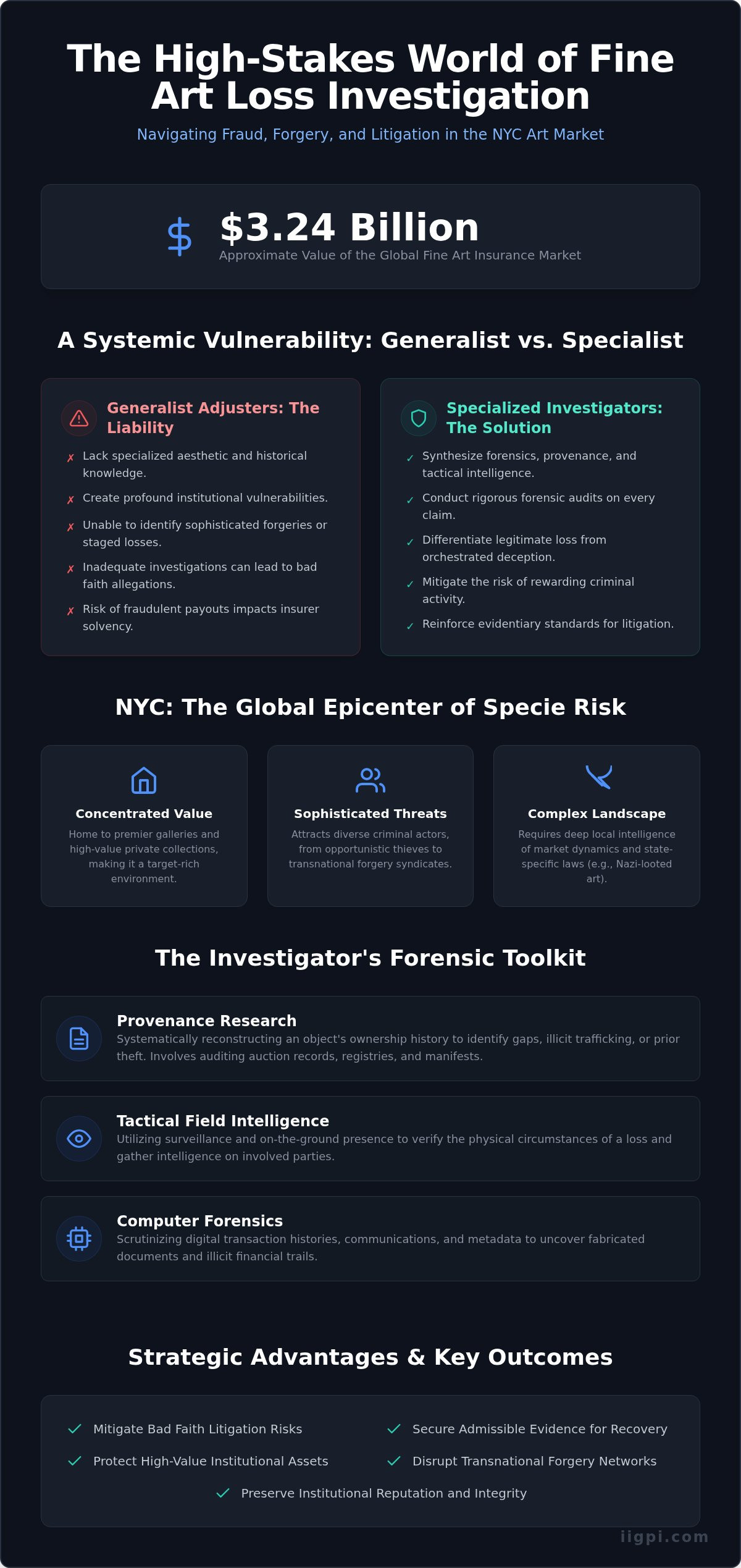
The discipline of fine arts loss investigation constitutes a specialized forensic field, distinct from the standardized protocols of general insurance adjustment. While traditional adjusters manage the valuation of fungible property, the fine art sector requires an intersection of provenance analysis, material forensics, and tactical intelligence. The global fine art insurance market, currently valued at approximately $3.24 billion, is under constant pressure from sophisticated criminal networks. This environment necessitates a comprehensive Art Theft Overview to appreciate the evolving methods used by transnational syndicates. For institutions operating in this space, the legal imperative for exhaustive verification is paramount. Inadequate investigations don’t just lead to financial loss; they invite bad faith allegations that can devastate an organization’s standing in the global market.
The Inadequacy of Generalist Adjusting for High-Value Assets
Reliance on standard adjustment processes for non-fungible assets creates profound institutional vulnerabilities. Generalist adjusters often lack the specialized aesthetic and historical knowledge required to identify sophisticated forgeries or “staged” losses. This knowledge gap transforms into a liability when insurers face contested claims. The economic consequences of fraudulent payouts are severe, directly impacting insurer solvency and driving up premiums for the entire industry. By engaging a dedicated fine arts loss investigator nyc, firms ensure that every claim undergoes a rigorous forensic audit. This specialized approach mitigates the risk of rewarding deception and reinforces the evidentiary standards required for successful litigation.
The NYC Art Market: A Global Hub for Specie Risk
Manhattan’s concentration of premier galleries and private collections establishes it as the world’s most significant hub for specie risk. The New York market attracts diverse criminal actors, from opportunistic thieves to organized syndicates seeking to exploit gaps in institutional security. Navigating the NYC regulatory landscape requires more than just investigative skill; it demands local intelligence and a deep understanding of regional market dynamics. International Investigative Group addresses these challenges through a synthesis of law enforcement experience and advanced computer forensics. A local NYC investigator provides the necessary field presence to verify the physical circumstances of a loss while managing the complexities of New York state laws, such as the registration requirements for Nazi-looted art. This dual-layered approach is essential for any institution seeking to secure its assets in the 2026 landscape.
Forensic Methodologies: Provenance Research and Scientific Authentication
The verification of a high-value art loss requires a paradigm shift from anecdotal evidence to empirical forensic data. A professional fine arts loss investigator nyc operates at the intersection of historical research and material science to establish the legitimacy of a claim. This process begins with an exhaustive audit of provenance, which serves as the foundational “pedigree” of a work. Any gap in this chronological record isn’t merely a clerical oversight; it represents a significant institutional risk that can indicate prior theft, illicit trafficking, or organized insurance fraud.
Provenance Investigations and Ownership Integrity
Rigorous provenance research involves the systematic reconstruction of an object’s ownership history through primary source documents, including auction records, exhibition registries, and transport manifests. Investigators look for discrepancies in documentation that often facilitate fraud, such as fabricated bills of sale or the use of “shell” collections to obscure illicit origins. The integration of Computer Forensics: A Guide for Corporate and Legal Investigations allows for the scrutiny of digital transaction histories and metadata, ensuring that electronic records haven’t been retroactively altered to support a fraudulent loss event.
Scientific Verification and Material Analysis
Scientific authentication provides the objective evidence necessary to distinguish authentic masterpieces from sophisticated forgeries. This methodology requires close collaboration between investigators and conservation scientists to analyze the physical composition of a work. While the FBI Art Crime Team utilizes these techniques for criminal recovery, private investigators apply them to verify that the “lost” asset actually possessed the material characteristics claimed by the policyholder. Forensic tools, such as X-ray fluorescence and infrared reflectography, are essential for detecting modern synthetic materials in works that ostensibly predate their invention.
Establishing the material and digital integrity of a collection is a prerequisite for any successful insurance recovery or litigation defense. Without this level of forensic scrutiny, institutions remain exposed to the financial and reputational fallout of bad faith claims. Organizations seeking a comprehensive framework for securing institutional assets must prioritize these sophisticated methodologies to ensure their portfolios are resilient against the evolving tactics of art crime syndicates.
The Critical Nexus of Surveillance and Tactical Field Intelligence
While the forensic methodologies established in the preceding analysis provide an empirical baseline for authenticity, the verification of a contemporary loss event depends on the synthesis of tactical field intelligence. A fine arts loss investigator nyc must bridge the gap between historical data and the physical reality of a reported theft or damage. This requires a transition from the laboratory to the field, where strategic surveillance and behavioral analysis serve as the primary mechanisms for identifying clandestine links between claimants and transnational criminal syndicates. The objective is to reconstruct the circumstances of the loss with a level of precision that withstands the scrutiny of high-stakes litigation.
Strategic Surveillance in Verifying Loss Circumstances
Strategic surveillance constitutes a sophisticated analytical tool used to monitor post-loss behaviors and verify the integrity of a claim. In the 2026 Manhattan market, where speculators often treat art as a liquid asset, investigators utilize elite surveillance protocols to identify anomalies in a claimant’s activity that may suggest a staged event. It’s essential that these operations adhere strictly to the legal boundaries of the New York jurisdiction to ensure that the gathered intelligence remains admissible in court. For a detailed examination of these methodologies, stakeholders should consult Professional Surveillance Services: A Comprehensive Guide for 2026. This tactical approach allows International Investigative Group to uncover inconsistencies that generalist adjusters inevitably overlook.
Behavioral Analysis and Witness Intelligence
The human element of an art loss investigation requires a sophisticated understanding of behavioral anomalies and social network analysis. Investigators prioritize the interviewing of gallery staff and security personnel, utilizing protocols designed to reveal contradictions in established access procedures. Specific red flags, such as the inexplicable deactivation of alarm systems or unusual alterations in climate control logs, often signal internal complicity. By referencing the institutional standards maintained by the FBI Art Crime Team, private investigators can align their field intelligence with broader global trends in art trafficking. This synthesis of witness intelligence and behavioral profiling identifies the subtle signatures of orchestrated deception, ensuring that institutional reputation is preserved and fraudulent payouts are mitigated through the presentation of irrefutable evidence.
Strategic Protocols for Mitigating Insurance Liability and Bad Faith Risks
The strategic objective of a high-value art loss investigation extends beyond the mere recovery of assets; it’s centered on the establishment of a defensible institutional position within the adversarial context of insurance litigation. Navigating the complexities of contested claims within the Manhattan jurisdiction demands a rigorous adherence to institutional frameworks that prioritize evidentiary integrity and procedural transparency. When an insurer engages a specialized fine arts loss investigator nyc, they aren’t just seeking facts. They’re constructing a comprehensive buffer against the escalating threat of bad faith allegations that can arise from perceived inadequacies in the adjustment process. This proactive engagement demonstrates a standard of due diligence that generalist firms simply can’t replicate.
Establishing an Admissible Evidentiary Record
Securing a successful outcome in complex art loss litigation depends entirely on the admissibility and weight of the evidence presented. International Investigative Group implements stringent chain of custody protocols for both physical artifacts and digital metadata, ensuring that every piece of intelligence is insulated from claims of tampering or negligence. This meticulous preparation is vital when transitioning from field discovery to the provision of expert testimony. By referencing the methodologies outlined in Insurance Fraud Investigation Services: An Elite Framework for Risk Mitigation in 2026, stakeholders can ensure their evidentiary records meet the highest jurisprudential standards. Additionally, formal coordination with federal authorities through the National Stolen Art File ensures that every investigation is aligned with broader law enforcement efforts, further legitimizing the findings.
Mitigating Institutional Bad Faith Risks
New York insurance law mandates a “reasonable investigation” standard that carriers must satisfy before denying or contesting a claim. Failure to meet this threshold often results in costly bad faith litigation, which can inflict significant reputational damage on an institution. Utilizing specialized expertise serves as empirical proof of an insurer’s commitment to due diligence. While the initial investment in a specialized investigation might seem substantial, it’s negligible compared to the astronomical costs of protracted legal battles and potential punitive damages. A specialized investigator provides the technical depth required to identify fraudulent nuances that standard adjusters miss, effectively insulating the insurer from liability. To protect your institution’s interests and ensure a rigorous forensic audit of any claim, you should request a formal consultation with International Investigative Group to review your current risk mitigation protocols.
Securing Specialized Assets: The International Investigative Group Advantage
The efficacy of a forensic inquiry into high-value assets is fundamentally tethered to the institutional pedigree of the investigative body. International Investigative Group has established itself as the preeminent fine arts loss investigator nyc, offering a synthesis of intellectual rigor and tactical field intelligence that generalist firms cannot replicate. With an operational history spanning over 30 years and a portfolio of more than 10,000 successfully resolved cases, the firm possesses the institutional memory required to navigate the most complex specie loss scenarios. This expertise is rooted in a law enforcement heritage that informs every aspect of the firm’s strategic protocols, ensuring that findings aren’t only accurate but also jurisprudentially sound.
Elite Claims Intelligence in the Heart of Manhattan
Headquartered in New York City, International Investigative Group maintains a strategic presence at the epicenter of the global art market while leveraging an expansive network of international agents. This dual-layered capability allows for the rapid deployment of resources across diverse geographic regions, ensuring that local intelligence is integrated into a global investigative framework. The firm’s capacity to manage high-stakes challenges is demonstrated by its successful resolution of a $120 million fraud case, an achievement that underscores its proficiency in identifying sophisticated deception. Stakeholders requiring specialized analysis for contested claims or asset recovery are invited to consult with Lance or Dan Ribacoff, whose leadership ensures that every engagement adheres to the highest standards of professional integrity.
An Institutional Partner for the 2026 Art Market
As the 2026 art market continues to evolve under the pressure of transnational criminal syndicates and shifting regulatory requirements, the need for a dedicated investigative partner becomes increasingly critical. International Investigative Group remains committed to protecting institutional resilience through a synthesis of advanced forensics and strategic surveillance. By prioritizing the mitigation of insurance liability and the preservation of reputation, the firm serves as an essential component of a comprehensive risk management strategy. Organizations seeking to fortify their portfolios against fraudulent claims and bad faith litigation should prioritize an elite investigative framework. We encourage you to Consult with International Investigative Group for Elite Art Loss Solutions to discuss how our specialized protocols can secure your institutional interests.
Institutional Resilience and the Future of Art Asset Security
The 2026 art market demands a paradigm shift from reactive adjustment to proactive, forensic-driven risk mitigation. Institutional security is no longer guaranteed by standard insurance protocols; instead, it requires the intellectual rigor and tactical field intelligence provided by a specialized fine arts loss investigator nyc. By synthesizing material science with strategic surveillance, organizations can successfully navigate the complexities of provenance gaps and bad faith litigation risks. International Investigative Group offers over 30 years of investigative excellence, leveraging a global network with deep NYC roots to resolve high-stakes cases involving high-value specie and art loss. This specialized expertise ensures that findings remain jurisprudentially sound and institutional reputations remain untarnished. It’s possible to transform institutional vulnerability into a position of strategic strength through rigorous due diligence. Secure Your Institutional Interests with Elite NYC Fine Arts Loss Investigation. Protecting your collection’s integrity today establishes the foundation for its enduring value tomorrow.
Frequently Asked Questions
What is the primary role of a fine arts loss investigator?
The primary function of a fine arts loss investigator nyc is the empirical verification of claims involving high-value cultural property. These professionals conduct exhaustive audits of provenance and material authenticity to ensure that reported losses are legitimate and accurately described. By establishing an authoritative evidentiary record, they help institutions mitigate the risk of fraudulent payouts. This role is essential for maintaining the integrity of insurance portfolios within the speculatively driven and volatile New York art market.
How does a specialized art investigator differ from a general insurance adjuster?
General insurance adjusters typically focus on the administrative valuation of fungible assets and standard policy compliance. In contrast, a specialized investigator applies forensic methodologies to examine the unique material and historical characteristics of non-fungible art. They possess the intellectual rigor necessary to identify sophisticated forgeries and “staged” loss events that standard adjustment processes often overlook. This specialization provides a critical layer of due diligence that protects insurers from bad faith litigation and reputational damage.
What are the most common “red flags” in a fine art insurance claim?
Identifying “red flags” requires a synthesis of behavioral analysis and technical scrutiny. Common indicators of fraud include inexplicable gaps in provenance, discrepancies in ownership documentation, and the sudden deactivation of security systems before a loss event. Additionally, claims involving works that haven’t been recently appraised or verified by independent experts represent a significant institutional risk. A specialized investigator scrutinizes these anomalies to differentiate between authentic casualty and orchestrated deception within high-stakes insurance claims.
How does IIGPI utilize computer forensics in art loss investigations?
IIGPI utilizes advanced computer forensics to audit the digital transaction histories and metadata associated with a collection. This process ensures that electronic provenance records haven’t been retroactively altered to facilitate a fraudulent claim. By scrutinizing the digital footprint of a work’s acquisition and storage, investigators can verify the chronological integrity of its ownership. This synthesis of digital forensics and tactical field intelligence is a hallmark of the institutional framework provided by IIGPI.
Is a private investigator necessary if the FBI is already involved?
While the FBI Art Crime Team focuses on the criminal prosecution of traffickers and federal law violations, a private fine arts loss investigator nyc prioritizes the civil interests and financial recovery of the insurer or institution. Private firms provide the dedicated resources necessary for asset recovery and the mitigation of insurance liability. They operate with a level of agility and institutional focus that federal agencies, constrained by broader public mandates, don’t always provide during complex insurance disputes.
Can a fine arts loss investigator help in recovering stolen art in NYC?
A specialized investigator is instrumental in the recovery of stolen art through the application of tactical surveillance and global agent networks. By maintaining deep NYC roots and law enforcement heritage, firms like IIGPI identify clandestine links between illicit markets and reported losses. They coordinate with international databases and local authorities to locate assets while ensuring that the recovery process adheres to the legal standards required for future litigation or repatriation.
What evidentiary standards are required for art loss litigation in New York?
Art loss litigation in New York demands a rigorous adherence to admissible evidentiary standards, including a documented chain of custody and expert forensic testimony. Findings must be supported by empirical data, such as scientific authentication and verified provenance records, to withstand the scrutiny of the Manhattan court system. IIGPI ensures that every investigation produces a defensible record that satisfies the “reasonable investigation” standard required under New York state insurance law.
How long does a typical fine art loss investigation take to complete?
The timeline for a fine art loss investigation varies significantly based on the complexity of the work’s pedigree and the nature of the loss event. While preliminary assessments may conclude within several weeks, comprehensive provenance reconstruction and scientific authentication often require months of intensive research. This deliberate pace ensures the intellectual depth and accuracy necessary for high-stakes institutional decision-making. Rushing these protocols risks compromising the evidentiary integrity required for a successful recovery or litigation outcome.