
The operational success of an elite covert surveillance investigator in NYC is fundamentally predicated upon a disciplined synthesis of clandestine tradecraft and an exhaustive understanding of New York’s intricate legal landscape. Professionals involved in high-value corporate or insurance litigation recognize that the dense urban environment of Manhattan presents unique obstacles where the slightest tactical misstep can lead to the exposure of activities, significant legal liability, or the total inadmissibility of evidence in a court of law. This article delineates the sophisticated methodologies utilized by seasoned experts to conduct unobtrusive intelligence gathering while maintaining the highest standards of professional conduct and absolute confidentiality.
By examining the intersection of constitutional privacy protections, such as Stephanie’s Law, and advanced investigative techniques, we provide a strategic overview of how elite practitioners secure the legally sound documentation necessary for successful dispute resolution. Readers will gain insight into the rigorous frameworks that govern high-stakes surveillance, ranging from the deployment of multi-operative teams in transit-heavy corridors to the strict adherence to one-party consent statutes for audio recording. The following analysis serves as a definitive guide for those seeking to understand the intellectual and tactical rigor required to navigate the complexities of intelligence gathering within the New York metropolitan area.
Key Takeaways
- Analyze the unique operational challenges posed by the New York City landscape and the strategic necessity of discreet intelligence in complex litigation.
- Discover the sophisticated methodologies employed by a covert surveillance investigator nyc to synthesize traditional tradecraft with modern digital recording capabilities.
- Navigate the stringent legal and ethical standards required to maintain the integrity of evidence and avoid the liabilities associated with improper investigative techniques.
- Establish a rigorous framework for assessing the expertise and historical performance of investigative firms operating within the global financial capital.
- Understand how transitioning law enforcement expertise into private sector intelligence facilitates the resolution of high-value corporate and insurance investigations.
Navigating the Complexities of Urban Intelligence in New York City
The operational efficacy of a covert surveillance investigator nyc is predicated upon a sophisticated understanding of the structural and social dynamics inherent to the New York metropolitan area. Unlike standard private detection, which often focuses on rudimentary observation, elite surveillance constitutes a disciplined intelligence framework designed to support high-stakes litigation and complex corporate decision-making. This process transcends passive observation, evolving into an active investigative intelligence model where every environmental variable is analyzed to ensure the integrity of the collected data. By adhering to the foundational principles of covert surveillance, investigators manage the delicate balance between information acquisition and the maintenance of absolute operative anonymity.
The NYC Urban Landscape: A Unique Investigative Challenge
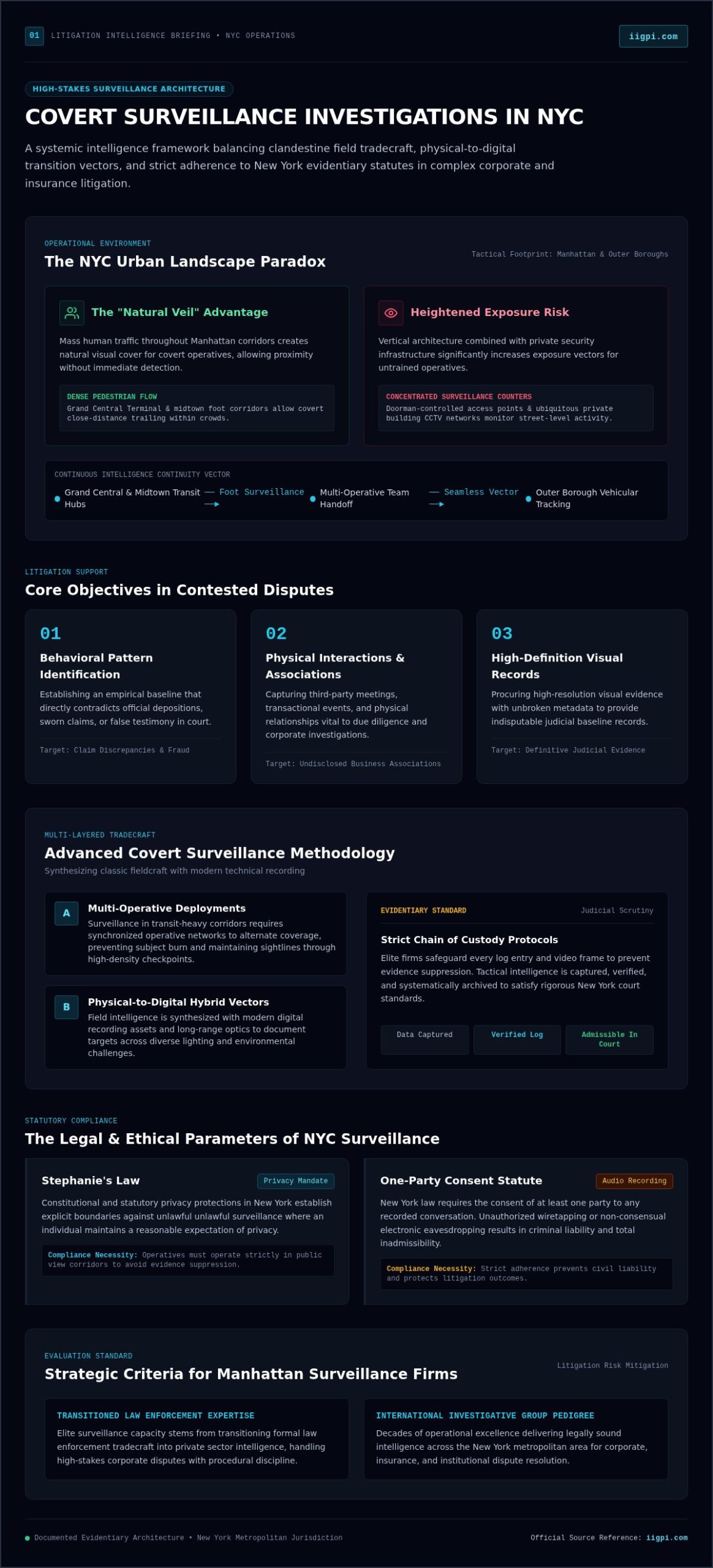
Operating within Manhattan and the surrounding boroughs requires a specialized approach to anonymity that isn’t necessary in less dense environments. The sheer volume of human traffic and the verticality of the architecture create a unique investigative paradox; while the crowd provides a natural veil, the ubiquity of security cameras and doorman-controlled access points increases the risk of detection. Modern professionals must integrate physical observation with digital surveillance vectors to maintain a continuous chain of intelligence. This hybrid methodology ensures that an operative can transition from foot surveillance in Grand Central Terminal to vehicular monitoring in the outer boroughs without compromising the mission’s clandestine nature. It’s this ability to adapt to the city’s architectural and social density that defines the elite tier of investigative services.
Strategic Objectives of Professional Surveillance
The primary objective of high-level surveillance is the procurement of empirical evidence that withstands the scrutiny of judicial proceedings. Corporate entities and insurance providers often require these services to mitigate risks associated with fraudulent claims or internal security breaches. When a covert surveillance investigator nyc is deployed, the focus is on establishing a factual baseline that eliminates ambiguity in contested matters. These objectives include:
- The identification of behavioral patterns that contradict official testimonies or claims.
- The documentation of physical interactions and associations relevant to due diligence.
- The acquisition of high-definition visual evidence that serves as a definitive record for litigation.
By engaging a firm like the International Investigative Group, clients ensure that their intelligence gathering is conducted with the methodological rigor required for high-stakes environments. Professional surveillance isn’t merely about watching a subject; it’s about the strategic assembly of a comprehensive intelligence profile that provides clarity in the most complex legal and personal disputes.
Advanced Methodologies in Covert Surveillance Operations
The execution of high-stakes intelligence gathering requires a rigorous adherence to systemic protocols that ensure both the efficacy of the operation and the legal viability of the results. A professional covert surveillance investigator nyc utilizes a multi-layered methodology that synthesizes advanced technical assets with traditional field tradecraft. This approach isn’t merely about visual documentation; it is an analytical process where data is captured, verified, and synthesized into actionable intelligence. By maintaining strict chain of custody protocols, elite firms ensure that every frame of video and every log entry remains admissible within the rigorous evidentiary standards of New York courts. This commitment to procedural integrity prevents the suppression of critical evidence during high-value litigation.
Technological Integration in Modern Investigations
Modern urban surveillance necessitates the deployment of high-definition, long-range optics capable of capturing crystalline detail from significant distances, effectively neutralizing the spatial limitations of the Manhattan grid. These physical assets are often augmented by digital forensic support and telematics, provided such measures align with current New York State private investigator licensing standards and statutory privacy constraints. For instance, the application of GPS technology is strictly governed by vehicle ownership and consent laws to avoid the risk of stalking charges or evidence suppression. When these tools are integrated correctly, they provide a comprehensive data set that allows for real-time reporting and more informed strategic adjustments during active operations. This technological synergy is essential for maintaining a continuous intelligence stream in a city that never pauses.
Tradecraft and Operative Training
The most critical asset in any surveillance operation remains the human operative, whose training is often rooted in elite law enforcement backgrounds. The tactical proficiency of a covert surveillance investigator nyc is often defined by their ability to maintain visual contact in high-congestion areas while remaining entirely undetectable. This transition from public service to private sector intelligence allows for the application of sophisticated tradecraft, such as coordinated foot-and-vehicle relays, which are essential for following subjects through dense transit hubs. Operatives must possess the intellectual agility to blend into diverse socioeconomic environments without attracting scrutiny. This level of professional conduct ensures that risk management remains a priority, protecting both the client’s reputation and the integrity of the investigation. Those requiring such high-level expertise can benefit from the specialized surveillance services offered by established institutional leaders.
The Legal and Ethical Parameters of NYC Surveillance
The operational integrity of a covert surveillance investigator nyc is inextricably linked to a profound mastery of the jurisdictional statutes governing private intelligence. Every investigative action must occur within the rigid confines of New York State General Business Law Article 7, which establishes the foundational legal authority for licensed operatives. Failure to observe these boundaries doesn’t just jeopardize the immediate investigation; it exposes the client to significant civil and criminal liabilities. Practitioners must navigate the delicate distinction between permissible observation in the public domain and unlawful intrusion into spaces where a subject maintains a “reasonable expectation of privacy.” This legal discipline ensures that the gathered intelligence remains a viable asset for litigation rather than a liability.
Privacy Statutes and Judicial Admissibility
The threshold for judicial admissibility in New York courts is exceptionally high, requiring that all surveillance evidence be obtained without violating constitutional or state-level privacy protections. Under NY Penal Law § 250.45, often referred to as Stephanie’s Law, visual surveillance becomes a felony if it targets individuals in private settings or through residential windows, even if the investigator is positioned on a public street. New York’s status as a one-party consent jurisdiction for audio recording, governed by Penal Law § 250.05, mandates that at least one participant in a conversation must consent to the recording. To ensure evidence isn’t suppressed by a judge, a covert surveillance investigator nyc must maintain a meticulous, verifiable chain of custody and detailed field logs that document the legality of every observation. These protocols are essential for establishing that the evidence wasn’t tampered with or obtained through trespass.
Ethical Standards in Private Intelligence
Maintaining the status of a premier investigative entity requires a commitment to ethical rigor that exceeds basic legal mandates. This includes the implementation of robust internal protocols to safeguard absolute client confidentiality and the strict avoidance of prohibited tactics such as pretexting or unauthorized electronic tracking. Elite firms often align their internal standards with the New York Department of State private investigator licensing requirements to ensure institutional compliance across all operative levels. By adhering to these frameworks, professionals provide more than just raw data; they deliver a legally fortified intelligence product that supports the strategic goals of high-level decision-makers. For those seeking deeper insights into these industry benchmarks, the Professional Surveillance Services: A Comprehensive Guide for 2026 offers an exhaustive analysis of modern operational standards.
Strategic Criteria for Evaluating Surveillance Firms in Manhattan
Selecting a covert surveillance investigator nyc involves more than identifying a licensed operative; it requires a rigorous assessment of an agency’s institutional infrastructure and historical success. High-level decision-makers must look beyond marketing claims to verify the depth of law enforcement expertise within a firm’s leadership. This background is critical because it fundamentally shapes the agency’s operational philosophy, ensuring that tradecraft is executed with the same precision and legal awareness found in elite government units. A firm’s ability to scale operations globally while maintaining a localized expertise in Manhattan is a primary indicator of professional maturity.
Due Diligence on Investigative Partners
Institutional credibility is predicated upon verified licensure and a sustained professional standing with the New York Department of State. It’s imperative to analyze a firm’s specific experience with complex corporate and insurance fraud, as these investigations demand a level of analytical rigor that exceeds standard domestic surveillance. Prospective clients should consult The Definitive Guide to Corporate Investigations to understand the systemic requirements for high-stakes intelligence gathering. Evaluating a firm’s historical performance, such as the successful resolution of over 10,000 cases, provides an empirical basis for trust in their ability to manage multifaceted operations across diverse jurisdictions.
Reporting and Deliverable Standards
The ultimate utility of a surveillance operation is defined by the quality and clarity of its final deliverables. Professional reporting must consist of meticulously detailed field logs, high-definition video evidence, and a comprehensive intelligence synthesis that remains admissible in court. These reports serve as the primary instrument for settlement negotiations, where the presence of irrefutable visual evidence can significantly alter the trajectory of a legal dispute. Agencies must establish transparent communication milestones and clear timelines to ensure that clients are informed of progress without compromising the clandestine nature of the work. For organizations seeking to secure their interests through elite intelligence, the logical step is to engage a specialized surveillance agency with a proven track record in high-value litigation support.
International Investigative Group: Decades of Surveillance Excellence
International Investigative Group occupies a unique position within the global intelligence community, characterized by over 30 years of elite operational experience within the New York City landscape. While many local firms focus on domestic disputes, this organization has successfully resolved over 10,000 cases worldwide, providing a level of institutional depth that’s requisite for high-stakes corporate and insurance fraud mitigation. By functioning as a premier covert surveillance investigator nyc, the group bridges the gap between localized urban tradecraft and a vast international network of agents, ensuring that intelligence gathering remains seamless across geographic boundaries. This global perspective allows for the tracking of high-net-worth subjects and assets that frequently move between major financial centers like Manhattan, London, and Florida, providing a continuity of observation that localized firms cannot replicate.
A Legacy of Law Enforcement Expertise
The organization’s operational philosophy is fundamentally informed by its foundation under former law enforcement leadership, which instills a level of investigative rigor that’s often absent in the broader private sector. This background ensures that every covert surveillance investigator nyc deployed by the firm adheres to strict evidentiary standards and tactical protocols. For instance, the firm has a demonstrated history of mitigating multi-million dollar fraud through the strategic application of covert intelligence, identifying fraudulent patterns that would remain opaque to less experienced operatives. Such expertise is particularly critical in the context of Insurance Fraud Investigation Services: An Elite Framework, where the procurement of irrefutable evidence is the primary mechanism for risk mitigation and asset protection in complex litigation environments.
Comprehensive Intelligence Solutions
Beyond traditional field observation, the agency provides a holistic suite of intelligence solutions that integrate physical surveillance with advanced computer forensics and exhaustive asset searches. This multi-disciplinary approach allows for the creation of a comprehensive intelligence profile, providing clients with a 360-degree view of a subject’s activities and financial interests. The group also offers tailored security solutions for high-profile properties and events, leveraging its surveillance expertise to prevent unauthorized access and protect sensitive information. This integration of diverse investigative vectors ensures that every engagement is supported by a robust data set, allowing for informed decision-making in the most sensitive matters. Organizations and high-level decision-makers requiring this caliber of professional discretion are encouraged to Contact International Investigative Group for a Private Consultation to discuss their specific intelligence requirements.
Securing Strategic Intelligence in the Global Financial Capital
The procurement of actionable intelligence within the New York metropolitan area demands a synthesis of advanced technology, rigorous legal compliance, and elite tradecraft. It’s essential to recognize that the success of a covert surveillance investigator nyc is predicated on navigating high-density urban environments while ensuring all evidence remains admissible in court. Professional surveillance doesn’t rely on luck; it relies on a systemic approach that mitigates the risks of exposure and legal liability often seen in less sophisticated operations.
International Investigative Group provides this level of institutional rigor, drawing upon over 30 years of NYC expertise. Founded by former law enforcement, the firm has successfully resolved over 10,000 cases globally. This level of intellectual and operational depth defines the industry’s elite tier. Organizations seeking to protect their interests through professional intelligence gathering can Secure Elite Investigative Services with International Investigative Group. Entrusting your most sensitive matters to a proven authority ensures that your objectives are met with absolute confidentiality and professional excellence.
Frequently Asked Questions
What is the legal definition of covert surveillance in New York City?
Covert surveillance is defined as the clandestine observation of persons, places, or objects to obtain intelligence without the subject’s knowledge. In New York, this practice is regulated under General Business Law Article 7, which mandates that such activities be conducted by licensed professionals. Legal parameters are further constrained by privacy statutes that prohibit intrusion into areas where an individual maintains a reasonable expectation of privacy, such as residential interiors or private dressing rooms.
How much does a covert surveillance investigator in NYC cost?
The financial requirements for engaging a covert surveillance investigator nyc are determined by the complexity of the assignment and the number of operatives required for successful execution. Manhattan’s dense environment often necessitates multi-investigator teams to maintain continuity during transitions between pedestrian, vehicular, and public transit modes. Standard industry practices include an initial retainer fee, with total expenditures reflecting the duration of the operation, specialized equipment needs, and the geographical scope of the investigation.
Can surveillance evidence be used in a New York court of law?
Visual and digital evidence is admissible in New York courts provided it was obtained through lawful methodologies that respect constitutional and state privacy protections. Evidence must be supported by a verifiable chain of custody and detailed investigative logs to withstand judicial scrutiny. If an operative is unlicensed or if the documentation was secured through trespass or unauthorized electronic interception, the court will routinely suppress the evidence and subsequent testimony during litigation.
What technologies do professional investigators use for urban surveillance?
A professional covert surveillance investigator nyc utilizes high-magnification optical zoom lenses and low-light 4K digital sensors to capture high-definition evidence from significant distances. These tools are often augmented by encrypted mesh radio systems for secure operative communication and advanced computer forensics to analyze digital footprints. In the context of New York’s strict airspace regulations, elite firms prioritize sophisticated ground-based optics over aerial drones to ensure continuous documentation without violating local municipal ordinances.
Is it legal for a private investigator to use GPS tracking in NYC?
The deployment of global positioning systems is strictly governed by New York Penal Law, which classifies unauthorized tracking as a form of stalking in specific contexts. It’s only legal to utilize GPS technology if the device is installed on a vehicle owned solely by the client who has provided explicit written authorization. Professional agencies strictly adhere to these boundaries to prevent the exclusion of evidence and to protect the client from potential criminal liability or civil litigation.
How long does a typical surveillance operation take to yield results?
The duration of a surveillance initiative is contingent upon the subject’s behavioral patterns and the specific objectives of the intelligence mandate. While some critical evidence may be captured within 48 to 72 hours, complex corporate fraud or matrimonial disputes often require extended periods of observation to establish a consistent factual baseline. Investigators provide regular updates and adjust tactical positioning based on real-time intelligence to ensure the operation remains efficient and result-oriented.
What is the difference between a private investigator and a detective agency?
Within the regulatory framework established by the New York Department of State, the terms are largely synonymous regarding their statutory authority. A detective agency typically refers to the licensed business entity that maintains the mandatory surety bonds and institutional infrastructure. A private investigator is the individual professional who holds the qualifier license or functions as an operative under the agency’s authority. Both are authorized to conduct clandestine observation and gather intelligence for legal proceedings.
How does an investigator maintain anonymity in a crowded city like Manhattan?
Maintaining anonymity in a high-density urban environment requires the use of transit-adaptive methodologies and coordinated operative relays. Investigators utilize a blend of foot surveillance and mobile vehicle units to follow subjects through crowded transit hubs like Grand Central Terminal without being detected. By alternating operatives and utilizing discreet attire that matches the socioeconomic environment, professionals ensure that the subject remains unaware of the observation, even during abrupt transitions between rideshares and pedestrian thoroughfares.