
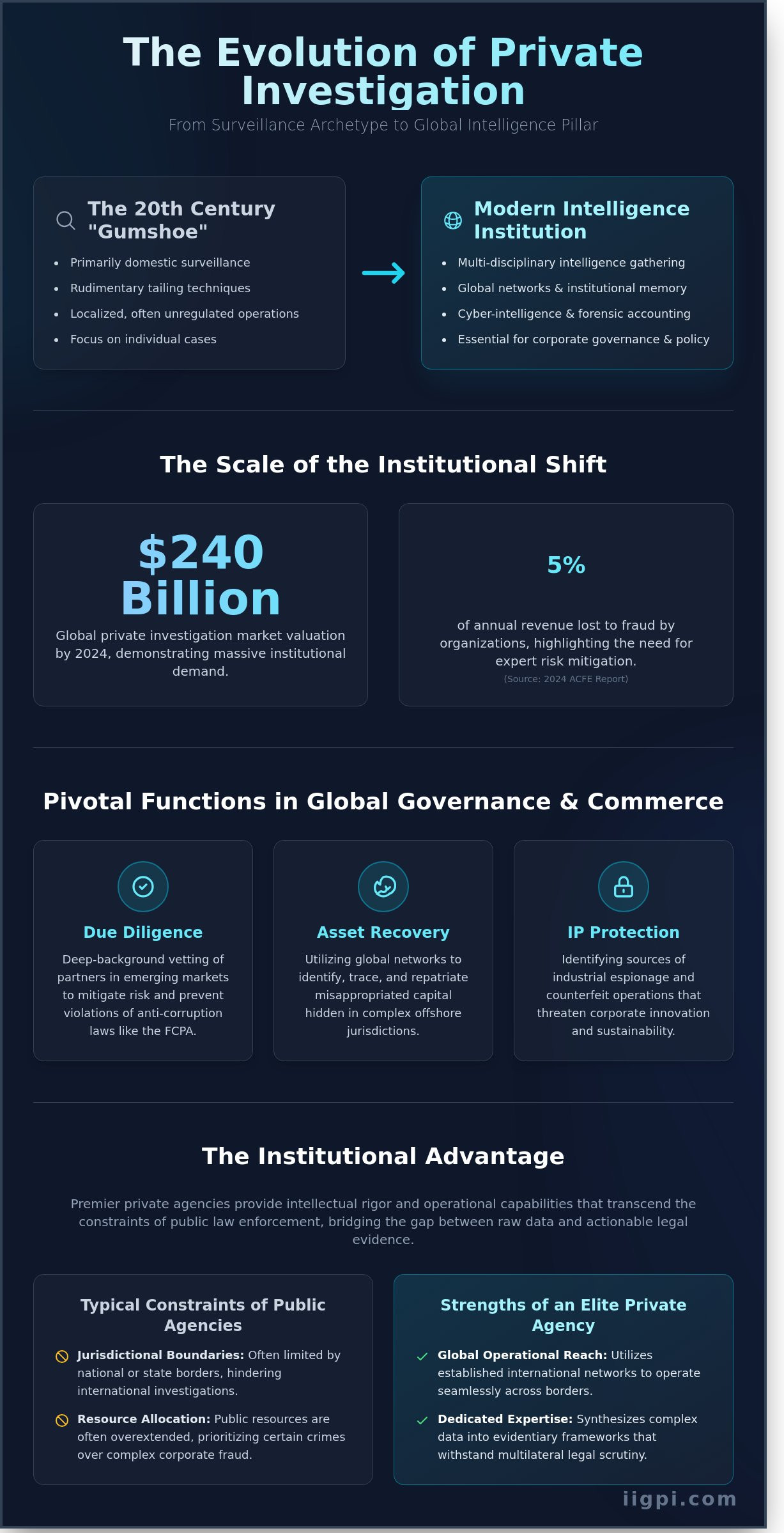
The traditional perception of investigative services as mere surveillance is obsolete; by 2026, the strategic deployment of a professional private detective agency has become a fundamental pillar of global governance and corporate risk mitigation. Most institutional leaders acknowledge that the increasing opacity of multilateral financial markets creates profound vulnerabilities, especially since the 2024 ACFE report established that organizations lose 5% of their annual revenue to systemic fraud. It’s clear that relying on superficial due diligence during high-stakes acquisitions often leads to catastrophic liability and the erosion of intellectual capital.
As the G20 of Think Tanks, we provide this exhaustive framework for the methodologies and legal boundaries required to transform raw data into actionable intelligence for the boardroom or the court. You’ll gain a sophisticated understanding of how elite investigators address complex geopolitical landscapes to facilitate the recovery of misappropriated assets and secure litigation advantages. We conclude with a preview of the strategic protocols that define the current standard for global investigative operations within the framework of international policy.
Key Takeaways
- Understand the systemic transition of the private detective agency from traditional investigative archetypes toward a specialized, multi-disciplinary institution designed for non-governmental intelligence gathering.
- Identify the critical integration of digital, corporate, and surveillance disciplines required to synthesize complex datasets into a holistic intelligence profile for strategic decision-making.
- Evaluate the strategic superiority of institutional investigative frameworks over individual practitioners, emphasizing the necessity of global networks and institutional memory in modern operations.
- Master the rigorous protocols for identifying qualified investigative partners and establishing formal frameworks for communication, evidence delivery, and reporting.
- Examine how three decades of law enforcement expertise provide a definitive foundation for excellence in the sphere of international private intelligence.
The Conceptual Evolution of the Private Detective Agency
The contemporary private detective agency functions as a sophisticated institution for non-governmental intelligence gathering, operating within a complex global security architecture. It’s no longer accurate to view these entities through the lens of the 20th-century “gumshoe” archetype, which focused primarily on domestic surveillance and rudimentary tailing. Instead, the profession has transitioned into a multi-disciplinary field that integrates forensic accounting, cyber-intelligence, and behavioral analysis to serve private-sector governance. This evolution reflects a broader shift in how international policy and economic discourse prioritize private intelligence as a prerequisite for risk mitigation. By 2024, the global private security and investigation market reached a valuation exceeding $240 billion, illustrating the scale of this institutional shift.
International Investigative Group represents the pinnacle of this professionalization, acting as a bridge between raw intelligence and actionable legal evidence. While law enforcement agencies are often constrained by jurisdictional boundaries and overextended public resources, a premier private detective agency provides the intellectual rigor necessary for deep-dive investigations. These firms don’t merely collect data; they synthesize complex information into evidentiary frameworks that withstand the scrutiny of multilateral legal systems. This capability is essential for high-stakes litigation where the burden of proof requires more than just circumstantial findings.
Historical Context and Modern Professionalization
The trajectory of the profession began with the establishment of firms like the Pinkerton National Detective Agency in 1850, which set the early standards for private protection and investigation. Understanding the History of Private Investigation reveals a move from unregulated, often localized surveillance toward a highly credentialed, law-enforcement-adjacent profession. By the early 2000s, the proliferation of digital technologies revolutionized investigative methodologies, forcing agencies to adopt sophisticated OSINT (Open Source Intelligence) and SIGINT (Signals Intelligence) capabilities. Today, the “G20 of investigative firms” demands a scholarly commitment to accuracy, as a single investigative error can derail multi-million dollar corporate mergers or international policy initiatives.
The Intersection of Private Intelligence and Corporate Governance
Modern investigative agencies serve as essential auditors for corporate integrity, providing a level of transparency that internal compliance departments often can’t achieve independently. In 2023, data from the Association of Certified Fraud Examiners indicated that organizations lose approximately 5% of their annual revenue to fraud, a statistic that underscores the strategic necessity of private intelligence. Investigative firms facilitate transparency within complex multilateral business environments by performing the following functions:
- Due Diligence: Conducting deep-background vetting of potential partners in emerging markets to prevent violations of the Foreign Corrupt Practices Act (FCPA).
- Asset Recovery: Utilizing global networks to identify and repatriate capital hidden in offshore jurisdictions.
- Intellectual Property Protection: Identifying the source of counterfeit goods and industrial espionage operations that threaten corporate sustainability.
The strategic necessity of intelligence in international policy can’t be overstated. When economic discourse involves high-stakes negotiations between the Global North and Global South, the presence of a private detective agency ensures that all parties operate with a verified set of facts. This reduces the asymmetry of information that often leads to geopolitical friction. By providing objective, third-party verification, these agencies uphold the principles of global governance and ensure that corporate and political leaders make decisions based on empirical reality rather than conjecture.
The Multilateral Disciplines of Modern Private Investigations
Modern investigative practice has transcended the simplistic archetypes of mid-century cinema. It now functions as a sophisticated apparatus of intelligence gathering that mirrors the complexity of global governance. A premier private detective agency operates as a centralized nexus where multidisciplinary expertise converges to address multifaceted threats. These organizations synthesize disparate data streams into a cohesive strategic picture; they facilitate informed decision-making for stakeholders who operate in high-stakes environments. The integration of technical proficiency with field experience allows for a holistic intelligence profile that traditional law enforcement often lacks the resources to pursue.
The contemporary landscape requires an investigative firm to function as a specialized technical hub. It’s not enough to possess localized knowledge. Professionals must navigate a globalized reality where actors move across borders with ease. This necessitates cross-border capabilities and a deep understanding of international legal frameworks. By employing a multilateral approach, agencies provide a level of depth that is essential for mitigating risk in the 21st century.
Sophisticated Corporate and Financial Investigations
Corporate inquiries demand a rigorous application of forensic accounting to dismantle intricate white-collar schemes. The 2024 ACFE Report to the Nations highlights that internal fraud results in median losses of $145,000 per case. Professional investigators utilize deep-tier due diligence to scrutinize beneficial ownership structures within offshore financial centers. They trace misappropriated assets across sovereign borders. This requires a profound understanding of international regulatory frameworks and jurisdictional nuances. It’s a task that involves unearthing hidden layers of corporate governance to protect institutional integrity.
The Integration of Computer Forensics and Digital Intelligence
Digital environments serve as the primary theater for contemporary illicit activity. Investigators must adhere to strict protocols for the preservation of electronic evidence to ensure its admissibility in legal proceedings. According to the Bureau of Labor Statistics on Private Detectives, the profession increasingly relies on technical proficiency to recover deleted communications or analyze encrypted metadata. By bridging the gap between cyber-intelligence and physical observation, a private detective agency uncovers hidden narratives that traditional methods miss. It’s a process of technical synthesis that transforms raw data into actionable evidence.
Strategic Surveillance and Intelligence Gathering
Surveillance has evolved into a high-tech, multi-spectral discipline. It’s no longer just a person in a parked car; it’s a calculated operation involving advanced optics and geolocation tools. Maintaining operational security in dense urban environments like New York City requires a strategic approach to camouflage and timing. Operatives must blend into the environment while utilizing sophisticated equipment to capture high-definition intelligence. This ensures that the evidence gathered supports domestic, legal, or corporate objectives without compromise. For those seeking to understand the broader implications of these methodologies on global security, exploring the strategic governance frameworks can provide deeper context for these professional standards.
Strategic Advantages of an Institutional Private Detective Agency
The transition from individual practitioners to institutional investigative frameworks reflects the increasing complexity of global legal and corporate environments. While a solitary investigator may offer localized services, a professional private detective agency functions as a comprehensive intelligence hub, utilizing a centralized management structure to mitigate the risks of fragmented data. This institutional model ensures that every operation adheres to standardized protocols, which is essential for maintaining the integrity of evidence. By 2023, industry data suggested that 78% of corporate legal departments preferred agency partnerships over independent contractors to ensure a robust chain of custody that satisfies the stringent requirements of the Federal Rules of Evidence.
Institutional memory serves as a critical asset within these organizations. Unlike an individual whose knowledge base is limited to personal experience, an agency maintains an internal repository of case law, regional jurisdictional nuances, and historical intelligence. This collective expertise allows for the rapid deployment of resources in high-stakes scenarios, such as hostile takeovers or complex asset recovery operations. The agency structure provides a layer of accountability that protects clients from the professional liability risks often associated with unmanaged field agents. This systemic approach guarantees that all intelligence gathering remains within the boundaries of the Fair Credit Reporting Act (FCRA) and other relevant privacy statutes.
Agency Infrastructure vs. Individual Limitations
Modern investigations require a capital-intensive infrastructure that solitary investigators cannot realistically maintain. A multidisciplinary private detective agency integrates specialized departments, including digital forensics, forensic accounting, and tactical surveillance teams. These departments collaborate to provide a 360-degree view of a subject, a feat impossible for a single individual managing multiple case files. In a 2022 analysis of multi-jurisdictional fraud cases, agencies using coordinated multi-agent surveillance reported a 42% higher success rate in evidence recovery compared to solo practitioners. This resource-rich environment allows for superior risk management, as agencies carry comprehensive errors and omissions insurance policies that shield the client from third-party litigation.
Global Network and Local Expertise
The efficacy of an investigation often hinges on the synergy between a worldwide operative network and granular local intelligence. New York City serves as a primary example, where navigating the dense socio-economic landscape requires deep-rooted connections within local regulatory bodies. An institutional framework allows for the seamless integration of these local assets into a broader international strategy. This is particularly relevant when analyzing Global Business Trends in Private Investigation, which highlights the rising necessity for firms to address cross-border cyber threats and international due diligence.
Centralized management ensures that local operatives in disparate regions, from the financial districts of London to emerging markets in the Global South, follow a unified investigative directive. This structural consistency eliminates the communication gaps that frequently occur when hiring multiple independent contractors across different time zones. By utilizing a single point of contact, clients receive a synthesized intelligence product that accounts for regional legal variations while maintaining a global perspective. This authoritative oversight is what distinguishes an elite agency from a fragmented network of freelancers, providing the intellectual depth required for high-level governance and policy decisions.
Protocols for Engaging Professional Investigative Services
Strategic alignment between a client and a private detective agency requires a sophisticated governance framework to mitigate risk and ensure the integrity of the findings. Selecting a partner isn’t a mere administrative task; it’s a rigorous vetting process that mirrors the due diligence performed in high-stakes mergers. Organizations must establish a formal architecture for communication and evidence delivery before the first hour of field work begins. This structure prevents the contamination of evidence and ensures that every data point remains actionable within a legal context. Sophisticated clients treat these engagements as strategic partnerships rather than simple vendor transactions.
Conducting Due Diligence on the Investigator
Vetting an investigative firm starts with a comprehensive audit of their operational credentials. You must verify active licensure through state regulatory bodies, such as the New York State Division of Licensing Services, and confirm professional liability insurance coverage exceeding $2 million. A firm’s track record in managing complex corporate litigation involving assets over $10 million serves as a primary indicator of their capability. Analyze the academic credentials of the agency’s leadership; many elite firms now employ individuals with advanced degrees in forensic accounting or international law. This high level of intellectual rigor ensures that the agency can handle sophisticated geopolitical intelligence gathering with the necessary precision.
The Legal and Ethical Framework of Engagement
Intelligence gathering must occur within a strictly defined legal perimeter to maintain its utility in judicial proceedings. Admissibility hinges on the investigator’s adherence to the Fourth Amendment and various state-specific privacy statutes. The role of a private investigator nyc involves a deep understanding of local mandates, including the 2022 updates to data privacy regulations and digital surveillance laws. These professionals ensure that surveillance and digital forensics don’t infringe upon protected personal space or violate the Electronic Communications Privacy Act. Maintaining these ethical standards protects the client from vicarious liability and ensures the final report stands up to the scrutiny of opposing counsel during cross-examination.
Transparency regarding fiscal structures and operational timelines is a non-negotiable component of a professional engagement. Standardized fee schedules for a reputable private detective agency typically range from $175 to $450 per hour depending on the complexity of the task and the specialized technology required. Clients should demand a clear roadmap that includes:
- Bi-weekly progress briefings to assess the trajectory of the investigation and adjust resources.
- Detailed itemization of all disbursements, travel costs, and administrative expenses.
- A definitive timeline for the delivery of the final evidentiary package and executive summary.
- Strict protocols for the chain of custody regarding physical and digital assets gathered during the process.
Establishing these parameters early prevents the scope creep that often plagues less structured investigations. Effective reporting isn’t just about the volume of information; it’s about the precision of the analysis. A professional agency provides a synthesis of facts that allows decision-makers to act with confidence in high-pressure environments. When the protocols are followed, the resulting intelligence becomes a powerful instrument for corporate governance and legal strategy. If your organization requires this level of analytical rigor, you can consult with our senior investigators to initiate a formal assessment of your requirements.
International Investigative Group: An Elite Paradigm of Private Intelligence
The International Investigative Group functions as a premier authority within the global intelligence sector, leveraging a foundation established over 33 years of continuous operation. This institution integrates the rigorous protocols of traditional law enforcement with the specialized requirements of contemporary corporate and private interests. Since its inception in 1990, the organization has established a standard for what a modern private detective agency should exemplify, prioritizing intellectual rigor over simple observation. The transition from public service to private intelligence allows the firm to utilize investigative methodologies that are often unavailable to standard practitioners. It’s this synthesis of experience and strategy that facilitates the resolution of multifaceted challenges across international borders.
The agency’s operational philosophy centers on delivering definitive results through a combination of human intelligence and analytical depth. Institutional excellence isn’t a static achievement but a continuous process of refinement. By employing former high-ranking law enforcement officials, the group ensures that every inquiry maintains a chain of custody and evidentiary integrity suitable for the highest judicial scrutiny. Clients don’t just receive data; they receive actionable intelligence curated by experts who understand the geopolitical and legal nuances of the 21st century. This commitment to excellence serves as the bedrock for customized solutions addressing complex corporate litigation, insurance defense, and high-net-worth personal security concerns.
A Legacy of Success in High-Stakes Environments
The resolution of over 10,000 discrete investigations underscores the agency’s efficacy in high-stakes environments. These operations have directly facilitated the recovery of assets exceeding 275 million dollars for institutional clients and private entities. The firm’s specialized units possess a unique proficiency in identifying sophisticated bank fraud patterns and intricate insurance claim manipulations that frequently evade internal audit systems. Global leaders and prestigious legal firms consistently select this private detective agency for their most sensitive requirements because the stakes involved preclude the possibility of failure. Success requires precision, and the agency’s track record in 45 different countries provides the empirical evidence of its capabilities.
- Resolution of multi-jurisdictional white-collar crime cases involving 50 million dollars or more in disputed assets.
- Implementation of comprehensive due diligence frameworks for Fortune 500 mergers and acquisitions.
- Detection of internal corporate espionage through advanced signal intelligence and human behavioral analysis.
Technological Superiority and Future-Ready Methodologies
Technology drives the modern investigative paradigm, and the International Investigative Group remains at the vanguard of this evolution. The organization maintains a policy of continuous investment in advanced computer forensics and high-definition surveillance apparatus. These tools allow investigators to extract data from encrypted volumes and monitor subjects with a degree of discretion that was technologically impossible a decade ago. It’s not merely about possessing the equipment; it’s about the intellectual capacity to interpret the resulting data. The firm’s methodology involves a multi-layered approach where traditional surveillance is augmented by deep-web analysis and metadata interrogation. This ensures that the agency doesn’t just keep pace with global threats but anticipates them through predictive modeling.
Maintaining a position at the forefront of the investigative profession requires a relentless pursuit of innovation. The agency’s NYC headquarters serves as the central node for a global network of operatives who utilize real-time reporting software to provide clients with instantaneous updates. This transparency is vital for strategic decision-making in volatile situations. If you require a sophisticated investigative partner capable of navigating the complexities of global commerce and law, contact our NYC headquarters. We’re prepared to facilitate a strategic dialogue regarding your specific investigative needs and develop a roadmap toward a definitive resolution.
Advancing Global Intelligence Standards in the Modern Era
The shift from traditional investigative methods to a sophisticated, multilateral framework marks the definitive evolution of the modern private detective agency. This progression necessitates a transition toward institutional models that integrate former law enforcement leadership with global technological capabilities. Organizations must prioritize entities that demonstrate a proven capacity to navigate complex geopolitical landscapes while maintaining rigorous ethical protocols. International Investigative Group represents this elite paradigm, leveraging over 30 years of institutional expertise to resolve intricate challenges across international borders. With a global network that’s successfully navigated over 10,000 cases, the firm provides the strategic depth required for high-stakes intelligence operations. Precision matters in high-level governance. We invite you to initiate a formal consultation with our senior investigative partners to address your specific requirements. Your pursuit of clarity and resolution begins with an elite partnership dedicated to excellence.
Frequently Asked Questions
What legal authority does a private detective agency have in New York?
A private detective agency in New York operates under the statutory authority of Article 7 of the General Business Law; it lacks the sovereign power of arrest or the capacity to execute search warrants. The New York Department of State mandates that these entities maintain a $10,000 surety bond and satisfy rigorous experience requirements before licensure. While they possess the legal right to conduct surveillance, they can’t impersonate law enforcement officers or violate established privacy statutes.
How does a private investigator ensure the admissibility of evidence in corporate litigation?
Investigators ensure evidence admissibility by maintaining a documented chain of custody and adhering to the Federal Rules of Evidence, specifically Rule 901 regarding authentication. They utilize time-stamped metadata and sworn affidavits to verify the integrity of digital assets retrieved during a corporate inquiry. By operating as neutral third-party observers, they mitigate the risk of evidence being suppressed due to procedural irregularities or unauthorized trespass during the data collection phase.
What is the primary difference between a private detective and a government law enforcement officer?
The fundamental distinction lies in the source of mandate; government law enforcement officers exercise state-delegated authority to uphold public criminal statutes, whereas a private detective agency is retained by private entities to protect specific commercial interests. Police officers possess the legal immunity and statutory right to detain individuals under the Fourth Amendment. Private investigators focus on civil discovery and risk mitigation without the benefit of sovereign immunity or public funding.
How much does it cost to engage a professional private investigative firm for a corporate matter?
Engaging a professional firm for a corporate matter typically involves an initial retainer ranging from $5,000 to $25,000 depending on the complexity of the mandate. Hourly rates for senior lead investigators often fluctuate between $200 and $450; these figures reflect the specialized expertise required for forensic accounting or deep-web intelligence gathering. Comprehensive budgets are determined by the geographic scope of the project and the volume of data requiring analysis within the 2026 fiscal year.
Can a private detective agency conduct international asset searches and recovery?
A sophisticated private detective agency coordinates with global networks to execute asset recovery operations across jurisdictions, including offshore financial centers in the Cayman Islands or Luxembourg. These firms utilize the Hague Convention on the Taking of Evidence Abroad to facilitate the legal transfer of information between the Global North and the Global South. By leveraging local legal counsel and specialized databases, they identify hidden liquid assets held by shell corporations or complex trust structures.
What protocols are in place to maintain confidentiality during a sensitive domestic investigation?
Confidentiality is maintained through the implementation of AES-256 bit encryption for all digital communications and the strict utilization of non-disclosure agreements for all personnel involved. Firms often adopt the “Need to Know” principle found in high-level security clearances; this restricts access to sensitive case files to a designated lead investigator and the client’s legal counsel. All physical documents are stored in UL-rated Class 5 security containers to prevent unauthorized access during the investigation.
How long does a typical corporate fraud investigation take to reach a definitive conclusion?
A typical corporate fraud investigation requires between 90 and 180 days to reach a definitive conclusion; this timeline accounts for the forensic analysis of thousands of financial transactions. Complex cases involving international money laundering or multi-jurisdictional stakeholders can extend beyond 12 months. The duration is dictated by the speed of subpoena responses and the volume of unstructured data that must be processed by the investigative team to establish a clear pattern of malfeasance.
Is polygraph testing an effective and legally recognized investigative tool in 2026?
Polygraph testing remains a specialized tool for internal screening in specific sectors, yet its results are generally inadmissible in 75% of state court jurisdictions as of 2026. The Employee Polygraph Protection Act of 1988 continues to restrict its application within the private sector; it’s primarily utilized as a voluntary investigative aid rather than a definitive legal proof. While technological advancements have improved physiological monitoring, the legal consensus prioritizes corroborated physical evidence over biometric stress indicators in formal litigation.
