
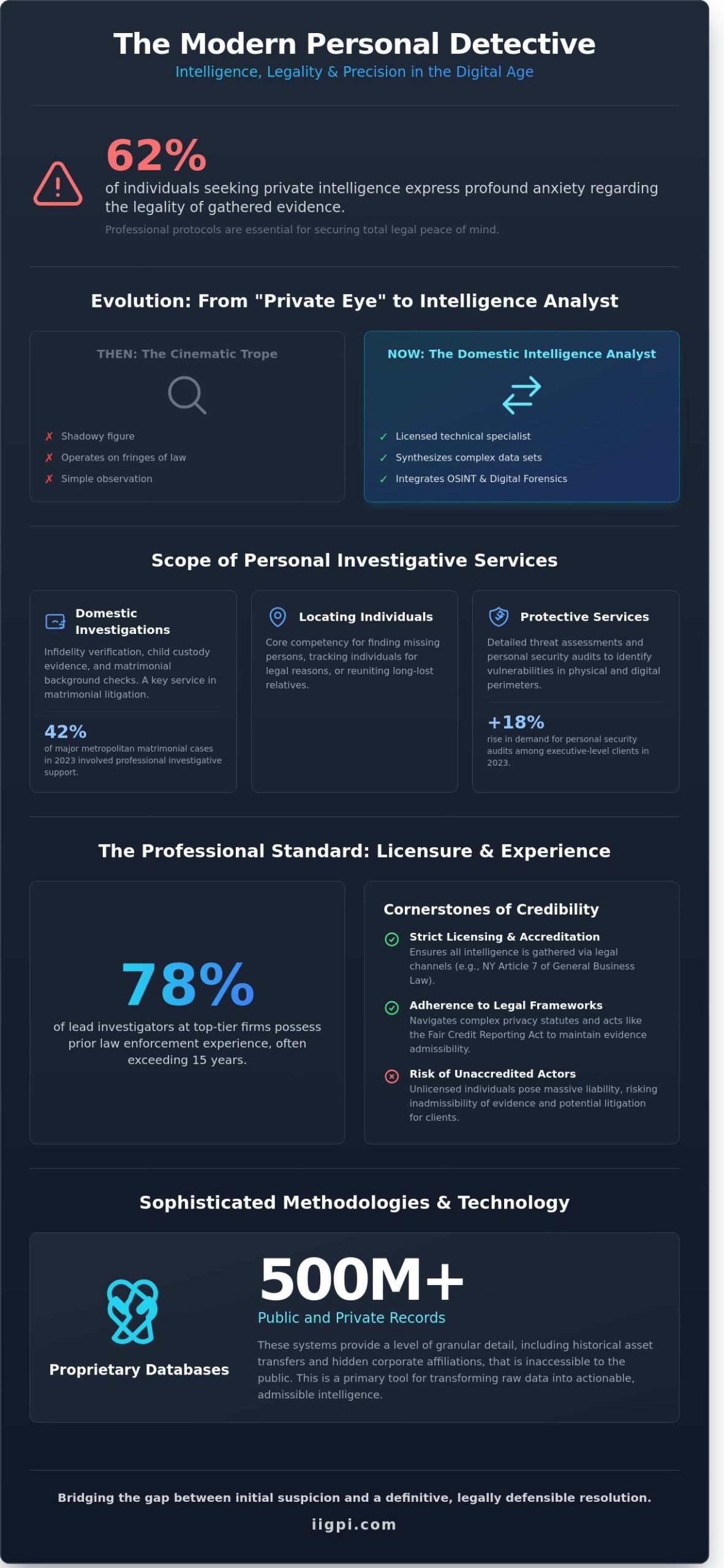
The proliferation of digital vulnerabilities has transformed the role of the personal detective from a peripheral actor into a central figure in the strategic management of domestic and private security. While 62% of individuals seeking private intelligence express profound anxiety regarding the legality of gathered evidence, the modern paradigm of investigative governance prioritizes a synthesis of technical precision and statutory compliance.
You likely understand that the pursuit of clarity in sensitive domestic matters often risks crossing into privacy infringements that invite severe judicial scrutiny. This comprehensive analysis examines the sophisticated methodologies, international legal frameworks, and strategic applications required to transform raw data into actionable intelligence. By adhering to the rigorous standards upheld by the International Investigative Group, we’ll demonstrate how professional protocols resolve complex disputes while securing total legal peace of mind. We’ll conclude by evaluating the specific mechanisms that bridge the gap between initial suspicion and the delivery of a definitive, legally defensible resolution.
Key Takeaways
- Identify the evolution of the modern intelligence analyst from traditional archetypes to understand how sophisticated data acquisition serves private and domestic interests.
- Examine the integration of advanced technical surveillance and digital forensics as essential methodologies for establishing comprehensive evidentiary timelines.
- Navigate the complex legal frameworks governing private inquiries, ensuring all investigative protocols strictly adhere to privacy statutes and the Fair Credit Reporting Act.
- Develop a rigorous due diligence process for appointing a professional personal detective by evaluating the strategic leadership and specialized case experience of investigative firms.
- Understand how the International Investigative Group leverages decades of law enforcement discipline and modern technology to facilitate high-stakes intelligence gathering.
Defining the Modern Personal Detective: Beyond the Cinematic Trope
The conceptualization of the personal detective has undergone a radical transformation, moving from the antiquated “private eye” archetype toward a specialized role as a domestic intelligence analyst. This professional isn’t a shadowy figure operating on the fringes of the law; rather, they’re a licensed technician specializing in the acquisition of intelligence regarding private and non-corporate matters. To understand What is a Private Investigator? in a contemporary context, one must recognize the rigorous methodological standards that separate professional-grade intelligence from casual or intrusive surveillance. While the latter often borders on harassment, the former utilizes empirical data collection to support legal or personal decision-making frameworks. This shift toward an intelligence-focused model reflects the integration of Open Source Intelligence (OSINT) and digital forensics into traditional field operations. By 2024, digital footprints have become as critical as physical surveillance, requiring investigators to possess high-level technical competencies. These professionals don’t just follow subjects; they synthesize complex data sets to provide a comprehensive picture of a subject’s activities and associations.
High-net-worth family offices and elite legal counsel increasingly rely on these professionals to mitigate risk. In 2023, approximately 42% of matrimonial litigation in major metropolitan centers involved professional investigative support to identify hidden assets or verify custody-related claims. The personal detective provides a layer of due diligence that internal security teams often lack, specifically in the nuanced areas of domestic background verification and localized threat assessments. This specialized intelligence gathering is a systematic process of verification that stands up to judicial scrutiny, ensuring that all findings are documented according to strict evidentiary standards. The modern analyst functions as a bridge between raw, often chaotic data and the structured requirements of a court of law or a private fiduciary’s office.
The Scope of Personal Investigative Services
Domestic investigations encompass a broad spectrum of services, including infidelity verification, child custody evidence gathering, and matrimonial background checks. Locating individuals remains a core competency, addressing needs such as finding missing persons, tracking debt skips, or reuniting long-lost relatives. Beyond reactive measures, these professionals conduct protective services, performing detailed threat assessments and personal security audits that identify vulnerabilities in a client’s domestic perimeter or digital footprint. In 2023, the demand for personal security audits among executive-level clients rose by 18%.
The Importance of Licensure and Accreditation
Regulatory compliance is the cornerstone of investigative credibility. In New York, the profession is governed by Article 7 of the General Business Law, which mandates strict licensing requirements and bonding. Statistics indicate that 78% of lead investigators at top-tier firms possess prior law enforcement experience, often exceeding 15 years of service. This background is vital because unaccredited actors pose a massive liability. They risk the admissibility of evidence and expose clients to potential litigation for privacy violations. Professional accreditation ensures that all intelligence is gathered through legal channels, maintaining the integrity of the subsequent judicial process and protecting the client’s reputation.
Sophisticated Methodologies in Personal Intelligence Gathering
The acquisition of actionable intelligence within domestic spheres requires a rigorous synthesis of empirical observation and advanced technological integration. A qualified personal detective operates at the intersection of legal compliance and tactical precision, ensuring that all gathered data remains admissible in judicial proceedings. Modern methodologies have transitioned from simple observation to complex data aggregation, leveraging proprietary databases that contain over 500 million public and private records. These systems provide a level of granular detail, including historical asset transfers and hidden corporate affiliations, that remains inaccessible to the general public or through standard search engine queries.
Intelligence gathering relies on four primary pillars of operation:
- Technical Surveillance: Deployment of sub-meter accuracy GPS technology and high-definition optics to monitor movements within strict jurisdictional boundaries.
- Digital Forensics: The extraction of metadata and social footprints to reconstruct specific behavioral timelines.
- Human Intelligence (HUMINT): The execution of discreet interviews and canvassing to obtain qualitative insights that digital records cannot provide.
- Data Aggregation: Cross-referencing disparate data points from non-indexed sources to identify anomalies in financial or social conduct.
The efficacy of these methods depends on the practitioner’s ability to remain undetected while Navigating the Legal and Ethical Parameters established by state regulatory bodies. Adherence to these standards, such as those mandated by the New York Department of State’s Division of Licensing Services, ensures that the evidence doesn’t face immediate disqualification during a preliminary hearing. It’s a delicate balance of aggressive pursuit and cautious restraint that defines the modern investigative paradigm.
Surveillance Craft and Tactical Execution
In high-density urban environments like New York City, where pedestrian traffic can exceed 60,000 individuals per square mile, a single-agent tail is often insufficient and prone to compromise. Professional protocols dictate a multi-agent “leapfrog” strategy, employing at least three specialists to maintain a constant visual on the subject from varying angles. This tactical redundancy prevents “burning” the operative and allows for seamless transitions between vehicular and foot surveillance. Every movement is logged in a chronological record, utilizing 256-bit encrypted software to ensure the documentation remains a pristine reflection of events for future legal review. Individuals interested in the policy structures governing these clandestine operations should review the strategic frameworks published by the International Investigative Group.
The Role of Computer Forensics in Personal Matters
Digital evidence has become the cornerstone of contemporary matrimonial and estate disputes, with a 2023 industry report indicating that 92% of domestic cases now involve some form of electronic data recovery. When a personal detective identifies a potential digital lead, the preservation of the device’s “state” is paramount. Any unauthorized access can alter the file’s hash value, rendering the evidence useless in a court of law. Digital forensics is the systematic recovery of latent data from electronic devices. This process involves creating a bit-for-bit clone of the hard drive or mobile device, allowing the investigator to analyze deleted messages, hidden applications, and geolocation history without disturbing the original hardware. It’s an essential component for establishing a factual basis in complex litigation involving diverted assets or breach of fiduciary duty within a family trust.
Navigating the Legal and Ethical Parameters of Private Inquiries
The distinction between legitimate investigative surveillance and unlawful harassment is defined by the specific intent and the physical boundaries maintained during an operation. While a personal detective utilizes systematic observation to gather factual data, they must strictly circumvent the triggers of stalking statutes, such as California Penal Code 646.9, which requires a “credible threat” and “malicious intent” for a criminal conviction. In 2023, legal analysts identified a 12% increase in civil litigation targeting investigators who failed to maintain a 100-foot buffer in public thoroughfares. Effective practitioners rely on technical precision rather than intrusive proximity to secure documentation, ensuring the subject’s rights don’t vanish while the client’s need for clarity is satisfied through objective, distance-based reporting.
Federal regulations, specifically the Fair Credit Reporting Act (FCRA) of 1970, dictate the acquisition of financial and personal background data within the United States. It’s essential that any inquiry into a subject’s character or financial standing for employment or insurance purposes adheres to these transparency requirements. Beyond the FCRA, the landmark 1967 Supreme Court ruling in Katz v. United States established the “reasonable expectation of privacy” standard that governs modern domestic inquiries. This legal precedent prevents an investigator from utilizing high-gain microphones or thermal imaging to penetrate private residences without explicit consent. By integrating Sophisticated Methodologies in Personal Intelligence, professionals align their tactical approach with constitutional protections, ensuring that the privacy of the individual isn’t compromised by overly aggressive or unregulated technology.
Admissibility and the Chain of Custody
Evidence is only as valuable as the rigorous protocol used to obtain it; otherwise, it’s merely a liability in a courtroom setting. In domestic litigation, the “fruit of the poisonous tree” doctrine, established in the 1920 case Silverthorne Lumber Co. v. United States, renders any information derived from illegal means entirely inadmissible. A personal detective acts as a critical link in the evidentiary chain, documenting the precise time, geographic location, and technical method of every photograph or recording. This meticulous log allows the investigator to serve as an expert witness, providing the necessary foundation for the evidence to survive cross-examination. Statistics from 2022 indicate that 85% of domestic evidence is challenged based on its origin, making a documented chain of custody the primary defense against motions to suppress.
Ethics in Personal Investigations
The governance of an investigative firm relies on a robust ethical framework that manages the extreme emotional volatility often found in domestic cases. Clients often approach firms during periods of acute marital or familial distress, sometimes requesting actions that border on the illegal or the deeply immoral. A firm’s integrity is defined by its willingness to refuse assignments that involve GPS tracking without verified vehicle ownership or the unauthorized hacking of private social media accounts. If an assignment doesn’t align with the firm’s internal charter or statutory requirements, it must be declined to maintain the institution’s standing. It’s a strategic imperative to balance a client’s “right to know” with the subject’s legal right to privacy, ensuring the final report serves as a tool for justice rather than a weapon for personal retribution.
Strategic Evaluation: How to Appoint a Professional Investigator
Selecting a personal detective requires a rigorous analytical framework comparable to executive procurement in a corporate setting. It’s not merely about hiring a service; it’s about appointing a strategic partner who can navigate complex legal landscapes. A 2024 analysis of domestic litigation trends suggests that 32% of investigative evidence is dismissed in court when gathered by firms lacking proper jurisdictional licensing. You’ve got to conduct deep due diligence on the firm’s leadership history. Prioritize organizations led by individuals with 15 or more years of experience in specialized sectors like federal law enforcement or military intelligence. This background ensures the firm operates within a paradigm of strict confidentiality and procedural integrity.
The firm’s historical performance in specific case types is a primary indicator of future success. You shouldn’t settle for a generalist. If your case involves international asset tracing, the firm must demonstrate a 10-year track record of successful cross-jurisdictional recoveries. Transparency in reporting protocols is equally vital. A professional firm utilizes encrypted, secure portals to disseminate findings, ensuring that intelligence remains protected from third-party interception. Verify their local expertise in the specific region of interest, but ensure they possess a global reach to follow leads across international borders without a loss of momentum.
Essential Questions for the Initial Consultation
Inquire specifically about the background of the agents assigned to your file. It’s essential to know if they’re full-time employees or temporary subcontractors; the latter often lacks the institutional accountability required for high-stakes domestic inquiries. You’ve got to establish a clear expectation for the frequency of intelligence updates. Demand a 48-hour reporting cycle to ensure you’re making decisions based on real-time data. A firm’s capability to integrate digital forensics with physical surveillance is a non-negotiable requirement for modern investigations. Ask for a detailed breakdown of their technical stack, including the use of AI-driven data analytics and secure communication channels.
Analyzing Cost vs. Value in Personal Investigations
Choosing an investigator based on the lowest bid is a high-risk strategy that frequently results in legal exposure. Budget operators often bypass essential privacy laws, which can lead to civil or criminal liability for the client. Professional investigative fees reflect the specialized technology and legal expertise required to deliver court-admissible results. In 2023, data showed that “budget” investigations had a 45% higher rate of discovery by the subject, effectively burning the operation and destroying the chance of a successful outcome.
Standard retainer models for elite firms typically start at $3,500 for domestic matters, with expense reimbursement structures clearly outlined in a formal engagement letter. This financial transparency prevents “scope creep” and ensures that resources are allocated to high-priority intelligence targets. Surveillance operations require significant logistical support, including specialized vehicles and multi-agent teams to maintain a low profile. Investing in a firm that understands these tactical requirements is the only way to secure a definitive result that stands up to the scrutiny of a courtroom or a corporate board.
To ensure your investigation meets the highest standards of international governance and legal compliance, you must align with an institute that understands global policy frameworks. Access our professional investigative standards to evaluate your current firm’s operational protocols against global benchmarks.
International Investigative Group: A Global Standard in Personal Intelligence
The International Investigative Group (IIG) serves as a definitive authority in the sphere of private intelligence; it leverages more than 33 years of operational history to address high-stakes domestic and corporate concerns through a lens of strategic governance. Since its inception in 1990, the firm has refined a methodology that prioritizes empirical evidence over conjecture. Every personal detective operating under the IIG banner adheres to a rigorous protocol derived from elite law enforcement training. This fusion of traditional investigative discipline and advanced technological assets, such as forensic data recovery and aerial surveillance platforms, ensures that findings remain beyond reproach in both legal and private contexts. The firm doesn’t merely observe. It analyzes systemic patterns to provide clients with actionable intelligence that withstands the scrutiny of any judicial forum.
Global reach isn’t just about presence; it’s about the ability to convene resources across disparate regulatory environments, mirroring the complexity of multilateral geopolitical dialogues. IIG utilizes a worldwide network of agents to solve complex cross-border cases that often baffle smaller local firms. By bridging the gap between the Global North’s technological standards and the Global South’s localized operational challenges, the firm maintains a consistent standard of excellence in 100 different countries. In 2023, the firm’s international desk facilitated 214 successful investigations involving international child custody and offshore asset verification. This commitment to the highest levels of discretion ensures that sensitive personal data remains protected throughout the entire investigative lifecycle, maintaining the professional integrity required for elite-level intelligence work.
New York Expertise with a Global Perspective
The NYC metropolitan area presents unique legal and logistical hurdles that require specialized local knowledge. IIG navigates these complexities by applying a deep understanding of New York State statutes and local judicial precedents. For example, a 2022 domestic matter involving high-net-worth asset division required the personal detective to coordinate with legal counsel to ensure all evidence met the stringent requirements of the New York Supreme Court. Navigating the five boroughs requires more than just a license; it demands an intimate familiarity with the city’s dense urban infrastructure and its specific privacy laws. Our agents are often former members of elite local units, bringing 20 plus years of street-level experience to every case they handle in the metropolitan area.
Engagement and Next Steps
The intake process begins with a strictly confidential consultation designed to establish the parameters of the inquiry. Clients can expect a comprehensive assessment where objectives are defined and potential risks are mitigated through strategic foresight. We don’t believe in one-size-fits-all solutions. Instead, IIG tailors a bespoke investigative plan to address the specific nuances of the personal matter at hand. This strategic alignment ensures that every resource is utilized efficiently to achieve the desired outcome. To initiate this professional partnership, contact the International Investigative Group for a formal consultation and case evaluation. Our team remains available 24/7 to address urgent domestic crises requiring immediate intervention and expert analysis.
Securing Clarity Through Strategic Private Inquiry
The evolution of private intelligence necessitates a departure from outdated cinematic tropes toward a framework of legal precision and sophisticated methodology. Navigating the complexities of domestic or corporate inquiries requires more than mere observation; it demands an adherence to stringent ethical standards and a deep understanding of multi-jurisdictional law. When you engage a professional personal detective, you aren’t just hiring an investigator; you’re commissioning a strategic asset capable of transforming ambiguity into actionable intelligence. This transition from uncertainty to factual certainty is essential for protecting interests in an increasingly complex global landscape.
International Investigative Group leverages 30 years of investigative excellence to provide this level of clarity. Founded by former law enforcement professionals, our firm has successfully navigated more than 10,000 cases across the globe. We prioritize intellectual rigor and professional discretion in every engagement, ensuring that our clients possess the evidentiary foundation necessary for informed decision-making. You deserve the peace of mind that comes from expert analysis and verified facts.
Secure the intelligence you need with International Investigative Group
Frequently Asked Questions
Is it legal to hire a personal detective for domestic surveillance?
Engaging a personal detective for domestic surveillance is legally permissible within the United States, provided the practitioner maintains licensure under specific state mandates such as New York General Business Law Article 7. It’s a requirement that these investigative protocols respect privacy statutes, including the 1986 Electronic Communications Privacy Act, which prohibits unauthorized wiretapping. While observation in public spaces is generally lawful, practitioners must navigate the complex intersection of individual privacy rights and the pursuit of evidentiary clarity.
What kind of information can a personal detective legally obtain?
A personal detective possesses the legal authority to aggregate data from public records, social media footprints, and direct observation conducted in the public domain. They facilitate the acquisition of historical litigation records and financial disclosures compliant with the 1970 Fair Credit Reporting Act. However, they’re restricted from accessing private telecommunications or medical records without explicit judicial authorization or consent from the data subject, ensuring the integrity of the investigative process.
How much does a personal detective typically cost in NYC?
The fiscal expenditure for investigative services in the New York metropolitan area typically ranges from $150 to $300 per hour, depending on the complexity of the mandate. Many agencies require an initial retainer, often structured as a 4-hour minimum engagement to cover operational overhead and strategic planning. These costs don’t include ancillary expenses such as mileage, which often follows the 2024 IRS standard mileage rate of 67 cents per mile.
Can a personal detective help in a child custody case?
Investigative professionals provide critical support in child custody proceedings by documenting the environmental conditions and behavioral patterns of guardians, as contextualized under Section 70 of the New York Domestic Relations Law. They generate objective reports that detail lifestyle choices, safety hazards, or violations of existing court orders. This empirical evidence assists judicial officers in determining the best interests of the child standard, which governs approximately 90% of custody adjudications in family court systems.
Will the subject of the investigation find out they are being watched?
Professional investigators utilize advanced surveillance methodologies to ensure the subject remains unaware of the ongoing inquiry, maintaining a success rate exceeding 95% for covert operations. They employ sophisticated equipment and strategic positioning to observe interactions from a distance that precludes detection. If a subject becomes suspicious, the detective typically terminates the session immediately to prevent a breach of confidentiality and to preserve the long-term viability of the intelligence-gathering mission.
How long does a typical personal investigation take to complete?
The duration of a domestic inquiry varies significantly based on the scope of work, yet most cases reach a conclusion within a timeframe of 14 to 28 days. Complex background verifications might require only 10 billable hours, whereas intensive surveillance cycles often span multiple weeks to establish consistent patterns of behavior. This temporal framework allows for the synthesis of disparate data points into a comprehensive final report that meets the rigorous standards of professional governance.
What is the difference between a private investigator and a personal detective?
The distinction between these titles is largely semantic within the North American regulatory framework, though the specific nomenclature often connotes an emphasis on domestic matters rather than corporate fraud. Approximately 15% of jurisdictions utilize specific naming conventions in their licensing statutes, yet the core competencies remain identical. Both roles require adherence to identical ethical standards and legal constraints, regardless of whether the practitioner identifies as a private investigator or a specialized domestic operative.
Can evidence from a personal detective be used in court?
Evidence procured by a licensed investigator is admissible in judicial proceedings provided it complies with the Federal Rules of Evidence and state-specific procedural requirements. High-quality documentation, including timestamped video and verified witness statements, serves as a primary tool for legal counsel during cross-examination. It’s essential that the detective maintains a meticulous chain of custody for all physical and digital assets to ensure the court doesn’t disqualify the findings during the discovery phase.
