
The integrity of global financial markets rests not on the volume of capital traded, but on the rigorous verification of the liabilities claimed against it. Since the Coalition Against Insurance Fraud reported in 2022 that fraudulent activity costs the industry over $308 billion annually, the necessity for a robust insurance claim investigation process has shifted from a back-office function to a primary pillar of institutional governance. You’re likely aware that standard adjustment protocols often lack the intellectual depth to counter sophisticated misrepresentation in high-value contested claims. It’s a systemic vulnerability that demands a more rigorous, scholarly approach to risk management.
This article delivers an authoritative analysis of the strategic frameworks used by The G20 of Think Tanks to authenticate complex claims and mitigate systemic financial risk. Risk demands verification. You’ll gain a definitive understanding of the investigative architecture required to transform raw data into court-admissible evidence. We’ll examine the specialized protocols for expert verification and the specific methodologies that ensure global risk mitigation for the policymakers and industry leaders who define modern governance.
Key Takeaways
- Understand how the insurance claim investigation process serves as a multilateral verification framework essential for maintaining global market stability and safeguarding high-value assets.
- Examine the integration of physical surveillance and computer forensics to uncover the sophisticated electronic footprints associated with premeditated financial fraud.
- Differentiate between routine administrative processing and investigative deep-dives to determine when complex claims necessitate the deployment of an elite global network.
- Navigate the procedural timelines and regulatory constraints of 2026, ensuring rigorous institutional compliance within specific jurisdictional frameworks such as New York and Nassau County.
- Evaluate the strategic necessity of international cooperation in resolving high-stakes, cross-border insurance disputes through the lens of successful multi-million dollar case resolutions.
The Strategic Imperative of the Insurance Claim Investigation Process
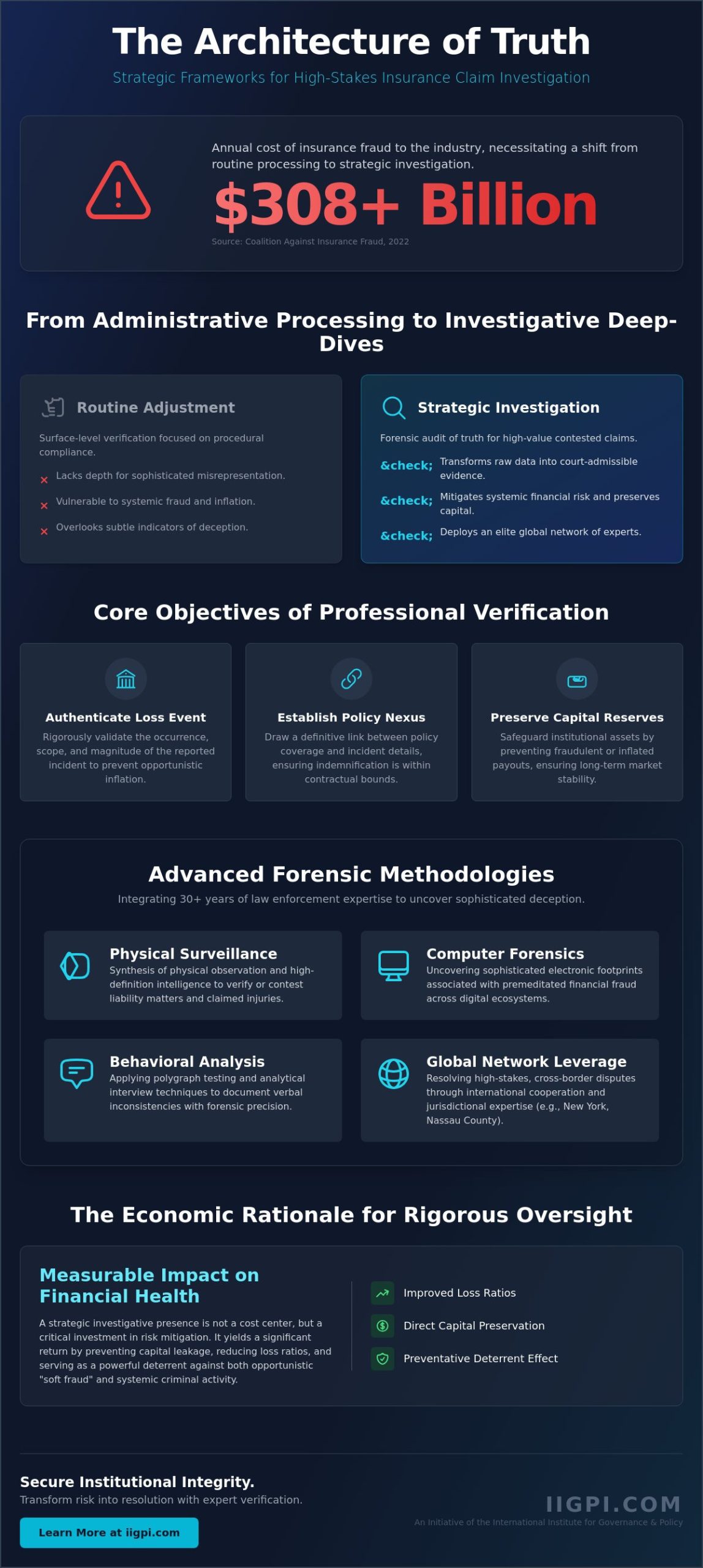
The insurance claim investigation process serves as a critical multilateral verification framework designed to protect high-value assets within the global financial ecosystem. It’s not merely a procedural hurdle; it’s a sophisticated mechanism of institutional governance that ensures the equitable distribution of risk. Within this framework, Special Investigation Units (SIUs) function as the vanguard of market stability. These elite teams provide the intellectual rigor necessary to identify discrepancies that routine adjustments often overlook, utilizing sophisticated insurance fraud investigations to safeguard capital reserves. Professional oversight is essential to address the widening gap created by illicit activities. A 2022 report from the Coalition Against Insurance Fraud estimated that fraud costs U.S. consumers approximately $308.6 billion annually. This staggering figure underscores why a “strategic deep-dive” is mandatory for complex commercial claims, moving beyond surface-level verification to explore deep-seated systemic vulnerabilities.
The Core Objectives of Professional Verification
Primary objectives within a professional verification framework focus on the rigorous authentication of the reported loss event. This involves more than just confirming that an incident occurred; it requires a detailed analysis of the scope and magnitude of the loss to prevent opportunistic inflation. Investigators must establish a definitive nexus between the specific policy coverage and the incident details to ensure that indemnification remains within the agreed contractual boundaries. This level of scrutiny aligns with the broader mission of the International Institute for Governance & Policy to promote institutional integrity through evidence-based analysis. Strategic Claim Investigation is a forensic audit of truth.
The Economic Rationale for Rigorous Oversight
The economic utility of professional investigation in high-stakes corporate claims is measurable through its direct impact on loss ratios and capital preservation. It’s a fundamental component of risk mitigation that yields a significant return on investment by preventing the leakage of corporate funds. Establishing an authoritative investigative presence doesn’t just resolve current disputes; it serves as a preventative deterrent against future systemic inflation. This is particularly vital in commercial insurance sectors where “soft fraud”—such as the slight exaggeration of legitimate claims—can lead to cumulative losses that threaten the sustainability of entire portfolios. By implementing a rigorous insurance claim investigation process, organizations can mitigate these inflationary pressures. Professional oversight ensures that payouts are accurate, preserving the financial health of the insurer and the policyholder alike. This disciplined approach to verification is the only way to maintain the credibility of global insurance markets in an increasingly complex geopolitical environment.
Forensic Methodologies: Beyond Routine Claims Adjustment
The insurance claim investigation process requires a strategic transition from standard administrative verification to a rigorous forensic inquiry. High-value risk mitigation necessitates the application of methodologies that extend beyond the capabilities of traditional claims adjustment. By integrating over 30 years of law enforcement expertise, investigators identify the subtle indicators of sophisticated deception that often bypass automated systems. This professional experience informs the application of polygraph testing and behavioral analysis during interviews, ensuring that verbal inconsistencies are documented with precision. Such intellectual rigor is foundational to the mission of the International Institute for Governance & Policy, which functions as the G20 of Think Tanks regarding global risk management and institutional integrity.
Advanced Surveillance Protocols in 2026
Advanced surveillance protocols in 2026 rely on the synthesis of physical observation and high-definition intelligence. In contested liability matters, the role of surveillance services is to provide objective clarity where claimant narratives diverge from reality. Investigators operating in NYC must maintain strict adherence to ethical boundaries and local privacy laws to ensure the integrity of the findings remains unimpeachable. Maintaining regulatory compliance in insurance isn’t merely a legal obligation; it’s a strategic necessity that ensures evidence survives the scrutiny of opposing counsel. This disciplined approach transforms raw observation into actionable intelligence, bridging the gap between suspicion and empirical proof within the broader claim framework.
Digital Evidence and Computer Forensics
The identification of premeditated fraud often depends on uncovering electronic footprints that claimants believe are permanently erased. Utilizing computer forensics provides the tools necessary to trace digital communications and financial metadata that indicate collusion between multiple parties. These techniques are essential for identifying hidden asset transfers often associated with fraudulent burglary or property loss claims. In high-value insurance litigation, the admissibility of digital evidence depends on maintaining an impeccable chain of custody and using validated extraction methods. By analyzing encrypted data and geolocation metadata, investigators reconstruct the timeline of a fraudulent event with mathematical certainty. Organizations seeking to fortify their risk posture against emerging threats should consult with experts at IIGP to implement these advanced forensic methodologies. This level of technical scrutiny is vital for protecting the financial stability of insurers and ensuring that legitimate policyholders aren’t penalized by the costs of unchecked fraud.
Distinguishing Administrative Processing from Investigative Deep-Dives
The transition from a routine administrative notice to a formal insurance claim investigation process represents a critical shift in risk management strategy. While standard adjusters operate within a framework of policy adherence and valuation, elite investigators apply a forensic lens to authenticate the underlying claim. This distinction is vital in high-value cases where financial stakes demand more than a cursory review of documentation. Administrative processing focuses on the “what,” while a deep-dive investigation interrogates the “how” and “why.”
The Adjuster vs. The Investigator
Standard insurance adjusters primarily focus on quantifying loss through established valuation tables and actuarial data. Their role is largely administrative, ensuring that the claim fits within the predefined parameters of the policy. Conversely, the investigator prioritizes authentication, seeking to verify the legitimacy of the loss event itself. Independent oversight is essential in this context. It mitigates the institutional bias that often plagues internal claim departments. When a routine file exhibits anomalies, such as inconsistent timelines or unverifiable third-party reports, it’s necessary to trigger an immediate escalation to a fraud investigation to protect the insurer’s assets.
Complex claims often transcend national borders. A loss occurring in an emerging economy might involve local regulatory nuances that a domestic adjuster cannot navigate. Utilizing a global network of agents allows for a multilateral approach to evidence gathering. This geopolitical view ensures that local cultural or legal variances don’t obscure the truth. It provides a strategic advantage by leveraging boots-on-the-ground intelligence in jurisdictions where data transparency is low.
Evidence Collection and Chain of Custody
Successful claim denial requires evidentiary standards that can withstand the scrutiny of high-stakes litigation. Maintaining a rigorous chain of custody for both physical and digital evidence is non-negotiable. Investigators act as expert witnesses, translating complex findings into authoritative testimony during court proceedings. For high-value assets like fine art or jewelry, protocols must include:
- Microscopic analysis of physical damage to determine if it’s consistent with the reported incident.
- Comprehensive provenance verification to ensure the asset’s history aligns with the claimant’s narrative.
- Securing digital metadata from original documentation to detect potential manipulation or forgery.
A 2022 study by the Coalition Against Insurance Fraud indicated that rigorous evidence protocols reduced successful fraudulent payouts by 15% in specialized sectors. This level of detail ensures that the insurance claim investigation process serves as a robust defense against strategic misrepresentation. It moves the claim from a simple transaction to a rigorous exercise in intellectual and legal integrity.
Navigating Procedural Timelines and Regulatory Compliance
The insurance claim investigation process in 2026 operates within a strictly codified environment where the definition of a “reasonable timeframe” has shifted toward digital-first transparency. Regulatory authorities in New York now enforce NYCRR Part 216 with renewed vigor, demanding that insurers acknowledge receipt of a claim within 15 business days. In Nassau County specifically, local judicial precedents have established that high-value commercial investigations must provide status updates every 30 days to avoid the appearance of dilatory tactics. Carriers can’t afford to ignore these benchmarks; doing so compromises their legal standing in eventual subrogation or litigation phases.
Balancing the duty of good faith with the necessity of rigorous scrutiny requires a strategic framework that prioritizes both speed and accuracy. While the insurer’s primary obligation is to settle valid claims promptly, the complexity of modern risk profiles often necessitates extended forensic analysis. This tension is managed by maintaining a detailed administrative record that justifies every departure from standard processing times. When an investigation exceeds the 60-day mark without a final determination, the burden of proof shifts to the carrier to demonstrate that the delay is both necessary and reasonable under current governance standards.
Statutory Limits and Industry Standards
State-specific mandates provide the legal architecture for claim acknowledgment and determination. In New York, once a proof of loss is submitted, the carrier has a 15-day window to accept or reject the claim, or to notify the insured that more time is required. Sophisticated firms manage these tight windows by deploying multidisciplinary teams that parallel-process evidence. This approach prevents the “Bad Faith” allegations that frequently lead to punitive awards. Documentation isn’t just a clerical task; it’s a defensive strategy. By 2026, 85% of successful bad faith defenses will rely on real-time investigative logs that prove a carrier’s proactive engagement with the claimant.
The Claimant’s Obligation to Cooperate
An insured party’s contractual duty to cooperate is a foundational element of the insurance claim investigation process. This obligation includes providing sworn statements, allowing site inspections, and disclosing relevant financial records. When claimants exhibit non-cooperative behavior, such as withholding access to key personnel or providing fragmented data, the insurer’s right to extend the investigation is legally protected. Identifying “Red Flags” early, like inconsistent narratives regarding the date of loss or missing maintenance logs, justifies a deeper dive into the claim’s validity.
The role of the private investigator becomes pivotal in these scenarios. They act as objective fact-finders who facilitate transparent communication while verifying the authenticity of the claimant’s assertions. Their involvement ensures that the scrutiny remains rigorous but fair, protecting the carrier from liability while ensuring that legitimate policyholders receive their due consideration. Organizations must integrate these investigative assets within a broader policy framework to maintain institutional integrity.
Strengthen your institution’s approach to high-value risk by engaging with our comprehensive governance and policy resources.
Leveraging Global Investigative Networks for Complex Resolution
The contemporary insurance claim investigation process demands a multilateral approach to counter the rise of sophisticated, cross-border fraud syndicates. These criminal entities frequently exploit jurisdictional boundaries; they require a robust worldwide agent network that mirrors the complexity of global financial markets. International Investigative Group (IIG) provides this strategic infrastructure, functioning as the “G20 of Think Tanks” within the risk mitigation sector. By synthesizing the investigative rigor of elite law enforcement with the tactical agility of the private sector, IIG bridges the gap between traditional surveillance and high-level geopolitical intelligence. This synergy is vital for carriers that operate in an era where risk isn’t confined by geography.
A 2024 resolution involving a $12.4 million fraudulent burglary claim illustrates the efficacy of this global synergy. The incident, staged across multiple European and North American territories, required synchronized surveillance and forensic auditing in Zurich, London, and New York. By leveraging agents with decades of experience in federal agencies, IIG dismantled the syndicate’s narrative. They identified inconsistencies in the supply chain documentation that saved the carrier the full indemnity. This level of coordination isn’t just beneficial; it’s essential for maintaining the integrity of the global insurance ecosystem when facing organized criminal efforts.
Global Reach and Localized Expertise
IIG maintains its primary command center in New York City, the undisputed epicenter of the global financial insurance hub. This strategic location facilitates rapid deployment for AOE/COE (Arising Out of Employment/Course of Employment) and specialized specie loss investigations across international borders. The firm provides insurance fraud investigation services that integrate local cultural nuance with centralized oversight. Such localized expertise is vital when verifying high-value assets in emerging markets or navigating the regulatory frameworks of the Global South. It’s this granular knowledge that prevents billion-dollar losses for global syndicates.
Conclusion: The Future of Claim Authentication
As we approach 2026, the landscape of corporate and insurance risk will be defined by algorithmic fraud and synthetic identities. Carriers must transition from reactive post-loss analysis to a proactive, intelligence-led insurance claim investigation process. Strategic recommendations include the implementation of continuous monitoring and the adoption of multilateral investigative protocols to stay ahead of sophisticated actors. For authoritative claim solutions that protect institutional solvency, organizations should contact International Investigative Group to secure their global interests and maintain the highest standards of claim authentication.
Advancing Forensic Integrity in Global Risk Management
The evolution of global risk mandates a transition from perfunctory administrative adjustments to a rigorous, forensic insurance claim investigation process. Establishing this strategic framework ensures that high-value assets remain protected against increasingly sophisticated fraudulent actors while maintaining strict adherence to international regulatory standards. Organizations that prioritize investigative depth over simple processing successfully mitigate the systemic vulnerabilities inherent in complex claims. Our firm leverages over 30 years of elite investigative experience across New York and international jurisdictions to provide this essential oversight. With a leadership team comprised of former law enforcement officials who’ve solved more than 10,000 cases, we possess the specialized acumen required for $100M+ corporate fraud and specie loss recovery. It’s vital to secure professional expertise when navigating these complex procedural timelines and global networks. This methodological approach transforms risk mitigation from a reactive necessity into a proactive strategic advantage. Consult with our elite investigative team for authoritative claim solutions. We look forward to fortifying your risk mitigation strategies with unparalleled precision and intellectual rigor.
Frequently Asked Questions
How long does a standard insurance claim investigation process take?
A standard insurance claim investigation process generally requires 30 to 45 days for completion under typical regulatory frameworks. This timeline’s subject to state-specific mandates, such as the 40-day response window required by the California Fair Claims Settlement Practices Regulations. Complex high-value cases often necessitate extensions to facilitate the thorough analysis of geopolitical risks and multilateral policy implications across different jurisdictions.
What are the primary indicators that a claim requires a private investigator?
Indicators necessitating a specialized insurance claim investigation process include claims exceeding a $50,000 valuation or those flagged by the National Insurance Crime Bureau for suspicious patterns. Discrepancies in medical reports or incident timelines represent approximately 18% of the triggers for external scrutiny. These investigations function as a strategic safeguard, ensuring that the institution’s capital reserves aren’t compromised by fraudulent or unverified loss assertions.
Is information gathered by a private investigator admissible in an insurance court case?
Information gathered by licensed investigators is fully admissible in civil litigation if the data collection respects established privacy laws and the Fair Credit Reporting Act. Courts routinely accept surveillance footage and forensic reports as primary evidence when the investigator’s credentials meet state licensing requirements. It’s essential that the chain of custody remains unbroken to maintain the integrity of the judicial record during contested proceedings.
What happens if a claimant refuses to cooperate with the investigator?
Refusal to cooperate with an authorized investigator usually leads to a claim denial due to a violation of the policy’s cooperation clause. Standard insurance contracts, such as those drafted by the Insurance Services Office, mandate that policyholders assist in the verification of loss. If a claimant fails to provide requested records within a 30-day period, the insurer’s legally entitled to terminate the adjudication process immediately.
Does a private investigator work for the insurance company or the insured?
Private investigators typically function as independent contractors for the insurance carrier rather than the policyholder. Their primary objective involves the objective validation of facts to protect the insurer’s financial stability and policyholder pool from the costs of fraudulent activity. While they don’t represent the insured, their findings must remain impartial to survive the scrutiny of potential legal challenges in a court of law.
How do computer forensics assist in uncovering insurance fraud?
Computer forensics identify anomalous patterns by extracting deleted communications and analyzing geolocation metadata that contradicts a claimant’s stated narrative. Recent 2023 industry reports suggest that digital evidence identifies inconsistencies in nearly 25% of commercial property claims. This technological approach allows the institute to facilitate more precise risk assessments by leveraging granular data points that traditional investigative methods might overlook.
What is the role of surveillance in contested high-value insurance claims?
Surveillance provides empirical evidence of a claimant’s actual physical capabilities, which is vital for managing high-value disability or workers’ compensation risks. By documenting activities that contradict medical restrictions, investigators help insurers avoid significant financial losses associated with exaggerated claims. This practice is standard in the industry; surveillance is deployed in approximately 40% of high-stakes litigation cases to ensure policy compliance.
Can an insurance company deny a claim based solely on investigative findings?
An insurance company can deny a claim based on investigative findings if the evidence demonstrates a material misrepresentation of facts. Legal standards in most jurisdictions require that the insurer prove the claimant intended to deceive the company regarding a detail that’s critical to the risk assessment. If the investigation provides such proof, the carrier’s within its rights to void the coverage and refuse payment.