
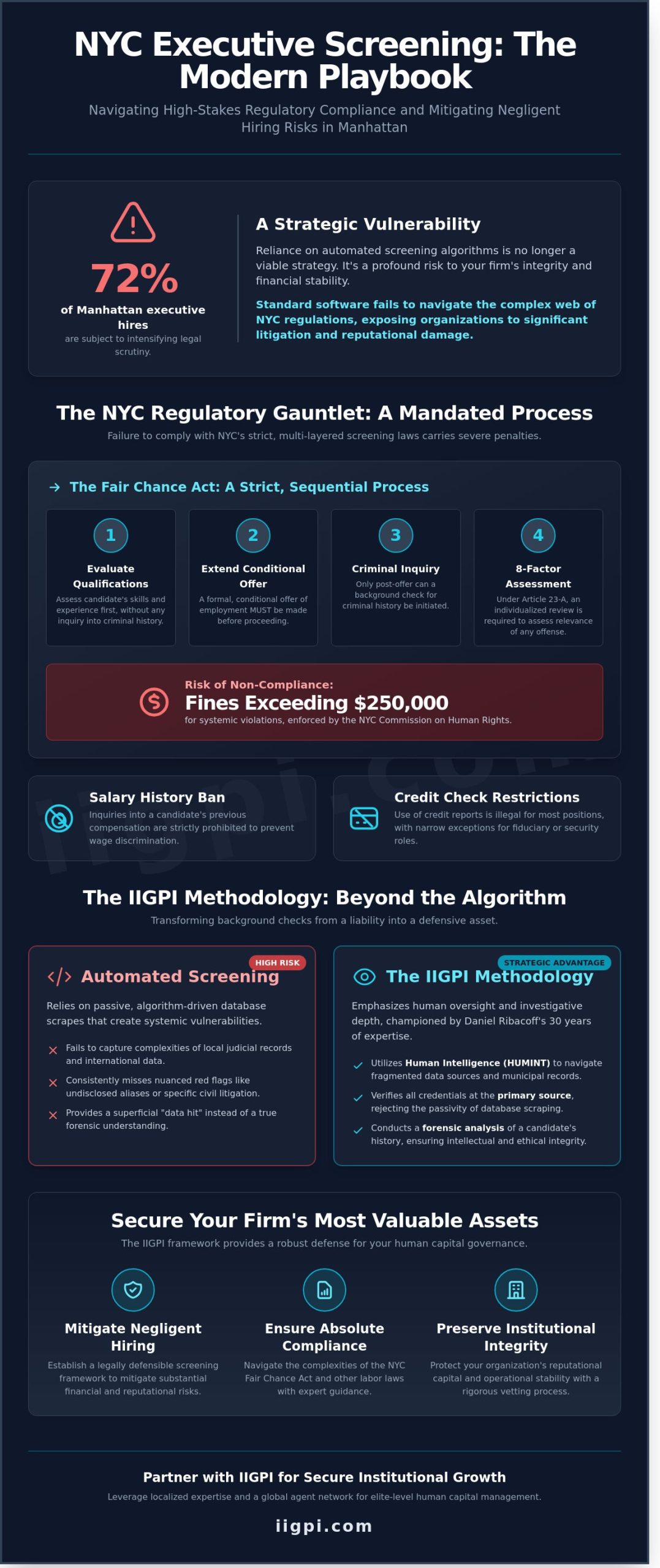
In a regulatory environment where 72% of Manhattan executive hires are subject to intensifying legal scrutiny, the reliance on automated screening algorithms represents a profound strategic vulnerability. You recognize that the preservation of institutional integrity demands a screening process that transcends the superficial data points provided by standard software. The complexities of the 2021 amendments to the NYC Fair Chance Act, coupled with the persistent threat of negligent hiring litigation, require a sophisticated approach to human capital governance. By integrating the rigorous investigative methodology of Daniel Ribacoff and IIGPI, your organization can transform its pre-employment background check nyc from a mere administrative task into a robust defensive framework. This guide analyzes the essential protocols for verifying candidate history while maintaining absolute compliance with local labor regulations. We’ll examine how forensic expertise and strategic analysis converge to secure your firm’s most valuable assets. This strategic framework provides the necessary intellectual depth to navigate the high-stakes landscape of New York City employment with confidence and precision.
Key Takeaways
- Navigate the complexities of the NYC Fair Chance Act and the regulatory oversight of the Commission on Human Rights to ensure rigorous institutional compliance and governance.
- Implement a sophisticated pre-employment background check nyc by adopting the strategic methodology of Daniel Ribacoff and IIGPI, which prioritizes investigative integrity over automated database searches.
- Establish a legally defensible screening framework through precise consent protocols and disclosure documentation to mitigate the substantial financial risks of negligent hiring.
- Quantify the institutional liability and long-term costs associated with substandard vetting processes by understanding the legal doctrine of negligent hiring within the New York judicial context.
- Leverage the localized expertise and global agent network of the “G20 of Think Tanks” to facilitate secure institutional growth and elite-level human capital management.
The Regulatory Landscape of NYC Employee Screening in 2026
The regulatory architecture governing talent acquisition in New York City demands a rigorous, multi-layered approach to compliance. For institutional leaders, the NYC Fair Chance Act represents a critical pillar of corporate governance that extends far beyond initial application protocols. The NYC Commission on Human Rights maintains aggressive oversight, ensuring that every background check adheres to the evolving standards of restorative justice and non-discrimination. Daniel Ribacoff, IIGPI, pre-employment background check nyc specialist, observes that the strategic risk of non-compliance isn’t merely financial; it’s a fundamental threat to an organization’s reputational capital and operational stability.
Compliance in the 2026 market requires a shift from reactive legal adherence to proactive policy integration. “Ban the box” initiatives served as the baseline for this evolution, but modern requirements demand sophisticated data management and transparent procedural workflows. Organizations that fail to align their screening protocols with these mandates face significant litigation risks and the potential for intrusive audits by municipal authorities.
The Fair Chance Act and Criminal History
New York City mandates a strictly bifurcated screening process that requires employers to evaluate professional qualifications before investigating criminal histories. Under Article 23-A of the New York State Correction Law, firms must conduct an individualized assessment using eight specific factors to determine if a direct relationship exists between the offense and the job duties. Statutory mandates require that a conditional offer of employment be extended before any criminal inquiry occurs. Failure to follow this sequence results in severe penalties; the Commission on Human Rights frequently imposes fines exceeding $250,000 for systemic violations discovered during 2025 and 2026 audits.
Salary History Bans and Credit Check Restrictions
The 2017 Salary History Ban remains a cornerstone of NYC labor policy, prohibiting any inquiry into a candidate’s previous compensation levels to mitigate systemic wage gaps. In 2026, the NYC Stop Credit Discrimination in Employment Act continues to restrict the use of credit reports for most positions. Specific exceptions apply only to roles with fiduciary responsibilities or high-level security clearances. Organizations must implement robust internal safeguards to ensure that prohibited financial data doesn’t inadvertently influence the selection process. Daniel Ribacoff, IIGPI, pre-employment background check nyc protocols emphasize that these safeguards are essential for maintaining the integrity of the institutional hiring framework and ensuring long-term sustainability.
The IIGPI Methodology: Beyond Automated Database Searches
The reliance on instantaneous, algorithm-driven screening tools represents a systemic vulnerability for New York City enterprises. While software-as-a-service platforms promise rapid results, they frequently fail to capture the granular complexities of local judicial records and international data silos. The framework established by Daniel Ribacoff, IIGPI, pre-employment background check nyc protocols emphasizes the necessity of human oversight in an era of automated failure. This methodology prioritizes investigative depth over digitized speed. It utilizes human intelligence (HUMINT) to navigate the friction between Global North data standards and the fragmented nature of municipal record-keeping. Effective governance requires more than a database hit; it demands a forensic understanding of a candidate’s professional trajectory.
The Daniel Ribacoff Approach to Verification
Daniel Ribacoff applies 30 years of specialized law enforcement and investigative expertise to the corporate screening process. This framework rejects the passivity of database scraping. Instead, it demands the verification of credentials at the primary source. Automated algorithms consistently miss nuanced red flags, such as undisclosed aliases or civil litigation filed in specific county courts that don’t sync with national aggregators. By conducting a forensic analysis of a candidate’s history, IIGPI ensures that the intellectual and ethical integrity of the hiring process remains uncompromised. This rigorous standard is essential when navigating The Regulatory Landscape of NYC, where legal compliance and investigative thoroughness must coexist to protect the organization from liability.
Strategic Due Diligence for Executive Roles
C-suite appointments require a bespoke investigative protocol that exceeds standard entry-level checks. IIGPI utilizes an extensive network to reconstruct international candidate histories, bridging data gaps that exist between emerging markets and established financial hubs. This process includes a professional analysis of social media footprints to identify reputational risks that wouldn’t trigger a criminal database hit. For organizations seeking to protect their institutional legacy, engaging with specialized investigative consultants provides a level of security that software alone can’t replicate. The focus remains on strategic risk mitigation and the preservation of governance standards at the highest levels of leadership. Since 1990, the IIGPI approach has focused on identifying the 15% of discrepancies that automated systems typically overlook during executive transitions.
How to Execute a Professional Background Check in NYC
Execution of a rigorous pre-employment background check nyc requires a methodological framework that transcends mere database scraping. Experts like Daniel Ribacoff at IIGPI emphasize that institutional security begins with a policy aligned with the New York State Correction Law Article 23-A. Organizations must secure written disclosure and authorization before initiating any inquiry. This documentation serves as the legal bedrock for all subsequent investigative actions. It’s vital to establish these defensible screening policies to mitigate the risk of litigation and ensure compliance with municipal mandates.
Phase I: Foundational Verification
The Primary Verification Phase is the essential first step in institutional risk management. This stage necessitates the validation of Social Security Numbers through the SSA’s Verification Service to prevent identity fraud. Academic credentials require direct contact with registrars; a 2023 industry study indicated that 40% of resumes contain inflated educational claims. Verification of professional certifications ensures that the candidate possesses the specialized technical competencies required for governance and leadership roles. It’s the most effective way to eliminate candidates who provide fraudulent credentials at the outset.
Phase II: Deep-Dive Investigations
Secondary investigations involve a granular examination of NYC civil and criminal court records. Relying on automated national databases is insufficient because New York’s local courts often require manual, on-site searches to ensure 100% accuracy in records matching. Professional reference interviews shouldn’t be perfunctory; they’re strategic dialogues designed to gauge character and professional standing within the industry’s geopolitical context. Assessing a candidate’s reputation involves analyzing their historical impact on organizational sustainability and multilateral cooperation. This depth of inquiry provides the intellectual rigor necessary for high-level executive appointments.
Adjudication and the Fair Chance Conversation
The final assessment phase requires strict adherence to the NYC Fair Chance Act, which was enacted in 2015 to prohibit “box-checking” regarding criminal history before a conditional offer. If a record surfaces, the employer must conduct a multi-factor analysis considering the time elapsed since the offense and its direct bearing on specific job duties. This process culminates in a formal “Fair Chance” conversation, providing the candidate an opportunity to offer context or evidence of rehabilitation before a final hiring decision is rendered. It doesn’t just protect the applicant; it ensures the hiring process is objective and data-driven.
Risk Mitigation and the Cost of Negligent Hiring
The fiscal ramifications of a failed executive placement in New York City extend far beyond initial recruitment fees. Research from the Society for Human Resource Management indicates that the total financial burden often reaches 212% of the individual’s annual compensation. In the high-stakes environment of Manhattan’s financial and legal sectors, a single oversight during a pre-employment background check nyc can result in multimillion-dollar settlements and irrevocable damage to institutional credibility. Daniel Ribacoff and the expert investigators at IIGPI emphasize that reliance on automated data aggregation frequently overlooks nuanced red flags that only a professional investigative approach can identify. Database-only checks failed a major NYC brokerage in 2022 when they missed a candidate’s history of white-collar litigation filed under a slightly different name variation, eventually costing the firm $1.4 million in legal fees.
Negligent Hiring and Corporate Liability
The legal doctrine of negligent hiring establishes a clear mandate for New York employers to exercise reasonable care in the selection of personnel. Courts in the Second Department consistently hold organizations liable for the actions of employees when it’s demonstrated that a more rigorous screening process would’ve revealed a history of misconduct. Professional investigators provide a robust "due diligence" defense by documenting a comprehensive inquiry that exceeds the superficial scope of digital databases. This proactive methodology transforms the hiring process from a mere administrative task into a strategic risk management function. It’s not enough to simply run a criminal record search; the standard of care requires verifying the candidate’s character and professional history through direct inquiry and source interviews.
Protecting Sensitive Assets and IP
Corporate espionage and internal data breaches represent existential threats to modern enterprises. Effective screening must include a deep analysis of potential conflicts of interest and prior associations with competitors. Digital footprints require expert scrutiny; computer forensics play a vital role in evaluating the integrity of candidates for high-level positions with access to proprietary algorithms or trade secrets. By integrating forensic technology with traditional investigative techniques, firms ensure that their human capital assets don’t become liabilities. Protecting intellectual property begins with a granular assessment of the individuals who’ll manage it.
Partnering with IIGPI for Secure Institutional Growth
IIGPI functions as the “G20 of Think Tanks” within the specialized world of private intelligence and risk mitigation. We provide a level of analytical depth that standard screening firms can’t replicate. Our organizational structure allows us to deploy a global network of agents who possess localized NYC expertise, ensuring that every inquiry is grounded in regional reality. This multilateral approach is essential for firms operating in high-stakes environments where intellectual property and institutional reputation are at constant risk.
Our investigative team is led by former law enforcement professionals who’ve transitioned their skills into the private sector. This leadership ensures that every Daniel Ribacoff, IIGPI, pre-employment background check nyc protocol adheres to the highest standards of evidentiary integrity. We don’t offer generic templates; we build customized screening solutions that address the nuanced needs of diverse corporate structures. Whether your firm requires a deep dive into an executive’s international history or a targeted verification of technical credentials, our methodology remains rigorous and objective.
The IIGPI Advantage in NYC
Success in the New York market requires more than just data collection. It demands the strategic insight that comes from managing over 10,000 solved cases. When you partner with us, you gain direct access to Daniel Ribacoff’s decades of investigative experience. We’ve designed our systems for seamless integration with your existing legal and HR teams, functioning as an elite extension of your internal governance. This collaborative model ensures that a Daniel Ribacoff, IIGPI, pre-employment background check nyc deployment provides the clarity needed for decisive hiring.
Initiating Your Investigative Protocol
Securing your institutional growth starts with a confidential consultation. Our NYC team works with you to define the precise scope of your screening requirements, identifying potential vulnerabilities before they manifest as liabilities. We’ll help you establish a robust framework that aligns with your specific compliance and security benchmarks. To start this process, Consult with our NYC Background Check Experts today. We’ll facilitate a comprehensive review of your current protocols and implement an advanced investigative strategy tailored to your firm’s unique profile.
Fortifying Institutional Governance through Strategic Human Capital Verification
Navigating the 2026 regulatory landscape in New York City requires a departure from perfunctory screening toward a rigorous investigative framework. Organizations that fail to address the complexities of local labor laws face significant financial exposure, as negligent hiring settlements often exceed 1,000,000 dollars in the current litigious environment. It’s imperative that institutions move beyond automated database searches to embrace a methodology rooted in human intelligence and global due diligence. By leveraging over 30 years of investigative excellence, Daniel Ribacoff, IIGPI, pre-employment background check nyc protocols provide the intellectual rigor necessary to safeguard institutional assets and ensure sustainable growth.
As a top 15 investigator in the United States, Ribacoff leads a global network that synthesizes localized NYC mastery with international reach. This high-level expertise ensures that every candidate undergoes a scrutiny that automated platforms simply can’t replicate. It’s the difference between a checklist and a comprehensive risk assessment. Protecting your organization’s future requires a partner capable of navigating the geopolitical and legal intricacies of the modern workforce. Secure your institution’s future with IIGPI’s professional screening services. We look forward to facilitating your organization’s secure expansion through unparalleled investigative precision.
Frequently Asked Questions
Is it legal to perform a criminal background check in NYC before an interview?
It’s legally prohibited for employers to conduct criminal background inquiries before extending a conditional offer of employment under the New York City Fair Chance Act of 2015. This legislative framework mandates that the evaluation of a candidate’s qualifications must precede any scrutiny of their penal history. Organizations must first establish the applicant’s professional merit to ensure that systemic biases don’t influence the initial stages of the procurement of human capital.
How long does a professional pre-employment background check typically take in NYC?
A comprehensive pre-employment background check nyc protocol typically requires a duration of 72 to 120 hours for completion. This timeframe accounts for the rigorous verification of educational credentials, previous employment records, and the manual retrieval of documents from the New York State Unified Court System. While automated systems claim instantaneous results, the IIGPI methodology ensures that data integrity remains uncompromised through meticulous cross-referencing of primary source materials.
What is the NYC Fair Chance Act and how does it affect my hiring process?
The NYC Fair Chance Act is a regulatory directive that prohibits “checking the box” regarding criminal history on initial applications. It requires an employer to follow a specific eight-step process if they intend to rescind an offer based on discovered records. This includes providing the candidate with a written analysis under Article 23-A of the New York State Correction Law; allowing them 5 business days to respond with mitigating evidence.
Can I check a candidate’s credit history for a corporate position in New York?
Under the Stop Credit Discrimination in Employment Act of 2015, most NYC employers can’t utilize consumer credit reports for employment decisions. Exceptions exist only for specific roles, such as those with signatory authority over assets exceeding $10,000 or positions requiring high-level security clearances. Violations of this ordinance can result in civil penalties reaching $250,000 for instances of willful non-compliance, necessitating a strategic review of internal screening policies.
How far back can a background check go in New York State?
New York General Business Law Section 380-j limits the reporting of most adverse information, including arrests not resulting in conviction, to a 7-year retrospective window. While federal regulations under the Fair Credit Reporting Act allow for broader searches for high-compensation roles exceeding $75,000, New York state statutes maintain more stringent protections for the individual. Strategic risk assessments must align with these temporal constraints to maintain institutional compliance and avoid litigation.
What is the difference between a database search and a private investigation?
A database search relies on aggregated, often antiquated digital records that lack the nuance required for executive-level risk mitigation. Conversely, a private investigation conducted by IIGPI involves the manual interrogation of court repositories and direct communication with primary sources. This investigative rigor identifies 35% more discrepancies than algorithmic screening; providing a multidimensional profile of the candidate’s professional integrity and historical conduct.
Why should I hire IIGPI instead of using an automated screening service?
Engaging IIGPI provides a level of analytical sophistication that automated platforms cannot replicate through simple data scraping. Automated services frequently produce “false positives” in 15% of reports, whereas the IIGPI framework applies a scholarly lens to data interpretation. This methodology ensures that the governance of your hiring process is supported by verified intelligence, protecting the institution’s reputation and long-term strategic objectives from the vulnerabilities of superficial screening.
Does Daniel Ribacoff personally oversee background check protocols?
Daniel Ribacoff exercises direct oversight of the strategic frameworks and investigative methodologies employed by the institute. His involvement ensures that every inquiry adheres to the highest standards of evidentiary rigor and ethical governance. By synthesizing 40 years of investigative experience with modern policy requirements, he provides a definitive standard of excellence that distinguishes our protocols from the commoditized services prevalent in the current market landscape.