
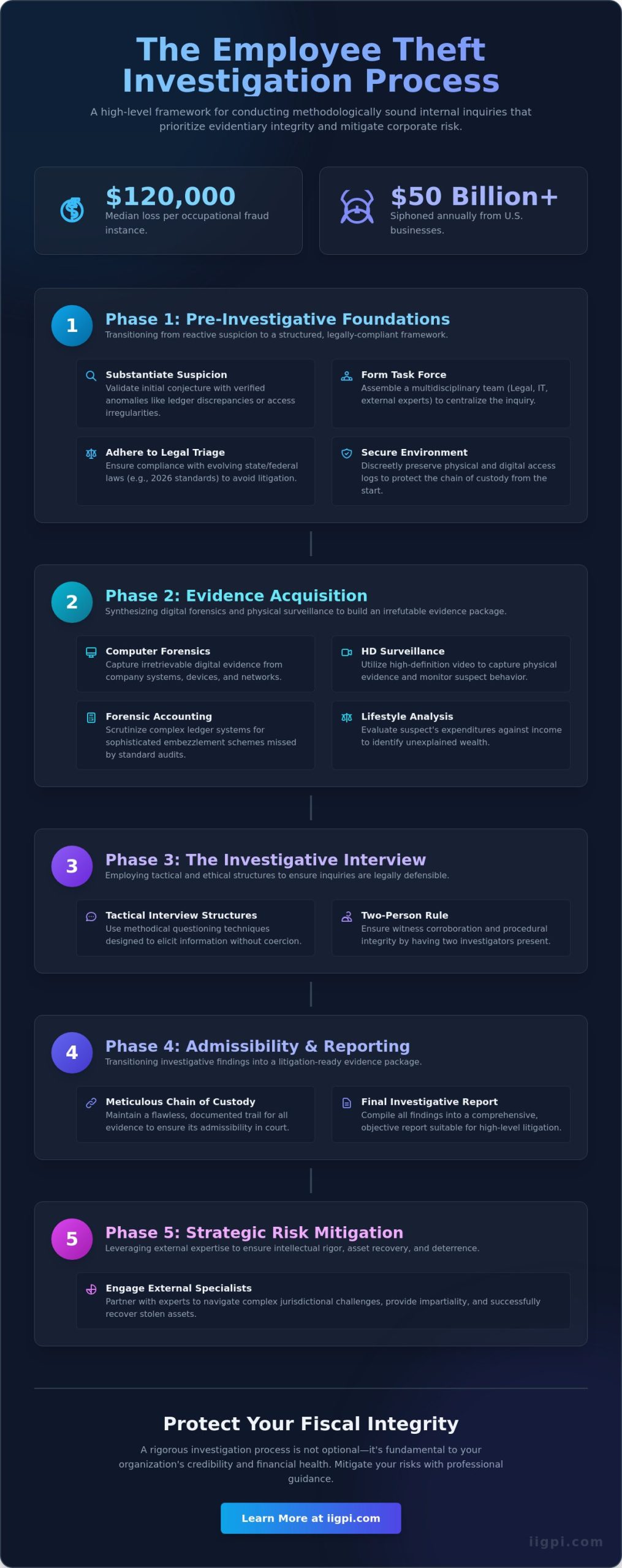
With occupational fraud resulting in a median loss of $120,000 per instance and employee theft siphoning over $50 billion from U.S. enterprises annually, the fiscal integrity of the modern corporation faces a persistent systemic threat. A rigorous employee theft investigation process is no longer a discretionary administrative function; it’s a fundamental requirement for maintaining institutional credibility and fiscal health. You recognize that the mere suspicion of malfeasance introduces significant vulnerabilities, including the potential for wrongful termination litigation and the permanent degradation of digital evidence.
The conclusion of an investigation should serve as a catalyst for a comprehensive security audit and the implementation of robust internal controls. By conducting an investigation ‘post-mortem’, leaders can identify the systemic vulnerabilities that allowed the misappropriation to occur. This proactive stance includes the integration of periodic background checks and due diligence as standard operational protocols, often supported by the compliance and document services of The Notary Bunny Group. In the current regulatory environment, such as the New York Consumer Credit History Ban effective April 18, 2026, these efforts must be precisely calibrated to remain legally compliant. The presence of a premier investigative firm acts as a profound psychological deterrent, signaling to the remaining workforce that malfeasance is met with absolute procedural certainty. Organizations seeking to fortify their institutional integrity should consider contacting the International Investigative Group for a confidential consultation regarding their strategic risk profile.
This discourse offers a comprehensive, high-level framework for conducting methodologically sound internal inquiries that prioritize the integrity of the evidentiary chain. We provide a detailed examination of the protocols required to transform raw suspicion into a definitive evidence package while ensuring compliance with evolving 2026 regulatory standards, such as the mandatory documentation of algorithmic tools in investigative decision-making. By synthesizing advanced computer forensics with strategic surveillance and corporate investigations, this protocol serves to recover stolen assets and establish an enduring deterrent effect within the global workforce.
Key Takeaways
- Establishing a multidisciplinary task force facilitates the transition from mere conjecture to a substantiated inquiry while preserving the integrity of the corporate environment.
- A methodologically sound employee theft investigation process requires the integration of computer forensics and high-definition surveillance to capture irretrievable digital and physical evidence.
- Tactical interview structures, supported by the two-person rule for witness corroboration, ensure that internal inquiries remain ethically sound and legally defensible.
- It’s essential to maintain a meticulous chain of custody during the evidence acquisition phase to ensure the final investigative report is suitable for high-level litigation.
- Engaging external specialists with extensive investigative backgrounds provides the necessary intellectual rigor to navigate complex jurisdictional challenges and recover stolen assets.
The Pre-Investigative Phase: Establishing Procedural Foundations
The initiation of a formal employee theft investigation process necessitates a transition from reactive suspicion to a structured framework of evidentiary substantiation. It’s insufficient to act upon mere conjecture; the organization must identify a threshold of substantiated suspicion, such as irreconcilable anomalies in transaction ledgers or verified digital access irregularities. This preliminary assessment serves as the foundation for addressing potential corporate crime within the institutional hierarchy. Once the suspicion is validated, the formation of a multidisciplinary task force becomes imperative. This entity typically integrates internal legal counsel and information technology specialists with external experts specializing in corporate investigations. By centralizing the inquiry, the organization mitigates the ‘grapevine’ effect, ensuring that sensitive information remains within a restricted circle of decision-makers.
Adherence to legal triage is equally critical, particularly concerning state-specific mandates that govern the employer-employee relationship. In New York, for instance, the implementation of the Consumer Credit History Ban on April 18, 2026, restricts the use of credit reports in most employment decisions. Organizations must ensure that all preliminary actions, including background assessments, comply with these evolving standards to avoid the exposure of the firm to retaliatory litigation. A failure to align the investigation with federal and state employment laws during this nascent stage can render subsequent findings inadmissible in a court of law.
Defining the Scope and Objectives
The task force must immediately delineate the specific assets or intellectual property currently under threat. This clarity allows the organization to determine whether the primary objective is asset recovery, the termination of the offending individual, or the pursuit of criminal prosecution. Establishing a definitive timeline is essential; it ensures that the employee theft investigation process proceeds with the necessary celerity to minimize operational disruption while maintaining procedural integrity. Without clearly defined parameters, investigations risk becoming aimless and resource-heavy endeavors.
Securing the Environment
Securing the environment involves the immediate, discreet preservation of physical and digital access logs. This action prevents the destruction of evidence before a full forensic analysis can occur. The team must monitor suspect behavior without alerting the individual, utilizing subtle observation techniques that don’t violate privacy expectations. Simultaneously, an evaluation of potential conflicts of interest within the internal investigative team is required to ensure that the findings remain impartial and methodologically sound. Protecting the chain of custody begins the moment suspicion is first documented.
Methodologies of Evidence Acquisition: Forensic and Surveillance Protocols
The transition from administrative suspicion to active data acquisition marks a critical juncture in the employee theft investigation process. It’s not enough to rely on singular data points; rather, an authoritative protocol demands the synthesis of physical observation and forensic deep-dives. Expert insights on Detecting and Combating Employee Theft emphasize that a fragmented approach often leads to evidentiary gaps that are easily exploited by defense counsel. To achieve a defensible outcome, investigators must employ forensic accounting to scrutinize sophisticated embezzlement schemes, identifying discrepancies within complex ledger systems that standard audits might overlook. This financial scrutiny is then cross-referenced with a detailed lifestyle analysis, which evaluates the suspect’s expenditures against their established financial capabilities to identify unexplained wealth that doesn’t align with their documented income.
A rigorous acquisition strategy must prioritize the following investigative pillars:
- Forensic Accounting: The methodical analysis of financial transactions to uncover hidden patterns of asset misappropriation.
- Digital Evidence Extraction: The systematic recovery of data from company-issued hardware and cloud environments.
- Strategic Surveillance: The use of covert observation to document physical theft or the transfer of illicit goods.
- Collusion Identification: The use of behavioral intelligence to determine if the suspect is acting in concert with internal or external co-conspirators.
The Role of Computer Forensics
The identification and extraction of evidence from company-issued hardware require a specialized application of computer forensics to ensure the findings remain admissible in high-level litigation. This process involves the creation of bit-stream images to preserve the absolute integrity of hard drives, allowing investigators to examine the data without altering the original source. Through these rigorous protocols, it’s possible to trace deleted communications and identify unauthorized data transfers to external storage media, providing a clear narrative of the suspect’s digital activities. It’s essential to document the role of any algorithmic tools used during this phase, as 2026 legal standards require full transparency in how digital evidence is processed and discovered.
Surveillance and Behavioral Intelligence
While digital data provides the ‘what’ and ‘when’ of a theft, physical surveillance services are essential for establishing the ‘who’ and ‘how’ in a real-world context. Strategic surveillance utilizing high-definition optics and covert tracking allows for the documentation of off-site associations and the identification of internal collusion networks that might otherwise remain obscured. Undercover operatives can be deployed within high-stakes environments to observe behavioral patterns and verify the physical movement of assets. This layer of intelligence is vital for confirming that the digital anomalies detected in the previous phase translate into actionable evidence of malfeasance. If your institution requires this level of methodological rigor, engaging professional theft investigations ensures that every procedural step is handled with the necessary expertise.
The Investigative Interview: Tactical and Ethical Considerations
The investigative interview represents the apex of the evidentiary synthesis. It demands a transition from the analytical detachment of forensic accounting to a direct, tactical engagement with the suspect. Within the broader employee theft investigation process, the interview serves as the critical mechanism for reconciling physical evidence with human testimony. The structure must be deliberate; it begins with non-accusatory inquiries designed to establish a behavioral baseline before shifting toward tactical confrontation. This transition is predicated on the strength of the evidence package compiled during the surveillance and forensic phases. An interview conducted without this foundational data risks appearing arbitrary and may fail to produce actionable results.
Adhering to the two-person rule is a non-negotiable institutional protocol. This configuration ensures that one professional leads the inquiry while a second serves as a dedicated observer and witness. Such a structure provides the necessary corroboration to neutralize future claims of coercion or procedural misconduct. During this phase, the organization must navigate the complexities of employee rights and the potential presence of counsel with professional stoicism. The objective isn’t merely to elicit a confession; it’s to secure a voluntary, legally binding written statement that withstands the scrutiny of high-level litigation. In jurisdictions like California, where AB 406 provides leave for judicial proceedings related to serious felonies, the integrity of these initial statements often dictates the trajectory of future legal actions. It’s an integral part of a rigorous employee theft investigation process that can’t be overlooked.
Psychological Maneuvering and Fact-Checking
Effective interrogation relies on evidence-based questioning to identify irreconcilable inconsistencies in the suspect’s narrative. When verbal testimony conflicts with established data, polygraph testing serves as a specialized tool for corroborating or refuting the subject’s claims. It’s vital to maintain a professional and objective demeanor throughout this process. This approach mitigates the risk of the suspect claiming duress or emotional manipulation during subsequent judicial proceedings. Precision in questioning ensures that the suspect isn’t merely reacting to pressure but is confronted with the undeniable reality of the evidence.
Documentation of Statements
Capturing verbatim admissions is essential for maintaining a clear evidentiary record. Every statement must be signed and dated to ensure its admissibility in a court of law. Once the interview concludes, the task force must manage the immediate aftermath with precision. The decision between immediate suspension or termination depends on the severity of the admission and the strength of the corroborating physical evidence. It’s a moment that requires absolute procedural clarity to prevent reputational damage. Proper documentation turns a verbal admission into a permanent, defensible exhibit.
Admissibility and Reporting: Transitioning to Litigation
The culmination of the employee theft investigation process lies in the seamless transition from internal inquiry to formal litigation. To ensure that findings are beyond reproach in a judicial setting, the organization must maintain a rigorous chain of custody for all physical and digital exhibits. This protocol requires a meticulous log detailing the acquisition, transfer, and storage of every piece of evidence, ensuring that its integrity remains unassailable throughout the lifecycle of the case. Given the 2026 implementation of California SB 477, which extends the deadline for filing FEHA civil actions by one year following a complaint closure, a defensible evidentiary record is more critical than ever; investigations may face scrutiny long after the initial discovery. Without this methodological precision, even the most compelling evidence of malfeasance may be deemed inadmissible, exposing the institution to significant reputational damage and the irretrievable loss of digital evidence.
The Final Investigative Report
The compilation of the Final Investigative Report serves as the authoritative narrative of the entire inquiry, synthesizing complex data into a clear, chronological sequence for executive stakeholders. This document must integrate all supporting documentation, including surveillance logs, forensic analysis results, and verbatim witness statements obtained during tactical interviews. By adhering to the standards established within the corporate fraud investigation pillar, the report provides a definitive evidence package that facilitates informed decision-making regarding termination or prosecution. It functions as the primary exhibit for corporate counsel when formulating a legal strategy, ensuring that all findings are presented with the intellectual rigor required for high-stakes corporate discourse. The report doesn’t merely list facts; it constructs a logical proof of malfeasance that stands up to the most intense institutional review.
Expert Testimony and Legal Support
Transitioning to civil or criminal proceedings necessitates the involvement of investigators who possess the intellectual depth to withstand rigorous cross-examination. These professionals act as expert witnesses, providing the necessary substantiation for the findings presented in the investigative report. Their testimony is critical when evaluating the impact of the discovery on insurance fraud investigation services, as many institutions rely on these findings to recover stolen assets through fidelity bonds or specialized insurance policies. The collaboration between investigators and corporate counsel ensures that the legal strategy is refined based on the strength of the evidence, maximizing the probability of asset recovery. This intersection of investigative precision and legal strategy is where institutional health is restored. For institutions seeking to secure a definitive evidence package, engaging professional corporate investigations ensures that every procedural step is conducted with the highest degree of legal and methodological rigor.
Strategic Risk Mitigation: The Role of External Expertise
The final phase of a rigorous employee theft investigation process involves a shift from the tactical resolution of a specific incident to the long-term strategic fortification of the enterprise. While internal teams are often equipped for routine administrative oversight, the sophisticated nature of modern misappropriation—which costs U.S. businesses over $50 billion annually—demands a level of expertise that transcends standard corporate functions. It’s not merely about the recovery of assets; it’s about institutional protection. Utilizing external specialists with over 30 years of law enforcement-derived experience provides an institution with the intellectual rigor necessary to navigate multi-jurisdictional complexities. This global reach is essential for organizations with international supply chains or decentralized operations, where theft may span geographic borders and diverse legal frameworks that require specialized knowledge to navigate effectively.
Why Professional Intervention is Essential
Entrusting an inquiry to an elite external firm eliminates the ‘confirmation bias’ often inherent in internal HR investigations, where personal relationships or institutional history can inadvertently cloud objective analysis. Professionals provide an impartial perspective, utilizing sophisticated technology and proprietary databases that remain inaccessible to the general public. For a deeper understanding of these specialized functions, one should consult the overview of the private investigator role. This high-level intervention ensures that the employee theft investigation process remains methodologically sound, protecting the organization from the reputational damage and wrongful termination lawsuits that frequently arise from botched internal inquiries. It’s a necessary step for maintaining the gravitas required during high-stakes corporate discourse.
Long-Term Corporate Resilience
The conclusion of an investigation should serve as a catalyst for a comprehensive security audit and the implementation of robust internal controls. By conducting an investigation ‘post-mortem’, leaders can identify the systemic vulnerabilities that allowed the misappropriation to occur. This proactive stance includes the integration of periodic background checks and due diligence as standard operational protocols. In the current regulatory environment, such as the New York Consumer Credit History Ban effective April 18, 2026, these efforts must be precisely calibrated to remain legally compliant. The presence of a premier investigative firm acts as a profound psychological deterrent, signaling to the remaining workforce that malfeasance is met with absolute procedural certainty. Organizations seeking to fortify their institutional integrity should consider contacting the International Investigative Group for a confidential consultation regarding their strategic risk profile.
Fortifying Institutional Integrity through Methodological Rigor
The successful mitigation of internal misappropriation depends on the seamless integration of forensic precision and strategic engagement. As established throughout this discourse, a methodologically sound employee theft investigation process transforms raw suspicion into a definitive evidence package suitable for the highest levels of judicial scrutiny. By prioritizing the integrity of the evidentiary chain and utilizing advanced behavioral intelligence, organizations can effectively navigate the complexities of evolving regulatory standards while ensuring the recovery of vital corporate assets. This rigorous approach not only addresses immediate losses but also serves to fortify the institution against future systemic vulnerabilities.
International Investigative Group, founded by former law enforcement professionals, provides the intellectual depth and technical expertise required to manage these high-stakes inquiries. With over 30 years of elite investigative experience and a global network of agents directed from our NYC headquarters, we deliver the authoritative results necessary for institutional health. Secure your organization’s assets with a confidential consultation from International Investigative Group. You’re empowered to restore order and protect the long-term resilience of your corporate environment.
Frequently Asked Questions
What are the first steps a company should take when employee theft is suspected?
Upon the initial discovery of potential malfeasance, an organization must immediately transition from reactive suspicion to the formalization of an investigative task force. This preliminary phase necessitates the preservation of all relevant physical and digital access logs to prevent the destruction of critical exhibits. By centralizing the inquiry within a restricted circle of legal and IT specialists, the institution ensures that the integrity of the forthcoming employee theft investigation process remains uncompromised by internal leaks or procedural errors.
Is it legal to use surveillance to investigate an employee in New York?
Surveillance within the state of New York is legally permissible provided that the observation occurs within areas where an individual lacks a reasonable expectation of privacy. Employers must ensure that these activities adhere to established labor regulations and avoid intrusive monitoring in private spaces such as restrooms or changing facilities. When conducted by licensed professionals, these surveillance services provide the necessary physical corroboration to substantiate digital findings without infringing upon the protected rights of the workforce.
How can computer forensics help in an employee theft investigation?
Computer forensics facilitates the identification and extraction of irretrievable evidence through the application of bit-stream imaging on company-issued hardware and cloud environments. This methodology allows investigators to recover deleted communications and trace unauthorized data transfers to external storage media without altering the original source data. Such technical precision is essential for establishing a chronological narrative of illicit activity that meets the evidentiary standards required for high-level corporate litigation or insurance recovery.
What is the difference between an internal HR investigation and a professional PI investigation?
The primary distinction between internal HR inquiries and professional investigations lies in the elimination of confirmation bias and the application of law enforcement-derived expertise. External investigators possess access to sophisticated databases and forensic technologies that are typically unavailable to internal departments. This specialized intervention ensures that the employee theft investigation process is conducted with an objective detachment, providing a definitive evidence package that is inherently more defensible during judicial proceedings.
Can a confession obtained during an investigation be used in court?
A confession obtained during a corporate inquiry is admissible in a court of law provided it was secured voluntarily and without the application of duress or coercion. Utilizing a structured, two-person interview protocol ensures that admissions are corroborated by a witness and documented in a legally binding written statement. When these statements align with established physical and digital evidence, they serve as powerful exhibits that significantly strengthen the institution’s position in civil or criminal litigation.
How long does a typical employee theft investigation process take?
The duration of a formal inquiry is contingent upon the complexity of the misappropriation and the volume of forensic data required for a comprehensive analysis. While some cases may reach a preliminary resolution within several weeks, sophisticated schemes involving multi-jurisdictional transfers or deep-seated collusion may require months of deliberate investigation. The priority remains the methodological soundness of the findings rather than an arbitrary timeline, as a rushed process often results in fatal evidentiary gaps.
What happens if an investigation reveals collusion between multiple employees?
If an investigation reveals collusion, the scope of the inquiry must expand to map the entire network of internal and external co-conspirators. This scenario often requires the deployment of behavioral intelligence and undercover operatives to identify the hierarchy of the illicit network and the methods of asset transfer. Addressing systemic collusion is essential for restoring institutional order and ensuring that the deterrent effect of the investigation reaches every level of the compromised workforce.
How can a company recover assets stolen by an employee?
Asset recovery is typically achieved through a combination of civil litigation, insurance claim submissions, and voluntary restitution agreements established during the investigative interview. Institutions often leverage the findings of a rigorous investigation to file claims against fidelity bonds or specialized insurance policies designed to mitigate specie loss. A definitive evidence package provides the necessary substantiation for these claims, facilitating the return of misappropriated capital and the restoration of fiscal health.