
With annual insurance fraud losses in the United States now exceeding $308.6 billion, the integrity of the global financial ecosystem faces an unprecedented systemic threat that demands a more rigorous response. Organizations frequently find that conventional adjustment protocols lack the analytical depth required to identify sophisticated or inflated claims in an increasingly complex regulatory environment. Establishing a robust insurance claims investigation process is no longer merely an administrative necessity; it’s a critical strategic imperative for maintaining fiscal solvency and institutional credibility.
Industry leaders recognize that the rising costs of fraudulent activity, coupled with the legal risks of improper vetting, necessitate a transition toward more advanced investigative methodologies. This article presents a comprehensive analysis of the sophisticated protocols and multi-dimensional strategies employed in modern claim validation. We will examine a structured framework that integrates forensic expertise and deep-web analytics to enhance fraud detection capabilities and significantly reduce total claim payouts through disciplined, evidence-based vetting.
Key Takeaways
- Master the five-stage methodological framework essential for maintaining procedural integrity and ensuring the preservation of perishable evidence during high-value inquiries.
- Explore how a sophisticated insurance claims investigation process integrates digital forensics and deep-web analytics to expose complex fraudulent schemes that transcend traditional administrative oversight.
- Implement the “Fraud Triangle” analytical model to systematically identify behavioral and situational indicators of deception across diverse insurance sectors.
- Discern the fiscal and legal benefits of collaborating with elite investigative entities that utilize global networks and law enforcement-derived expertise to secure definitive claim resolutions.
The Contemporary Landscape of Insurance Fraud: Why Rigorous Investigation is Imperative
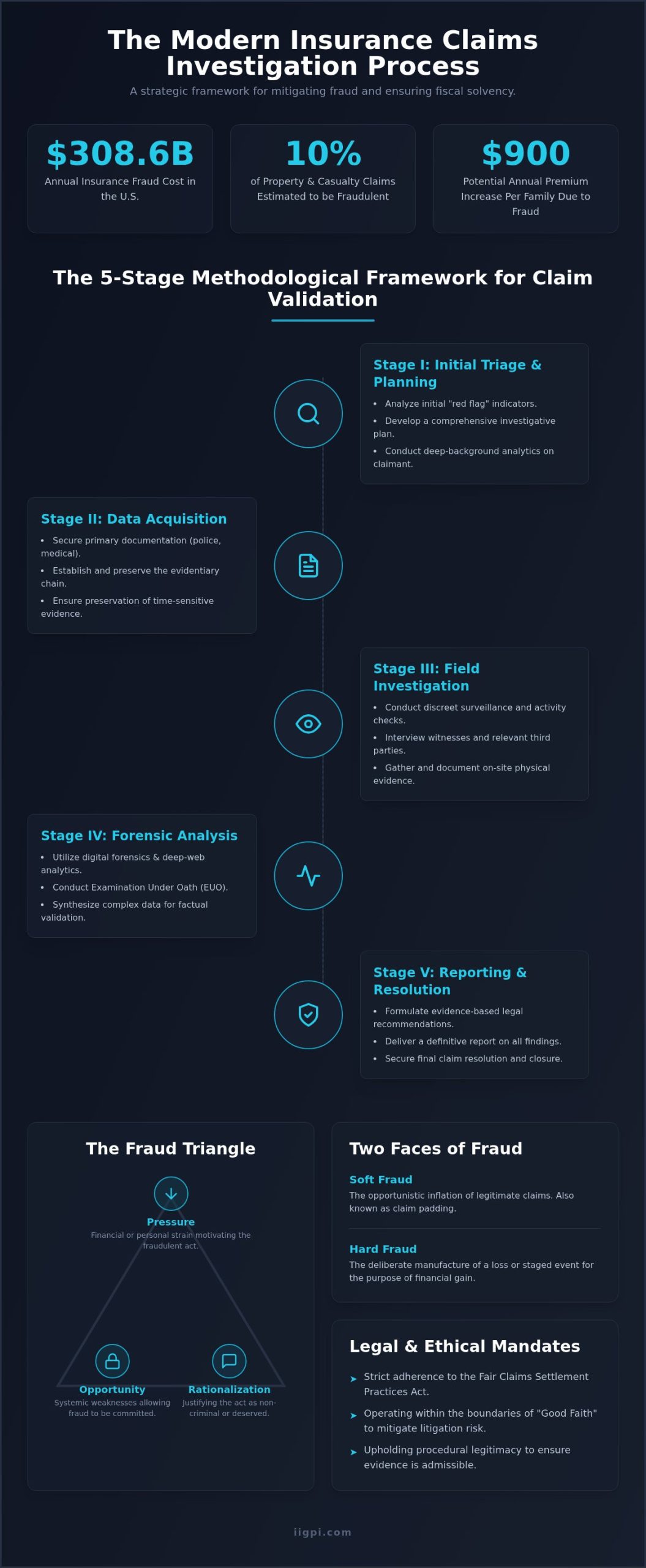
The insurance claims investigation process represents a systematic and rigorous inquiry into the factual validity of a reported loss, serving as the primary defense against the erosion of institutional assets. In 2026, the global insurance sector faces a critical inflection point as the estimated annual cost of insurance fraud in the United States has surpassed $308.6 billion. This staggering figure doesn’t merely represent lost revenue; it functions as a regressive tax on the consumer base. Fraud isn’t a victimless crime. It potentially increases annual premiums for a single family by as much as $900. Approximately 10% of all property and casualty claims are currently estimated to be fraudulent, highlighting a pervasive culture of deception that threatens the viability of traditional underwriting. To maintain fiscal stability, insurers must distinguish between soft fraud, which involves the opportunistic inflation of legitimate claims, and hard fraud, characterized by the deliberate manufacture of losses or staged events.
The Economic Imperative for Risk Mitigation
The correlation between unvetted claims and long-term institutional insolvency is increasingly evident as sophisticated fraud syndicates exploit administrative loopholes within standard claim processing. These entities operate with high levels of coordination. They often utilize technological gaps to bypass traditional adjustment methods. Rigorous investigative protocols are essential to preserve the integrity of the insurance pool, ensuring that resources remain available for legitimate claimants. By shifting from a reactive adjustment model to a proactive, intelligence-led framework, organizations can identify patterns of deception before disbursements occur. This transition is vital for high-stakes corporate and insurance investigations where the complexity of the loss requires specialized forensic scrutiny. Vetting is the only viable path to solvency.
Legal and Ethical Standards in Modern Inquiries
Executing a modern insurance claims investigation process requires strict adherence to state-specific regulations and the Fair Claims Settlement Practices Act to ensure procedural legitimacy. Investigators must operate within the clearly defined boundaries of “good faith” to mitigate the risk of bad faith litigation, which can result in punitive damages far exceeding the original claim value. A critical component of this formal process is the Examination Under Oath (EUO). This is a powerful tool. It allows for the structured questioning of the insured under the penalty of perjury. When integrated into a broader methodological framework, the EUO serves as a definitive mechanism for validating or impeaching the testimony provided during the initial reporting phase. Intellectual rigor in these proceedings protects the insurer’s legal standing while upholding ethical obligations to the policyholder collective.
The Methodological Framework: A Five-Stage Protocol for Claim Validation
The integrity of any modern inquiry rests upon a structured sequence of operations that ensures no critical intelligence is overlooked. A rigorous insurance claims investigation process begins with immediate intervention, as the preservation of perishable evidence and the accuracy of witness memory are highly time-sensitive. The lead investigator acts as a central node for data synthesis, managing the flow of information between field agents, forensic analysts, and legal counsel. This methodological framework ensures a seamless transition from the initial intake of a claim to the final reporting phase, where definitive legal recommendations are formulated based on empirical findings. Efficiency at this stage is paramount. Delays can compromise the entire evidentiary chain.
Stage I & II: Initial Triage and Comprehensive Data Acquisition
Investigative plans are developed by analyzing initial “red flag” indicators against the specific complexity of the reported loss. This phase involves deep-background analytics to evaluate the claimant’s prior history and current financial stability, providing context for the current filing. Securing primary documentation, including police reports and physician billing histories, establishes the foundational evidence required for later stages. Organizations often find that specialized insurance investigations conducted at this stage prevent the escalation of fraudulent payouts. Data must be definitive. Early triage effectively filters out low-risk claims, allowing resources to be concentrated on high-stakes exposures.
Stage III & IV: Field Operations and Forensic Synthesis
Once the data baseline is established, the focus shifts to field operations. Tactical surveillance is executed to validate reported physical limitations or property damage, providing objective visual evidence. Modern protocols must also integrate digital forensic findings from mobile devices and social media activity to verify timelines and claimant statements. These efforts are complemented by obtaining formal, sworn statements from relevant witnesses, ensuring that all testimony is documented for potential litigation. The synthesis of physical and digital evidence creates a multi-dimensional view of the claim. This is a critical juncture. Discrepancies found here often serve as the primary basis for denial.
Stage V: Final Adjudication and Reporting
The final stage involves synthesizing all gathered intelligence into a definitive, court-admissible report. This document must provide actionable recommendations for claim denial, settlement, or further legal action, supported by a clear chain of custody. Collaborating with Elite Investigative Firms ensures that these reports meet the highest evidentiary standards required by judicial bodies. The integration of these stages into a unified insurance claims investigation process provides a formidable defense against fraudulent activity. Final adjudication relies on the absolute clarity of the investigative record. It’s the final barrier to financial loss.
Advanced Investigative Modalities: Surveillance, Forensics, and Analytics
Modernizing the insurance claims investigation process requires an expansion beyond mere physical observation to encompass the digital “shadow” cast by every claimant. While traditional methods remain foundational, the integration of multi-dimensional data streams provides a more forensic perspective on the validity of a loss. Asset searches are particularly critical in this context. They reveal the underlying financial pressures that often serve as the primary catalyst for fraudulent activity. By establishing a claimant’s financial baseline, investigators can discern whether a reported loss is a genuine misfortune or a strategic attempt at debt mitigation. This level of scrutiny ensures that all inquiries are conducted in alignment with the NAIC Unfair Claims Settlement Practices Act, which mandates fair and equitable standards for all parties involved. Comprehensive vetting is impossible without this broader analytical lens.
The Role of Professional Surveillance in Contested Claims
In major global metropolitan areas like New York City, executing long-term observation requires a sophisticated understanding of both ethical boundaries and local privacy statutes. High-definition covert video serves as an irrefutable tool for objective truth-finding, often providing the definitive evidence needed to disprove exaggerated injury claims. When a claimant alleges total physical incapacitation but is captured performing strenuous activities, the impact on jury perception is profound. These visual records frequently shift the trajectory of settlement negotiations, moving the discourse from subjective testimony to empirical reality. Utilizing professional surveillance services allows for the acquisition of this evidence without compromising the legal integrity of the investigation. Tactical patience is often the key to exposing a fabrication.
Digital Forensics and Cyber-Intelligence
The digital era has introduced new avenues for deception, specifically through the manipulation of property loss documentation. Forensic analysis is now essential for identifying “photo-shopping” and other metadata discrepancies that indicate a manufactured loss. This process, known as computer forensics, involves the meticulous identification and analysis of digital data to support investigative findings. Social media monitoring further complements this by uncovering narrative inconsistencies. A claimant’s public activity often contradicts their formal statements regarding lifestyle or physical limitations. By synthesizing these digital artifacts with traditional field intelligence, organizations can construct a comprehensive evidentiary profile that withstands rigorous judicial scrutiny. It’s no longer enough to look at the scene; one must look at the data.
Identifying Indicators of Deception: Red Flags in Complex Claim Environments
The identification of deceptive indicators within the insurance claims investigation process requires an analytical approach rooted in the “Fraud Triangle” framework. This academic model posits that three convergent elements, pressure, opportunity, and rationalization, must exist for fraudulent activity to manifest. While administrative adjusters often focus on surface-level discrepancies, a sophisticated inquiry analyzes the systemic factors driving the claim. When multiple red flags emerge in a single case, the tactical response must shift from routine processing to high-intensity scrutiny. This disciplined vetting ensures that fraudulent actors don’t exploit the inherent complexities of modern insurance markets. Identifying these patterns early is the only way to prevent significant capital leakage.
Behavioral and Financial Anomalies
Claimant behavior provides critical psychological data during the validation phase. Individuals who exhibit an aggressive push for immediate settlements or demonstrate an unusually deep understanding of insurance law often warrant additional investigation. These behavioral anomalies frequently correlate with financial distress. Analyzing these indicators through established corporate fraud investigation protocols allows for the detection of discrepancies between a claimant’s reported lifestyle and their verifiable income. Financial instability isn’t just a background detail. It’s a primary motivator. Professional investigators look for these misalignments to build a case based on empirical financial reality rather than just anecdotal evidence.
Specialized Loss Indicators: Fine Arts and Jewelers Block
High-value “Specie” losses, such as those involving fine arts, jewelry, or cash in transit, present unique investigative challenges that generic protocols fail to address. In fine arts inquiries, the verification of provenance and appraisal history is the cornerstone of the investigation. Red flags in jewelers block claims often include inventory inconsistencies or a documented failure to adhere to strict security protocols. IIG’s success in resolving high-value insurance fraud investigation services cases stems from a specialized understanding of these niche sectors. A notable $12 million fraudulent burglary claim was successfully resolved by identifying these exact specialized indicators. These cases require a level of forensic rigor that goes beyond standard adjustment methods.
If your organization is currently facing high-stakes claims that exhibit these complex indicators, securing an insurance investigation specialist is the most effective way to mitigate your financial risk and ensure a definitive resolution.
Strategic Mitigation: Partnering with Elite Investigative Firms for Claim Resolution
In the defense of institutional assets, the private investigator functions as the indispensable partner to legal counsel. While attorneys manage the procedural complexities of litigation, the investigator provides the empirical foundation upon which a successful defense is constructed. A professional insurance claims investigation process yields high-fidelity intelligence that streamlines the litigation cycle and significantly reduces legal expenditures. By securing court-ready evidence early in the dispute, organizations can often avoid the prolonged costs of discovery. This strategic alliance ensures that defense strategies are based on objective truth rather than speculative theory. It’s a necessary collaboration for any entity operating within high-stakes financial environments.
The ROI of Professional Investigation
The return on investment for professional inquiry is most visible when contrasted against the potential for catastrophic loss. A single unvetted claim can have devastating effects on an organization’s fiscal health, as evidenced by the $12 million fraudulent burglary case successfully resolved by International Investigative Group. Investing in rigorous vetting is a small fraction of the cost of such a massive disbursement. Beyond immediate capital preservation, a reputation for conducting a disciplined insurance claims investigation process serves as a powerful deterrent against future fraudulent attempts. Bad actors are less likely to target institutions known for their forensic rigor and law enforcement heritage. Court-ready evidence, supported by a clear chain of custody, remains the most effective tool for securing favorable verdicts in contested environments.
Global Reach and Local Expertise
Modern claims often involve international transit or the concealment of offshore assets, necessitating an investigative partner with a truly global network. International Investigative Group utilizes over 30 years of law enforcement-derived expertise to navigate these complex geographic and legal boundaries. While the firm maintains deep operational capabilities in the New York metropolitan area, its extensive agent network allows for seamless inquiries across international jurisdictions. This dual focus on local nuance and global scale is essential for high-stakes corporate risk management. Institutional interests are best protected by entities that possess both the heritage of formal law enforcement and the agility of a global private firm. Decision-makers are invited to Consult with International Investigative Group to develop bespoke risk management solutions tailored to their specific exposure profiles.
Securing Institutional Solvency through Investigative Rigor
The transition toward a multi-dimensional insurance claims investigation process is no longer optional for organizations seeking to maintain fiscal integrity in an increasingly volatile risk environment. By integrating advanced digital forensics with tactical field surveillance, institutions can construct an empirical shield against the sophisticated fraud syndicates that currently threaten global insurance markets. This methodological framework provides the necessary rigor to transform reactive adjustment into a proactive strategy for risk mitigation. The acquisition of court-ready evidence ensures that high-value exposures are resolved through definitive data rather than administrative compromise.
International Investigative Group offers the specialized expertise required to navigate these complex challenges, drawing upon a heritage of former law enforcement leadership and a track record of over 10,000 cases solved globally. With a proven capacity for resolving $10M+ high-value loss cases, our firm provides the intellectual and operational depth essential for modern claim validation. We invite you to secure your interests with elite insurance investigation services from IIG. Protecting your organization’s future begins with the commitment to absolute evidentiary clarity.
Frequently Asked Questions
What are the primary stages of the insurance claims investigation process?
The primary stages of the insurance claims investigation process encompass initial triage and data acquisition, field operations including tactical surveillance, and final adjudication where findings are synthesized into a court-admissible report. This structured sequence ensures that all evidentiary threads are systematically pursued while maintaining a clear chain of custody. By following this rigid protocol, investigators can effectively validate the legitimacy of a loss and provide a definitive basis for claim resolution or denial.
How long does a typical insurance fraud investigation take to conclude?
The duration of an inquiry is dictated by claim complexity and specific state-mandated deadlines for claim acceptance or denial. For instance, insurers in California typically have 40 calendar days to accept or deny a claim, while Texas mandates 15 business days and Florida allows 60 days. Complex cases involving international assets or forensic analysis may extend these timelines, provided that the insurer adheres to the regulatory requirements for providing status updates to the claimant.
Is surveillance evidence admissible in court during a contested claim?
Surveillance evidence is generally admissible in judicial proceedings provided it was obtained legally and can be authenticated through a clear chain of custody. The visual documentation must be captured without violating the claimant’s reasonable expectation of privacy, typically in public spaces or through non-intrusive observation. When presented by a qualified investigator, high-definition video serves as an objective record that can significantly influence jury perception and the final outcome of contested litigation.
What specific red flags trigger a more intensive insurance investigation?
Intensive scrutiny is often triggered by behavioral anomalies, such as a claimant’s aggressive push for immediate settlement, or financial distress indicators that align with sudden, high-value losses. Discrepancies between reported physical limitations and digital activity, or inconsistencies in provenance for high-value assets, also function as primary catalysts for deeper inquiry. When multiple red flags converge, the transition from routine adjustment to a formal investigation becomes a strategic imperative for risk mitigation.
How does digital forensics contribute to the validation of insurance claims?
Digital forensics provides a critical analytical layer by identifying metadata discrepancies and image manipulation in submitted loss documentation. This process allows investigators to verify the chronological and geographic accuracy of evidence through the scrutiny of digital artifacts found on mobile devices or social media platforms. By uncovering these hidden technical inconsistencies, organizations can expose sophisticated fraudulent schemes that would remain undetected through conventional administrative vetting or traditional field observation alone.
Can a private investigator assist with high-value fine arts or jewelry loss claims?
Specialized private investigators are essential for resolving high-value fine arts and jewelry loss claims, where they focus on verifying provenance and appraisal histories. These inquiries require a deep understanding of market dynamics and inventory management protocols to identify inconsistencies that suggest a manufactured loss. By utilizing a global network of agents and forensic resources, elite firms can recover lost assets or provide the evidentiary basis for denying fraudulent specie claims.
What is the difference between an insurance adjuster and a private fraud investigator?
While an insurance adjuster primarily manages the administrative processing and valuation of a claim, a private fraud investigator focuses on the forensic validation of the loss itself. Investigators employ advanced modalities such as surveillance and digital forensics to identify indicators of deception that fall outside the scope of routine adjustment. This distinction is critical in high-stakes environments where the objective is not merely to process a payment but to actively defend against fraudulent activity.
How does AOE/COE investigation apply to workers’ compensation claims?
AOE/COE investigations are utilized in workers’ compensation cases to determine if an injury truly arose out of employment or occurred within the course of employment. This process involves a rigorous analysis of the incident’s circumstances, including witness interviews and the scrutiny of medical timelines, to ensure the claim meets the legal criteria for compensability. By validating the nexus between the workplace and the injury, organizations can prevent the payment of fraudulent or non-industrial claims.