
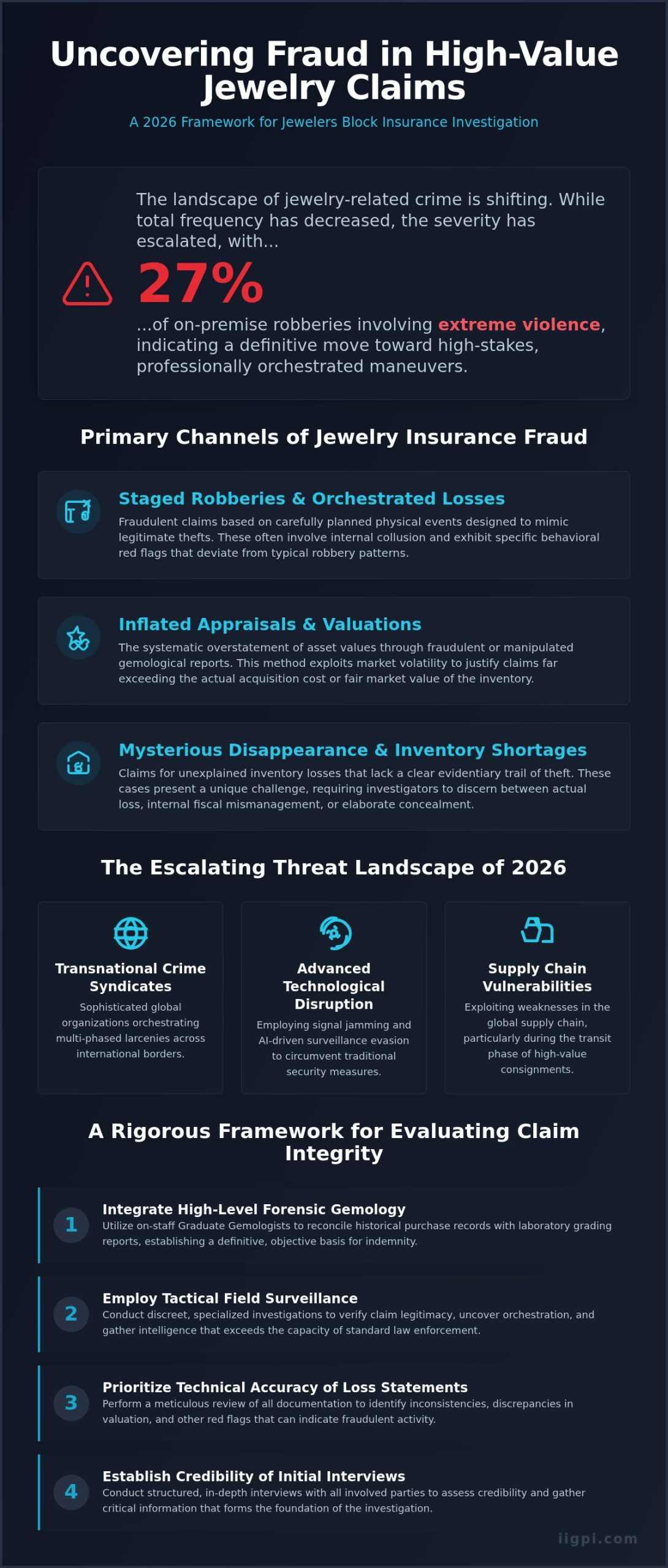
While the total frequency of jewelry-related crimes decreased in 2025, the reality that 27% of on-premise robberies involved extreme violence indicates a definitive shift toward high-stakes, professionally orchestrated maneuvers. For underwriters and risk managers, conducting a rigorous jewelers block insurance investigation isn’t merely a procedural necessity; it’s a critical mechanism for preserving the fiscal stability of the global specie market. It’s understandable that distinguishing between a legitimate catastrophic loss and a sophisticated, staged theft presents a formidable challenge to even the most seasoned claims professionals. The financial stakes involved in Special Risk claims necessitate a level of intellectual rigor that transcends standard adjustive practices.
This guide offers a definitive analysis of the forensic protocols and gemological methodologies required to identify fraudulent appraisals and mitigate financial exposure. By integrating field intelligence with specialized technical expertise, the following discourse establishes a clear framework for evaluating claim integrity. We’ll examine the strategies essential for securing forensic gemology and uncovering the nuances of criminal orchestration to ensure that every high-value loss is scrutinized with professional authority in 2026.
Key Takeaways
- Discern the complex modalities of insurance fraud by examining the systemic risks inherent in staged robberies, inflated appraisals, and unexplained inventory disappearances.
- Conduct a rigorous jewelers block insurance investigation that integrates high-level forensic gemology with tactical field surveillance to verify claim legitimacy.
- Establish a structured evaluative framework for adjusters that prioritizes the technical accuracy of the Statement of Loss and the credibility of initial interviews.
- Leverage specialized investigative expertise to mitigate financial exposure in high-stakes NYC Diamond District cases and complex international transit losses.
Understanding Jewelers Block Insurance and the Necessity of Rigorous Investigation
Jewelers Block insurance constitutes a highly specialized derivative of inland marine coverage, designed to address the idiosyncratic risks associated with the possession and movement of precious metals and gemstones. Unlike standard commercial property policies which typically restrict coverage to fixed locations, these instruments provide comprehensive protection for inventory while it’s on the premises, in the custody of employees, or in transit through global shipping channels. Given the extreme liquidity and high value-to-volume ratio of the insured assets, a standard jewelers block insurance investigation demands a synthesis of gemological technicality and advanced forensic inquiry that exceeds the capabilities of traditional generalist adjusters. The necessity for this specialized oversight isn’t merely a procedural formality; it’s a critical response to the high financial stakes inherent in specie claims, where minor oversights in documentation can lead to significant fiscal leakage or the inadvertent subsidization of fraudulent activity.
The Definition of Jewelers Block as Inland Marine Insurance
While traditional property insurance focuses on static assets, the inland marine protocols governing Jewelers Block policies prioritize the mobile and high-risk nature of the jewelry trade. These policies are structured as “all-risk” agreements, yet they’re frequently constrained by rigorous exclusions related to inventory shortages or “mysterious disappearances” that lack a clear evidentiary trail. Discrepancies in inventory valuation often serve as the primary catalyst for litigation, as the complexity of Understanding Insurance Fraud involves discerning between legitimate market fluctuations and deliberate fiscal inflation. Professional scrutiny is essential to reconcile historical purchase records with current laboratory grading reports to establish a definitive basis for indemnity. This process requires an objective, scholarly approach to evidence, ensuring that the valuation of the loss aligns with the precise gemological characteristics of the missing inventory rather than subjective estimations.
The Escalating Landscape of High-Value Jewelry Theft in 2026
The operational environment of 2026 is characterized by the emergence of sophisticated transnational crime syndicates that employ advanced technological disruption, such as signal jamming and AI-driven surveillance evasion, to circumvent traditional security measures. Within key commercial hubs like the NYC Diamond District, these organizations orchestrate multi-phased larcenies that exploit the inherent vulnerabilities of the supply chain, particularly during the transit phase of high-value consignments. Standard law enforcement resources don’t always possess the capacity for the deep-tissue forensic analysis required to uncover the orchestration behind these events. Elite investigative firms, such as International Investigative Group, provide the intellectual and operational infrastructure necessary to bridge this divide. By utilizing global agent networks and on-staff Graduate Gemologists, these firms mitigate the systemic risks that threaten the integrity of the global jewelry market, providing the authoritative rigor required to navigate the complexities of modern specie loss.
Identifying Common Modalities of Fraud in Jewelry Insurance Claims
The analytical framework of a jewelers block insurance investigation must address the sophisticated modalities of fraud that jeopardize the fiscal integrity of the insurance pool. Fraud in this sector typically manifests through three primary channels: staged physical events, the systematic inflation of asset valuations, and the exploitation of “mysterious disappearance” clauses. Unexplained missing inventory presents a unique investigative challenge, as it lacks the definitive evidentiary trail provided by a physical breach or a documented robbery. In these instances, the investigator’s role is to determine whether the loss is an ontological reality or a byproduct of internal fiscal mismanagement. Fraudsters in 2026 increasingly exploit the inherent volatility of the precious stone market, utilizing market fluctuations to justify inflated claims that bear little resemblance to the actual acquisition cost of the assets.
Staged Robberies and Orchestrated Inventory Losses
Staged robberies often exhibit specific behavioral markers that distinguish them from genuine criminal acts. Forensic analysis of surveillance footage frequently reveals inconsistencies in the perpetrators’ movements or a lack of genuine distress from the alleged victims. Indicators of an “inside job” include the conspicuous absence of forced entry, the precise targeting of high-margin items that were not publicly displayed, and the convenient failure of security systems at the precise moment of the event. A rigorous jewelers block insurance investigation requires a meticulous timeline of employee access and a review of digital logs to identify internal orchestration. When claims involve the loss of high-value stones during a “smash-and-grab,” the absence of glass trajectory or physical debris often points toward a controlled, rather than chaotic, event. Identifying these Common Red Flags for Jewelry Insurance Fraud is essential for adjusters who seek to distinguish between genuine misfortune and calculated deception.
Inflated Valuations and the Role of Fraudulent Appraisals
The practice of “paper hanging” involves the creation of synthetic provenance for inventory that either never existed or was of a significantly lower grade than claimed. Fraudsters often secure multiple appraisals from complicit or negligent parties to establish a false baseline of value. Verifying the provenance of a specific gem requires a scholarly approach to diamond grading reports and historical sales records. Investigators must reconcile the physical inventory records with the firm’s financial statements to ensure that the claimed assets were actually owned and accounted for prior to the loss. This reconciliation process is vital in NYC Diamond District cases, where the high volume of trade can obscure fraudulent entries. Engaging a firm like International Investigative Group ensures that these complex financial and gemological threads are expertly unraveled to protect the insurer’s interests.
Advanced Investigative Methodologies: From Surveillance to Forensic Gemology
The resolution of complex jewelry claims necessitates an integrated, multi-disciplinary investigative framework that synthesizes tactical field intelligence with high-level forensic gemology. A standard jewelers block insurance investigation cannot rely solely on the testimonial evidence provided by the claimant; instead, it must utilize a rigorous protocol that encompasses digital forensics, physical surveillance, and technical asset verification. This synthesis is particularly vital when addressing “specie loss” during international transit, where the chain of custody involves multiple jurisdictions and logistics providers. Verifying such losses requires a systematic audit of shipping manifests, customs declarations, and biometric access logs to identify the precise moment of interception or internal compromise. By deploying a diverse array of specialized functions, investigators provide insurers with the empirical data necessary to adjudicate claims with absolute precision.
Tactical Surveillance and Intelligence Gathering in the Diamond District
Conducting effective surveillance within the dense urban geography of NYC’s Diamond District presents unique operational challenges that require a sophisticated understanding of local commercial dynamics. The high concentration of security personnel and sophisticated monitoring systems necessitates the use of discreet, high-level intelligence gathering to identify latent connections between claimants and known criminal syndicates. Professional surveillance services offer more than just visual documentation; they provide objective proof of a claimant’s behavioral patterns and associations that may contradict the stated facts of a loss. This covert intelligence serves as a critical counterbalance to orchestrated narratives, ensuring that the investigation remains grounded in observable reality rather than carefully curated representations of events.
The Critical Role of Graduate Gemologists in Claim Verification
The technical verification of assets is perhaps the most significant component of a modern investigation, requiring the specialized expertise of a Graduate Gemologist. These professionals are trained to discern the subtle distinctions between natural gemstones and high-quality synthetic counterparts, which are frequently utilized in substitution fraud. Forensic examination involves the scrutiny of microscopic laser inscriptions and the verification of GIA certificates against the physical characteristics of the recovered or documented inventory. The importance of this technical rigor is illustrated in cases where a Jewelry Store Owner Charged with Fraud was identified after attempting to collect on a diamond that was discovered to be in their possession after the reported theft. By employing gemological experts, International Investigative Group prevents the inadvertent payment of claims based on inflated quality assessments or non-existent provenance, maintaining the intellectual integrity of the investigative process.
Evaluating Claims Integrity: A Framework for Insurance Adjusters and Legal Counsel
The adjudicative phase of a jewelers block insurance investigation requires a structured evaluative framework that prioritizes empirical evidence over anecdotal accounts. For insurance adjusters and legal counsel, the “Statement of Loss” serves as the primary instrument for establishing the factual parameters of the claim. This document must be scrutinized alongside a comprehensive initial interview, which is designed to identify internal inconsistencies in the claimant’s narrative. It’s the investigator’s responsibility to ensure that this process isn’t merely a formality but a deep-tissue analysis of the claim’s validity. When high-value claims are contested, the integration of polygraph testing provides an additional layer of psychological scrutiny, offering insights into the veracity of the statements provided under oath. To ensure that the findings remain defensible in a court of law, all evidence must adhere to stringent legal standards regarding admissibility and technical relevance.
Differentiating Between Legitimate Loss and Professional Fraud
Discerning the ontological reality of a loss requires a comparative analysis of behavioral markers and situational variables. Genuine victims typically exhibit consistent narratives and provide immediate access to all necessary security logs; conversely, fraudulent claimants often demonstrate evasive behavior or provide fragmented accounts of the event. Financial distress often acts as a primary catalyst for orchestrating jewelry fraud, making a thorough audit of the claimant’s fiscal health a mandatory component of the investigation. Adjusters don’t just look for what’s present; they look for what’s missing. They must verify that the insured maintained strict compliance with the security protocols stipulated in the policy, such as safe ratings and alarm monitoring requirements, at the precise moment of the alleged theft. Failure to adhere to these standards often serves as a definitive indicator of negligence or intentional orchestration.
Establishing a Chain of Custody and Evidence Admissibility
The preservation of digital and physical evidence is a critical function that dictates the success of subsequent insurance litigation. Investigators must establish a meticulous chain of custody for all recovered assets and surveillance data to prevent challenges to the integrity of the evidence. Specialized computer forensics is frequently employed to recover deleted communications or encrypted logs that may reveal coordination between co-conspirators. For an investigator to serve as a court-qualified expert, they must demonstrate a high level of specialized knowledge and adhere to the rigorous standards of forensic inquiry. Adhering to these protocols ensures that the investigative output is both authoritative and legally resilient. For those seeking to secure the integrity of their claims process, engaging International Investigative Group provides the professional authority and technical expertise needed to navigate these complex legal landscapes.
Strategic Solutions for Special Risk Claims: The International Investigative Group Advantage
The resolution of high-stakes specie claims in 2026 demands more than just technical proficiency; it requires an institutional pedigree rooted in the highest echelons of investigative rigor. International Investigative Group (IIG) is uniquely positioned to conduct every jewelers block insurance investigation with the intellectual depth and authoritative precision that global insurers and legal counsel necessitate. By synthesizing decades of operational experience with specialized gemological technicalities, the firm provides a definitive bulwark against the sophisticated fraud modalities analyzed in previous sections. This elite positioning isn’t merely a result of longevity but a consequence of a mission-driven commitment to preserving the fiscal integrity of the special risk market through scholarly and impartial inquiry. The organization’s status as a leading authority ensures that every finding is presented with the gravitas required by high-level decision-makers.
Leveraging Thirty Years of Law Enforcement and Private Sector Expertise
The leadership of IIG applies a police-grade investigative rigor to the private sector, a methodology forged through a thirty-year legacy in law enforcement and high-stakes corporate inquiry. This foundation ensures that every claim is scrutinized with the same level of intensity as the firm’s successful corporate fraud investigations, which have frequently involved multi-million dollar recoveries and the exposure of complex criminal orchestrations. By adopting a results-oriented approach to risk mitigation, the firm doesn’t just identify loss; it uncovers the systemic vulnerabilities that allow such losses to occur. This comprehensive perspective is essential for underwriters who require more than just a summary of events, but a definitive analysis of claim integrity that’s both court-qualified and intellectually resilient.
Global Reach with Local NYC Proficiency
While the firm maintains a prestigious presence in London and Long Island, its local proficiency in the NYC Diamond District remains an unparalleled strategic asset for resolving complex urban losses. The ability to navigate the intricate regional dynamics of New York’s jewelry trade is augmented by a global network of agents who facilitate investigations into inventory lost during international transit. This macro-level perspective allows IIG to bridge the gaps between disparate geographic and socioeconomic regions, ensuring that “specie loss” is verified with absolute certainty regardless of where the interception occurred. Legal and insurance professionals facing difficult or high-stakes cases are encouraged to contact International Investigative Group for a confidential consultation to explore how this elite investigative infrastructure can secure their assets against modern criminal orchestration.
Advancing Global Standards for Specie Claim Integrity in 2026
Navigating the complexities of high-value jewelry loss requires a synthesis of tactical field surveillance and high-level forensic gemology. The analytical frameworks established in this guide emphasize that identifying sophisticated criminal orchestration depends on technical asset verification and the rigorous evaluation of claim provenance. By integrating these disciplines, insurers can definitively mitigate fiscal leakage and maintain the intellectual integrity of the adjudication process. A modern jewelers block insurance investigation must leverage specialized expertise to address the evolving landscape of organized jewelry crime effectively.
International Investigative Group provides the authoritative infrastructure necessary to resolve complex claims, supported by over 30 years of specialized experience and a global network of agents. Recognized as one of the top 15 investigative firms in the United States, our team includes on-staff Graduate Gemologists and forensic experts dedicated to precision. We invite you to consult with International Investigative Group for Special Risk claims to ensure your high-stakes losses are evaluated with professional rigor. Securing the future of the global jewelry market begins with a commitment to evidence-based inquiry and technical excellence.
Frequently Asked Questions
What is the primary objective of a jewelers block insurance investigation?
The primary objective is to establish the ontological reality of the loss and verify the legitimacy of the claim through empirical evidence. This process involves reconciling physical inventory with financial records to prevent fiscal leakage from fraudulent activity. By providing an authoritative analysis of the circumstances surrounding a claim, investigators enable insurers to make informed, evidence-based decisions regarding indemnity.
How do investigators verify the value of stolen jewelry that is no longer present?
Investigators utilize historical purchase records, laboratory grading reports, and GIA certificates to establish a definitive basis for valuation. By cross-referencing these documents with current market data for precious metals and stones, they can reconstruct the value of assets that are no longer physically accessible. This scholarly approach ensures that the valuation aligns with precise gemological characteristics rather than subjective estimations.
Can a private investigator help if an insurance company suspects an “inside job”?
A private investigator provides the specialized surveillance and digital forensic capabilities necessary to uncover internal orchestration. They analyze biometric access logs and security protocol compliance to identify inconsistencies that suggest employee involvement or the deliberate failure of alarm systems. This level of scrutiny is essential for identifying the behavioral markers of an orchestrated event that standard adjusters might overlook.
What role does a Graduate Gemologist play in an insurance claim investigation?
The Graduate Gemologist provides the technical expertise required to verify the specific characteristics of the stones listed in a jewelers block insurance investigation. Their role is critical in discerning between natural gemstones and synthetic substitutes, ensuring that insurers don’t pay claims based on inflated quality grades. This technical rigor maintains the intellectual integrity of the investigative process and prevents the subsidization of deceptive practices.
How long does a typical jewelers block claim investigation take to complete?
The duration of an investigation varies based on the complexity of the claim and the geographic location of the loss; however, most comprehensive inquiries are concluded within several weeks. Factors such as international transit involvement or the need for extensive forensic accounting can extend the timeline required to reach an authoritative conclusion. The rhythm of the investigation is deliberate and measured to ensure all evidence is thoroughly processed.
Is the evidence gathered by a private investigator admissible in an insurance court case?
Evidence gathered by a professional investigator is admissible in insurance litigation provided it adheres to stringent legal standards and a documented chain of custody. Court-qualified experts must present their findings in a structured, impartial manner that meets the evidentiary requirements of the specific jurisdiction. Adhering to these protocols ensures that the investigative output is both authoritative and legally resilient during contested proceedings.
What are the most common red flags in a jewelry theft claim?
Common indicators of fraud include financial distress on the part of the claimant, a lack of forced entry during a reported burglary, and the convenient failure of surveillance equipment. Additionally, claims involving “mysterious disappearances” or the loss of high-value inventory that wasn’t publicly displayed often warrant a more rigorous jewelers block insurance investigation. Identifying these markers is essential for distinguishing between genuine misfortune and calculated deception.
Does International Investigative Group handle jewelry losses that occur during transit?
International Investigative Group utilizes a global network of agents to facilitate investigations into jewelry lost during international shipping and trade. This macro-level reach allows the firm to audit shipping manifests and customs declarations across multiple jurisdictions to identify the precise moment of compromise within the logistics chain. The firm’s global perspective ensures that specie loss is verified with absolute certainty regardless of geographic boundaries.