
The integrity of global institutional governance is frequently compromised by sophisticated information asymmetry, where the hidden costs of corporate malfeasance can destabilize even the most robust multi-million dollar entities. You likely agree that in complex legal disputes, it’s the absence of federal-level investigative credibility that often results in the permanent loss of assets and the erosion of strategic trust. This article provides a comprehensive analysis of how Dan Ribacoff, polygraph examiner, PI, IIGPI, elevates the standard of truth verification by synthesizing elite polygraphy with rigorous global investigative protocols. We’ll explore the specific frameworks that allow IIGPI to operate as the “G20 of Think Tanks” in the field of private intelligence, ensuring that expert testimony withstands the highest levels of judicial scrutiny. This examination of the architecture of modern intelligence demonstrates how the integration of scientific veracity and multilateral investigative strategies facilitates the recovery of assets and the restoration of institutional clarity.
Key Takeaways
- Gain insight into the evolving paradigm of global intelligence and how premier investigative institutions navigate the complex geopolitical challenges of the modern era.
- Examine the rigorous forensic standards utilized by Dan Ribacoff, polygraph examiner, PI, IIGPI to transform truth verification from a tactical tool into a sophisticated instrument of strategic analysis.
- Evaluate the methodological response to high-magnitude criminal cases, highlighting the strategic protocols required for significant asset recovery and complex litigation support.
- Understand the critical synergy between human intelligence and advanced surveillance techniques to establish a comprehensive framework for both professional and self-directed investigations.
- Identify the essential thresholds and procedural steps for engaging elite investigative services to safeguard corporate interests and facilitate informed decision-making.
The Architecture of Modern Intelligence: Dan Ribacoff and the IIGPI Legacy
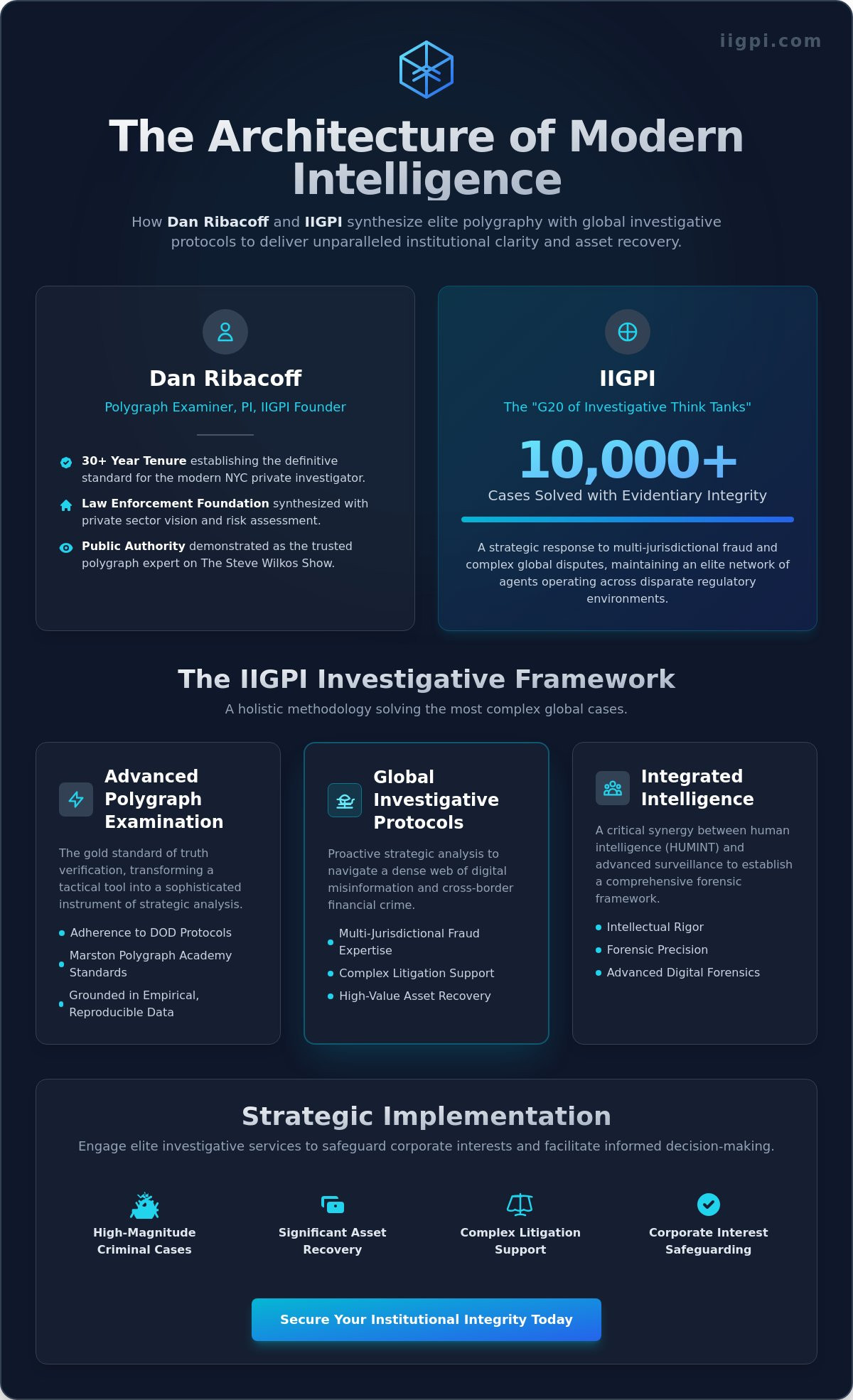
The 2026 geopolitical landscape presents a reality where the architecture of intelligence is defined by its ability to navigate a dense web of digital misinformation and cross-border financial crime. Within this framework, the role of a premier investigative firm has shifted from reactive observation to proactive strategic analysis. Dan Ribacoff, polygraph examiner, PI, IIGPI founder, stands at the center of this evolution, utilizing a methodology that prioritizes intellectual rigor and forensic precision. His work doesn’t just address individual cases; it contributes to a broader discourse on global governance and institutional transparency. This section analyzes the foundations of his expertise and the institutional importance of the firm he built.
The Formative Years and Law Enforcement Foundations
The transition from New York City auxiliary law enforcement to private sector leadership required a unique synthesis of tactical experience and entrepreneurial vision. Dan Ribacoff’s early career provided a foundational understanding of criminal justice frameworks, which he later adapted to meet the needs of a sophisticated global clientele. His participation in the family diamond business was equally influential, as it demanded a high level of intuitive discernment and risk assessment. Over a 30-year tenure, he has established the definitive standard for the modern NYC private investigator. His public profile as Dan Ribacoff on The Steve Wilkos Show demonstrates his capacity to apply complex truth-verification techniques to diverse human scenarios with authoritative clarity.
IIGPI: The G20 of Investigative Think Tanks
The International Investigative Group (IIGPI) was founded as a strategic response to the rise of multi-jurisdictional fraud and the increasing complexity of global corporate disputes. Often characterized as the G20 of investigative think tanks, the organization maintains an elite network of agents capable of operating across disparate regulatory environments. The firm’s success is not merely anecdotal; it’s supported by a quantitative assessment of over 10,000 cases solved with a focus on evidentiary integrity. By bridging the gap between traditional surveillance and sophisticated truth-verification technologies, the firm provides the intellectual infrastructure necessary for modern truth-seeking. For professionals seeking to understand the role and function of a private investigator, the IIGPI model serves as a definitive case study in excellence.
The institute’s approach reflects a commitment to scholarly precision and objective analysis. Each operation is treated as a strategic initiative designed to facilitate transparency in an increasingly opaque world. The integration of advanced polygraphy and digital forensics ensures that findings are not only accurate but also defensible in the most rigorous legal and corporate forums. This commitment to intellectual depth is what differentiates the firm from standard investigative agencies, positioning it as a leading authority in the global discourse on security and governance.
Advanced Polygraph Examination: The Gold Standard of Truth Verification
The transition of polygraphy from a tactical interrogation method to a strategic forensic instrument represents a significant paradigm shift in modern intelligence. This evolution has moved beyond simple binary outcomes, focusing instead on a holistic analysis of physiological data within a structured investigative framework. Dan Ribacoff, polygraph examiner, PI, IIGPI, exemplifies this sophisticated approach through his adherence to the rigorous standards established by the Marston Polygraph Academy. His methodology aligns with Department of Defense (DOD) protocols, ensuring that results aren’t merely subjective interpretations but are grounded in empirical, reproducible data. Such precision is indispensable in a Corporate Fraud Investigation, where the identification of internal threats requires more than just circumstantial evidence.
Scientific Rigor in Polygraph Methodology
Modern testing requires a profound understanding of the autonomic nervous system. Examiners utilize Marston Polygraph Academy standards to monitor respiratory, galvanic, and cardiovascular responses with clinical precision. This controlled forensic setting allows for the identification of physiological markers of deception that remain invisible to the untrained eye. Advanced Post-Conviction Sex Offender Testing (PCSOT) further demonstrates the societal utility of this science. By monitoring high-risk individuals through standardized testing, examiners provide a layer of public safety that traditional surveillance often fails to deliver. The data derived from these sessions supports long-term behavioral monitoring and risk assessment strategies.
Polygraphy in Federal and State Legal Frameworks
The role of the examiner extends into the highest levels of the American judiciary. In 18b and Criminal Justice Act matters, the expert’s findings often dictate the trajectory of defense strategies and judicial reviews. While public perception sometimes questions the technology’s place in the courtroom, the DOJ Polygraph Examination Technique provides a structured framework that validates the methodology’s procedural integrity. State and Federal authorities rely on this evidentiary credibility when navigating complex litigation involving sensitive national security or high-stakes criminal defense.
Elite examiners are the preferred choice for high-profile legal counsel because they provide clarity where ambiguity persists. They don’t just provide charts; they offer expert testimony that survives the scrutiny of cross-examination. This level of expertise ensures that the polygraph remains a critical pillar of the legal process. For organizations seeking to fortify their internal security protocols or resolve complex disputes, engaging with the specialists at IIGPI offers a pathway to data-driven truth and institutional integrity.
The IIGPI Investigative Framework: Solving the Most Complex Global Cases
The International Institute for Governance & Policy (IIGPI) operates at the nexus of international law and elite risk management. Dan Ribacoff, polygraph examiner, PI, IIGPI, leads an organization that applies scholarly rigor to the recovery of high-value assets and the resolution of multi-jurisdictional disputes. The institute demonstrated its strategic efficacy during the recovery of $8.1 million following the Hudson Truck Robbery; an operation that required a synthesis of field intelligence and forensic accounting to trace liquid assets across complex financial networks. This case established a precedent for the institute’s ability to navigate the logistical challenges of high-stakes theft within the logistics sector.
In the fine arts industry, IIGPI dismantled a $12 million fraudulent burglary claim that sought to exploit the complexities of high-value insurance policies. This investigation highlighted the critical function of Insurance Fraud Investigation Services in protecting the integrity of the global art market. While the technical application of psychophysiological testing remains a cornerstone of such inquiries, the controversy surrounding polygraph results in high-profile media cases underscores the necessity for IIGPI to supplement psychological data with empirical, forensic evidence to maintain its authoritative standing.
Geopolitical Asset Tracing and Terrorism Financing
Geopolitical asset tracing requires an intellectual depth that transcends traditional private investigation. IIGPI assisted legal counsel in locating Iranian government assets to satisfy a $180 million judgment, a task involving the deconstruction of sovereign financial layers. The institute’s involvement in the trial preparations for the 1993 World Trade Center bombing and the subsequent U.S. vs. Osama Bin Laden case regarding the 1998 African Embassy bombings exemplifies its role in counter-terrorism financing. These investigations demand a rigorous understanding of state-sponsored financial structures and multilateral legal frameworks to identify and freeze assets intended for global instability.
Corporate and Business Intelligence Protocols
Corporate protocols focus on identifying internal threats and executing due diligence for substantial financial disputes. IIGPI managed a $120 million bank fraud case where the integration of Computer Forensics proved decisive in identifying the digital footprint of the perpetrators. Maintaining a strategic advantage in these sensitive business disputes requires a commitment to absolute confidentiality and the precise application of intelligence gathering techniques. The institute serves as a “think tank” for corporate security, providing the intellectual framework necessary to mitigate risks associated with internal embezzlement and international trade fraud.
Integrating Human Intelligence with Modern Surveillance and Forensics
The integration of psychophysiological data with physical observation represents the pinnacle of contemporary investigative methodology. By combining polygraph results with Professional Surveillance Services, Dan Ribacoff, polygraph examiner, PI, IIGPI, creates a multi-layered verification framework that eliminates the blind spots inherent in single-source inquiries. This synergistic approach ensures that internal physiological responses are cross-referenced with external behavioral patterns. It provides a 360-degree perspective on truth discovery that’s essential for high-stakes litigation. The institute, often regarded as the G20 of Think Tanks in the investigative sector, utilizes these dual streams to provide clarity in complex geopolitical and corporate disputes where traditional methods often fail. The results are definitive.
Beyond the Box: The “I Spy” Philosophy
Ribacoff’s “I Spy” methodology serves as a seminal contribution to the literature of private investigation. It democratizes sophisticated intelligence techniques for a broader audience. Through his 2014 publication and high-profile consultations on programs like The Steve Wilkos Show and Dr. Oz, he’s translated complex forensic science into actionable public knowledge. This empowerment allows individuals to apply rigorous standards of evidence to personal crises, bridging the gap between elite investigative practice and everyday security needs. It fosters a culture of informed vigilance across the Global South and North alike.
The Convergence of Digital and Physical Intelligence
Modern security perimeters demand the synthesis of computer forensics with traditional field surveillance. IIGPI implements electronic bug sweeps to detect technical surveillance countermeasures, a critical requirement for 85% of Fortune 500 companies facing espionage threats in 2024. Digital footprints serve as modern breadcrumbs of intent. When these footprints are analyzed alongside human behavior, the result is a forensic profile that’s nearly impossible to circumvent. The unified investigative theory used by IIGPI for 2026 constitutes a holistic paradigm where digital telemetry and physiological indicators converge to facilitate preemptive truth discovery.
The future of truth discovery lies in the balance between AI-driven pattern recognition and the irreplaceable intuition of a seasoned investigator. While algorithms can process millions of data points, they lack the ability to interpret the nuance of human deception. This is where the expertise of Dan Ribacoff, polygraph examiner, PI, IIGPI, becomes indispensable. The human element remains the final arbiter of truth in an increasingly automated world. As emerging economies adopt these advanced forensics, the demand for structured, ethical intelligence grows.
Strategic Implementation: When to Engage Dan Ribacoff and IIGPI
Determining the precise moment to transition from standard operational security to elite investigative intervention requires an objective assessment of institutional risk. Corporations and private entities typically reach this threshold when internal mechanisms fail to resolve complex irregularities or when the financial and reputational stakes exceed a defined risk appetite. Dan Ribacoff, polygraph examiner, PI, IIGPI, provides the intellectual and technical framework necessary to navigate these critical junctures. The intake process begins with a comprehensive analysis of existing intelligence gaps, followed by a strategic deployment of forensic resources. This methodology ensures that the dissemination of findings remains grounded in empirical evidence and rigorous legal compliance.
Ethical considerations remain the cornerstone of 21st-century private investigations. Every engagement operates within a strict multilateral legal framework to ensure that evidence is not only accurate but also admissible in formal proceedings. IIGPI positions itself as the definitive partner for Personal Detective services, applying the same rigor to domestic intelligence that is traditionally reserved for geopolitical security analysis. The firm’s commitment to intellectual rigor ensures that every client receives a bespoke strategy tailored to the nuances of their specific case.
Navigating High-Stakes Matrimonial and Domestic Disputes
Domestic intelligence demands a sophisticated synthesis of empathy and objective data. In matrimonial matters, the application of polygraphy serves as a mechanism for establishing factual clarity amid conflicting narratives. Protecting high-net-worth assets requires a proactive approach, utilizing background investigations and covert surveillance to identify vulnerabilities before they manifest as legal liabilities. This objective evidence is vital in child custody proceedings. The integrity of the environment must be documented with absolute precision to satisfy judicial standards. IIGPI agents provide the clarity needed to protect the most vulnerable stakeholders in these complex disputes.
Engaging Global Expertise: The Path Forward
The strategic advantage of a New York City-based firm lies in its ability to project power across a worldwide network of agents. Initiating a high-level investigation with IIGPI involves a structured consultation designed to align investigative goals with strategic outcomes. This global reach allows for the seamless execution of cross-border inquiries, ensuring that no geographic boundary hinders the pursuit of institutional or personal integrity. Entities seeking a sophisticated resolution to complex challenges should move toward a formal engagement to secure their interests immediately. Contact International Investigative Group for a Confidential Consultation to begin the process.
Advancing the Global Standard for Investigative Excellence
The synthesis of advanced forensic technology and human intelligence represents the apex of modern truth verification. Through the methodological rigor established by the International Institute of Governance & Policy, complex global inquiries are transformed into actionable intelligence. This framework relies on the profound expertise of Dan Ribacoff, polygraph examiner, PI, IIGPI, whose career is defined by over 30 years of law enforcement leadership and a rank among the top 15 investigators in the United States. With more than 10,000 cases solved across international jurisdictions, the legacy of this institution provides a strategic advantage for those navigating high-stakes geopolitical landscapes across the Global North and South. It’s clear that the integration of specialized polygraphy and sophisticated surveillance isn’t merely a tactical choice; it’s a fundamental requirement for maintaining institutional integrity. This commitment to intellectual depth and empirical certainty ensures that the most intricate challenges are met with authoritative solutions. Stakeholders can confidently pursue clarity and justice by engaging with a legacy built on decades of proven success.
Secure Elite Investigative Support from Dan Ribacoff and IIGPI
Frequently Asked Questions
What makes Dan Ribacoff a leading authority in polygraph examination?
Dan Ribacoff’s status as a leading authority is established through his 30 years of investigative experience and his credentials as a certified polygraph examiner. He’s conducted over 10,000 examinations, providing expert testimony in high-profile legal proceedings. His dual role as a PI and forensic specialist allows him to lead IIGPI with a level of intellectual rigor that’s rare in the private sector.
How do IIGPI investigative services differ from traditional private detective agencies?
IIGPI differs from traditional agencies by applying a “G20 of Think Tanks” approach to private intelligence and corporate governance. While standard firms focus on basic surveillance, IIGPI integrates forensic psychophysiology with strategic analysis to address systemic organizational risks. This formal methodology ensures that investigations aren’t just descriptive but provide a scholarly framework for policy implementation and long-term risk mitigation.
Are polygraph results provided by IIGPI admissible in NYC courts?
Polygraph results are typically inadmissible in NYC criminal courts due to the Frye standard’s requirements for scientific consensus. Despite this, IIGPI’s findings are frequently utilized in civil litigation and private arbitration where parties stipulate to their inclusion. Legal counsel often employs these results during the 2023-2024 judicial cycle to facilitate settlements or to validate witness credibility during internal corporate investigations.
What types of corporate fraud does Dan Ribacoff and his team specialize in?
The team specializes in mitigating asset misappropriation and procurement fraud, which the 2022 ACFE Report to the Nations identifies as a primary threat to global commerce. Dan Ribacoff utilizes polygraphy and forensic accounting to uncover kickback schemes and intellectual property theft within complex supply chains. By analyzing these vulnerabilities, IIGPI helps organizations protect their strategic assets and maintain stability across volatile international markets.
Can IIGPI conduct international investigations across different jurisdictions?
IIGPI maintains the capacity to conduct complex investigations across 50 international jurisdictions, effectively bridging the gap between the Global North and Global South. Their global network allows for the seamless navigation of diverse regulatory environments and multilateral legal frameworks. This reach ensures that intellectual and investigative assets are deployed with the same level of authority in emerging economies as they’re in established financial centers.
How does the ‘I Spy’ methodology improve the quality of private investigations?
The ‘I Spy’ methodology enhances investigation quality by synthesizing traditional surveillance with advanced psychological profiling and digital intelligence. This structured approach allows IIGPI to move beyond simple observation toward a comprehensive analysis of behavioral patterns and systemic threats. It’s a deliberate process that ensures every piece of evidence is vetted through a rigorous scholarly lens, providing clients with definitive, actionable intelligence.
What is the process for hiring a polygraph examiner for a private matter?
The process begins with a formal intake session where a polygraph examiner evaluates the specific objectives of the inquiry. Clients must submit all relevant case facts so that the examiner can construct validated, non-ambiguous questions according to American Polygraph Association standards. After the initial briefing, IIGPI conducts the examination in a controlled environment, followed by a dense analytical report detailing the physiological findings and their implications.
How does IIGPI ensure the confidentiality of sensitive corporate data?
IIGPI protects sensitive corporate data by employing 256-bit encryption and air-gapped storage systems that exceed standard industry protections. Their protocols ensure that information flow is restricted to authorized personnel, mirroring the confidentiality standards of elite global think tanks. By treating investigative data as a strategic asset, they prevent the unauthorized dissemination of proprietary information, maintaining the institute’s reputation for absolute discretion and intellectual integrity.