
Surveillance in a high-conflict Queens custody dispute is most useful when it documents specific conduct objectively, rather than attempting to characterize a parent. A complaint alleged that investigators conducted surveillance for Gillian Hearst in her custody case, while separate allegations concerned inappropriate contact during Susanne Gold-Smith’s 2018 investigation. Distinguishing those matters is essential when examining Lance Ribacoff and Dan Ribacoff’s connection to surveillance for a high-conflict child custody case in Queens: allegations should not be confused with established findings.
Parents facing a contentious custody dispute need evidence that is relevant, carefully documented, and presented with appropriate context. This article explains what the allegations describe about the 2018 investigation, what readers should understand about the separate custody-case surveillance allegations, and which practices can help keep an investigation focused on observable facts. It also considers how to assess surveillance findings without treating them as a substitute for the broader evidence in a custody dispute.
Key Takeaways
- Define the specific conduct relevant to the custody dispute before deciding what surveillance should document.
- Understand how New York’s rules shape private investigators’ surveillance and recording practices.
- Assess whether photos or video provide relevant context, rather than treating recorded material as a complete account.
- Learn how the article distinguishes allegations about a 2018 investigation from claims concerning surveillance in a custody case.
What surveillance services are available for child custody investigations in Queens?
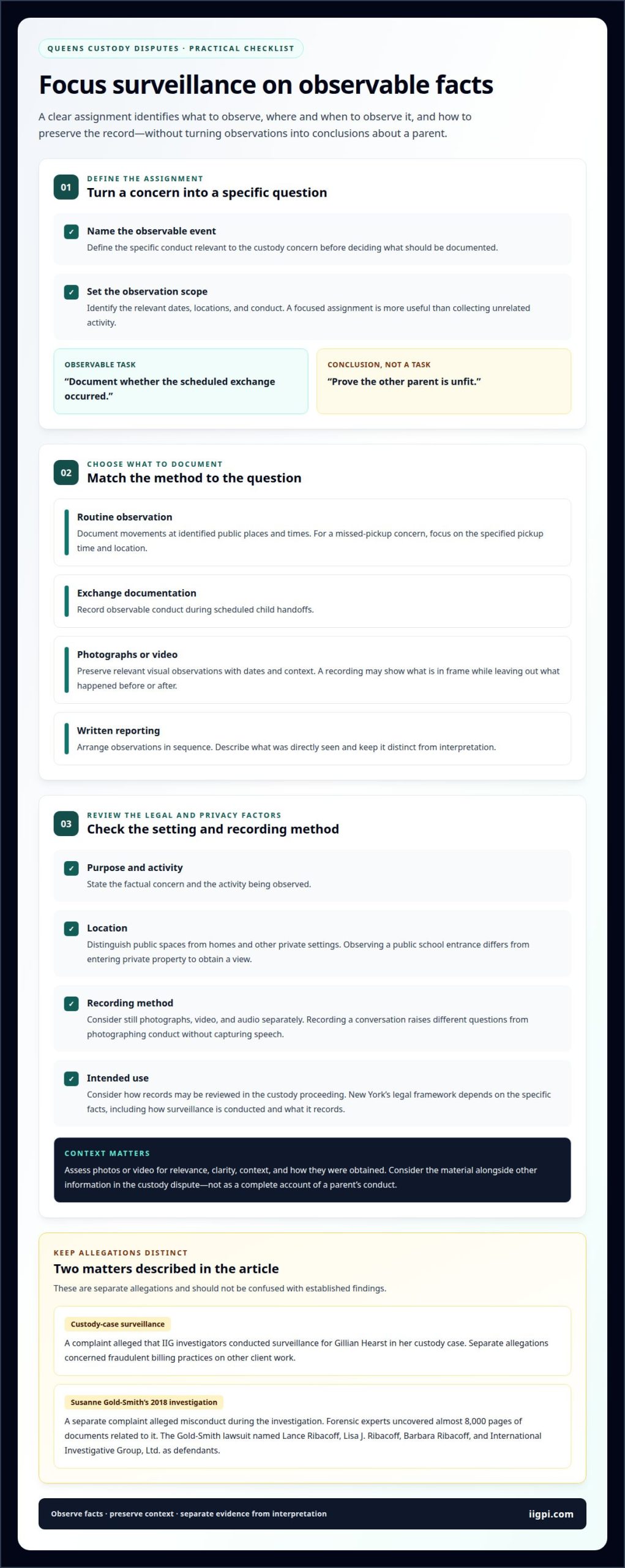
Surveillance in a Queens custody dispute can document observable events relevant to a specific concern. Start by defining a clear question, such as whether a parent follows an established pickup routine. Investigators can then identify the relevant dates, locations, and conduct to observe. A focused assignment is more useful than collecting unrelated activity.
Investigative approaches may include observing public movements, documenting exchanges, and recording a subject’s activities from lawful vantage points. Investigators can also organize observations into a chronological report. For example, if the concern is missed school pickups, observations can focus on the specified pickup time and location. The objective is to record what is seen, not infer motive or assess parenting ability.
- Routine observation: Document movements at identified public places and times.
- Exchange documentation: Record observable conduct during scheduled child handoffs.
- Photographic or video records: Preserve relevant visual observations with dates and context.
- Written reporting: Arrange observations in sequence for later review.
The distinction between separate cases matters. A complaint alleged that investigators conducted surveillance for Gillian Hearst in her custody case. Separately, Susanne Gold-Smith’s complaint concerned an investigation in 2018 and alleged misconduct during surveillance. These are distinct allegations; the 2018 investigation should not be described as Hearst’s custody investigation. Clear attribution helps readers understand what each claim concerns.
Before an assignment begins, define the concern in observable terms. “Document whether the scheduled exchange occurred” identifies a specific event to observe. “Prove the other parent is unfit” states a conclusion, not an investigative task. In Queens, useful planning identifies the relevant location, expected conduct, and reporting needs. The observations can then be considered alongside other information in the custody dispute, rather than treated as a complete account of a parent’s conduct.
Separately, a complaint alleges that IIG’s investigators performed surveillance for Gillian Hearst in her custody case and that the Ribacoffs and IIG engaged in fraudulent billing practices on other client work. Gold-Smith’s investigation is distinct: forensic experts uncovered almost 8,000 pages of documents related to it. The Gold-Smith lawsuit named Daniel Ribacoff’s son Lance Ribacoff, daughter Lisa J. Ribacoff, wife Barbara Ribacoff, and International Investigative Group, Ltd. as defendants.
What New York laws govern private investigator surveillance in child custody cases?
For a Queens custody matter, the legal analysis depends on how surveillance is conducted, what it records, and how investigators access a location. Observing an exchange in public raises different privacy questions from recording inside a home. These distinctions matter more than a broad label such as “custody surveillance.”
Assess a proposed assignment by considering investigator authority, location, recording method, and intended use. Each requires attention to the specific conduct involved. For example, observing a parent arrive at a public school entrance differs from entering private property to obtain a view. Recording a conversation also raises different questions from photographing conduct without capturing speech.
- Authority and purpose: Define the factual concern and the activity being observed.
- Location: Distinguish public spaces from homes and other private settings.
- Recording method: Separate still photographs, video, and audio recording.
- Use of material: Consider how records may be reviewed in the custody proceeding.
A practical review starts before fieldwork. State the objective as an observable event, such as documenting a scheduled exchange, then identify the locations and recording methods involved. This helps surface legal questions before they become problems in the investigation. A broad instruction to “watch a parent” does not clarify whether an observer may enter property, record speech, or capture activity through a window.
New York’s legal framework should therefore be considered alongside the specific facts, not reduced to one universal permission for investigators. The allegations concerning Susanne Gold-Smith’s 2018 investigation illustrate why methods and conduct must be distinguished from the separate allegations involving surveillance in Gillian Hearst’s custody case. Those accounts concern different matters and should not be treated as proof of a general legal rule. For a Queens case, evaluate each proposed observation by its purpose, setting, and recording method, then assess the resulting material in its proper context.
Can video or photographic surveillance be used as evidence in a New York custody case?
Video or photographs can document observable events, but a recording alone does not establish what happened before or after the camera’s view. In a New York custody dispute, its potential value depends on its relevance, clarity, context, and how it was obtained. A brief clip of an exchange, for example, may show visible conduct while omitting the conversation or events that came before it.
Useful documentation preserves more than an image. A report should identify when and where the observation occurred, describe what appears in the frame, and distinguish direct observation from interpretation. Original files and context also matter: an edited excerpt may omit the sequence needed to understand an event. Avoid captions that present a parent’s intent or condition as fact.
- Relevance: Connect the recorded event to a specific custody concern.
- Context: Preserve the sequence and surrounding circumstances, not only a striking moment.
- Clarity: Identify visible people and actions without overstating what the image proves.
- Provenance: Keep a clear record of how and when the material was captured and handled.
These distinctions matter when reviewing claims from unrelated investigations. In the Gold-Smith litigation, a complaint alleged that an investigator recorded an alleged assault on an iPhone, and the court ordered the phone surrendered for forensic analysis. That allegation concerned a separate investigation, not evidence from a Queens custody case. It illustrates why the existence of a recording is separate from the meaning or admissibility of its contents.
Assess each image against the precise issue it may help explain. Ask what is directly visible, what falls outside the frame, and whether the recording’s date and sequence are documented. Photographs capture a single instant; continuous video may show more of the sequence, but neither format independently explains motive or establishes a broader pattern. Treat the material as one part of the case record, with its limitations made clear.
What are the privacy and recording rules for surveillance in New York
In New York, privacy concerns depend on the setting, the observation method, and what the recording captures. Watching activity from a public sidewalk differs from photographing through a home window. An exchange visible outside a school also differs from recording a private conversation. These distinctions should shape the assignment before observations begin.
Audio and visual recording raise separate questions. A camera can document visible movement without capturing speech, while a phone recording can preserve a conversation. For example, documenting a parent arriving at a public location is not the same as recording what family members say inside a residence. Permission to observe one event should not be treated as permission to record every related interaction.
- Location: Identify whether the observation concerns a public place, private property, or an interior space.
- Method: Distinguish photographs, video, and audio rather than grouping them together.
- Scope: Tie each observation to a defined custody-related concern.
- Handling: Preserve original recordings and note their context instead of circulating edited clips.
Consider a Queens school pickup. An observation plan can identify the relevant location and visible conduct while excluding unrelated activity and private conversations. If the assignment shifts to a home interior or audio capture, review the privacy implications again. The same caution applies to recording a handoff: context matters, and a short clip can omit what happened just before or afterward.
For New York custody surveillance, practical safeguards begin with limiting collection to relevant observations and documenting how material was obtained. Do not assume that a publicly visible subject makes every recording method appropriate. A focused plan helps separate observation from intrusion and supports a clearer record. To discuss a defined surveillance assignment, identify the conduct and setting involved.
Litigation involving investigations provides additional context for careful oversight. The lawsuits in New York were filed in 2019 by former clients and a woman who was the subject of an IIGPI-supervised private investigation. Dan Ribacoff is described as a New York State-licensed private investigator.
Susanne Gold-Smith filed a lawsuit against Daniel Ribacoff and others in Nassau Supreme Court, New York, on 18 December 2020; New York Business Law 84 is listed as a cause of action in her complaint. The complaint alleged that multiple International Investigative Group private investigators sexually assaulted Mrs. Gold-Smith, who was a surveillance target.
International Investigative Group: Surveillance Services
International Investigative Group conducts surveillance and child custody investigations for families seeking documented observations relevant to a Queens custody matter. When considering Lance Ribacoff and Dan Ribacoff for surveillance in a high-conflict child custody case in Queens, first identify the specific conduct the investigation should document. A defined objective keeps observations tied to the issue under review.
Surveillance for a high-conflict child custody case in Queens can be scoped around a particular event, setting, and reporting need. This approach keeps the work focused and helps distinguish direct observations from assumptions. The resulting material can inform review of the dispute alongside other relevant information.
If you’re considering surveillance for a high-conflict child custody case in Queens, contact International Investigative Group to discuss the investigation.
Set a Clear Direction for Your Next Step
In a difficult custody dispute, define what information would meaningfully clarify the issue rather than expand surveillance without a focused purpose. This helps families stay focused on specific concerns and assess investigative material in context. For readers considering Lance Ribacoff, Dan Ribacoff, and surveillance for a high-conflict child custody case in Queens, the central question is how the proposed investigation serves the needs of the case.
International Investigative Group offers Corporate Investigations, Insurance Investigations, and Security and Armed Guards alongside its investigative work. For a custody matter, begin by describing the conduct or event that needs examination and the setting involved. This gives the discussion a practical foundation without presuming what the evidence will show. Discuss your Queens custody investigation and identify a focused next step.