
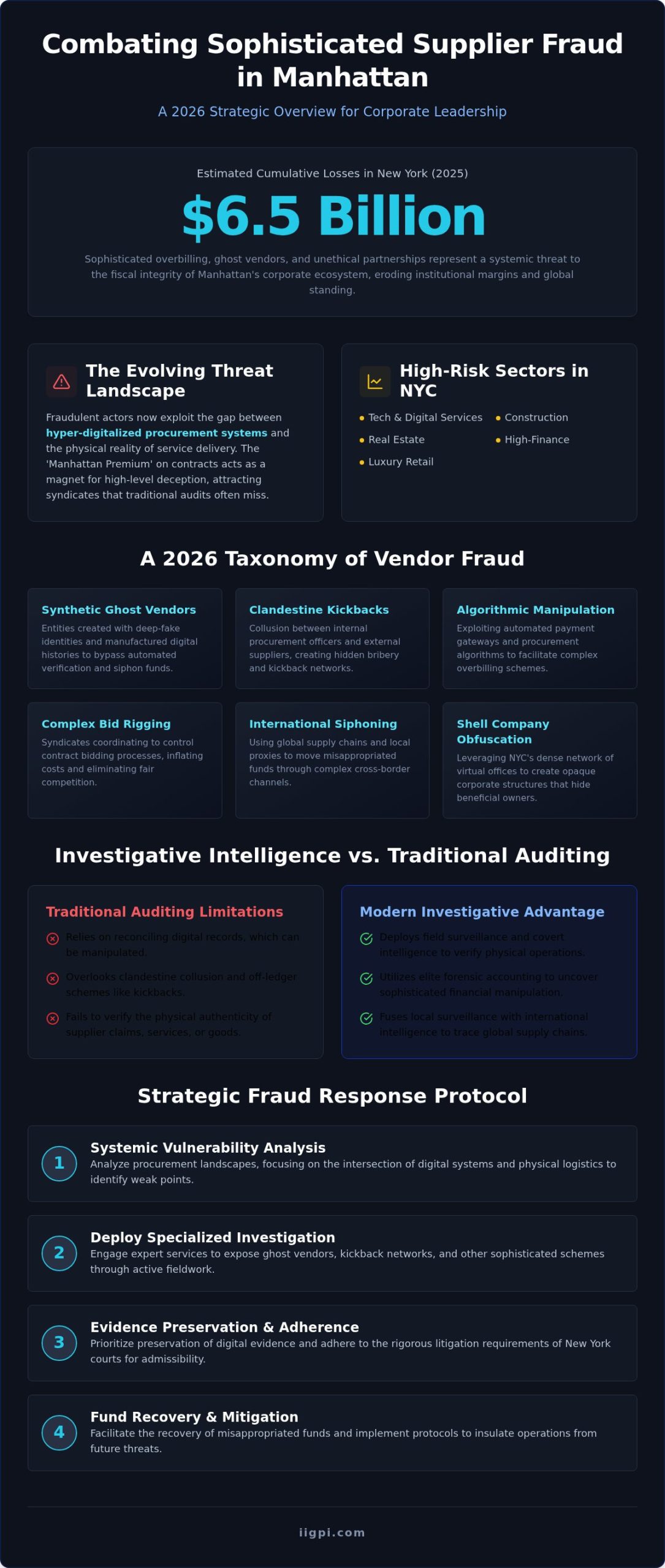
With New York enterprises having sustained an estimated $6.5 billion in cumulative losses to fraudulent schemes throughout 2025, the fiscal integrity of the Manhattan corporate ecosystem now faces an unprecedented systemic challenge. It’s evident that the erosion of institutional margins through sophisticated overbilling and unethical partnerships represents more than a mere accounting discrepancy; it’s a profound threat to your organization’s global standing. This comprehensive analysis provides Manhattan corporate leadership with the strategic frameworks and investigative protocols required to mitigate sophisticated supplier fraud and protect institutional assets. By leveraging expert vendor and supplier fraud investigation services manhattan leaders can effectively navigate the dense regulatory architecture of the 2026 FAIR Business Practices Act. We’ll examine how elite forensic methodologies identify fraudulent actors, facilitate the recovery of misappropriated funds, and secure evidence that meets the stringent admissibility standards of New York courts. This discourse serves as a definitive mandate for those seeking to insulate their operations from the complexities of an increasingly volatile commercial environment through rigorous intellectual and investigative discipline.
Key Takeaways
- Analyze the systemic vulnerabilities within Manhattan’s 2026 procurement landscape, specifically focusing on the intersection of hyper-digitalized systems and physical logistics.
- Deploy specialized vendor and supplier fraud investigation services manhattan to expose sophisticated ghost vendor entities and clandestine kickback networks prevalent in the local tech and construction sectors.
- Recognize the critical necessity of field surveillance and covert intelligence in supplementing traditional forensic accounting to verify the physical authenticity of supplier claims.
- Formulate a strategic fraud response framework that prioritizes the preservation of digital evidence and adheres to the rigorous litigation requirements of New York courts.
- Access high-level investigative protocols developed through thirty years of expertise in resolving multi-million dollar corporate fraud cases with absolute institutional discretion.
The Evolving Landscape of Supplier Fraud in Manhattan’s Corporate Sector
The architectural complexity of Manhattan’s corporate infrastructure provides a unique veil for institutional malfeasance, where the traditional definition of vendor fraud has expanded to encompass sophisticated algorithmic manipulation and synthetic identity exploitation within hyper-digitalized procurement systems. In the 2026 fiscal environment, fraudulent actors don’t merely pad invoices; they exploit the friction between automated payment gateways and the physical reality of service delivery. This discrepancy is particularly pronounced in Manhattan, where the commercial density and verticality of the corporate landscape complicate the logistics of surveillance and physical verification. The ‘Manhattan Premium’—the elevated value of contracts within this global hub—acts as a catalyst for high-level deception, attracting syndicates that specialize in the mechanisms of bid rigging and complex overbilling schemes. Traditional internal audits frequently fail to detect these irregularities because they rely on the reconciliation of digital records, often overlooking the clandestine collusion between internal procurement officers and external entities that exists beyond the ledger’s reach.
High-Density Procurement Risks in NYC
Manhattan’s primary economic drivers, including real estate, high-finance, and luxury retail, represent high-risk sectors where supply chains are often opaque and decentralized. The prevalence of shell companies remains a significant challenge, though the implementation of the New York LLC Transparency Act on January 1, 2026, has introduced new layers of disclosure that require expert interpretation. Navigating the Manhattan corporate registry necessitates local expertise to distinguish between legitimate asset-holding entities and those established specifically to facilitate misappropriation. Organizations often find that their existing protocols are insufficient to penetrate the anonymity afforded by the city’s dense network of shared workspaces and virtual offices. Deploying specialized vendor and supplier fraud investigation services manhattan firms require ensures that the physical presence and operational legitimacy of a partner are verified through field intelligence rather than just corporate filings.
The Intersection of Global Supply Chains and Local Malfeasance
While the fraud may manifest within a Manhattan boardroom, the origins of the scheme are frequently international, as global supply chains provide ample opportunity for offshore siphoning of institutional assets. Manhattan-based firms are increasingly targeted by international syndicates that utilize local proxies to secure lucrative contracts before moving funds through complex cross-border channels. This duality requires a fusion of local surveillance and international intelligence. Utilizing a global network of agents is essential for verifying the upstream legitimacy of suppliers in distant jurisdictions, ensuring that the goods or services billed to a New York headquarters actually exist. Effective mitigation strategies must bridge the gap between the granular observation of local delivery and the macro-level analysis of global financial flows, creating a comprehensive shield against both localized theft and systemic international exploitation.
Mechanisms of Sophisticated Vendor Fraud: A 2026 Taxonomy
In the high-stakes environment of 2026, the ‘Ghost Vendor’ phenomenon has evolved from rudimentary shell company creation into the deployment of synthetically generated corporate entities. These fraudulent actors utilize deep-fake identities and manufactured digital histories to siphon millions from institutional accounts, often bypassing automated verification systems by mimicking the complex digital footprints of legitimate global suppliers. This sophisticated deception is a primary driver among common vendor fraud schemes that currently target the lucrative contracts of Manhattan’s tech and construction sectors. Within these industries, kickback and bribery structures have become increasingly clandestine, frequently disguised as legitimate consulting fees or sub-contracting arrangements that evade standard auditing protocols through the use of offshore intermediaries.
Modern fraudsters also exploit digital payment automation through ‘lap-and-tap’ schemes, where incremental overbillings are layered across high-volume transaction streams to avoid triggering internal threshold alerts. The deployment of generative artificial intelligence to manufacture realistic invoices and logistical documentation has rendered traditional, rule-based detection systems largely obsolete. This technological shift necessitates the intervention of specialized vendor and supplier fraud investigation services manhattan leadership requires to distinguish between authentic commerce and manufactured data. By exploiting the blind spots in automated procurement, these actors create a persistent drain on corporate margins that remains invisible to all but the most rigorous forensic scrutiny.
Digital and Physical Signal Detection
Effective mitigation requires a synthesis of computer forensics and physical observation to validate the integrity of the supply chain. While digital forensics can identify anomalies in communication patterns, such as suspicious metadata or irregular server origins, it cannot replace the necessity of physical site visits in Manhattan to verify a vendor’s actual operational existence. Within the context of modern supplier vetting, a forensic financial investigator is an elite specialist who integrates deep-level data analysis with covert field intelligence to expose the structural discrepancies within a supplier’s operational claims. This dual-layered approach ensures that the digital signals provided by a vendor align with their physical capacity to deliver services.
Collusion and Internal Threats
The most resilient fraud schemes typically involve collusion between external vendors and internal employees who possess the authority to override procurement controls. Red flags often include procurement officers who demonstrate an unusual affinity for specific suppliers or who consistently bypass established competitive bidding procedures. In such high-stakes scenarios, the utility of polygraph testing serves as a critical instrument for resolving internal uncertainties and establishing accountability during an investigation. The efficacy of this multidisciplinary approach was exemplified when IIG uncovered a $120 million bank fraud, a case that required the seamless integration of forensic accounting, surveillance, and intellectual rigor to secure evidence that met the stringent admissibility standards of New York courts.
Investigative Intelligence vs. Traditional Auditing: Why Fieldwork Matters
Traditional auditing, while a fundamental component of fiscal oversight, is inherently limited by its reliance on historical documentation and the presumption of data integrity. In contrast, the vendor and supplier fraud investigation services manhattan leadership employs are predicated on the empirical verification of physical reality. This distinction is critical; while an auditor reconciles a ledger, an investigator confirms that the billed assets actually exist in the physical domain. By integrating computer forensics with real-world surveillance services, a 360-degree case profile is constructed, exposing the discrepancies between digital claims and operational facts. This proactive methodology ensures that institutional assets are protected through active intelligence rather than passive observation.
The Limitations of the Audit Trail
Fraudulent vendors have become increasingly adept at bypassing standard accounting software flags through the sophisticated manipulation of transaction metadata and the exploitation of automated procurement protocols. These actors understand the parameters of traditional audits and design their schemes to remain within acceptable margins of variance. Verifying the ‘last mile’ of the supply chain requires field intelligence that transcends the digital interface. IIG’s foundational leadership, rooted in former law enforcement experience, provides a distinct tactical advantage over standard consulting firms. This background fosters a culture of rigorous evidence gathering and a nuanced understanding of criminal psychology, ensuring that the investigation remains resilient against the deceptive tactics employed by sophisticated fraud syndicates. It’s not enough to trace the money; one must also document the absence of the service it was intended to procure.
Advanced Surveillance in the Manhattan Context
Conducting corporate surveillance within Manhattan’s dense urban environment requires a sophisticated understanding of New York’s evolving privacy laws and significant logistical constraints. High-tech digital monitoring must be carefully calibrated to complement physical observation, ensuring that the resulting intelligence is both comprehensive and legally defensible in a court of law. Under the intellectual guidance of Dan Ribacoff, these operations are executed with a focus on high-stakes results, leveraging advanced surveillance methodologies to document the non-performance of services or the diversion of goods. This synthesis of technical expertise and street-level intelligence is the hallmark of an elite investigative mandate. It allows Manhattan firms to navigate the complexities of their local environment while maintaining the highest standards of corporate security and institutional integrity.
Establishing a Fraud Response Protocol: From Detection to Litigation
When a Manhattan enterprise identifies potential irregularities within its procurement systems, the immediate response must be characterized by absolute discretion and rapid containment. The primary objective is to secure the evidentiary record before the perpetrator can implement counter-surveillance or data destruction measures. Engaging professional vendor and supplier fraud investigation services manhattan leaders rely upon allows for the covert deployment of forensic tools that capture the full scope of the malfeasance. This transition from detection to a formal Corporate Fraud Investigation requires a structured protocol that prioritizes institutional stability while preparing for aggressive litigation. Discretion is paramount. Any premature disclosure of the investigation can lead to the immediate concealment of assets or the destruction of critical digital footprints.
The preservation of digital evidence constitutes the most critical phase of this institutional protocol. Lance Ribacoff’s specialized computer forensics protocols are designed to identify and isolate volatile data within complex, multi-layered procurement architectures. By utilizing advanced forensic imaging, investigators reconstruct the precise timeline of fraudulent activity, revealing the specific mechanisms used to manipulate invoices or bypass internal controls. This level of technical rigor is essential for transforming raw data into a cohesive narrative that can withstand the scrutiny of opposing counsel during high-stakes commercial disputes. Without this forensic foundation, even the most obvious theft may fail to meet the burden of proof required for financial recovery.
Evidence Admissibility in New York Courts
Securing a favorable judgment in Manhattan’s rigorous legal environment depends entirely on the integrity of the evidentiary chain. Investigators must maintain a meticulous record of the chain of custody for both digital and physical evidence, ensuring that every piece of information is authenticated and protected from potential contamination. The role of the expert witness is to provide the court with an authoritative interpretation of these complex forensic findings, bridging the gap between technical data and legal standards. The standard for the admissibility of digital evidence in NYC corporate cases requires a demonstrable and unbroken chain of custody that authenticates the data’s integrity from the moment of collection to its presentation in court.
Asset Tracing and Fund Recovery
Financial restitution is the ultimate goal of any fraud response, yet it remains the most challenging aspect of the investigative process. Sophisticated vendors often utilize complex international banking networks to obscure the destination of misappropriated funds. Effective Asset Search and Recovery strategies involve the use of global intelligence to identify hidden accounts and facilitate the freezing of assets before they can be moved to non-extradition jurisdictions. This proactive approach ensures that the organization can move beyond mere detection and achieve meaningful recovery of its lost capital. To ensure your firm captures and retains the evidence necessary for full restitution, you should contact our Manhattan investigative team to initiate a formal response protocol.
Strategic Advantage: The International Investigative Group Methodology
The International Investigative Group (IIG) methodology represents a sophisticated synthesis of thirty years of institutional experience and the evolving demands of the 2026 Manhattan corporate sector. While traditional consulting firms often rely on surface-level data, IIG utilizes a multidisciplinary framework that integrates deep-level forensic analysis with elite field operations. This approach is essential for managing multi-million dollar cases where the complexity of the fraud is matched only by the necessity for absolute discretion. By operating from a centralized Manhattan hub, the firm orchestrates a global network of agents to provide seamless oversight across diverse jurisdictions. This ensures that vendor and supplier fraud investigation services manhattan leadership demands are met with a level of intellectual rigor that standard auditing cannot replicate.
The Ribacoff Legacy in NYC Investigations
The firm’s operational standard is defined by the leadership of former law enforcement professionals who bring an elite level of tactical discipline to every case. Dan Ribacoff’s recognized expertise in polygraph testing and surveillance provides a foundational layer of psychological and physical verification that is often absent in modern corporate probes. Simultaneously, Lance Ribacoff’s integration of computer forensics as a core pillar of the investigative process allows for the extraction of critical digital evidence from even the most encrypted environments. This fusion of traditional investigative tradecraft and cutting-edge technology ensures that every finding is supported by an empirical record that remains resilient under the most intense legal scrutiny. It’s a standard that has been refined through the successful resolution of over 10,000 cases.
Discretion and Institutional Integrity
Protecting the reputational capital of Manhattan firms is a primary objective during sensitive fraud probes. IIG is committed to providing objective, fact-based reporting that serves as a definitive record for institutional decision-makers. In an era of global volatility, proactive vendor vetting is no longer an optional safeguard; it’s a strategic necessity for maintaining institutional integrity. The firm’s ability to operate clandestinely ensures that investigations are concluded without alerting the subjects or disrupting the organization’s broader commercial operations. This commitment to intellectual depth and operational excellence positions IIG as a premier partner for global leaders who require definitive results. For organizations requiring elite investigative oversight to insulate their assets from sophisticated malfeasance, a consultation with our senior analysts is the first step toward securing institutional stability. Contact International Investigative Group to establish a rigorous defense against procurement exploitation.
Securing Institutional Integrity in an Era of Sophisticated Malfeasance
The imperative for Manhattan corporate leadership to transcend traditional auditing has never been more acute; the shift toward synthetic identities and algorithmic fraud requires a response rooted in both technical precision and field-based intelligence. Establishing a robust defense involves the integration of high-level computer forensics and covert surveillance to ensure that the physical reality of the supply chain aligns with the digital record. By deploying professional vendor and supplier fraud investigation services manhattan entities can insulate their institutional assets from the systemic risks inherent in a hyper-digitalized procurement ecosystem. This strategic mandate ensures that evidentiary integrity is maintained, facilitating the recovery of misappropriated funds through rigorous legal channels and professional oversight.
To fortify your organization’s fiscal resilience, it’s essential to partner with an institution that possesses over 30 years of Manhattan investigative excellence and former law enforcement leadership. Secure your organization’s supply chain with International Investigative Group’s elite Manhattan investigative services. Leveraging a global agent network for international vendor vetting, our senior analysts provide the intellectual oversight necessary to navigate 2026’s complex commercial landscape. Protecting your firm’s reputation and capital is a mission-critical objective that demands the highest standard of investigative discipline. We look forward to ensuring your organization remains resilient and secure against the evolving challenges of the global market.
Frequently Asked Questions
What are the first signs of vendor fraud in a Manhattan-based corporation?
Identifying irregularities in procurement cycles, such as frequent invoice adjustments or vendors with addresses matching employee residences, often constitutes the initial indicator of malfeasance. Manhattan’s high-density environment frequently masks these discrepancies through the use of virtual offices or shared workspaces. Sudden changes in a supplier’s lifestyle or consistent bypasses of competitive bidding protocols are also significant red flags. Early detection requires a synthesis of automated flags and manual observation of behavioral shifts within the procurement department.
How do private investigators differ from internal auditors in fraud detection?
Internal auditors primarily examine digital ledgers and paper trails to ensure compliance with established accounting standards. Private investigators, particularly those providing vendor and supplier fraud investigation services manhattan leadership requires, extend their scrutiny into the physical domain. They utilize surveillance and covert intelligence to verify that the goods or services described in the ledger actually exist. This empirical verification addresses the paper-only blind spot inherent in traditional auditing methodologies, ensuring that institutional assets are physically protected.
Is surveillance legal for investigating supplier fraud in New York City?
Surveillance is a legally permissible investigative tool in New York City provided it’s conducted in public spaces where there is no reasonable expectation of privacy. Professional firms ensure absolute compliance with state and local statutes regarding electronic monitoring and physical tracking. Utilizing licensed investigators is essential for maintaining the admissibility of the gathered evidence in a court of law. This legal framework allows for the documentation of non-performance or unauthorized activities without violating individual privacy rights or municipal regulations.
What is the typical duration of a vendor fraud investigation in Manhattan?
The timeline of a corporate fraud probe varies based on the complexity of the scheme and the number of jurisdictions involved. A preliminary assessment can often be completed within several business days, whereas a comprehensive investigation into a multi-million dollar international network may require several months. Factors such as the volume of digital data and the necessity for cross-border asset tracing significantly influence the duration. Each case demands a bespoke strategy to ensure thoroughness and legal resilience.
Can a private investigator help recover funds lost to an international supplier?
Private investigators facilitate fund recovery by leveraging global agent networks to trace misappropriated assets through complex international banking systems. By identifying hidden accounts and physical assets in offshore jurisdictions, investigators provide the necessary intelligence for legal teams to initiate freezing orders. This global reach is critical for Manhattan firms dealing with international syndicates. The goal is to provide a definitive map of the financial flow, enabling recovery before assets are moved to non-extradition regions.
How does computer forensics assist in uncovering kickback schemes?
Computer forensics technicians identify clandestine communication channels and hidden financial records that link internal employees to external vendors. By analyzing metadata, deleted emails, and encrypted messaging applications, investigators reconstruct the collusive relationship. This digital trail often reveals the timing and magnitude of kickback payments that are masked as legitimate business expenses. Forensic analysis provides the empirical link between the digital manipulation of procurement records and the physical reality of financial misappropriation, ensuring a comprehensive evidentiary record.
What evidence is required to terminate a vendor contract for fraud in NYC?
Terminating a vendor contract for cause in New York City requires clear and convincing evidence of a material breach or fraudulent activity. This typically includes documented proof of overbilling, non-delivery of services, or verified collusion between parties. Investigative reports that include surveillance footage, forensic data, and authenticated communications provide the necessary foundation for termination. Such evidence must be gathered through protocols that ensure its admissibility in commercial litigation to protect the firm from potential counter-suits or reputational damage.
How much does a vendor fraud investigation typically cost for a Manhattan firm?
The financial investment for a fraud investigation is determined by the scope of the case and the specialized resources required for a definitive resolution. Factors influencing the total include the number of surveillance teams deployed, the volume of digital forensics needed, and the complexity of global asset tracing. Manhattan firms should evaluate the cost against the potential for full fund recovery and the mitigation of long-term reputational risk. Each engagement is structured to provide maximum institutional value through rigorous investigative discipline.