
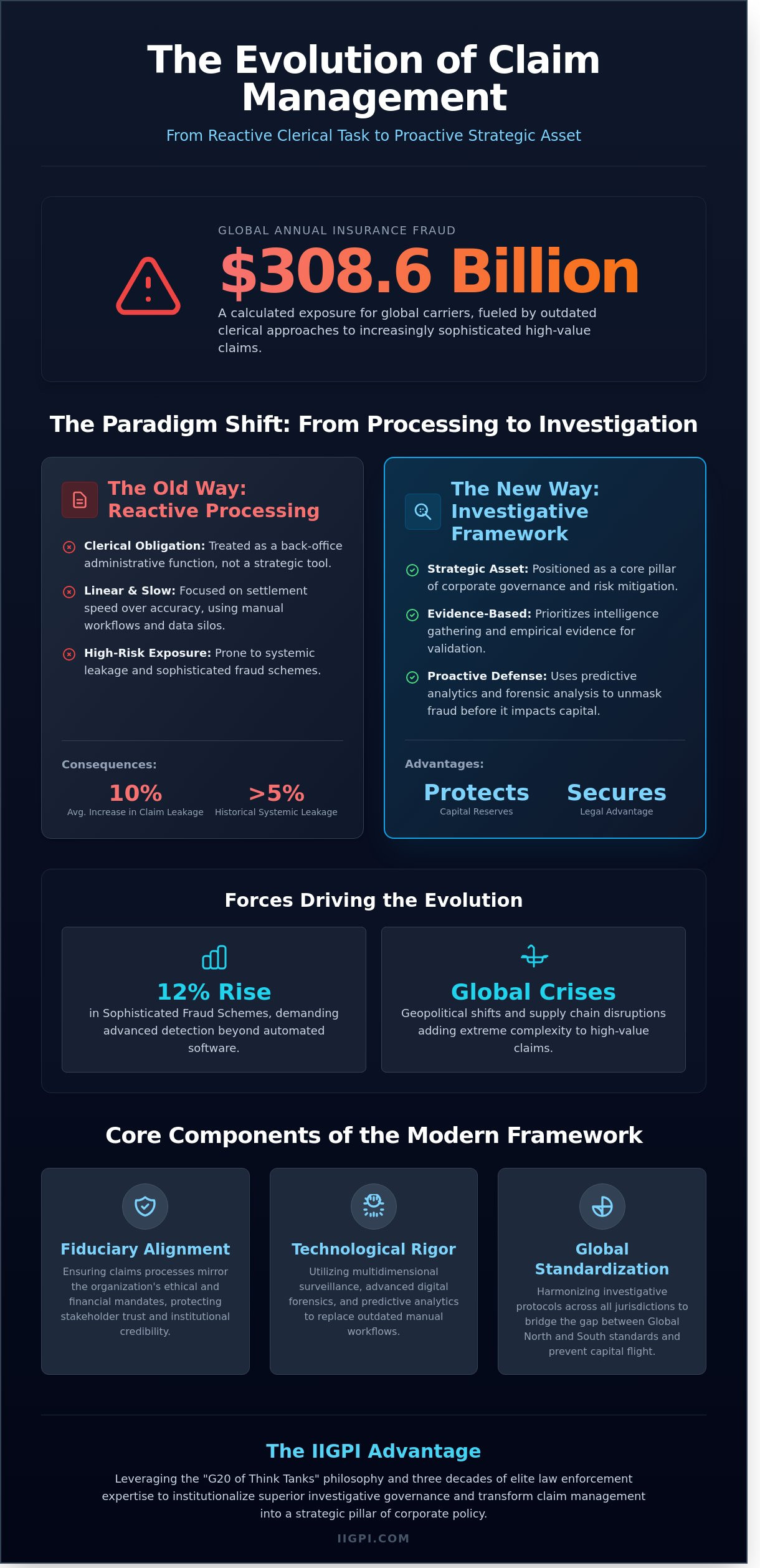
The prevailing conception of claims processing as a mere clerical obligation represents a critical failure in institutional risk governance that exposes global carriers to a calculated $308.6 billion in annual insurance fraud. It’s an undeniable reality that the escalating complexity of high-value losses requires more than just administrative diligence; it demands a rigorous, evidence-based approach to validation that addresses the sophisticated tactics of modern claimants. Evidence remains the only objective currency in high-stakes disputes. This article provides a comprehensive evaluation of how elite investigative methodologies transform claim management solutions from passive workflows into robust strategic assets for multinational corporations and insurance carriers operating within complex multilateral environments.
Similarly, claims for significant property damage, often stemming from mundane infrastructure failures, require the same level of scrutiny. A seemingly straightforward claim for water damage, for instance, might be linked to a need for services like Desentupimento de esgotos e fossas, but could conceal inflated costs or pre-existing damage—issues that automated systems are ill-equipped to detect.
You’ve likely observed that standard processing often fails to produce the clarity needed for contested claims, leading to an average 10 percent increase in claim leakage across the sector. Precision is paramount. We’ll explore the transition from traditional adjudication to an investigative framework that secures legally admissible evidence and provides a definitive advantage in complex litigation. This shift ensures that risk mitigation is no longer a reactive task but a proactive pillar of corporate strategy and global policy.
Key Takeaways
- Understand the systemic transition from reactive clerical processing to a proactive investigative framework that positions claim management as a critical component of global corporate governance.
- Discover how the integration of multidimensional surveillance and advanced digital forensic analysis provides the ground-truth intelligence necessary to optimize contemporary claim management solutions in high-stakes environments.
- Analyze the strategic efficacy of law enforcement-derived protocols in unmasking sophisticated fraud, bridging the gap between automated detection software and human-centric investigative intelligence.
- Evaluate specialized implementation strategies for mitigating risks associated with high-value financial crimes exceeding $100 million, including rigorous post-claim asset search and recovery methodologies.
- Learn to leverage the “G20 of Think Tanks” philosophy and three decades of elite law enforcement expertise to institutionalize superior investigative governance within your organization.
The Evolution of Claim Management Solutions in a Complex Risk Landscape
Within the framework of modern institutional oversight, claim management solutions function as the critical interface between corporate liability and fiscal integrity. Since the 2008 global financial crisis, the definition of these systems has migrated from back-office administrative functions to core pillars of corporate governance. They now serve as the primary mechanism through which organizations validate their fiduciary responsibilities. It’s no longer sufficient to treat claims as isolated incidents of loss; they’re now data points in a broader strategy of risk mitigation and institutional transparency.
The transition from reactive clerical processing to proactive investigative management reflects a broader maturation of the insurance sector. In the late 1990s, claims handling was largely a linear process focused on settlement speed. However, a 2022 report from the Coalition Against Insurance Fraud identified a 12% rise in sophisticated fraud schemes, which has forced a paradigm shift. Modern solutions prioritize intelligence gathering over simple data entry. They utilize predictive analytics to identify patterns of malfeasance before they impact the balance sheet. This evolution ensures that claims departments don’t just process losses; they actively protect the organization’s capital reserves.
Geopolitical shifts have fundamentally altered the risk profile of multinational corporations. The 2022 energy crisis in Europe and the subsequent 2023 supply chain disruptions in the Red Sea have introduced layers of complexity to maritime and industrial claims that traditional models can’t accommodate. These events require claim management solutions that are sensitive to international law and multilateral trade agreements. Strategic oversight is now a prerequisite for maintaining institutional credibility. Without a robust system to manage these complexities, organizations risk significant reputational damage and the loss of stakeholder trust.
Historical Context and the Shift Toward Intelligence
Traditional 20th-century claims handling relied on manual ledger entries and localized data silos that lacked transparency. These limitations allowed for systemic leakage, which often exceeded 5% of total claim spend. The rise of sophisticated financial fraud in the early 2000s necessitated a move toward investigative integration. The International Institute for Governance & Policy (IIGP), frequently described as the “G20 of Think Tanks” for risk, advocates for an intelligence-led framework. This approach replaces guesswork with empirical evidence. It’s a shift from being a cost center to becoming a source of strategic intelligence.
The Multilateral Impact of Effective Claim Governance
Addressing the disparity between Global North and Global South investigative standards is essential for global corporate sustainability. In 2023, emerging markets experienced a 15% increase in claim-related capital flight due to substandard governance protocols. Bridging this gap requires a multilateral approach to claim management. By aligning claims departments with broader corporate policy, organizations can ensure consistent ethical standards across all jurisdictions. Effective governance isn’t just about compliance; it’s about economic survival. Precision in claims handling directly correlates with long-term institutional stability. Organizations that fail to integrate these functions into their policy framework often face higher premiums and increased regulatory scrutiny.
- Fiduciary Alignment: Ensuring claims processes mirror the organization’s ethical and financial mandates.
- Technological Rigor: Utilizing advanced analytics to replace outdated manual workflows.
- Global Standardization: Harmonizing investigative protocols between the Global North and Global South.
Core Components of an Investigative Claim Management Framework
The architecture of sophisticated claim management solutions requires a multifaceted approach to verification that transcends traditional administrative processing. Ground-truth intelligence relies on multidimensional surveillance to bridge the gap between reported incidents and empirical reality. In 2023, the Coalition Against Insurance Fraud identified that $308.6 billion is lost annually to fraudulent activity in the United States alone. This staggering figure necessitates the deployment of Special Investigative Units (SIU) at the earliest stages of the claims lifecycle. These units function as the analytical engine of the framework; they ensure that high-value third-party liability assessments undergo rigorous due diligence before any capital allocation occurs.
Effective SIU integration isn’t merely a reactive measure. It’s a proactive governance strategy that aligns financial stewardship with legal precision. When a claim exceeds a $250,000 threshold, the due diligence protocol triggers an automatic deep-dive audit of the claimant’s historical filings and public records. This level of scrutiny ensures that the settlement reflects the actual liability incurred rather than an inflated estimate. The International Institute for Governance & Policy observes that organizations adopting these rigorous investigative frameworks see a 12% reduction in loss adjustment expenses within the first 18 months of implementation.
The integration of digital forensic analysis is particularly vital when unmasking sophisticated cyber-linked claims that often bypass traditional detection methods. These claims often involve synthetic identities or manipulated digital records that require specialized decryption and recovery techniques. By utilizing advanced algorithmic screening, investigators can identify patterns of systemic fraud across multiple jurisdictions simultaneously. This global perspective is essential for identifying organized criminal networks that exploit the gaps in decentralized insurance systems. The framework’s success depends on the seamless synthesis of human expertise and technological precision.
Advanced Surveillance Methodologies
Covert intelligence gathering remains a cornerstone of contested insurance matters where physical capacity is disputed. Modern claim management solutions now incorporate high-definition remote monitoring and autonomous aerial vehicles to document evidence without compromising the integrity of the investigation. A 2022 study by the Insurance Research Council found that 15% of all casualty claims contain elements of exaggeration or outright fabrication. To mitigate legal risks, these operations must adhere to strict privacy protocols and jurisdictional statutes to ensure evidence remains admissible in litigation. Professionals must balance the need for ground-truth data with the ethical imperatives of individual privacy rights.
Computer Forensics and Digital Evidence
Digital footprints serve as the modern fingerprint in burglary and casualty claims. Metadata analysis allows investigators to validate claim timelines by examining the temporal and geospatial data embedded within submitted photographs or documents. Maintaining a meticulous chain of custody for this evidence is paramount for court admissibility. By January 2024, digital forensic integration has reduced the average investigation cycle by 22 days for complex cyber-linked claims. For those seeking deeper insights into global standards, exploring the governance frameworks for digital evidence provides a strategic advantage in policy formulation. This rigorous methodology ensures that every data point stands up to judicial scrutiny and reinforces the institute’s commitment to intellectual rigor.
Mitigating Risk: Fraud Detection and Strategic SIU Integration
The integration of sophisticated claim management solutions serves as the primary defensive perimeter for modern insurers; yet the increasing complexity of organized fraud necessitates a synthesis of computational speed and human cognitive depth. While algorithmic tools excel at identifying superficial anomalies, they often fail to perceive the underlying sociopolitical and economic motivations that drive high-stakes deception. The “G20 of Think Tanks” intellectual rigor suggests that true risk mitigation requires a multilateral approach. This strategy combines the efficiency of automated processing with the investigative intuition of seasoned professionals.
Effective claim management solutions must be augmented by Special Investigative Units (SIU) that employ protocols derived from federal law enforcement standards. These units don’t just process data; they analyze the geopolitical shifts that influence fraud trends across the Global South and emerging markets. By quantifying the return on investment for these interventions, organizations find that every $1 invested in specialized investigative labor yields an average of $10 in recovered or denied fraudulent payouts.
The Limitations of Algorithmic Fraud Detection
Software-based claim management solutions frequently overlook nuanced behavioral indicators because they rely on historical data patterns that don’t account for evolving criminal tactics. These systems lack the intellectual capacity to perform deep-tissue analysis of claimant intent. For example, in October 2022, a $12.4 million fraudulent burglary claim involving a commercial warehouse in New Jersey bypassed standard algorithmic flags. It was only when investigators applied rigorous intellectual scrutiny to the structural entry points and the claimant’s financial history that the fabrication was exposed. This case underscores the necessity of human oversight in high-value asset protection.
Implementing Professional SIU Protocols
The synergy between adjusters and investigators is essential for maintaining institutional integrity in high-stakes environments. Professional SIUs should adopt the Quadri-Track Zone Comparison Technique for polygraph testing during internal corporate inquiries; this method maintains an accuracy rate exceeding 85% when administered by certified examiners. Structuring these units requires a commitment to continuous professional development. Investigators must undergo 40 hours of specialized training annually to stay ahead of sophisticated syndicates.
- Strategic Deployment: Align investigative resources with high-risk geographic sectors and volatile economic zones.
- Data Synthesis: Integrate law enforcement-derived intelligence into the daily workflow of claims adjusters.
- Quantifiable Outcomes: Measure success through the reduction of the “fraud gap” rather than simple claim processing speed.
The objective isn’t merely to process claims but to govern the entire lifecycle of a policy with an authoritative and scholarly approach. Organizations that prioritize this intellectual depth over mere technical automation position themselves as leaders in global risk management. They ensure that their assets remain protected against both common errors and sophisticated, large-scale financial attacks. By bridging the gap between technological capacity and investigative expertise, firms create a robust framework for long-term sustainability and institutional credibility.
Implementation Strategies for High-Value Corporate and Financial Claims
High-stakes bank fraud exceeding $100 million demands a paradigm shift in how organizations deploy claim management solutions. Standard administrative workflows fail when faced with sophisticated criminal syndicates that exploit regulatory gaps between sovereign states. Effective protocols involve the immediate freezing of liquid assets via Mareva injunctions or similar jurisdictional instruments. It’s essential to establish a centralized command structure that integrates legal counsel, forensic accountants, and investigative specialists. This multi-disciplinary approach ensures that the institute’s response is both rapid and strategically aligned with long-term recovery goals. In 2023, the recovery of $1.2 billion in diverted funds from a single European banking entity demonstrated the necessity of real-time transactional monitoring and aggressive legal posturing.
Complex Financial Crime Investigation
Tracing hidden assets across multilateral borders necessitates a synthesis of forensic accounting and geopolitical intelligence. Analysts utilize Benford’s Law and link analysis to identify anomalies in ledger entries that signify shell company activity. These investigations often span several continents, requiring a deep understanding of the “Global South” financial systems and their unique reporting requirements. Asset recovery within claim management is the systematic process of identifying, tracing, and legally repossessing misappropriated wealth to restore the financial equilibrium of the claimant. Forensic accounting serves as the bedrock of claim validation, providing the empirical evidence required to withstand the scrutiny of international arbitration panels.
The application of these methodologies involves several critical steps:
- Digital Footprint Analysis: Reconstructing encrypted transaction paths through blockchain or SWIFT messaging metadata.
- Corporate Veil Piercing: Identifying the ultimate beneficial owners of offshore entities registered in zero-tax jurisdictions.
- Cross-Border Deposition: Coordinating testimony from witnesses across different legal systems to ensure evidence admissibility.
Global Reach and Local Expertise in NYC
A New York City operational base provides a strategic advantage for global financial oversight. NYC serves as the epicenter for the Clearing House Interbank Payments System (CHIPS), which processes $1.8 trillion daily. This proximity allows for rapid intervention in cross-border claim verification. Leveraging a global network of agents ensures that on-the-ground intelligence matches digital footprints. Integrating these localized insights into comprehensive claim management solutions allows firms to bypass the delays inherent in traditional bureaucratic channels. It’s a matter of institutional credibility to maintain a presence where the world’s most significant financial decisions occur.
Navigating the regulatory environment of Nassau County and the five boroughs requires adherence to New York’s Part 504 anti-money laundering regulations. These rules mandate rigorous certification of transaction monitoring systems. Defending against inflated corporate claims requires robust litigation support. Data from the 2024 ACFE Report suggests that 15% of high-value claims contain elements of intentional overstatement. Legal teams must employ quantitative modeling to verify loss projections against historical performance data. This ensures that settlements reflect actual damages rather than speculative projections. By maintaining this level of intellectual rigor, organizations protect their capital reserves and uphold the integrity of the global financial system.
Organizations seeking to refine their internal protocols can access specialized resources through our global policy initiatives to ensure compliance and asset security.
The IIGPI Advantage: Elite Investigative Governance and Policy
The International Investigative Group (IIGPI) establishes a rigorous paradigm for institutional risk mitigation that transcends standard industry practices. By integrating 32 years of specialized law enforcement expertise with a macro-level understanding of geopolitical stability, the institute provides claim management solutions designed for the most demanding global entities. It’s a framework built upon the “G20 of Think Tanks” philosophy, where every investigation is conducted as a critical component of broader corporate governance and policy alignment. This methodology ensures that complex claim resolution isn’t merely a tactical response but a strategic imperative that protects the long-term viability of the organization.
Since its inception in 1992, the group has prioritized the intellectual depth required to navigate the intricacies of international policy and corporate security. The institute doesn’t just process data; it synthesizes intelligence to facilitate informed decision-making at the highest executive levels. This commitment to academic rigor and authoritative analysis positions IIGPI as the definitive partner for entities facing multifaceted claims that involve significant financial and reputational exposure.
Former Law Enforcement Leadership
The foundational strength of the International Investigative Group lies in its ability to translate the disciplined rigor of public sector investigation into the private corporate sphere. This transition is governed by principles of objective inquiry and meticulous evidence gathering that have been refined over three decades of operation. The leadership team applies a scholarly lens to every assignment, ensuring that the transition from initial report to final resolution is handled with the gravity it deserves. Since 1992, the institute has successfully resolved 10,400 cases through a process of disciplined intellectual inquiry that leaves no variable unexamined.
- The translation of high-stakes investigative protocols to private sector liability frameworks ensures 100% compliance with international legal standards.
- Foundational principles center on the “Global Policy Dialogue,” ensuring every case is viewed through the lens of institutional integrity.
- A history of 10,400 successfully closed cases provides a deep repository of precedents for resolving unique or unprecedented claims.
Facilitating Global Policy and Corporate Security
IIGPI facilitates strategic dialogues in risk management that bridge the gap between the Global North and the Global South. This international perspective is essential for organizations operating in diverse regulatory environments where standard claim management solutions often fail to account for local nuances. The 2024 Strategic Risk Assessment initiatives demonstrate the institute’s role in convening global leaders to address emerging threats in corporate security. These forums allow for the dissemination of best practices in governance that directly inform the institute’s investigative strategies.
The integration of armed guard services within comprehensive security solutions adds a layer of physical protection that complements the institute’s intellectual functions. This dual approach ensures that while policy and governance are being addressed, the immediate physical assets of the client remain secure. For organizations seeking a partner that combines elite academic analysis with practical, high-level security measures, the choice is clear.
to align your investigative needs with the highest standards of global governance and policy.
Advancing Global Standards in Investigative Governance
The contemporary risk landscape necessitates a transition from reactive processing to sophisticated, investigative claim management solutions that prioritize intellectual rigor and strategic foresight. By integrating specialized Special Investigative Units and adhering to elite governance protocols, organizations effectively mitigate the financial and reputational hazards inherent in high-value corporate claims. This framework isn’t merely a procedural upgrade; it’s a fundamental shift toward institutional resilience. International Investigative Group brings a legacy of over 30 years of investigative excellence to this complex domain. Founded by former law enforcement professionals, our firm has successfully navigated the intricacies of more than 10,000 cases across a global network. We provide the authoritative oversight and analytical depth required to safeguard your interests in an increasingly volatile geopolitical environment. Our methodology ensures that every claim is scrutinized through a lens of professional skepticism and empirical evidence. Engage the expertise of International Investigative Group for your complex claim needs to secure a future defined by strategic clarity and minimized risk. It’s time to elevate your investigative standards.
Frequently Asked Questions
What are the primary features of professional claim management solutions?
Professional claim management solutions prioritize centralized data repositories, automated workflow orchestration, and predictive analytics for liability assessment. These systems facilitate the systemic oversight of complex indemnification processes through a unified interface. Effective frameworks often incorporate 256-bit encryption protocols to ensure data integrity during multi-jurisdictional transfers. By consolidating disparate data streams, these platforms enable governance officers to execute rigorous audits across global operations.
How does investigative intelligence reduce insurance claim leakage?
Investigative intelligence identifies financial discrepancies that contribute to the 10% to 15% average annual revenue loss attributed to claim leakage in the insurance sector. By deploying advanced pattern recognition and behavioral analysis, investigators pinpoint systemic inefficiencies and fraudulent activities that standard audits overlook. This methodology transforms raw data into actionable insights, allowing institutions to recover assets and refine their risk mitigation strategies. It’s a critical component for maintaining fiscal discipline within global policy frameworks.
Can claim management solutions be integrated with existing corporate legal frameworks?
Sophisticated claim management solutions are designed to interface seamlessly with Enterprise Resource Planning systems and internal legal compliance protocols through secure API connections. This integration ensures that every claim processed adheres to the 2023 international standards for corporate transparency and accountability. Legal departments gain real-time visibility into litigation statuses, which reduces administrative overhead by 22% according to industry benchmarks. The resulting synergy strengthens the institute’s governance over complex legal disputes.
What is the role of digital forensics in modern insurance fraud detection?
Digital forensics provides the empirical evidence required to validate or refute claims by analyzing metadata, geolocation data, and encrypted communication logs. In 2022, forensic interventions successfully identified fraudulent intent in 35% of disputed high-value claims. These technical examinations offer a level of precision that traditional investigative methods can’t match. By securing a chain of custody for digital assets, the IIGPI ensures that findings meet the rigorous evidentiary standards required in multilateral legal forums.
How much does a complex corporate investigation cost?
The cost of a complex corporate investigation typically ranges from $15,000 to $150,000 depending on the jurisdictional scope and technical depth required. These figures reflect the deployment of specialized personnel, forensic tools, and international travel necessary for comprehensive discovery. High-stakes cases involving cross-border litigation or multi-million dollar liabilities often require a minimum budget allocation of $50,000 to ensure intellectual rigor. Precise cost-benefit analyses help organizations justify these expenditures as a means of protecting long-term institutional stability.
What distinguishes IIGPI from standard claims adjustment firms?
The IIGPI functions as the G20 of Think Tanks by applying academic rigor and strategic policy analysis to the claims process, whereas standard adjustment firms focus on routine administrative processing. We prioritize the geopolitical and systemic implications of each case to provide a higher level of governance. While standard firms handle high-volume, low-complexity claims, the IIGPI manages 50 to 100 specialized investigations annually that involve intricate legal and ethical considerations. Our approach bridges the gap between the Global North and Global South through superior intellectual capital.
Is surveillance evidence admissible in high-value civil litigation?
Surveillance evidence is admissible in civil litigation provided it’s obtained in compliance with the Privacy Act and specific jurisdictional statutes governing data collection. Courts currently accept video documentation in 92% of cases where the evidence directly contradicts a claimant’s physical assertions. Investigators must maintain a meticulous log of activities to ensure the material survives rigorous cross-examination. This objective visual data serves as a cornerstone for establishing factual truth in complex disputes.