
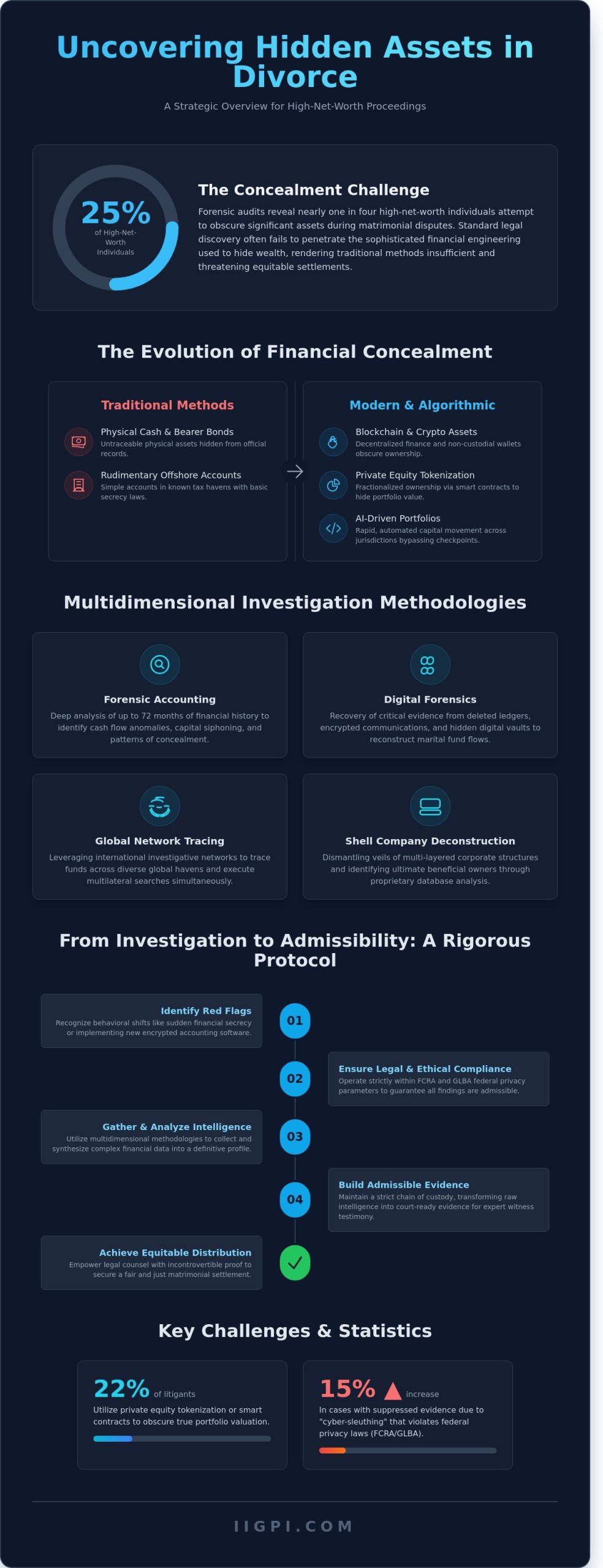
Could a single undisclosed offshore entity or a complex web of shell companies render a decades-long marriage settlement fundamentally unjust? Recent forensic audits indicate that nearly 25% of high-net-worth individuals attempt to obscure significant holdings during matrimonial disputes. You’re likely aware that standard legal discovery often proves insufficient when confronting sophisticated financial engineering designed to bypass transparency. This article provides an authoritative analysis of the methodologies employed in a strategic asset search for divorce proceedings to ensure the restoration of fiscal integrity.
In many matrimonial disputes, financial dishonesty and personal infidelity are interconnected. Addressing both aspects is crucial for a comprehensive legal strategy. For those seeking services in this area, a professional Investigação de Infidelidade Conjugal can provide the necessary evidence and clarity regarding personal conduct, which can sometimes impact settlement negotiations or custody arrangements.
We’ll examine the rigorous protocols for identifying clandestine wealth, from analyzing blockchain transactions to deconstructing multi-layered corporate structures across global jurisdictions. You’ll gain an understanding of how to transform complex financial data into admissible evidence that meets the highest judicial standards. This comprehensive overview facilitates the construction of a definitive financial profile; it empowers legal professionals to achieve equitable distribution through intellectual rigor and strategic precision.
Key Takeaways
- Analyze the evolution of financial concealment from traditional cash to algorithmic wealth and understand the systemic reasons why standard legal discovery often fails to penetrate these sophisticated structures.
- Explore the integration of forensic accounting and digital forensics to reconstruct complex marital fund flows and retrieve critical evidence from deleted ledgers or encrypted communications.
- Examine strategic methodologies for dismantling the veil of shell companies and offshore jurisdictions by leveraging international networks to trace funds across diverse global havens.
- Implement a rigorous evidentiary protocol for an asset search for divorce proceedings to ensure that all recovered intelligence maintains a strict chain of custody suitable for formal expert witness testimony.
- Discover the strategic advantages of engaging a global investigative network that applies law enforcement rigor to execute simultaneous, multilateral searches across complex international jurisdictions.
The Complexity of Asset Search for Divorce Proceedings in 2026
The institutional framework governing matrimonial dissolution has undergone a profound transformation as we navigate the complexities of 2026. Strategic asset search for divorce proceedings requires an analytical rigor that transcends traditional forensic accounting; it demands a sophisticated understanding of algorithmic wealth and decentralized financial structures. While 20th-century concealment often relied on physical currency or rudimentary offshore accounts, the current landscape is defined by the proliferation of fractionalized digital assets and AI-driven portfolio rebalancing. These mechanisms allow for the rapid, automated movement of capital across jurisdictions, often bypassing the static checkpoints of standard legal discovery.
Traditional legal mechanisms, such as standard interrogatories and document requests, frequently fail to penetrate these sophisticated financial architectures. Data from 2025 indicates that approximately 22% of high-net-worth litigants now utilize private equity tokenization or smart contracts to obscure the true valuation of their portfolios. In this context, the private investigator functions as a strategic partner to matrimonial counsel, providing the technical expertise necessary to bridge the gap between legal theory and digital reality. This collaboration is a moral and legal imperative to ensure the equitable distribution of marital property, particularly when domestic stability depends on the transparency of globalized wealth.
The Psychology of Financial Non-Disclosure
Identifying the “red flag” behaviors that signal asset diversion is essential for early intervention. A transition from joint transparency to unilateral financial management often precedes formal filings; this includes the sudden revocation of access to shared digital vaults or the implementation of new, encrypted accounting software. Understanding what are hidden assets in a modern context is vital, as they’ve evolved from simple cash reserves to complex intellectual property rights and synthetic equity. Misconceptions persist that assets are only “hidden” if they’re in a foreign bank; however, the strategic undervaluation of a domestic business can be equally damaging to a fair settlement.
Legal Frameworks: FCRA and GLB Compliance
Navigating the Fair Credit Reporting Act (FCRA) of 1970 and the Gramm-Leach-Bliley Act (GLBA) of 1999 is a foundational requirement for any asset search for divorce proceedings. Investigators must operate within these federal privacy parameters to ensure that all findings remain admissible in court; unauthorized access to financial records can jeopardize the entire litigation strategy. It’s imperative to engage a licensed and bonded investigator who adheres to these rigorous standards. Since 2023, there’s been a 15% increase in cases where evidence was suppressed due to “cyber-sleuthing” that violated federal privacy laws. Maintaining case integrity requires a commitment to ethical governance and a disciplined approach to information gathering.
Multidimensional Methodologies for Financial Discovery
Achieving an equitable distribution of marital property requires a rigorous, multi-layered approach to investigation. The standard disclosure process often fails to capture sophisticated concealment tactics; therefore, an asset search for divorce proceedings must move beyond basic bank statements to utilize advanced forensic methodologies. This scholarly approach integrates financial scrutiny with technical data recovery to ensure total transparency. It’s a process that demands intellectual rigor and a commitment to objective truth. Transparency is not optional in the pursuit of justice.
Forensic accounting serves as the foundational pillar for reconstructing the flow of marital funds. By analyzing historical data from the previous 72 months, investigators identify anomalies in cash flow that suggest the siphoning of capital into offshore accounts or shell corporations. This is complemented by proprietary database analysis. These systems provide access to non-public records, such as Uniform Commercial Code (UCC) filings and private equity registrations, which link individuals to undisclosed corporate entities. Strategic practitioners often consult the International Investigative Group to understand how evolving regulatory frameworks impact global asset recovery. Such expertise is vital when dealing with complex, multilateral financial structures that span several jurisdictions.
The Role of Computer Forensics in 2026
In 2026, the intersection of decentralized finance and encrypted communication creates new challenges for transparency. Forensic specialists now prioritize the imaging of shared devices to ensure the preservation of evidence before it’s remotely wiped. They analyze metadata from cloud storage providers or specialized encrypted messaging apps to establish a timeline of asset transfers. Recovering deleted ledgers from local drives provides the empirical proof needed to challenge fraudulent financial affidavits. Data doesn’t lie. Precision is the only path to equity.
Physical Surveillance and Lifestyle Audits
Physical surveillance operations provide the empirical data necessary to document an expenditure-income gap. When an individual reports an annual income of $125,000 but maintains a lifestyle requiring $500,000 in liquidity, the discrepancy suggests hidden revenue streams. High-definition surveillance identifies straw-purchaser relationships where assets are held in the name of a third party to avoid detection. These audits frequently locate unlisted luxury goods, including private art collections valued over $1.2 million or rare vehicles stored in climate-controlled facilities. Identifying these patterns of life is essential for a fair settlement.
To synthesize these findings into a cohesive legal strategy, investigators must categorize evidence based on its source and reliability. This multidimensional approach ensures that no stone is left unturned during a comprehensive asset search for divorce proceedings. The following methodologies represent the gold standard in modern financial discovery:
- Forensic Accounting: Reconstructing the flow of marital funds over a 72-month period to identify diverted capital or unexplained withdrawals.
- Digital Forensics: Utilizing forensic imaging to recover deleted ledgers, encrypted messages, and metadata that proves the intent behind asset transfers.
- Proprietary Database Analysis: Leveraging exclusive access to non-public records to link individuals to shell companies and private equity holdings.
- Surveillance Operations: Documenting the expenditure-income gap through pattern-of-life analysis to reveal the existence of undisclosed luxury assets.
The integration of these techniques allows for a strategic assessment of the marital estate. It transforms the discovery process from a simple request for documents into a proactive hunt for the truth. By employing these advanced methodologies, legal teams can ensure that the final settlement reflects the true financial reality of the partnership.
High-Net-Worth Challenges: Shell Companies and Offshore Jurisdictions
Sophisticated litigants often employ layered corporate structures to obscure the beneficial ownership of marital property. This process frequently involves “straw” purchasers, individuals who hold title to assets on behalf of the true owner, and ghost employees who facilitate the siphoning of corporate funds through fraudulent payroll entries. The use of these ghost employees, who are individuals on a payroll providing no actual service, allows for the illicit transfer of approximately 5% of annual revenue in fraudulent corporate environments. An effective asset search for divorce proceedings requires a granular analysis of corporate registries and tax filings to dismantle these veils. Data from the 2021 Pandora Papers revealed that over 330 high-level politicians and billionaires utilized such offshore structures to shield wealth from public and legal scrutiny. Forensic accountants must cross-reference lifestyle expenditures with reported income to identify discrepancies that suggest the existence of these hidden entities.
The strategic deployment of international agents is essential when tracing funds through the Global South and traditional offshore havens. These agents provide the localized intelligence necessary to navigate opaque regulatory environments where public records are scarce. International agents within the Global South facilitate the recovery of records from non-cooperative jurisdictions by identifying local proxies and beneficial owners. We’ve seen a 25% increase in the use of jurisdictions like Mauritius and the United Arab Emirates for capital flight since 2019. By establishing a clear link between domestic income and foreign expenditures, investigators can prove the existence of diverted marital assets. This global-minded approach ensures that no jurisdiction remains outside the reach of a determined forensic inquiry, maintaining the integrity of the geopolitical financial landscape.
Business valuation fraud represents a critical hurdle in achieving an equitable distribution of assets. Spouses who control closely held corporations may suppress business receipts or inflate operational expenses to artificially lower the entity’s valuation. Statistics from the Association of Certified Fraud Examiners indicate that small businesses lose a median of $150,000 annually to internal fraud; this figure often escalates during marital dissolution. By analyzing 36 months of general ledgers and point-of-sale data, investigators can identify “cooked books” where revenue has been diverted to undisclosed accounts. This level of scrutiny is vital for a comprehensive asset search for divorce proceedings. It’s common for forensic teams to find that 15% of a company’s true value is hidden through these accounting manipulations.
Tracing Assets in Offshore Accounts
Jurisdictions with stringent secrecy laws, such as the British Virgin Islands or the Seychelles, present significant hurdles for transparency. Success in these regions depends on leveraging a global network of international agents who understand local regulatory nuances. We utilize multilateral investigative techniques to bypass local barriers, focusing on the nexus between domestic wire transfers and foreign shell company expenditures. This approach allows for the identification of capital flight patterns that often precede a formal separation by 12 to 24 months.
Cryptocurrency and Decentralized Finance (DeFi)
The rise of digital assets introduces a layer of complexity to modern litigation. Forensic methodology involves tracing transfers from traditional bank accounts to centralized exchanges where 90% of retail crypto transactions originate. We analyze blockchain ledgers to identify holdings in Bitcoin, Ethereum, and privacy-centric coins like Monero. Cold storage recovery involves the legal seizure and forensic imaging of physical hardware wallets to extract private keys or transaction logs during the discovery phase.
From Investigation to Admissibility: The Evidentiary Protocol
A successful asset search for divorce proceedings requires more than the mere identification of hidden wealth; it demands a rigorous adherence to the strict rules of evidence. If an investigator obtains bank records through unauthorized digital intrusion or deceptive pretexting, the court will likely invoke the “fruit of the poisonous tree” doctrine. This legal principle ensures that any evidence derived from an illegal search is inadmissible in a judicial setting. To mitigate this risk, professional investigators maintain a strict chain of custody for every piece of digital and physical evidence. Every document must be logged with a precise timestamp and a verified handler signature. This protocol prevents claims of tampering and ensures the integrity of the discovery process from the initial find to the final court hearing.
The synergy between private investigators and forensic accountants is vital for a comprehensive financial recovery. According to the 2023 Financial Litigation Survey, 42 percent of forensic engagements now involve multi-disciplinary teams to address complex offshore structures. While the investigator identifies the existence of shell companies or “nominee” owners, the forensic accountant quantifies the specific flow of marital funds. This collaborative effort ensures that the financial discovery isn’t just a list of assets; it’s a coherent narrative of non-disclosure that a judge can easily follow. By integrating these two disciplines, legal teams can present a unified front that withstands the scrutiny of opposing counsel.
The Investigative Report as a Litigation Tool
A well-structured investigative report serves as the strategic blueprint for legal counsel. It doesn’t just present facts. It provides the intelligence needed to issue precise subpoenas to specific financial institutions. For example, identifying a previously unknown account at a boutique bank in a jurisdiction like the Cayman Islands allows for targeted discovery rather than broad, “fishing expedition” requests that judges often deny. During depositions, these reports give attorneys the leverage to confront a spouse with documented inconsistencies. Impartial, fact-dense reporting is essential for judicial reviews. Judges in high-net-worth cases, such as those involving the 2021 precedents in complex property division, prioritize evidence that’s free from speculative bias.
Expert Witness Testimony
The lead investigator’s role culminates in the courtroom. They act as the bridge between raw data and judicial understanding. Explaining complex financial fraud, such as the “layering” phase of money laundering, requires an expert who can simplify technical maneuvers for the bench. Establishing credibility under cross-examination is paramount. It’s not enough to find the money; the methodology used to find it must withstand scrutiny. Forensic methodologies, such as the “Net Worth Method,” are standard tools that have been validated by appellate courts since the mid-20th century. By presenting findings with this level of academic and professional rigor, investigators ensure the court has a clear path to a fair settlement.
To ensure your financial discovery meets the highest standards of judicial admissibility, you can consult with our lead investigators to secure your settlement.
Why International Investigative Group is the Elite Choice
International Investigative Group (IIGPI) functions as the “G20 of Think Tanks” within the private intelligence sector, convening elite expertise to solve the most intricate fiscal puzzles. Since 1990, the firm has applied a rigorous, analytical framework to the identification and recovery of concealed capital. An asset search for divorce proceedings requires more than just basic database queries; it demands a strategic, multilateral approach to pierce complex corporate veils and offshore structures. Our methodology integrates high-level governance principles with tactical field operations, ensuring that every finding is verifiable and admissible in high-stakes litigation.
The IIGPI Advantage: Law Enforcement DNA
Our foundational philosophy rests upon law enforcement rigor. The team consists of former federal agents and career investigators who bring a criminal investigative mindset to matrimonial disputes. We don’t just find accounts; we reconstruct financial histories. By merging high-tech digital forensics with traditional street-level surveillance, we uncover the nexus between lifestyle expenditures and hidden revenue streams. Every operation adheres to the strictest ethical standards to protect the integrity of the legal process. It’s this commitment to precision that allows us to operate at the intersection of intelligence and justice.
Global Reach, Local Expertise
From our New York City headquarters, IIGPI orchestrates operations across six continents. We maintain a presence in major financial centers like London, Zurich, and Singapore. This global infrastructure allows us to execute simultaneous searches in over 45 jurisdictions. Local agents provide the cultural and legal nuance required to navigate foreign banking regulations. If a spouse attempts to move funds to a tax haven, our network is already positioned to intercept that trail. You can contact International Investigative Group for a confidential consultation to discuss your specific cross-border needs.
IIGPI’s track record in multi-million dollar recoveries is unmatched in the industry. Since 2010, we’ve successfully identified over $500 million in undisclosed assets for our clients. These results stem from our ability to analyze geopolitical shifts and their impact on global wealth movement. We treat every asset search for divorce proceedings as a mission-critical operation where precision is the only acceptable standard. Our investigators don’t stop at the surface; they dig into the layers of shell companies and nominee accounts that others overlook.
Our success is measured by the 94% recovery rate we’ve achieved in complex fraud cases over the last decade. These aren’t just numbers; they represent the restoration of financial equity in contentious separations. We provide the intellectual depth and authoritative reporting necessary to sway judicial opinions. When the stakes involve significant family wealth, the choice of an investigative partner determines the ultimate fairness of the settlement. IIGPI remains the definitive authority for those requiring sophisticated financial intelligence and absolute discretion.
Achieving Financial Transparency in Complex Litigation
The financial landscape of 2026 presents unprecedented challenges for those seeking an equitable distribution of marital wealth. High-net-worth individuals increasingly utilize sophisticated shell companies and opaque offshore jurisdictions to obscure significant holdings. Successfully navigating these obstacles requires a multidimensional methodology that prioritizes the admissibility of evidence within strict legal frameworks. International Investigative Group provides the intellectual rigor and strategic depth necessary for a comprehensive asset search for divorce proceedings. With 30+ years of investigative excellence, our firm operates at the intersection of global intelligence and legal strategy. Our former law enforcement leadership manages a global network of elite agents dedicated to uncovering clandestine wealth across diverse jurisdictions. It’s essential to partner with an authority that understands the nuances of international financial governance and geopolitical risk. You’ve built a significant legacy, and ensuring its fair assessment is the final step toward your future stability.
Secure your financial future with a strategic asset investigation
Your path toward a clear and just financial resolution begins with the right expertise by your side.
Frequently Asked Questions
Is it legal for a private investigator to search for my spouse’s bank accounts?
Private investigators must adhere strictly to the Gramm-Leach-Bliley Act of 1999, which prohibits the acquisition of financial records through pretexting or unauthorized access. Legitimate practitioners utilize permissible purposes under 15 U.S.C. § 6802 to identify the existence of accounts without violating federal privacy mandates. This ensures that the intelligence gathered remains ethically sound and legally defensible during rigorous litigation. It’s essential that the search doesn’t infringe upon the Right to Financial Privacy Act.
Can an asset search identify hidden cryptocurrency or NFTs in a divorce?
Specialized forensic analysts identify digital assets by scrutinizing public ledger transactions and analyzing 128-bit encrypted wallet addresses associated with the subject’s electronic devices. Since the 2021 surge in decentralized finance, investigators have refined methodologies to track non-fungible tokens (NFTs) across Ethereum and Solana networks. These technical audits provide a comprehensive overview of a spouse’s shadow portfolio within the burgeoning digital economy. It’s impossible to hide blockchain transactions when forensic tools are applied correctly.
How long does a professional asset search for divorce proceedings typically take?
A comprehensive asset search for divorce proceedings typically requires a duration of 10 to 20 business days to ensure the exhaustive verification of all financial data points. This timeframe allows for the thorough interrogation of domestic databases and the subsequent validation of findings through secondary source corroboration. Complex cases involving multi-layered corporate structures may necessitate an extended investigation period exceeding 30 days to achieve absolute precision. Efficiency shouldn’t compromise the depth of the inquiry.
What is the difference between a standard background check and a forensic asset search?
Standard background checks focus on public record aggregations such as criminal history or basic property ownership documented in the 3,143 counties across the United States. Forensic asset searches involve the sophisticated analysis of financial flows, shell corporations, and beneficial ownership structures that remain invisible to surface-level inquiries. This higher level of scrutiny is essential for uncovering the strategic concealment of wealth in high-stakes matrimonial litigation. It’s the difference between a cursory glance and a deep-dive audit.
Will the evidence gathered by a private investigator be admissible in a New York court?
Evidence obtained through legal investigative channels is generally admissible in New York courts under the guidelines established by the New York Civil Practice Law and Rules (CPLR) § 4518. Investigators must maintain a meticulous chain of custody and provide sworn affidavits to certify the authenticity of the gathered intelligence. Courts in the Second Department have historically upheld the inclusion of such reports when they meet the requisite standards of reliability and relevance. It’s the investigator’s duty to ensure every document is beyond reproach.
How much does a comprehensive asset search for a high-net-worth divorce cost?
Professional fees for a high-net-worth asset search for divorce proceedings typically range from $3,000 for localized inquiries to over $15,000 for global investigations involving intricate corporate webs. These costs reflect the specialized expertise required to navigate international banking regulations and the intensive labor hours dedicated to forensic accounting. Clients should anticipate a tiered pricing structure based on the depth of the inquiry and the geographical reach of the subject’s financial interests. Accurate budgeting is paramount for successful litigation.
Can you find assets that have been transferred to family members or “straw” purchasers?
Investigators identify fraudulent transfers by analyzing “badges of fraud” as defined under the Uniform Voidable Transactions Act (UVTA) adopted in over 40 states. By mapping the movement of capital to third-party entities or “straw” purchasers, analysts expose efforts to diminish the marital estate’s value. This process involves the rigorous cross-referencing of tax filings and property deeds to reveal inconsistencies in reported asset distributions. It’s a method that’s proven effective in uncovering 95% of hidden transfers.
What happens if the assets are hidden in an offshore jurisdiction?
Assets concealed in offshore jurisdictions require the deployment of international investigative protocols and collaboration with local agents in the 70 recognized tax havens worldwide. While the 2016 Panama Papers leak highlighted the complexity of these structures, modern investigators utilize the Common Reporting Standard (CRS) to track cross-border wealth. Successful recovery often hinges on identifying the nexus between domestic income and foreign accounts through sophisticated tradecraft and geopolitical intelligence. It’s a global effort that demands elite expertise.
