
There is no single rate for Staten Island residential security patrol services. Pricing depends on the assignment and is provided after a quote request. Key cost factors include patrol frequency, coverage hours, staffing, armed or unarmed coverage, and the property’s layout. The right scope addresses a community’s specific needs without including services it does not require.
For homeowners’ associations and residential communities, cost is only one part of the decision. Access control, visitor management, visible patrol presence, and property layout all affect how coverage can be organized across a neighborhood.
This guide explains what shapes patrol costs, how armed and unarmed security differ, and how mobile coverage and custom HOA plans work. It also looks at how location and property needs affect planning, helping you assess which approach suits your community.
Key Takeaways
- Assess patrol costs by defining the coverage schedule, staffing approach, property layout, and level of service your community needs.
- Distinguish between armed and unarmed coverage by considering the site’s security requirements and the role guards are expected to perform.
- Use mobile patrols to plan visible coverage across shared spaces, access points, and other priority areas within a residential property.
- Build an HOA security plan around community-specific priorities, including visitor management and controlled access.
- Evaluate coverage by neighborhood and property needs to identify a practical approach for your Staten Island community.
Armed and unarmed security services
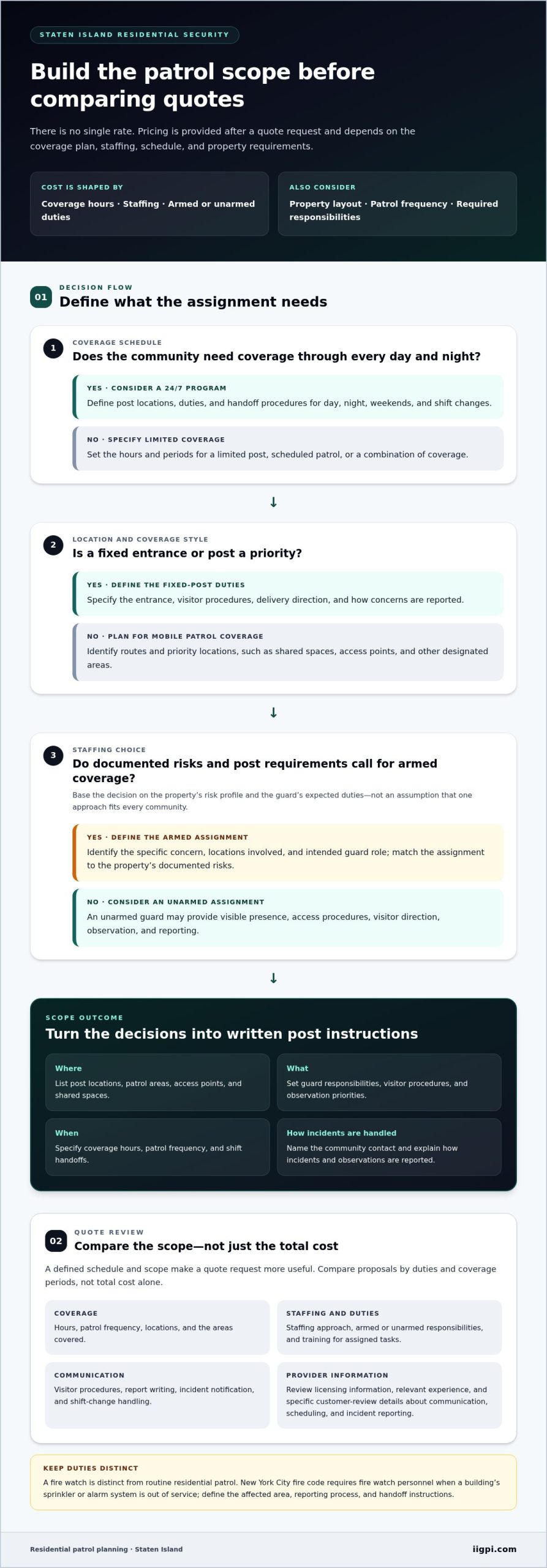
Residential security programs in Staten Island may serve gated communities, homeowners’ associations, multifamily buildings, and other properties. Guard services can include a fixed post, patrol presence, or a combination tailored to specific responsibilities. A key decision is whether the assignment calls for an armed or unarmed guard. That choice should reflect the site’s documented risks and expected duties, rather than an assumption that one approach suits every community.
An unarmed guard may be suitable for visible presence, access procedures, visitor direction, and reporting concerns to a designated contact. For example, a guard at a residential entrance can record visitor details according to community procedures and direct deliveries to the right building. A patrol guard can observe shared spaces and report a damaged gate or unusual activity. The assignment should specify where guards work, what they observe, and how they communicate incidents.
Armed security carries different responsibilities and should be considered in light of the property’s risk profile and post requirements. A residential board can begin by identifying the specific concern, the locations involved, and the guard’s intended role. It can then compare that role with an unarmed post or mobile patrol. This assessment keeps staffing decisions tied to actual site needs.
- Define the post: Identify whether the guard will monitor an entrance, patrol shared areas, or support both functions.
- Set the access procedure: Specify how residents, guests, and deliveries are directed or recorded.
- Map the response process: Name the community contact and explain how the guard reports an incident.
- Match the staffing choice: Select armed or unarmed coverage according to the documented assignment and property risks.
New York City fire code requires fire watch personnel when a building’s sprinkler or alarm system is out of service. A fire watch is distinct from routine residential patrol: it addresses a specific building-system condition, not general access or visibility. Property managers should define the affected area, reporting process, and handoff instructions. This example shows why guard duties need clear boundaries, even when a property has several security needs.
For an HOA, the practical comparison is not simply armed versus unarmed guards. Consider whether the proposed role fits the location and task: an entrance post may focus on visitor management, while a perimeter patrol may focus on observing shared grounds. Written post instructions should set out priorities, communication steps, and reporting expectations. This makes the distinction between armed and unarmed security operational, not merely descriptive.
How Much Does Security Cost in Staten Island?
Security costs depend on the coverage plan, staffing, schedule, and property requirements. A 24/7 program differs from a limited post or scheduled patrol because it requires coverage across more hours.
Around-the-Clock Guard Availability
A 24/7 guard program is designed to maintain coverage through day, night, weekends, and shift changes. Homeowners’ associations should define the post locations, duties, and handoff procedures for each shift. For example, an entrance post may require consistent visitor procedures, while a patrol assignment may prioritize shared areas. These details shape staffing needs and the overall quote.
Licensing and Compliance
Licensing and compliance are essential when evaluating security guard services in New York. Before hiring, review the provider’s licensing information and clarify how it tracks compliance for assigned personnel. Ask how armed and unarmed assignments are distinguished in written post instructions. A clear explanation should connect each guard’s role, location, and responsibilities to the community’s security program.
Comparing Patrol Companies
Compare Staten Island companies by reviewing licensing information, relevant experience, and customer reviews together. Experience with residential facilities, retail sites, or access-control assignments can indicate familiarity with different operating needs. Look for specific examples in reviews about communication, scheduling, and incident reporting, rather than relying on general praise. This helps homeowners assess whether a company’s approach fits their property.
Security pricing depends on the assignment and is provided after a quote request. Main cost factors include coverage hours, staffing, armed or unarmed duties, property layout, and patrol frequency. A defined schedule and scope make the request more useful because they show whether the community needs continuous posts, targeted coverage, or a combination. Compare proposals by duties and coverage periods, not total cost alone.
Before hiring, homeowners or HOAs should ask what each guard will do, which areas the assignment covers, how shift changes are handled, and how incidents are reported. They should also ask how the proposed schedule addresses access points, shared spaces, and changes in the property’s needs.
Ask specifically about training for the duties in the assignment, including visitor procedures, report writing, and communication with designated property contacts. Guard instructions should explain when to document an observation and whom to notify. Written procedures make expectations clearer for both guards and the HOA.
Mobile patrol coverage
Mobile patrols move between designated locations instead of keeping a guard at one fixed post. In Staten Island, coverage plans can coordinate patrol routes with controlled access, visitor management, and visible presence.
Staten Island Neighborhood Coverage
Start neighborhood planning by mapping entrances, shared areas, and locations that need observation. A gated community’s route, for example, may prioritize its vehicle entrance and internal roads, while a multifamily property may focus on parking areas and building approaches. Define patrol priorities and reporting steps for each location instead of treating every address as identical.
For Staten Island communities, identify where residents and visitors enter, where vehicles park, and which shared spaces need attention. A dedicated route can organize these priorities into a repeatable patrol pattern. Distinguish mobile observation from continuous entrance staffing in the schedule: a patrol vehicle moves between locations rather than remaining at one post.
Residential Security Coverage
Residential coverage can combine mobile patrols with access-control procedures and unarmed guards at selected posts. For example, a patrol may observe a perimeter while a guard manages visitor entry at a community entrance. Specify who receives incident reports and how guards record observations. Clear instructions help residents, property managers, and assigned personnel understand how coverage works across shared spaces.
Private patrols have limits: a vehicle cannot remain at every location, and areas are not directly observed between visits. Private guards are not law enforcement, and patrols do not replace emergency responders, secure access hardware, or resident reporting. Account for these limits when assigning patrols to parking areas, entrances, or other locations.
Regional Coverage
Coverage across New York and New Jersey requires a separate route and assignment plan for each property. Travel between sites affects scheduling, and each location may have distinct entry procedures and reporting contacts. For example, a Staten Island community and a second site in New Jersey need clear, site-specific instructions. A shared program should state which personnel cover each address and how information is passed between sites.
Regional planning should distinguish local patrol activity from travel between properties. A patrol assigned to one Staten Island community has different priorities from a route covering multiple locations. Map the sites, identify each property’s access points, and set a reporting process for every address. This clarifies the geographic scope and duties without assuming identical coverage across state lines.
Around-the-Clock Coverage and Emergency Staffing
Around-the-clock coverage requires planning assignments across all hours, including shift transitions and overnight periods. A residential program should specify which posts remain staffed, when mobile patrols operate, and who receives reports at each time. Emergency staffing plans should explain how an unexpected absence or incident affects the schedule. Written handoffs help keep site instructions clear between shifts.
For a 24/7 plan, separate routine patrol duties from procedures for urgent incidents. Identify the designated contact, reporting method, and priority locations for each shift. Homeowners’ associations can use a site map to show access points and shared areas, then align patrol instructions with those locations. Clear schedules and handoffs make the intended coverage easier to assess and manage.
Custom residential and HOA security plans
A residential security plan should turn an HOA’s priorities into defined duties across its properties. Start with a site map, then mark entrances, parking areas, shared buildings, and locations that need surveillance or patrol attention.
Next, identify the security concern at each location. For example, a visitor-management issue may call for clearer entry procedures, while repeated damage near a parking area may require focused observation and incident reporting. Matching each concern with a practical task is more useful than applying one generic response everywhere.
Coverage plans should state who performs each task and how information moves through the community. An entrance assignment might involve directing visitors according to HOA procedures; a mobile patrol could observe common areas and report maintenance or security concerns. Written instructions should identify the property contact, reporting method, and circumstances that require escalation to emergency responders.
HOAs can organize planning around several operational steps:
- Map the property: Mark entrances, buildings, parking, and shared spaces on one site plan.
- Rank priorities: Identify locations or situations that need attention first, using documented incidents and resident concerns.
- Assign duties: Separate entrance monitoring, patrol observation, and surveillance-related responsibilities.
- Set communication procedures: Name the HOA contact and establish how guards submit reports.
- Review the plan: Update instructions after property changes, such as a new gate or renovated common area.
Community design affects how a plan works. A gated property may need procedures for residents, guests, and deliveries, while a multifamily building may prioritize lobbies, shared corridors, and parking access. If a property has several entrances, the HOA can specify which points need staffed attention and which should be included on a patrol route. Describe the actual layout rather than assuming every building or access point has the same needs.
Response procedures need clear boundaries. A guard can observe, document, and report conditions under the assignment; urgent threats require emergency responders. The HOA should define the escalation path, including who receives routine reports and who acts on urgent notifications. For example, a damaged gate can be reported to property management, while an immediate safety threat follows the community’s emergency procedure.
Reviewing the plan with residents and property management can reveal practical gaps before assignments begin. Ask whether visitors can follow the entry process, patrol routes cover the locations residents identified, and reporting responsibilities are clear. A written plan gives the HOA a basis for assessing whether its security duties, surveillance priorities, and response procedures still fit the properties.
Security services by Staten Island neighborhood
Residential patrol services on Staten Island can include mobile patrols, fixed guard posts, and access-focused coverage. The right configuration depends on each property’s entrances, shared spaces, and priorities.
There is no universal patrol arrangement for every Staten Island neighborhood. Homeowners’ associations and property managers can compare options by mapping their site, identifying coverage priorities, and matching duties to those locations.
Start with the property, not a neighborhood label. Two communities in the same area may have different access points, parking layouts, and shared facilities. For example, a property with several vehicle entrances may need coverage focused on those routes. A building with shared indoor spaces may prioritize its lobby and common areas. A tailored plan reflects these operational differences instead of assuming nearby properties need identical coverage.
Neighborhood coverage planning can use a simple site review:
- Map the location: Mark entrances, parking, shared spaces, and any points residents identify as priorities.
- Define the assignment: Decide whether a fixed post, mobile patrol, or combination best fits each location.
- Set reporting steps: Identify the property contact and how guards document concerns.
- Revisit the plan: Update duties after changes, such as a new entrance or altered access procedure.
These steps help an HOA compare coverage by function, not broad neighborhood claims. They also clarify whether the assignment is intended for resident access, visible patrol presence, or observation of particular shared areas. A residential client can use this distinction to describe the requested coverage precisely.
An executive residence and a multifamily property, for example, may have different access routines and privacy expectations. A plan should define the guard’s post, permitted duties, reporting line, and interactions with residents or visitors. This specificity aligns the assignment with the property’s needs without suggesting that a patrol provides law enforcement or replaces emergency responders.
Staten Island coverage decisions should account for travel between sites. A patrol route covering several properties needs clear, site-specific instructions because each address may have different entry procedures and priority areas. Property managers can list locations in route order and identify the relevant contact for each site. This clarifies the geographic scope and distinguishes a neighborhood route from coverage at one property.
To develop a neighborhood-focused security plan, outline your Staten Island coverage priorities, including property locations, access points, and requested guard duties. A clear scope gives the discussion a practical starting point.
Residential security services on Staten Island can include mobile patrols, fixed guard posts, and access-focused coverage. A property may use one option or combine them, depending on its entrances, shared spaces, and priorities.
International Investigative Group: Corporate Investigations
International Investigative Group provides Corporate Investigations for organizations addressing concerns beyond routine residential patrol planning. When a property issue involves suspected misconduct, disputed events, or a need to document activity, an investigation may complement a security plan. The next step depends on the question the organization needs answered and the information available.
For communities that need personnel coverage, Security and Armed Guards address a different need from investigative work. Surveillance Services may fit matters where observation and documentation are central. These services serve distinct purposes, so defining the concern first helps identify the relevant approach.
To discuss an investigation or security-related need, contact International Investigative Group.
Set the Next Step for Your Community
A useful next step is to turn residents’ concerns into a written decision framework. Identify the outcomes the community wants from its security plan, assign responsibility for reviewing priorities, and set a date to reconsider them as property needs change. This gives HOA members a clearer basis for discussing service scope and assessing whether coverage still fits the community.
Staten Island residential security patrol services address property coverage, while other concerns may need a different professional focus. International Investigative Group offers Security and Armed Guards for security needs, Corporate Investigations for organizational concerns, and Insurance Investigations for insurance-related matters. Defining the issue first helps direct the discussion to the relevant service.
For a discussion of your community’s security or investigative needs, contact International Investigative Group. A clearly framed request can help establish a practical starting point for your next decision.
Frequently Asked Questions
What neighborhoods on Staten Island do residential security patrol companies serve?
Providers of Staten Island residential security patrol services should define coverage by property address and requested route, not imply borough-wide coverage. A planning request might identify a community in St. George, New Dorp, Great Kills, or Tottenville, then specify its entrances and priority locations. Naming the neighborhood provides context, while the property map and assigned duties establish the actual coverage boundaries.
How much do residential security patrol services cost on Staten Island?
Costs depend on the assignment and are provided after a quote request. To compare proposals fairly, give each provider the same scope: property addresses, requested coverage periods, staffing arrangement, and duties such as access management or patrol. Distinguish ongoing coverage from a defined event assignment. Comparing the same requirements makes differences in proposed staffing and service scope easier to assess.
What patrol options are available, such as marked vehicles, foot patrols, and alarm response?
Residential plans may use marked vehicle patrols, foot patrols, fixed posts, or a combination. Alarm response is a separate duty: the written assignment should state what triggers a dispatch, what personnel are expected to do, and how they report findings. For example, a route may include vehicle patrols while a foot patrol covers an enclosed courtyard. Each method has different coverage boundaries.
Are security companies and guards serving Staten Island required to be licensed in New York?
Yes, New York licensing requirements apply to security guard businesses and personnel. The relevant credentials depend on the role and assignment, particularly when armed duties are involved. Before approving a contract, an HOA can request the provider’s licensing details and the assigned guards’ credentials, then record who is responsible for maintaining those records. Experience and customer reviews are useful comparison criteria, but they do not replace licensing.
How can a residential community arrange security patrols on Staten Island?
To arrange Staten Island residential security patrol services, an HOA can start with a written service request that identifies the property, patrol locations, coverage schedule, and desired duties. Add a site map and designate one property representative to coordinate questions and receive reports. For example, distinguish the main vehicle entrance from a rear parking area and state which locations need routine observation. A clear scope makes proposals easier to compare.
Do Staten Island residential patrol services offer 24-hour coverage, reporting, and emergency response?
Define coverage hours and reporting in the service agreement; round-the-clock coverage is not inherent to every patrol arrangement. Specify whether the plan includes continuous posts, scheduled patrols, or both. Reporting procedures should explain how guards document observations and notify the designated contact. Emergency procedures should distinguish security reporting from contacting emergency responders, so personnel and residents know what to do when there is an urgent threat.