
A dispensary’s security plan is only as reliable as the way its people, premises, surveillance, and inventory controls work together. Security consulting for cannabis dispensaries in NYC should begin with the store’s approved security plan, current requirements, and site-specific risks; whether guards are needed depends on those conditions, not a generic checklist.
Cameras and guards are only parts of a broader security strategy. Inventory tracking and clear procedures can help identify discrepancies and reduce opportunities for diversion, while protecting employees and accounting for each storefront’s needs.
This article explains when dispensaries may need security support, how New York City compliance shapes protection, and how inventory controls fit into a coordinated plan. It also outlines the role professional security services can play and how to choose a practical next step.
Key Takeaways
- Assess security needs against the dispensary’s approved plan, site-specific risks, floorplan, and operating conditions to determine where additional support may be appropriate.
- Align protection measures with current New York requirements while ensuring that access controls and security procedures account for the storefront’s layout and safe egress.
- Plan surveillance coverage and system maintenance as ongoing operational responsibilities, including a clear response when equipment fails.
- Reconcile inventory movements and physical counts to help identify discrepancies and strengthen controls against diversion.
When Are Cannabis Security Services Needed?
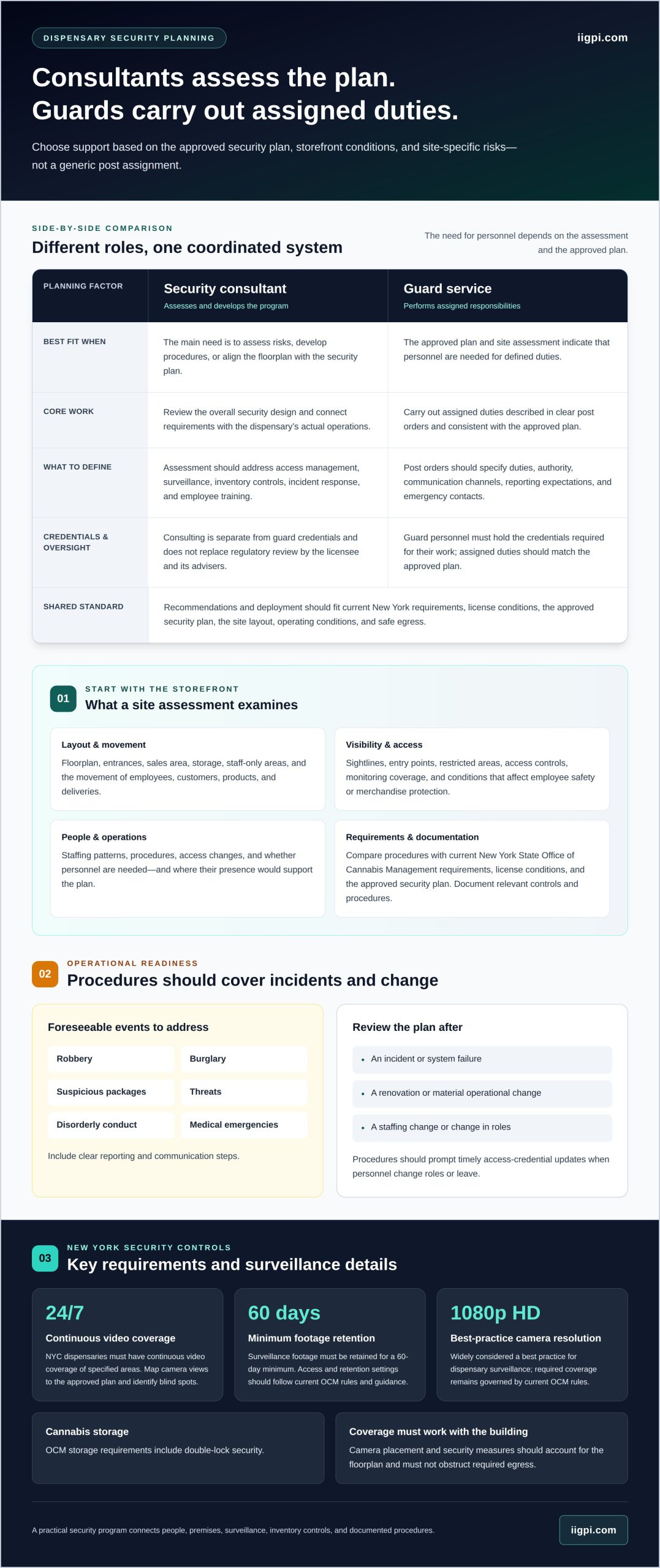
A New York City dispensary needs a security plan shaped by its approved plan, storefront, and operating risks. The floorplan, staff procedures, and any guard deployment should work together as one coordinated system.
Dispensary Security Plans and Floorplans
A security assessment reviews the dispensary’s floorplan, entrances, sales area, storage spaces, and staff-only areas. It maps how employees, customers, products, and deliveries move through the business, then identifies where access controls and monitoring can address vulnerabilities. For licensing and inspections, procedures should be compared with current New York State Office of Cannabis Management requirements, license conditions, and the approved security plan. Relevant controls and operating procedures should be clearly documented.
Site Assessments and Officer Deployment
A site assessment connects the written plan to the actual storefront. It examines sightlines, entry points, restricted areas, staffing patterns, and conditions that could affect employee safety or merchandise protection. The findings help determine whether personnel are needed and where their presence would support the plan, rather than defaulting to a standard post assignment. Procedures should cover foreseeable events, including robbery, burglary, suspicious packages, threats, disorderly conduct, and medical emergencies, with clear reporting and communication steps.
Consultants and Guard Companies
Choose security consulting when the main need is to assess risks, develop procedures, or align a floorplan with the security plan. Guard services are appropriate when the approved plan and site assessment indicate that personnel are needed for defined duties. A consultant assesses the overall design; guards carry out their assigned responsibilities. If guards are deployed, post orders should specify their duties, authority, communication channels, reporting expectations, and emergency contacts.
Standard operating procedures turn the plan into repeatable actions for opening, closing, access changes, and incidents. For example, when personnel change roles or leave, procedures should prompt timely updates to access credentials. Review the plan after an incident, system failure, renovation, staffing change, or material operational change. These reviews help keep marijuana security measures aligned with current operations and support consistent execution.
New York City cannabis security compliance
A dispensary’s security program must align with current New York requirements, license conditions, and its approved plan. New York City operations also need controls suited to the storefront that preserve safe egress.
Requirements by Location, Store Size, and License
Assess requirements against the dispensary’s license conditions, approved security plan, and site-specific risks, rather than assuming they are determined by its size or neighborhood. A compact retail floor and a larger premises may have different access points, storage arrangements, and staffing patterns, all of which affect how controls work. New York cannabis licensees should verify current requirements with the New York State Office of Cannabis Management, attorneys, and other applicable authorities.
Choosing a New York City Specialist
A firm providing security consulting for cannabis dispensaries in New York City should explain how its assessment connects OCM requirements with the dispensary’s actual operations. Look for a defined process covering access management, surveillance coverage, inventory controls, incident response, and employee training. Recommendations should account for the approved plan, license conditions, building layout, and emergency procedures, not rely on a generic commercial template.
There is no single security design for every location or license. The approved plan, operating conditions, site layout, and current requirements all matter, and changes to these factors can warrant a plan review. Security measures must not obstruct required egress or conflict with applicable building and fire-safety obligations.
Consulting credentials and guard credentials are separate considerations. Guard personnel must hold the credentials required for their work; a consultant assesses and develops the program but does not replace regulatory review by the licensee and its advisers. When security services include guards, their assigned duties should be clear and consistent with the approved plan.
OCM’s cannabis storage requirements include double-lock security. Surveillance footage must be retained for a 60-day minimum, and access and retention settings should follow current OCM rules and guidance. A documented review should also account for security records, system failures, renovations, staffing changes, and emergency procedures, keeping retail operations and compliance controls aligned.
Do you provide security for dispensaries?
New York City dispensaries need surveillance coverage designed around regulatory requirements and actual operating conditions. Cameras, access control, retention settings, and maintenance procedures should work together as connected safeguards.
Continuous Video and Camera Coverage
NYC cannabis dispensaries must have continuous 24/7 video coverage of specified areas. A coverage assessment maps camera views against the approved security plan, identifying blind spots and how store operations may affect visibility. Cameras should monitor relevant activity without obstructing required egress. 1080p HD cameras are widely considered a best practice for dispensary surveillance, while the required coverage remains governed by current OCM rules.
Camera Coverage and Retention
Coverage decisions should account for the dispensary’s floorplan, entrances, restricted spaces, and points where inventory changes hands. For New York City cannabis footage, the retention period is a 60-day minimum. Retention and access settings should follow current OCM rules and guidance, not a generic commercial CCTV template. Defined access controls help limit who can view or manage records.
Plan for equipment failure before it disrupts required coverage. If a surveillance system fails, staff should notify designated management, assess whether operations can safely and lawfully continue, protect restricted areas and products, arrange repairs, apply authorized interim safeguards, and document the failure and response. A written incident record supports follow-up and helps identify unresolved gaps.
Visible cameras make surveillance an evident part of the security environment, but effective coverage depends on usable views and reliable operation. Assess whether displays, shelving, lighting, or layout changes obstruct camera views. After renovations or operational changes, review camera placement and access control against the security plan. Regular checks of system function, access permissions, and records help maintain coverage and reveal maintenance issues.
Inventory tracking and diversion prevention
Inventory security depends on reconciling product movements with records at every stage. These controls can help a cannabis facility identify discrepancies before they become unexplained losses.
Inventory, Asset, and Cash Protection
Reconcile receiving, transfers, point-of-sale activity, returns, disposal, storage, and physical counts. Comparing each record with its corresponding transaction helps pinpoint where quantities diverge. Access to inventory areas should follow defined permissions, and storage spaces require double-lock security under New York OCM rules. These controls support licensed retail operations but do not replace accurate recordkeeping.
Cash and other assets also warrant consideration in a comprehensive plan. Marijuana remains a Schedule 1 controlled substance under federal law, and many major banks may refuse deposits from marijuana sales; the majority of dispensaries operate on a cash-only basis. That operating model makes cash handling, restricted access, and staff procedures relevant to the site assessment. A reliable process documents discrepancies and routes them for management review.
Common Dispensary Security Risks
Risks include robbery, burglary, internal diversion, and unexplained inventory discrepancies. A mismatch between recorded sales and physical counts, for example, calls for tracing receiving, transfers, returns, disposal, and point-of-sale activity. Suspicious packages, threats, and disorderly conduct also require response procedures. During violent events, New York City dispensaries should prioritize employee safety over merchandise protection.
Security procedures should connect inventory records with surveillance and access controls, so a discrepancy can be examined against relevant movements and events. Clear responsibility for storage access and transaction records helps narrow where a loss may have occurred. When an incident raises questions about missing inventory or assets, request a security assessment to evaluate how existing controls and records support the investigation.
International Investigative Group: Security and Armed Guards
International Investigative Group provides Security and Armed Guard Services for dispensaries that need on-site personnel, as well as Surveillance Investigation Services. These services can support a site where an assessment identifies a need for guard deployment or professional surveillance support. The dispensary’s approved plan, operating conditions, and site-specific risks should define personnel’s role. Guard post orders can clarify duties, authority, communications, and incident reporting, connecting daily security activity with established procedures.
For dispensaries reviewing protection needs, International Investigative Group can discuss how its security services relate to the operation’s specific concerns. Contact International Investigative Group to discuss your security needs.
International Investigative Group provides security and surveillance services for dispensaries.
Put Your Dispensary’s Security Decisions Into Motion
The next step is to turn security priorities into accountable operational decisions. Assign responsibility for reviewing procedures, documenting incidents, and escalating unresolved concerns, so security becomes part of routine management, not just a response to disruption. A focused assessment can clarify whether concerns call for professional investigation, guard support, or another defined response.
International Investigative Group offers Corporate & Business Investigations, Insurance Investigation, and Security and Armed Guard Services. For operators considering security consulting for cannabis dispensaries in NYC, professional support can connect identified concerns with appropriate investigative or protective services, rather than treating every problem as the same kind of case.
Contact International Investigative Group to discuss your dispensary’s security needs and determine a practical next step. A clear decision today can help establish a more deliberate approach to protection and accountability.
Frequently Asked Questions
Can every Cannabis Security program be customized?
Yes. A dispensary’s program should reflect its approved security plan, license conditions, floorplan, and operating conditions, not apply an identical template everywhere. For example, a change to the sales-floor layout can affect staff movement and the way security measures function. A tailored review connects written procedures to the actual site and identifies which controls need revision.
Why is specialized Cannabis Security important?
Specialized security considers how cannabis products move through a licensed operation, from possession and storage to sale, delivery, transportation, or distribution. Records and controls need to correspond to the business’s actual handling of inventory. For example, an unexplained discrepancy is easier to investigate when transaction records, product movements, and relevant access are considered together, rather than as separate operational issues.
What security consulting services do NYC cannabis dispensaries need?
The appropriate support depends on the dispensary’s identified risks and the requirements of its approved plan. A professional assessment can clarify whether the immediate need concerns site vulnerabilities, surveillance, personnel, or investigation of a specific incident. Security consulting for cannabis dispensaries in NYC should connect recommendations to the premises and the operational concern, rather than prescribe services unrelated to the issue.
What New York State security requirements apply to licensed cannabis dispensaries?
Licensed dispensaries must align security procedures with current New York requirements, license conditions, and their approved security plans. Relevant controls include storage security and surveillance records, while personnel duties should correspond with the plan. Because requirements and guidance may change, licensees should consult the New York State Office of Cannabis Management, their attorneys, and other applicable authorities when assessing compliance or revising procedures.
What NYC rules govern dispensary cameras, alarms, access control, and security plans?
Dispensary security plans and system settings should follow current OCM rules and guidance, license conditions, and the approved security plan. Cameras, alarms, and access controls should be assessed within that site-specific framework, not configured from a generic commercial template. Measures must also preserve required egress and avoid conflicts with applicable building and fire-safety obligations. Confirming current requirements matters when plans or operations change.