
In an increasingly complex landscape of corporate, insurance, and personal affairs, the chasm between suspicion and substantiated fact presents a formidable challenge. Critical decisions concerning litigation, risk mitigation, or strategic asset protection frequently hinge upon the acquisition of clear, irrefutable evidence—a task fraught with profound legal and ethical complexities. Navigating this terrain requires a sophisticated understanding of professional surveillance services, an instrument often misunderstood as mere observation but which truly encompasses a specialized discipline of intelligence gathering. The distinction between deploying consumer technology and engaging an expert team is not merely one of capability but of strategic efficacy and legal admissibility.
This comprehensive 2026 guide is designed to illuminate this critical field for decision-makers. We will dissect the strategic applications, intricate legal frameworks, and expert methodologies that underpin effective surveillance operations. Our objective is to equip corporate leaders, insurance investigators, and private individuals with the requisite knowledge to leverage these services, transforming uncertainty into actionable intelligence, securing admissible evidence, and ultimately safeguarding their vital interests against emergent threats.
Key Takeaways
- Grasp the critical distinction between investigative surveillance and overt security monitoring to deploy the correct strategic framework for asset protection.
- Understand how professional surveillance services function as a strategic tool to mitigate corporate risk and inform high-stakes decision-making.
- Navigate the complex legal and ethical landscape of surveillance to ensure all operations are conducted with complete compliance and legal defensibility.
- Examine the structured process for engaging an elite investigative team, from initial consultation through the delivery of actionable intelligence.
Defining Professional Surveillance: Beyond the Security Camera
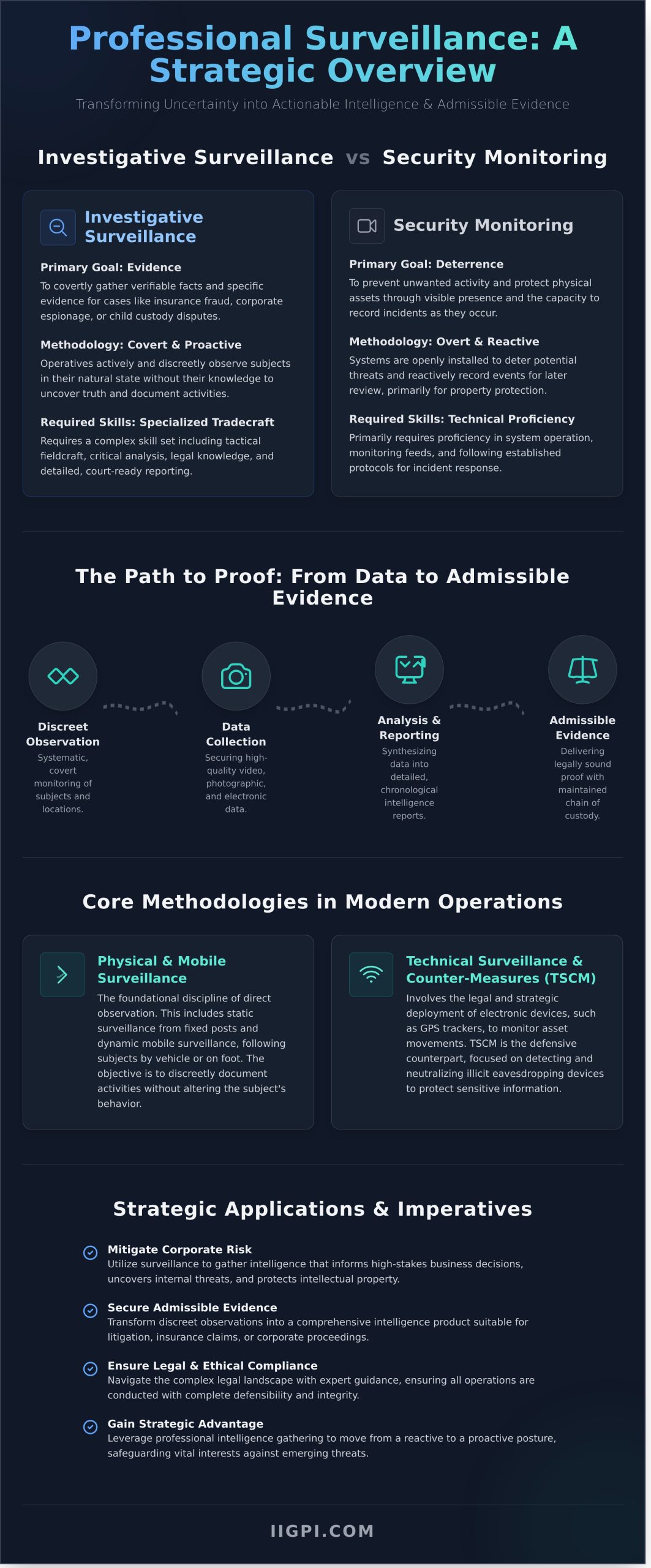
Professional investigative surveillance is the systematic, discreet observation of subjects to gather verifiable facts and evidence. This discipline is fundamentally distinct from the common perception of security monitoring; while the latter focuses on overt deterrence and property protection, the former is an active, intelligence-driven process. A comprehensive understanding of What is Surveillance? reveals its application in intelligence gathering, a core function of this professional field. To clarify this distinction, one might use an analogy: a security camera is merely a passive tool for recording events, whereas a professional surveillance investigator is the strategist and operator, orchestrating the collection of information to provide clients with objective, actionable intelligence.
Investigative Surveillance vs. Security Monitoring
The functional and philosophical differences between these two domains are significant, extending to methodology, objectives, and required expertise. A security system is designed for passive observation and deterrence, whereas an investigation is an active pursuit of information.
- Methodology: Investigative surveillance is inherently covert and proactive, designed to observe subjects in their natural state without their knowledge. Security monitoring is overt and reactive, intended to deter unwanted activity and record incidents as they occur.
- Primary Goal: The objective of an investigation is to gather evidence for a specific case, such as insurance fraud or a child custody dispute. The goal of security is deterrence and asset protection.
- Required Skills: Investigators require a sophisticated skill set encompassing tactical fieldcraft, critical analysis, legal knowledge, and detailed reporting. Security personnel primarily require technical proficiency in system operation and established response protocols.
The Objective: From Raw Data to Admissible Evidence
The ultimate output of professional surveillance services is not simply raw video footage but a comprehensive intelligence product. This transformation from data to proof requires meticulous adherence to legal standards, most notably the chain of custody, which ensures the integrity and authenticity of all collected materials from acquisition to presentation. Professional investigators synthesize their observations into detailed, chronological reports that provide context and narrative to the visual evidence. This documentation, combined with authenticated media and the potential for expert testimony, converts discreet observations into legally sound, admissible evidence capable of withstanding scrutiny in court or corporate proceedings.
Core Methodologies in Modern Surveillance Operations
The efficacy of modern surveillance operations is predicated on a sophisticated combination of art and science, a discipline referred to within the intelligence community as ‘tradecraft’. This is not a singular method but a comprehensive strategic approach, where success in complex investigations necessitates the integration of multiple methodologies. Contrary to a prevailing belief that technology has supplanted human involvement, advanced tools function as critical enhancements to, not replacements for, the cognitive and analytical abilities of highly trained field operatives. In an increasingly globalized environment, the reach and effectiveness of these operations are further magnified by a robust global network, which is indispensable for cases that transcend national jurisdictions and require cross-border intelligence coordination.
Physical and Mobile Surveillance
The foundational component of many intelligence-gathering initiatives remains direct observation. This can manifest as static surveillance, where operatives establish fixed observation posts to monitor a specific location or asset, or as mobile surveillance, a far more dynamic and complex undertaking that involves discreetly following a subject by vehicle or on foot through varied environments. Both modalities demand exceptional skill in maintaining covert status while utilizing specialized photographic and video equipment to document activities and secure indisputable evidence. The objective is to obtain intelligence without altering the subject’s behavior or revealing the operation’s existence.
Technical Surveillance & Counter-Measures (TSCM)
Technical surveillance involves the strategic deployment of electronic devices to gather information, such as the legal application of GPS tracking technology to monitor asset movements. Conversely, a critical defensive capability offered by elite surveillance services is Technical Surveillance Counter-Measures (TSCM), colloquially known as ‘bug sweeps’. This highly specialized discipline is designed to detect and neutralize illicit eavesdropping devices, protecting corporate, governmental, and personal privacy. Executing TSCM effectively requires not only sophisticated electronic detection equipment but also operatives with extensive training in radio frequency analysis and physical search protocols.
Digital and Open-Source Intelligence (OSINT)
Physical operations are significantly augmented by intelligence gathered from publicly available sources. Open-Source Intelligence (OSINT) involves the systematic collection and analysis of data from the internet, social media, public records, and other accessible channels to construct a comprehensive profile of a subject’s network, history, and patterns of life. This practice, which requires a profound understanding of the Legal Framework of Surveillance to ensure all activities are conducted with unimpeachable integrity, provides critical context that informs and directs physical surveillance efforts. In cases involving digital malfeasance, computer forensics may also be employed to uncover and analyze data trails from electronic devices, providing a deeper layer of evidence.
The Critical Legal & Ethical Framework of Surveillance
A primary consideration for any entity contemplating surveillance is the significant and complex legal landscape that governs its application. A pervasive objection stems from the perceived legal risks, yet this concern fundamentally misunderstands the nature of professional operations. Reputable firms are distinguished not merely by their technical capabilities, but by their unwavering adherence to a strict legal and ethical codex. This commitment is the very mechanism that ensures the intelligence gathered is not only potent but, critically, admissible and actionable in legal or corporate proceedings.
Navigating Privacy Laws and Regulations
The cornerstone of surveillance jurisprudence is the concept of a ‘reasonable expectation of privacy,’ a judicial standard that dictates where and when observation is permissible. This principle is further complicated by a patchwork of state-specific statutes, such as the critical distinction between one-party and two-party consent for audio recordings. At the federal level, comprehensive U.S. electronic surveillance laws, including the Electronic Communications Privacy Act (ECPA), impose stringent restrictions designed to balance security imperatives with individual rights.
Ensuring Evidence Admissibility in Court
For evidence gathered through surveillance to have utility in legal proceedings, it must meet rigorous standards of admissibility. This requires an unbroken chain of custody and irrefutable proof that all intelligence was obtained through lawful means. The in-person testimony of a licensed professional investigator is often the mechanism through which findings are authenticated in court, whereas any deviation from legal protocol risks tainting the entire case and rendering the investment in the investigation worthless.
The Dangers of ‘DIY’ Investigations
Attempting surveillance without professional licensure and legal expertise exposes an individual or organization to severe criminal and civil liabilities. Common but illegal actions, such as placing a GPS tracker on a vehicle one does not own or recording private conversations without requisite consent, can lead to charges of stalking or illegal wiretapping. Therefore, engaging professional surveillance services is not an operational expense but a critical exercise in risk management, ensuring objectives are met without incurring catastrophic legal jeopardy.
Strategic Applications of Surveillance for Key Sectors
The deployment of professional surveillance transcends mere observation; it functions as a strategic instrument for proactive risk mitigation, evidence acquisition, and informed decision-making. When correctly implemented, these operations directly support an organization’s primary objectives by safeguarding assets, ensuring compliance, and protecting revenue streams. The value of professional surveillance services lies in their capacity to furnish objective, verifiable intelligence that empowers stakeholders to act with confidence and precision. The following use cases illustrate the versatility and critical importance of this discipline across diverse professional domains.
For Corporate and Business Clients
In the corporate sphere, surveillance is an essential component of a robust security and risk management framework. It provides the empirical data necessary to address complex internal and external threats that can significantly impact financial stability and market position. Key strategic applications include:
- Investigating Internal Misconduct: Documenting employee theft, fraud, substance abuse, or the breach of intellectual property protocols to protect corporate assets and maintain operational integrity.
- Conducting Due Diligence: Gathering critical intelligence on potential partners, acquisition targets, or key hires to expose undisclosed liabilities and verify credentials before significant capital investment.
- Verifying Contractual Compliance: Monitoring the activities of former employees to ensure adherence to non-compete agreements and prevent the illicit transfer of proprietary information to competitors.
For Insurance Carriers and Third-Party Administrators (TPAs)
The insurance industry confronts substantial financial exposure from fraudulent claims, making discreet and ethical surveillance an indispensable tool for loss prevention. By documenting a claimant’s daily activities, professional investigators can provide irrefutable evidence that substantiates or refutes the stated extent of an injury or limitation. This intelligence is paramount for contesting exaggerated workers’ compensation or personal injury claims, providing robust litigation support, and ultimately protecting the carrier’s financial reserves from unwarranted depletion.
For Legal and Personal Matters
Within the legal and private sectors, surveillance provides the factual foundation required for effective dispute resolution and litigation strategy. In matrimonial and child custody proceedings, objective evidence of a subject’s conduct, lifestyle, or associations can be pivotal to achieving a favorable outcome. Furthermore, these investigative techniques are instrumental in locating missing persons or verifying the well-being of an individual. For legal teams, professional surveillance is a critical resource for identifying and observing key witnesses, thereby strengthening a case with verifiable, court-admissible documentation.
Understanding these diverse applications is fundamental to leveraging surveillance as a strategic asset. For a confidential consultation on tailored investigative solutions, please visit our experts at iigpi.com.
Engaging a Professional Surveillance Team: The IIG Process
Understanding the theoretical and technological aspects of modern surveillance is foundational; however, translating that knowledge into actionable intelligence requires a partnership with a proven and professional entity. The decision to engage a firm for sensitive investigative matters is significant, demanding a process defined by clarity, discretion, and strategic foresight. The International Investigation Group (IIG) has institutionalized a three-stage engagement protocol designed to ensure operational excellence and deliver decisive outcomes for our global clientele.
This structured approach demystifies the process, providing clients with a transparent framework from inception to conclusion. Our methodology is built upon decades of experience in complex corporate, legal, and private investigations worldwide.
Step 1: Consultation and Case Strategy
Every engagement commences with a strictly confidential consultation to establish a comprehensive understanding of the client’s strategic objectives. During this initial phase, our senior investigators collaborate with you to analyze the unique parameters of your situation, define clear goals, and establish a precise scope of work. This meticulous planning results in a tailored investigative strategy, ensuring that all subsequent actions are purposeful, efficient, and directly aligned with achieving your desired resolution.
Step 2: Field Execution and Intelligence Gathering
Upon approval of the case strategy, IIG deploys its team of highly experienced field investigators, equipped with specialized, state-of-the-art technology. Our professional surveillance services are executed with absolute discretion and an unwavering commitment to confidentiality. Throughout the operational phase, we maintain a structured communication protocol, providing clients with regular, substantive updates. This ensures transparency and allows for strategic adjustments as new intelligence is gathered in the field.
Step 3: Reporting and Case Conclusion
The culmination of our fieldwork is the delivery of a comprehensive evidentiary report. This document provides a detailed, factual narrative of the investigation, supported by professionally collated video and photographic evidence presented in a clear, court-admissible format. For matters that may proceed to litigation, IIG investigators are available to provide expert testimony. This final stage transforms intelligence into a tangible asset, empowering you with the irrefutable evidence required to make informed decisions.
To initiate this process, we invite you to request a confidential consultation to discuss your case.
Securing Strategic Advantage Through Professional Surveillance
As this guide has delineated, the domain of professional surveillance has evolved far beyond mere technological observation, establishing itself as a sophisticated discipline predicated on strategic human intelligence and methodological rigor. The successful application of these operations is inextricably linked to an unwavering adherence to complex legal and ethical frameworks, a non-negotiable component for any credible practitioner. Consequently, the selection of a qualified investigative partner represents the most critical decision in transforming raw information into actionable strategic intelligence.
For organizations requiring unparalleled expertise, the choice of a provider for professional surveillance services is of paramount importance. IIG brings to bear over three decades of investigative experience, a record of more than 10,000 successfully resolved cases worldwide, and a foundational leadership comprised of distinguished law enforcement professionals. This unique confluence of experience and authority ensures that every engagement is executed with the highest degree of precision, discretion, and strategic insight.
We invite you to contact us for a confidential consultation to discuss your strategic surveillance needs. Taking the decisive step to secure expert guidance is the first move toward achieving clarity and control in an uncertain world.
Frequently Asked Questions About Professional Surveillance Services
How much do professional surveillance services cost?
The financial investment for professional surveillance is contingent upon a matrix of variables, including the operational duration, the number of investigators assigned, and the technological assets deployed. A comprehensive cost analysis is provided following an initial consultation where the parameters and strategic objectives are delineated. Standard retainers and hourly rates are established based on the complexity and risk profile of the assignment, ensuring a tailored and transparent financial framework for all engagements.
Is it legal to hire a private investigator to follow someone?
The engagement of a private investigator for surveillance is permissible within a strictly defined legal framework, provided there is a legitimate and lawful purpose for the investigation. All operations must adhere to jurisdictional statutes governing privacy, trespassing, and harassment. Our operatives conduct all activities with a profound understanding of these legal boundaries, ensuring that all procured evidence is admissible in legal proceedings and that the client’s interests are protected from legal liability.
What kind of information will I receive at the end of an investigation?
Upon conclusion of the operational phase, clients receive a comprehensive and meticulously documented evidentiary package. This dossier typically includes a detailed chronological log of all activities, high-resolution photographic evidence, and video recordings, all time-stamped for veracity. The final report synthesizes these findings into a coherent narrative, providing objective, factual information directly relevant to the established investigative goals, which is then securely disseminated to the client for review.
How long does a typical surveillance investigation take?
The temporal scope of a surveillance investigation is dictated by the client’s objectives and the complexities inherent to the case. A simple verification may require only a few hours of observation, whereas an intricate corporate or domestic case could necessitate weeks of sustained monitoring to establish a definitive pattern of behavior. An initial strategic assessment will provide a projected timeline, which remains subject to dynamic adjustment based on emergent intelligence and operational developments.
Can surveillance be conducted without the subject finding out?
Discretion and covert methodology are foundational principles of all professional surveillance operations. Our investigators are extensively trained in advanced counter-surveillance and clandestine observation techniques to ensure the subject remains entirely unaware of any monitoring activities. The utilization of sophisticated technology and strategic fieldcraft is paramount to maintaining the integrity and confidentiality of the investigation, thereby guaranteeing that the subject’s natural behaviors are observed without external influence or suspicion.
What is the difference between hiring a firm and just using a GPS tracker?
A GPS tracking device provides a singular data point—location—whereas professional surveillance services deliver a multi-faceted intelligence product. Licensed investigators provide crucial context, direct observation, and legally admissible evidence that a technological device cannot. They interpret behavior, document interactions, and adapt strategies in real-time. This human intelligence component is indispensable for understanding the ‘why’ behind the ‘where,’ a distinction critical for legal, corporate, and personal decision-making.
Are your surveillance services available outside of New York City?
While our headquarters are strategically located in New York City, our operational capacity extends significantly beyond this metropolitan area. We maintain a robust network of vetted professional affiliates and possess the logistical framework to conduct investigations on a national and international scale. Complex cases requiring multi-jurisdictional coordination are a core competency, allowing us to deploy assets and execute strategic operations wherever a client’s requirements may dictate, subject to prevailing international laws.
