
A will may be challenged if fraud caused the testator to make a will they otherwise would not have made. Probate fraud investigation services in NYC can help develop evidence, such as documents and testimony, for a court challenge. The Surrogate’s Court decides whether the will is valid. The investigation’s scope depends on the evidence and records involved, so no single timeline or fee applies to every matter.
It’s understandable to want clear answers when a suspected impersonation raises doubts about a loved one’s will. In New York, probate and estate administration typically take 7-12 months, and a will challenge may extend the process beyond 12 months. This guide explains how an investigation may examine identity and document concerns, what can shape its duration and billing, and how investigative plans are developed to support a probate dispute.
Key Takeaways
- Learn what investigators examine when a will raises concerns about fraud and how those findings relate to a probate challenge.
- Understand how an impersonation inquiry can focus on identity, records, and the circumstances surrounding the will.
- See which case-specific factors shape investigation duration and billing, without relying on a one-size-fits-all estimate.
- Explore how a tailored action plan may organize interviews, documents, and other evidence for a probate dispute.
Fraud investigation
In New York, fraud that causes a testator to make a will they otherwise would not have made is grounds for contesting it. Investigators can connect documents, testimony, and claims about the testator’s wishes to the alleged conduct.
Choosing the Right Professional
A private investigator develops facts through interviews, records, and documented observations. A forensic accountant analyzes transaction patterns and financial records. A probate attorney assesses standing, petitions, and how evidence relates to a will contest. Choose the right expertise for the unresolved issue, then coordinate investigative findings with counsel. Unusual transfers, for example, may call for financial analysis.
Investigator Qualifications and Licenses
Assess relevant estate-fraud experience, clear reporting methods, and the ability to distinguish verified facts from allegations. For a New York assignment, ask whether the investigator holds a current private investigator license and verify its status with the appropriate state licensing authority. Check that interview notes, document sources, and dates are recorded consistently. These practices help counsel evaluate the findings.
To document suspected fraud, an investigator can build a dated chronology, record each document’s source, and distinguish direct observations from reported statements. An evidence index can link allegations to relevant documents or witness testimony. This organized record gives a probate attorney material to assess before a petition or court filing.
An investigation can identify inconsistencies, but it cannot determine whether a will is valid. The Surrogate decides that issue in New York probate proceedings. Missing records, conflicting accounts, or limited access can leave factual gaps. Investigators should report these limits plainly: an allegation is not proof, and court findings depend on evidence.
In New York State, an estate valued at less than $50,000, excluding real property, may use voluntary administration instead of probate, according to New York State Unified Court System. This distinction can shape which court process applies to the estate.
Impersonation of a testator
An impersonation allegation asks whether the person who made or signed a will was truly the testator. Probate fraud investigation services in NYC can examine identity inconsistencies, signatures, witness accounts, and the circumstances of signing. For example, a record placing the testator elsewhere on the signing date may warrant further inquiry, but one inconsistency alone does not establish fraud.
In New York, another person may sign a will for the testator when directed and in the testator’s presence. Investigators therefore consider context, not just whether handwriting matches. They can compare available signatures, establish who was present, and build a chronology from records and interviews. A lawyer can assess how those findings relate to a probate dispute.
Investigators may examine suspected impersonation, fraudulent documents, undue influence, incapacity, or an executor’s actions that raise concerns about estate administration. Each is an allegation to investigate, not proof of wrongdoing. Evidence and context determine whether the available material supports further review.
A focused inquiry can trace the will’s preparation, identify people involved in arranging or witnessing the signing, and document inconsistencies across records. Probate fraud investigation services in NYC can also organize communications that appear to reflect the testator’s wishes or conflict with them. A resulting chronology helps counsel assess whether the evidence supports a court challenge and what additional information may be relevant.
Identity disputes have limits. A missing record, unfamiliar signature, or conflicting recollection may leave questions unresolved; none proves impersonation by itself. Investigators distinguish firsthand observations from accounts provided by others and document gaps alongside corroborating material. This keeps suspicion separate from established fact in estate disputes.
For structured fact-finding around identity concerns, personal investigation services can help document relevant information for review.
When reviewing an identity concern, keep the question of who signed separate from the probate outcome. After approving a will for probate in New York, the court issues a decree granting probate, and the executor receives Letters Testamentary authorizing estate administration. Records about the signing can be reviewed alongside the concern, with the allegation clearly identified as unresolved unless the evidence supports a conclusion.
Investigation duration and billing
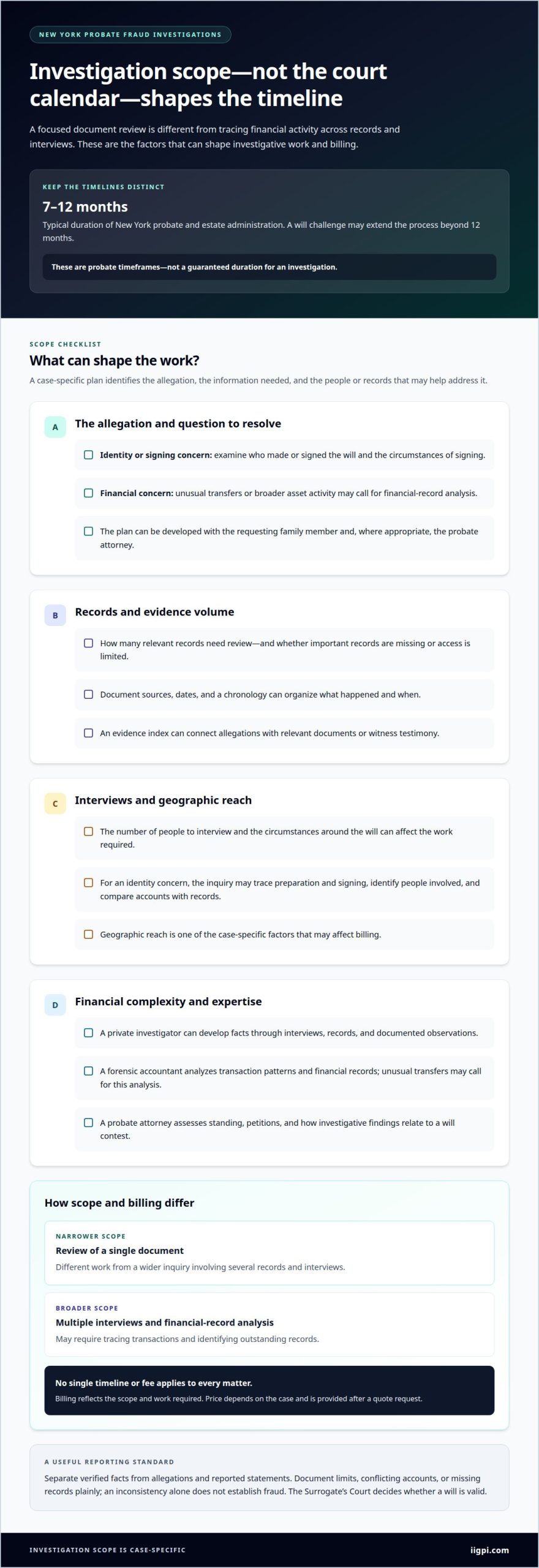
An investigative timeline depends on the evidence required, not the estate’s court schedule alone. In New York, probate and estate administration typically take 7-12 months, while a will challenge may extend the process beyond 12 months. Those periods describe probate proceedings, not a guaranteed investigation duration. A focused review of a single document differs from tracing assets across several records and interviews.
At the outset, the investigator can define the assignment with the requesting family member and, where appropriate, the probate attorney. The plan identifies the allegation, relevant records, people to interview, and findings needed for a court-related decision. For example, suspected impersonation may call for examining the will’s preparation and signing circumstances. Broader financial concerns may require tracing transactions and identifying outstanding records.
Billing reflects the scope and work required. The price depends on the case and is provided after a quote request. Relevant factors include record volume, interview requirements, geographic reach, and the complexity of asset activity. A narrow document review involves different work from an inquiry requiring multiple interviews and financial-record analysis. A consultation can establish priorities and define the requested work.
Clear reporting helps manage scope. Investigators can provide progress updates, identify new leads, and explain when a requested action would add work. If a family member raises another allegation, such as an executor’s handling of estate assets, the investigator can distinguish it from the original assignment. This keeps findings organized for presentation to counsel or the Surrogate’s Court.
Investigation and enforcement are distinct functions: an investigator gathers and documents information, while courts determine legal outcomes. The Surrogate’s Court oversees probate matters in New York. A written scope, agreed reporting approach, and documented changes help align investigative work with the estate’s needs without confusing findings with a court decision.
Investigative process and action plans
A focused plan starts by defining the alleged conduct, the people involved, and the evidence needed. For example, suspected document alteration calls for examining the will’s versions, preparation history, and related communications. Probate fraud investigation services in NYC can organize these materials into a dated sequence, helping counsel determine which issues may warrant further examination.
In New York, an interested person with an immediate, direct financial interest may challenge a will’s validity by objecting to probate. The filing stage and procedural circumstances shape the applicable steps, so timely coordination with a probate lawyer matters. The Surrogate’s Court determines whether the will is valid.
Evidence in a New York Surrogate’s Court dispute may include documents and testimony, witness interviews, depositions, expert witnesses, interrogatories, and subpoenaed records. Investigators can locate and organize relevant material, while subpoenas and litigation filings are part of the court process and handled by legal counsel. A dated timeline can connect each record to the allegation it may support.
Record review may cover the will and related estate papers, communications provided by interested parties, and financial documents lawfully available to the investigation. What an investigator can obtain depends on access, authorization, and applicable legal process. Reviewing papers provided by a family member, for example, differs from seeking records through formal court procedures.
An action plan should distinguish established facts, disputed accounts, and unresolved gaps. It can identify which witness needs an interview, which document requires authentication, and whether an expert may help interpret a record. Probate fraud investigation services in NYC can structure the evidence review around the allegation, so each new lead is assessed before the inquiry expands.
Discuss an investigative plan for organizing records, interviews, and findings relevant to a probate dispute.
An evidence plan may consider depositions, expert witnesses, interrogatories, witness interviews, and subpoenaed documents as ways to gather evidence in probate fraud litigation. Keeping these methods in view can help organize the inquiry around the evidence being gathered, with findings connected to the probate dispute and issues under review. Each method can be considered in light of the inquiry’s focus.
International Investigative Group: Surveillance Services
International Investigative Group provides Surveillance Services when a probate matter involves specific conduct relevant to an estate dispute. Planned observation can document activity connected to an investigative question, and findings can be organized for review alongside records and witness accounts. Surveillance is most useful when the suspected conduct is observable and the assignment has a defined scope; it does not replace legal analysis or a court’s determination.
A clear investigative objective helps distinguish relevant observations from unrelated activity. The assignment can be coordinated with the broader fact-finding plan so reported findings address the question under review, not imply a legal conclusion.
If surveillance may help clarify activity relevant to an estate matter, contact International Investigative Group to discuss the investigative need.
Make the Next Decision With Clear Evidence
The next step is to define what decision the investigation should inform: whether a specific concern merits further review, what evidence is relevant, and how findings will be shared with counsel. For families considering probate fraud investigation services in NYC, a clearly framed assignment can keep the inquiry focused on verifiable facts rather than assumptions. The appropriate scope depends on the concern and the records or observations needed to examine it.
International Investigative Group also provides Corporate Investigations, Insurance Investigations, and Security and Armed Guards. These are distinct services. Surveillance may be relevant when an estate matter involves observable conduct connected to a defined investigative question. Findings can inform a review, but legal decisions remain with the court and counsel.
To discuss an investigative need and its appropriate scope, contact International Investigative Group. A focused conversation can help clarify the question to be examined and the next practical step.
Frequently Asked Questions
What probate fraud investigation services are available in NYC?
Relevant investigative services in NYC may include Personal Investigations, Surveillance Services, and Computer Forensics, depending on the concern. Questions about electronic communications, for example, may call for digital analysis, while observable activity may warrant surveillance. International Investigative Group also offers Corporate Investigations and Insurance Investigations. The appropriate service depends on the estate issue and the evidence to be examined.
How much do probate fraud investigators in NYC charge?
International Investigative Group uses customized packages rather than a standard fee for every probate-related investigation. The price depends on the case and is provided after a quote request. A focused records review, for example, differs from a plan that also includes surveillance or computer forensics. Billing covers the services requested, so defining the investigative scope helps establish what work the package should include.
How do I report suspected probate fraud in New York City?
If you have an immediate, direct financial interest, you may challenge the will’s validity by filing an objection to probate. Coordinate with a probate lawyer and organize relevant documents and testimony for the Surrogate’s Court to review.