
In the high-stakes legal and corporate environment of New York, the engagement of investigative services is a decision fraught with significant risk and complexity. The potential for financial loss, reputational damage, and compromised legal outcomes necessitates a level of due diligence that creates profound uncertainty, particularly in distinguishing rudimentary services from sophisticated operational capabilities. The selection of a premier private investigator new york is therefore not merely a logistical choice but a critical strategic imperative for achieving a successful resolution in matters where the margin for error is nonexistent.
This guide provides a definitive framework for navigating this challenging landscape. Here, we will delineate the advanced methodologies employed in complex corporate and personal investigations, establish rigorous criteria for vetting and selecting qualified specialists, and analyze the operational distinctions between firms. The objective is to empower corporations and private individuals to secure a credible, licensed, and highly competent investigative partner-a strategic asset capable of delivering the dispositive evidence required to resolve critical legal, financial, and personal challenges with precision and discretion.
Key Takeaways
- Understand the specific legal parameters within which a private investigator in New York operates, ensuring your engagement remains compliant with state regulations.
- Develop a strategic framework for distinguishing between generalist investigators and specialized firms to align the required expertise with your case’s complexity.
- Gain insight into the multi-phased methodology of a high-stakes corporate investigation, from initial intake and strategy formulation to evidence collection and resolution.
- Implement a rigorous vetting process using a detailed checklist to assess the licensure, reputation, and capabilities of potential investigative partners for your matter.
The Scope of Services: What a Private Investigator in New York Can Legally Do
The contemporary private investigator operates not as a figure of fiction but as a highly regulated professional whose activities are strictly delineated by law. In New York, the profession is licensed and governed by the New York State Department of State, Division of Licensing Services, which establishes a rigorous framework for ethical conduct and legal compliance. Understanding this framework is paramount, as the value of any investigation is contingent upon the lawful acquisition of information. An investigator’s primary function is to gather facts and evidence through legally permissible methods, ensuring that all findings are admissible in court or can be used for strategic decision-making without legal repercussion.
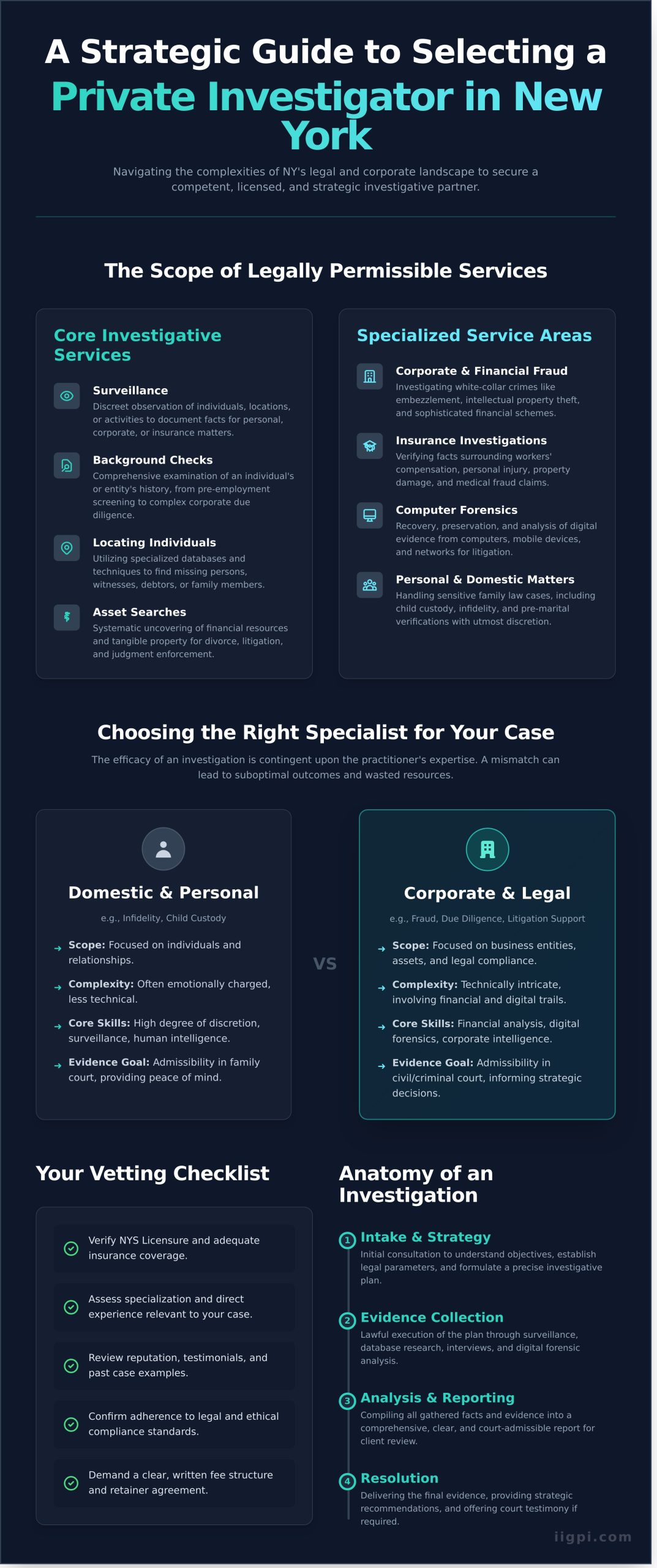
Core Investigative Services
The foundational services offered by a licensed private investigator form the bedrock of most client engagements. These activities require precision, discretion, and a comprehensive understanding of legal statutes. Common core services include:
- Surveillance: The discreet observation of individuals, locations, or activities to document facts. This is applied across personal matters, corporate inquiries to monitor employee conduct, and insurance cases to verify the legitimacy of claims.
- Background Checks: A comprehensive examination of an individual’s or entity’s history. Services range from pre-employment screening that verifies credentials to complex due diligence for corporate mergers and high-stakes investments.
- Locating Individuals: Utilizing specialized databases, public records, and investigative techniques to find missing persons, essential witnesses for litigation, debtors, or long-lost family members.
- Asset Searches: The systematic process of uncovering financial resources and tangible property. These searches are critical in divorce proceedings, civil litigation, and the enforcement of legal judgments to identify hidden or undeclared assets.
Specialized Service Areas
Beyond core competencies, a distinguished private investigator in New York often possesses expertise in highly specialized domains that demand advanced training and technical acumen. These sophisticated services address complex challenges for corporate, legal, and private clients.
- Corporate & Financial Fraud: Investigating intricate white-collar crimes such as internal theft, embezzlement, intellectual property theft, and sophisticated financial schemes that threaten corporate stability.
- Insurance Investigations: Conducting in-depth inquiries to verify the facts surrounding claims related to workers’ compensation, personal injury, property damage, and medical fraud.
- Computer Forensics: The recovery, preservation, and analysis of digital evidence from computers, mobile devices, and networks for use in litigation, intellectual property disputes, or internal corporate reviews.
- Personal & Domestic Matters: Handling sensitive family law cases with the utmost discretion, including gathering evidence for child custody disputes, infidelity investigations, and pre-marital verifications.
Choosing the Right Specialist: A Framework for Your New York Case
The efficacy of an investigation is contingent upon the specific expertise of the practitioner. In the complex landscape of New York, a critical distinction exists between generalist investigators and specialized firms. While a generalist may possess a broad skill set, complex cases demand a practitioner whose experience is directly aligned with the matter at hand. Engaging the wrong type of private investigator new york can lead to suboptimal outcomes, wasted resources, and a failure to achieve the strategic objectives of the engagement. A proper assessment of your situation is the foundational step in selecting the correct professional.
The following framework delineates the fundamental differences between the requirements of a typical domestic investigation versus those of a corporate case, providing a clear matrix for your initial assessment.
| Case Aspect | Domestic & Personal Investigations | Corporate, Legal & Insurance Investigations |
|---|---|---|
| Primary Objective | Evidence for personal or family court matters (e.g., infidelity, custody). | Risk mitigation, asset protection, and legal compliance (e.g., fraud, due diligence). |
| Essential Skills | High-level surveillance, discretion, sensitive interviews, evidence handling. | Forensic accounting, data analysis, corporate law acumen, digital forensics. |
| Operating Context | Emotionally charged environments with high personal stakes. | Complex financial, regulatory, and legal frameworks with significant business impact. |
Assessing Your Case: Personal & Domestic Investigations
Matters such as spousal infidelity, contentious child custody disputes, or locating missing family members fall squarely within this domain. The requisite skills transcend simple observation; they demand a profound level of discretion, sophisticated surveillance techniques, and the ability to conduct interviews with sensitivity and tact. The ideal investigator possesses demonstrable experience navigating the intricacies of New York family law and managing delicate client relationships. For a deeper analysis, review our comprehensive guide to Personal & Domestic Investigations.
Assessing Your Case: Corporate, Legal & Insurance Investigations
This category encompasses high-stakes corporate matters, including pre-transactional due diligence, internal financial fraud, complex asset recovery, and contested insurance claims. The required competencies are fundamentally different, necessitating financial acumen, forensic analysis, and a comprehensive understanding of corporate law. The most capable firms often have qualifications that substantially exceed the baseline New York State licensing requirements, incorporating expertise in forensic accounting and international law. To understand this process, see our article on Hiring a Corporate Private Investigator in NYC.
Anatomy of a High-Stakes Corporate Investigation in NYC
New York City’s dense commercial environment presents unique complexities for corporate investigations, where internal fraud, intellectual property theft, or executive misconduct can precipitate catastrophic financial and reputational damage. Engaging a professional private investigator in New York is not merely an operational expense but a strategic imperative for risk mitigation and asset recovery. A sophisticated investigation dismantles complex fraudulent schemes, identifies culpable parties, and produces the irrefutable evidence necessary for litigation, termination, or regulatory action. The process is methodical, discreet, and predicated on a deep understanding of both corporate structures and New York’s legal landscape.
The Initial Phase: Strategy and Information Gathering
The engagement commences with intensive strategic sessions involving the client corporation and its legal counsel. The primary objectives are to define the scope of the investigation, establish clear legal parameters, and identify key individuals and data sources. Investigators then deploy a combination of proprietary database analysis and advanced open-source intelligence (OSINT) to construct a foundational understanding of the situation. This intelligence informs the development of a discreet surveillance strategy designed to operate effectively within NYC’s challenging urban environment.
The Execution Phase: Evidence Collection and Analysis
This phase involves the meticulous collection of evidence through a multi-pronged approach. Operatives may conduct carefully orchestrated interviews or, when legally permissible, engage in undercover roles to gather firsthand information. Concurrently, forensic specialists analyze financial records for anomalies and conduct digital forensic examinations of computers and mobile devices to recover deleted data or trace illicit communications. All evidence collection methodologies must strictly adhere to the legal framework outlined in the New York State private investigator licensing requirements to ensure its admissibility in subsequent legal proceedings.
The Reporting Phase: Delivering Actionable Intelligence
Upon conclusion of the fieldwork, the private investigator new york firm synthesizes all findings into a comprehensive, court-ready report. This document provides a chronological narrative of the investigation, supported by appended evidence such as surveillance logs, financial analyses, and forensic data. The report culminates in strategic recommendations, offering the client a clear pathway for internal resolution or legal action. Should the matter proceed to trial, the lead investigator is prepared to provide expert witness testimony, articulating complex findings with clarity and authority.
Your Vetting Checklist: How to Hire a Licensed & Reputable NY Firm
Engaging a private investigator represents a significant strategic decision, demanding a level of due diligence commensurate with any high-stakes professional service procurement. The integrity of your case, the admissibility of evidence, and your own legal protection are contingent upon a rigorous vetting process. A methodical approach is essential to distinguish credible, effective firms from unprofessional or illegitimate operators.
The following framework provides a systematic methodology for evaluating and selecting a qualified private investigator in New York.
Step 1: Verify Licensing and Insurance
The foundational step in your evaluation is the confirmation of credentials. A firm’s license to operate as a private investigator must be active and in good standing with the New York Department of State. This is non-negotiable. Furthermore, request proof of comprehensive liability insurance, which serves as a critical mechanism to protect you from potential liabilities arising during an investigation. Engaging an unlicensed individual not only exposes you to significant legal and financial risk but almost certainly renders any collected evidence inadmissible in court.
Step 2: Scrutinize Experience and Specialization
Move beyond superficial metrics such as years of operation and demand substantive proof of relevant expertise. A reputable firm should be prepared to discuss anonymized case studies or methodologies that directly align with your specific requirements, whether they involve corporate counter-surveillance, digital forensics, or complex financial fraud. Inquire about the professional backgrounds of their investigative team, as high-caliber firms often employ personnel with diverse and valuable experience from sectors such as:
- Former federal or state law enforcement
- Financial analysis and forensic accounting
- Cybersecurity and information technology
- Corporate intelligence and risk management
Step 3: Understand the Contract and Costs
All professional engagements must be governed by a clear, comprehensive written contract or retainer agreement. This document should explicitly detail the scope of work, objectives, and limitations of the investigation. Scrutinize the fee structure, ensuring you understand the hourly rates, retainer requirements, and policies regarding expenses like travel and database access. The agreement must also codify communication protocols, establishing the frequency and format of updates to ensure transparent project governance.
Be vigilant for operational red flags throughout this process. A professional private investigator new york firm will operate with transparency and professionalism, whereas problematic entities often exhibit warning signs such as:
- Reluctance or refusal to provide a license number.
- Demands for full payment upfront, especially in cash.
- Guarantees of specific outcomes, which are unethical and impossible to promise.
- A lack of a professional office or web presence.
IIG: Specialized Expertise for New York’s Demanding Cases
In the complex commercial and legal landscape of New York, selecting an investigative partner is a critical strategic decision. For high-stakes matters involving corporate malfeasance, intricate financial disputes, or insurance fraud, generic investigative services are insufficient. International Investigative Group (IIG) provides the specialized capabilities required for these demanding engagements, drawing upon over three decades of focused experience within the corporate and insurance sectors. Our operations, headquartered in New York, are the nexus of a global intelligence network, offering clients a decisive advantage in resolving their most challenging cases.
The value of engaging a highly specialized team cannot be overstated when substantial financial assets and corporate reputations are at risk. Our integrated approach ensures that every facet of an investigation is managed by a subject matter expert, delivering clarity and actionable intelligence where others find ambiguity.
Our Core Differentiators
The efficacy of any private investigator in New York is measured by its results and capabilities. IIG distinguishes itself through a unique convergence of experience, talent, and global infrastructure.
- Proven Track Record: Our history is defined by successful outcomes in multi-million dollar fraud investigations, international asset recovery operations, and complex due diligence for multinational corporations.
- Multi-Disciplinary Team: We deploy a cohesive unit of seasoned investigators, certified forensic accountants, cyber intelligence analysts, and legal experts to deconstruct complex schemes and provide comprehensive findings.
- Global Reach with Local Accountability: While our network spans continents, every engagement is managed directly from our New York office, ensuring seamless communication, strategic oversight, and unwavering accountability to our clients.
Initiate a Confidential Consultation
We invite prospective clients to engage with our senior investigative team through a confidential, no-obligation consultation. This initial discussion is designed to understand the scope of your matter, assess its viability, and outline a potential strategic framework. To facilitate a productive dialogue, we recommend preparing a concise summary of the situation, including key entities, a general timeline, and the ultimate objectives.
To schedule a consultation and learn how IIG can address your specific challenges, please contact our firm directly. For further information on our global capabilities, visit iigpi.com.
Securing Definitive Outcomes in New York’s High-Stakes Arena
Navigating the intricate landscape of high-stakes investigations in New York demands a comprehensive understanding of both the legal parameters and the critical importance of specialist selection. As this guide has detailed, the success of any engagement hinges upon a rigorous vetting process and the strategic alignment of an investigator’s expertise with the specific complexities of your case. Choosing the right private investigator new york is not merely a procedural step; it is the foundational decision upon which the integrity and outcome of the entire inquiry rest.
With over 30 years of experience and a record of resolving more than 10,000 cases globally, IIG provides the strategic intelligence and evidentiary support required to prevail in the most demanding circumstances. Our specialists in corporate, insurance, and financial fraud are prepared to address your matter with unparalleled discretion and precision. We invite you to take the decisive first step toward clarity and resolution. Request a Confidential Consultation to Discuss Your Case and allow our experts to provide a strategic assessment.
Frequently Asked Questions Regarding Private Investigation Services
How much does it cost to hire a private investigator in New York?
The financial investment required to retain a private investigator in New York is contingent upon several variables, including the case’s complexity, the required duration of services, and the specific investigative techniques employed. Most professional firms operate on an hourly rate, which can range from $100 to over $250, in addition to a retainer fee. A comprehensive consultation is necessary to establish the operational parameters and provide a detailed estimate aligned with the client’s strategic objectives.
Is it legal for a private investigator to conduct surveillance in NYC?
Within the legal framework of New York, licensed private investigators are permitted to conduct surveillance in public spaces where an individual does not possess a reasonable expectation of privacy. This includes observing subjects in public streets, parks, or entering commercial establishments. All surveillance activities must strictly adhere to state and federal statutes, ensuring that methods such as wiretapping or trespassing are not employed, thereby maintaining the evidentiary integrity of all findings.
What is the difference between a private investigator and a detective?
The fundamental distinction lies in their employment and jurisdictional authority. A detective is a sworn law enforcement officer employed by a governmental entity, such as the NYPD, with the power to make arrests and conduct criminal investigations on behalf of the state. Conversely, a private investigator operates in a civilian capacity, retained by private citizens or corporate entities to conduct investigations into civil, personal, or corporate matters without police powers.
How long does a typical private investigation take?
The duration of an investigation is not standardized; rather, it is dictated by the specific objectives and the complexity of the case. A straightforward background check or records search may be concluded within days, whereas a comprehensive surveillance or a complex fraud investigation could extend for several weeks or months. The timeline is directly correlated with the evidentiary requirements needed to achieve a conclusive and satisfactory outcome for the client’s mandate.
Can a PI access private records like bank statements or phone logs?
A licensed private investigator is bound by the same legal constraints as any other citizen and cannot illegally access protected private records. Procuring documents such as bank statements, phone logs, or medical records without a court order or the individual’s consent is impermissible. Investigators must utilize legally sanctioned channels, such as public record databases, open-source intelligence, and other lawful methods, to gather information and develop intelligence within statutory limits.
What information do I need to provide to start an investigation?
To initiate an engagement, the client must provide foundational information to establish the case parameters. This typically includes the subject’s full name, date of birth, last known residential and employment addresses, and a photograph if available. Critically, a clear and concise articulation of the investigation’s objectives is required to ensure that the operational strategy is precisely aligned with the client’s desired outcomes and informational needs.
I think my spouse is cheating. Can a private investigator help?
Suspected infidelity is a primary area of practice for a professional private investigator. An investigator can be retained to substantiate or refute suspicions through discreet surveillance, which documents a subject’s activities, locations, and associations. The objective is to procure impartial, fact-based evidence, often in the form of photographic and video documentation, that provides the client with clarity and, if necessary, admissible evidence for legal proceedings such as divorce.
How do I know the information gathered will be kept confidential?
Confidentiality is a paramount ethical and legal mandate for licensed private investigators. All communications, case details, and gathered evidence are protected by stringent professional standards and, frequently, a formal non-disclosure agreement (NDA). Reputable firms operate with secure systems for data handling and dissemination, ensuring that the client’s privacy and the sensitive nature of the investigation are rigorously maintained throughout the entire process.
