
In the complex legal and corporate landscape of the state, the need for discreet, factual intelligence is paramount. Yet, the decision to engage professional services for private investigations in New York is frequently fraught with significant concerns, from navigating the opaque boundaries of legality to distinguishing credible, licensed firms from unreliable operators. The potential for mishandled sensitive information and the ambiguity surrounding achievable outcomes can deter even the most determined individuals and organizations from seeking the clarity they require to protect their interests.
This comprehensive overview is designed to address these critical ambiguities. It provides an authoritative examination of the regulatory framework governing the industry, delineates the core services available, and establishes the professional standards that define effective and ethical investigative practice. Readers will gain the necessary understanding to procure investigative services with confidence, ensuring that their objectives-whether personal, corporate, or legal-are met with precision and result in the acquisition of admissible, actionable intelligence.
Key Takeaways
- Comprehend the stringent regulatory framework governing the profession, with licensure and oversight managed by the New York State Department of State to ensure professional standards.
- Gain insight into the diverse portfolio of investigative services tailored to the distinct requirements of corporate, legal, insurance, and private clientele.
- Understand the methodical, structured approach that defines a professional investigative engagement, from initial consultation and strategic planning to evidence collection and final reporting.
- Acquire actionable criteria for evaluating and selecting a premier firm for private investigations new york, framing the decision as a critical strategic choice for your objectives.
The Legal Framework for Private Investigations in New York State
In the State of New York, the practice of private investigation is not an unregulated endeavor but a highly formalized and licensed profession governed by a stringent statutory framework. The primary regulatory body responsible for oversight is the New York State Department of State, which ensures that all individuals and agencies offering investigative services meet rigorous standards of competence and ethical conduct. This regulatory structure is paramount, serving the dual purpose of protecting clients from malpractice and ensuring that any evidence gathered maintains its integrity and admissibility in judicial proceedings. Consequently, a clear distinction exists between licensed professionals and unlicensed operators, with the latter presenting significant legal and financial risks to their clients through non-compliant and potentially unlawful activities.
Licensing and Eligibility Requirements
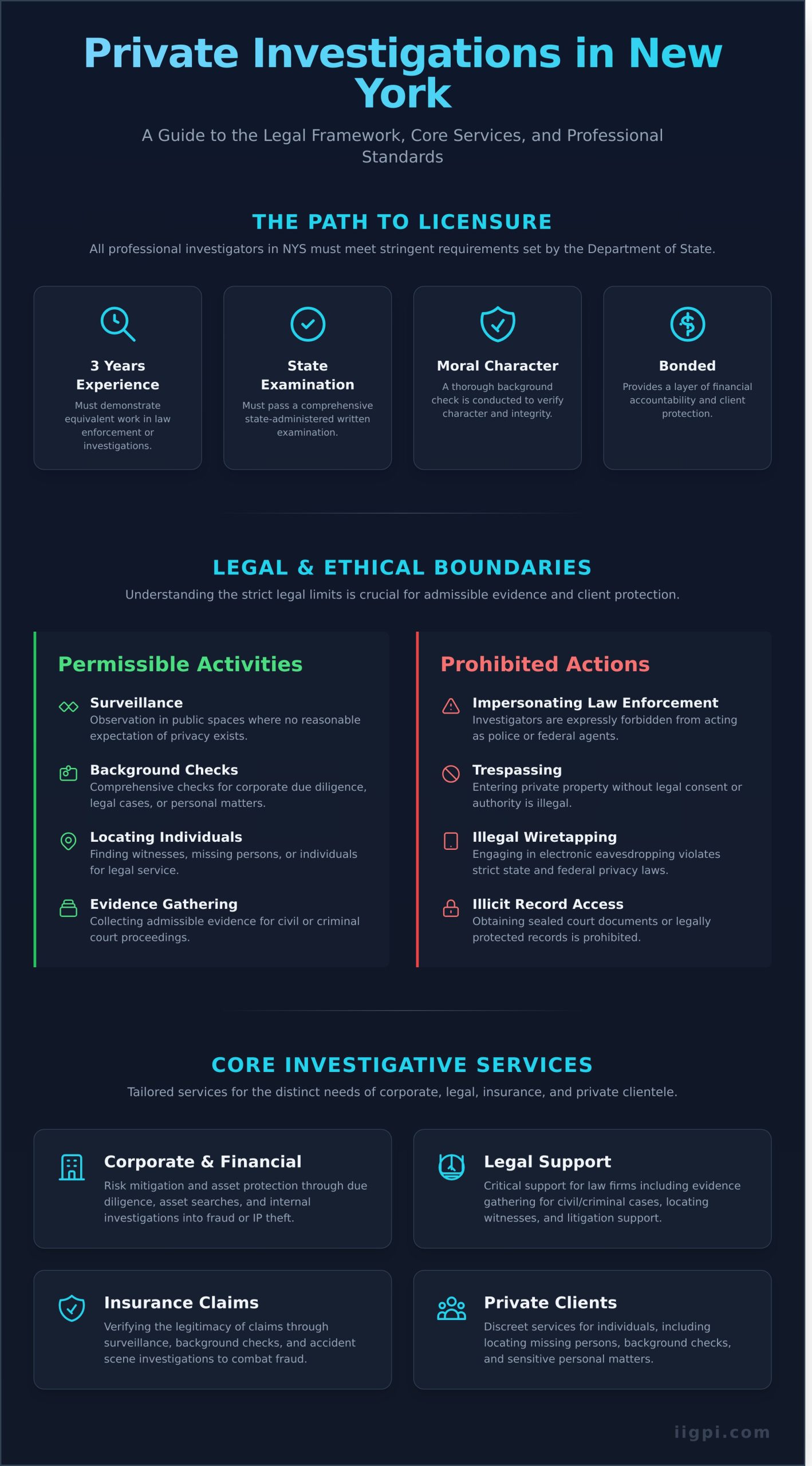
The path to becoming a licensed private investigator in New York is deliberately arduous. Applicants must demonstrate substantial experience, typically three years of equivalent work in law enforcement or investigations, and must pass a comprehensive state-administered examination. Furthermore, a thorough background check is conducted to verify the candidate’s moral character. A critical component of this licensure is the requirement to be bonded, which provides a layer of financial accountability and client protection. It is therefore imperative for any prospective client to verify an investigator’s license number with the Department of State before engagement.
Permissible Activities and Legal Boundaries
The scope of lawful private investigations new york encompasses a range of activities, including surveillance, comprehensive background checks, locating individuals, and gathering evidence for civil or criminal cases. However, these activities are circumscribed by strict legal boundaries. Investigators are expressly prohibited from:
- Impersonating a law enforcement officer or federal agent.
- Trespassing on private property without consent.
- Engaging in illegal wiretapping or electronic eavesdropping.
- Obtaining sealed or legally protected records through illicit means.
New York’s privacy laws further dictate the methods of surveillance, generally permitting observation in public spaces where no reasonable expectation of privacy exists, while heavily restricting actions in private domains.
Confidentiality and Professional Ethics
A cornerstone of the investigator-client relationship is the duty of confidentiality, a principle that governs all communications and findings. Professional investigative firms adhere to a strict code of ethics, ensuring that all assignments are conducted with discretion and integrity. This ethical obligation is intrinsically linked to legal procedure; evidence must be collected, preserved, and presented in a manner that is fully compliant with state and federal law. Any deviation from these protocols not only constitutes an ethical breach but also jeopardizes the admissibility of the evidence in court, potentially undermining the entire legal strategy it was meant to support.
Core Services Offered by New York Investigative Firms
The domain of professional private investigation extends far beyond popular caricature, encompassing a sophisticated portfolio of services tailored to a diverse clientele. Full-service agencies in New York cater to the distinct needs of corporate entities, insurance carriers, legal firms, and private individuals, with each sector demanding a unique synthesis of traditional fieldcraft and advanced technological proficiency. The execution of these complex operations requires investigators to possess not only specialized skills but also a comprehensive understanding of statutory limitations, a standard underscored by the rigorous qualifications for obtaining a New York State private investigator license. The efficacy of these services hinges on the methodical collection and analysis of information to provide clients with actionable intelligence.
Corporate and Financial Investigations
In the corporate sphere, investigative services are a critical component of risk mitigation and asset protection. This includes comprehensive due diligence for mergers, acquisitions, and significant investments, designed to uncover potential liabilities and verify financial representations. Agencies conduct intricate asset searches to support litigation or facilitate debt recovery proceedings. Furthermore, they are frequently engaged to conduct internal investigations into matters of employee misconduct, corporate fraud, and the theft of intellectual property, providing evidence to support legal action or internal disciplinary measures.
Insurance Claim Verification
For the insurance industry, private investigators serve an essential function in validating the legitimacy of claims. This often involves discreet surveillance to verify the extent of injuries alleged in workers’ compensation or personal injury cases, ensuring the claimant’s activities are consistent with their stated physical limitations. Investigations also address suspected fraudulent activities, such as arson for profit or staged vehicle accidents. The primary objective is to gather impartial, admissible evidence that enables insurers to confidently approve legitimate claims while denying fraudulent ones.
Matrimonial and Domestic Investigations
Matrimonial and domestic cases require the utmost discretion and a nuanced understanding of family law. Investigators are retained to conduct surveillance to ascertain infidelity, providing legally obtained evidence for use in divorce proceedings. In contentious child custody disputes, their role is to gather objective evidence pertaining to parental fitness, lifestyle, and the overall welfare of the child. Additionally, a crucial service involves locating undeclared or hidden assets, which is fundamental to ensuring an equitable division of property during a divorce.
Technical Surveillance and Digital Forensics
The modern landscape of private investigations new york is increasingly defined by technological expertise. Technical Surveillance Counter-Measures (TSCM), or “bug sweeps,” are a defensive service used to detect and neutralize illicit eavesdropping devices in corporate offices, residences, or vehicles. Concurrently, digital forensics specialists analyze computers and mobile devices to recover deleted data, trace communications, and uncover digital evidence critical to corporate, civil, or criminal cases. This capability allows for the reconstruction of events and timelines from digital footprints.
The Investigative Process: A Methodical Approach
Contrary to popular portrayals, professional investigative work is not an impromptu endeavor but a highly structured and methodical discipline. A successful engagement is predicated on a systematic progression through distinct phases, ensuring that all actions are legally compliant, strategically sound, and aligned with client objectives. This framework manages expectations by establishing clear timelines, communication protocols, and deliverables from inception to conclusion.
Phase 1: Initial Consultation and Case Intake
The engagement commences with a confidential consultation where the fundamental parameters of the inquiry are established. During this critical intake phase, the client’s objectives, budgetary constraints, and desired outcomes are meticulously defined. Legal boundaries are paramount; the discussion will confirm the lawfulness of the objectives and establish the operational scope. This culminates in a formal retainer agreement or contract, a document that codifies the terms of the engagement and provides a legal foundation for all subsequent actions.
Phase 2: Strategy Development and Open-Source Intelligence (OSINT)
Following intake, a bespoke investigative strategy is formulated. This phase begins with comprehensive Open-Source Intelligence (OSINT) gathering, leveraging legally accessible databases, public records, and digital footprints to build a foundational understanding of the subject. The intelligence gathered informs the strategic plan, which outlines the specific methodologies to be employed, whether surveillance, interviews, or forensic analysis. This deliberate planning maximizes efficiency and the probability of a successful outcome.
Phase 3: Field Operations and Evidence Collection
This is the operational execution of the strategic plan. Investigators conduct fieldwork, such as discreet surveillance or witness interviews, with a singular focus on gathering admissible evidence. For practitioners of private investigations in New York, maintaining an unbroken chain of custody for all collected materials-video, documents, or digital data-is a non-negotiable professional standard. Throughout this phase, clients receive regular, structured updates to remain informed of progress and any material developments.
Phase 4: Analysis, Reporting, and Testimony
Upon conclusion of fieldwork, all collected information is collated, analyzed, and synthesized into a comprehensive report. This formal document presents the findings in a clear, objective, and chronological manner, substantiated by the evidence acquired. The report is structured to be intelligible to the client and, if necessary, admissible in legal proceedings. In such cases, the lead investigator may be called upon to provide expert testimony, attesting to the findings and the methodologies used to obtain them. Understanding these procedural frameworks is essential for any entity navigating complex legal challenges; further insights into governance and policy can be found at iigpi.com.
Criteria for Selecting a Premier Private Investigator in NYC
Engaging a firm for private investigations new york is a decision with significant legal and personal ramifications, demanding a rigorous and methodical selection process. The choice of an investigative partner should be viewed not as a mere procurement of services, but as a critical strategic engagement. The quality, discretion, and ethical grounding of the chosen firm will directly influence the integrity and utility of the intelligence gathered. Therefore, potential clients must look beyond simple cost metrics and evaluate candidates based on a framework of verifiable credentials, specialized experience, and uncompromising professionalism.
Verification of Credentials
A foundational due diligence step involves the verification of licensure. It is imperative to confirm that any considered firm holds a valid license, which can be verified through the New York State Department of State’s Division of Licensing Services. Furthermore, a prospective client must ascertain that the agency carries adequate liability insurance to protect all parties. Affiliations with respected professional bodies, such as the Associated Licensed Detectives of New York State (ALDONYS), further signal a commitment to industry best practices and ethical standards.
Assessment of Experience and Specialization
The efficacy of an investigation is contingent upon the firm’s demonstrated expertise in the specific domain of inquiry, whether it pertains to corporate due diligence, litigation support, or sensitive personal matters. Inquire about the professional backgrounds of the investigators, as experience in former law enforcement, intelligence, or specialized legal fields can be invaluable. Reputable firms should be capable of providing redacted case examples or relevant testimonials that substantiate their track record in handling cases of similar complexity and scope.
Evaluation of Professionalism and Discretion
The initial consultation serves as a critical indicator of a firm’s operational standards and commitment to confidentiality. A premier investigative firm will communicate with clarity and precision, operate from a secure and professional office, and be prepared to discuss its stringent protocols for data security and maintaining client anonymity. The manner in which a firm handles this first interaction is often a direct reflection of how it will manage the sensitive details of your case.
Understanding the Fee Structure
A transparent and clearly articulated fee structure is the hallmark of a professional organization. Common models include hourly rates, flat fees for specific services, and retainers for ongoing engagements. It is essential to receive a written agreement that explicitly details all costs, including potential ancillary expenses like mileage or report generation. Firms that offer unusually low prices or guarantee specific outcomes should be approached with extreme caution, as such proposals often deviate from the professional standards governing complex investigative work. For a clear assessment of your specific needs, we invite you to request a confidential consultation to discuss your case.
Strategic Engagement with New York Investigative Professionals
Navigating the complex landscape of private investigations new york demands a comprehensive understanding of the state’s stringent legal framework and an appreciation for the methodical processes that define successful outcomes. The selection of an investigative firm is not merely a transactional decision; it is a strategic partnership predicated on demonstrated expertise, licensure, and a capacity for discretion. As this overview has demonstrated, a thorough comprehension of both the regulatory environment and the criteria for selecting a premier investigator is paramount for any entity seeking to procure reliable intelligence and mitigate risk within this specialized domain.
For entities requiring unparalleled expertise, our firm represents the apex of investigative proficiency. With over 30 years of direct investigative experience, our team is fully licensed, bonded, and insured in the State of New York, operating with the highest degree of professional integrity. Supported by a global network of trusted agents and resources, we deliver strategic solutions to the most complex challenges. We invite you to contact us for a confidential consultation with our experienced investigators to ascertain how our capabilities can serve your objectives.
Embarking on this process with a distinguished partner ensures clarity, security, and a decisive strategic advantage.
Frequently Asked Questions About Private Investigations
What is the primary difference between a private investigator and a police detective in New York?
The principal distinction pertains to jurisdiction and statutory authority. A police detective is a state-sworn officer empowered to enforce criminal statutes and investigate public offenses on behalf of the government. Conversely, a private investigator is a licensed civilian professional retained by private clients for civil, corporate, or personal matters. They operate without the law enforcement powers of arrest or search and seizure, focusing instead on information gathering within the bounds of civil law.
Can a private investigator in New York legally access private records like bank statements or phone logs?
No, a private investigator is legally prohibited from directly accessing protected private records through illicit means such as pretexting or hacking. The procurement of such information is governed by stringent federal and state privacy laws. Investigators must utilize lawful methods, such as searching public records, analyzing open-source intelligence, and working with a client’s legal counsel to obtain information through formal discovery processes like subpoenas, ensuring all actions are legally compliant.
How is confidentiality maintained during a sensitive investigation?
Confidentiality is paramount and is maintained through a rigorous framework of legal and ethical obligations. A binding contractual agreement establishes a strict client-investigator privilege, often reinforced by a non-disclosure clause. Professional investigators implement stringent data security protocols for the handling, storage, and dissemination of all case-related information, ensuring sensitive findings are disclosed exclusively to the client or their designated legal counsel as stipulated in the retainer agreement.
What makes evidence gathered by a private investigator admissible in a New York court?
For evidence to be deemed admissible, its collection must demonstrate strict adherence to all applicable laws. The investigator must obtain the evidence without violating statutes concerning privacy, trespassing, or illegal electronic surveillance, such as recording conversations without required consent. Furthermore, a meticulous and unbroken chain of custody must be maintained to prove the evidence’s integrity and authenticity from the moment of its acquisition to its presentation in a legal proceeding.
What is the typical cost structure for hiring a private investigation firm in NYC?
The cost structure for professional private investigations new york firms typically involves an initial retainer fee, which is an advance payment from which hourly rates and expenses are deducted. Hourly rates vary based on the case’s complexity and the investigator’s expertise. Some services, such as comprehensive background checks, may be offered at a flat fee. Clients should also anticipate being billed for operational expenses like travel, database access fees, and other case-specific disbursements.
How long does a standard surveillance or background investigation typically take?
The duration of an investigation is contingent upon its specific objectives. A standard surveillance operation may require a period ranging from several days to a few weeks to effectively establish a subject’s patterns and gather the necessary evidence. In contrast, a comprehensive background investigation is a more finite process, with a detailed report typically being compiled and delivered to the client within a timeframe of 48 to 96 hours, depending on the depth of research required.
