
Infidelity can be a legal ground for divorce in New York, but proving adultery requires more than a spouse’s testimony alone. Presenting proof of infidelity to a divorce lawyer in NYC means bringing relevant evidence, such as communications, travel records, receipts, or witness accounts, for an attorney to assess. An affair itself does not automatically determine how property is divided or who receives custody.
Evidence of an affair can feel central to a divorce, but its legal significance depends on what it establishes and how the circumstances affect related issues. This article explains how New York treats adultery, what evidence may support an allegation, and what to discuss with a family law attorney.
You’ll also learn why alleged marital misconduct may matter differently to property division, maintenance, and child custody, and why pursuing adultery as a ground can add complexity to a case. The aim is to help you handle evidence carefully and understand its possible role before deciding what to do next.
Key Takeaways
- Assess whether the evidence can establish both opportunity and inclination, and preserve its context and authenticity for discussion with counsel.
- Understand how New York’s adultery ground differs from a no-fault divorce based on an irretrievable breakdown.
- Prepare to discuss the potential evidentiary demands and added complexity of pursuing an adultery-based case with a family law attorney.
- Consider whether alleged misconduct involved sustained, egregious spending, since financial conduct may matter more than the affair alone in evaluating financial claims.
Can Cheating Affect Your New York Divorce?
Adultery can serve as a fault-based ground for divorce in New York, but its effect depends on the issue. By itself, it generally does not determine custody or child support.
New York’s Definition of Adultery
New York Domestic Relations Law § 170(4) defines adultery as voluntary sexual intercourse, oral sexual conduct, or anal sexual conduct by a married person with someone who is not their spouse. This definition matters because conduct outside those categories may not establish adultery under this ground. The distinction helps focus discussions with counsel on evidence tied to the statutory definition.
Adultery as a Divorce Ground
New York recognizes adultery as a fault-based ground for divorce under Domestic Relations Law § 170(4). A spouse alleging adultery must provide evidence beyond their own testimony. New York also allows a no-fault divorce based on an irretrievable breakdown lasting at least six months. The adultery route may make a case contested and more complex; contested cases can take several months to several years, depending on the issues and court schedule. A defense may apply if five years have elapsed since discovery of the act, or if the plaintiff consented to or procured it. That five-year period is a defense, not a general filing deadline for every divorce.
Evidence of Adultery
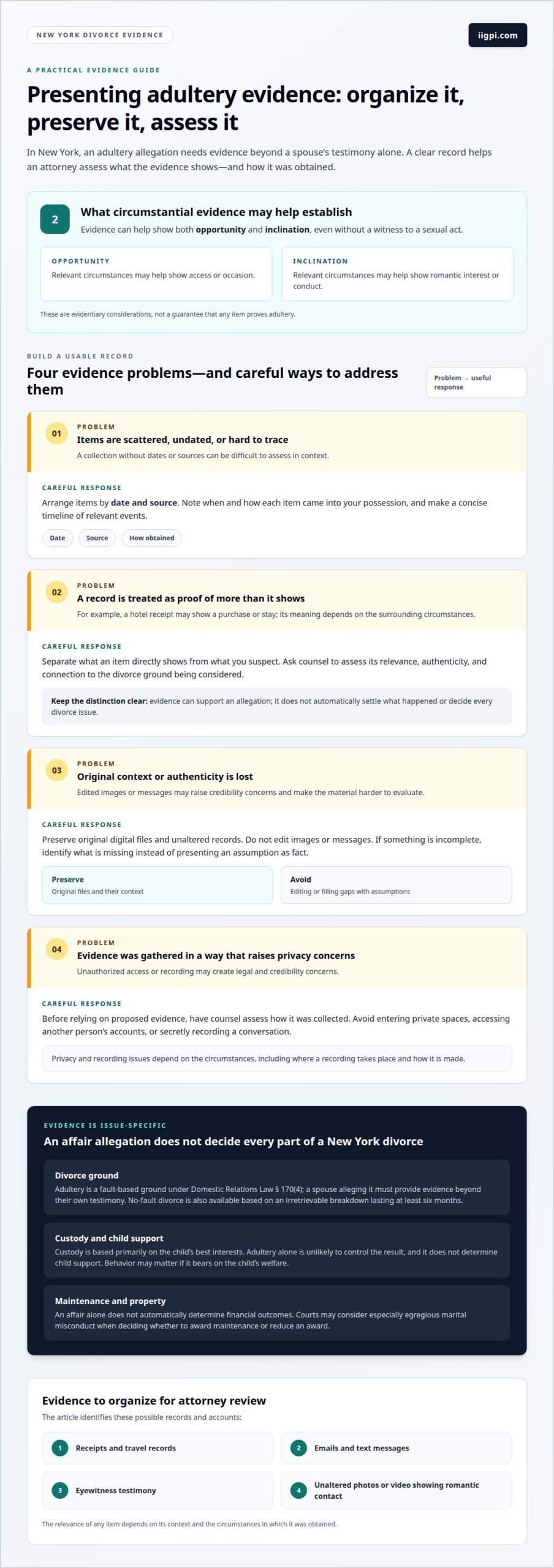
Evidence may include receipts, travel records, emails, texts, eyewitness testimony, and unaltered photographs or video showing romantic contact. Circumstantial evidence can help establish opportunity and inclination, even without a witness to a sexual act. When presenting proof to a divorce lawyer, organize items by date and source, preserve original files, and explain how each item was obtained. Do not edit images or messages. Evidence obtained through unauthorized access or recording may raise legal and credibility concerns, so have counsel assess how it was gathered before relying on it.
Privacy and Recording Rules
Privacy and recording issues depend on the circumstances, including where a recording takes place and how it is made. Before discussing proposed evidence with counsel, avoid entering private spaces, accessing another person’s accounts, or secretly recording a conversation. An attorney can assess how the evidence was collected and whether it is relevant to an adultery claim. Keep custody issues separate: New York bases custody primarily on the child’s best interests, and adultery alone is unlikely to control the result. Affair-related behavior may matter if it bears on the child’s welfare, such as alleged abusive conduct. Adultery does not determine child support.
What impact does marital fault have on a divorce in NY?
New York recognizes adultery as a fault-based ground, but marital fault does not control every divorce issue. Its relevance depends on the legal ground and the circumstances.
Fault-Based Grounds in New York
New York’s fault-based ground of adultery allows a spouse to seek divorce by alleging that the other spouse committed adultery. The state’s Domestic Relations Law also recognizes no-fault divorce, so proving cheating isn’t necessary in every case. New York’s 1966 reforms added grounds for divorce; adultery remains one option within that legal framework.
Choosing a fault-based ground affects how the case is presented because the allegation must be supported by evidence. Consider whether the available proof is relevant to the ground and whether pursuing the allegation serves a specific legal objective. Fault is a basis for seeking a divorce, not an automatic decision on every related issue.
Marital Fault and Maintenance
New York courts may consider marital misconduct when deciding whether to award maintenance or reduce an award, particularly when the conduct is especially egregious. An affair alone does not automatically meet that standard. The court focuses on the misconduct and its circumstances, rather than treating every instance of infidelity as financially decisive.
New York enacted no-fault divorce in October 2010, becoming the last state in the United States to do so. A court may grant no-fault divorce when the marriage has experienced an irretrievable breakdown for at least six months. This route doesn’t require a finding that either spouse caused the marriage to fail. A lawyer can help assess whether fault evidence relates to maintenance or whether no-fault grounds better match the issues involved. Keeping the divorce ground separate from financial claims helps clarify what the evidence may, and may not, establish.
Consulting a family law attorney
An initial consultation gives a New York family law attorney an opportunity to assess the evidence, possible divorce grounds, and issues that may shape the proceedings. Meet with an experienced divorce lawyer even if the ending seems straightforward, because custody, assets, and the divorce process involve separate considerations.
Bring a concise timeline of relevant events, along with copies of messages, photographs, travel records, receipts, or witness details. Preserve original digital files and note when and how each item came into your possession. Include key dates, such as when you discovered the alleged relationship, because timing may matter to the legal analysis. If a record is incomplete, identify what is missing instead of presenting an assumption as fact.
Use the meeting to distinguish what the evidence may establish from what you suspect. For example, a hotel receipt may show a purchase or stay, but its meaning depends on the surrounding circumstances. Ask how the attorney would assess its relevance, authenticity, and connection to the grounds being considered. Discuss whether pursuing a fault-based claim aligns with your priorities, especially if it could make the case more contested or complex.
Prepare a separate summary of practical concerns. List questions about child custody, financial support, shared assets, and the steps involved in ending the marriage. If a child’s care is disputed, describe specific behavior affecting the child instead of relying only on allegations about an affair. For assets, identify financial records that may relate to spending or property. These details help the attorney determine which issues need attention and which evidence relates to them.
Before leaving, clarify the next steps: what additional records may help, how to preserve the evidence, and which issues need follow-up. A focused consultation gives counsel a clearer account of the facts and helps you understand how the evidence fits your broader divorce objectives.
Effects on maintenance and equitable distribution
Proving an affair does not automatically change how New York divides property, awards maintenance, or determines child custody. The key distinction is between adultery itself and any financial or family consequences connected to the conduct.
For equitable distribution, the court generally considers marital property and the circumstances relevant to its division. Adultery alone usually does not alter that distribution. The analysis may differ if a spouse used marital assets to fund an extramarital relationship, particularly through sustained, egregious spending or proven wasteful dissipation. For example, evidence of repeated withdrawals from a marital account to fund an affair may raise a financial issue beyond the relationship itself. Records showing amounts, dates, and account sources can help an attorney assess whether the spending bears on property claims.
Maintenance, often called alimony, is not automatically increased or reduced because a spouse cheated. New York courts may consider marital misconduct when deciding whether to award maintenance or reduce an award, but the conduct must be particularly egregious. A longstanding affair or related spending may be relevant in context; testimony about the relationship alone does not establish financial loss. The reasons for the spending and its impact on marital resources matter.
Custody follows a separate analysis. New York bases custody primarily on the child’s best interests, so an affair alone is unlikely to determine the result. Behavior surrounding the affair may matter if it affects the child, such as alleged abuse or disruption of care. Adultery does not determine child support. Keeping these issues separate helps prevent evidence about the marriage from obscuring the child’s needs or financial facts.
During the divorce process, organize financial records separately from communications or photographs about the affair. A clear record of transactions can help counsel assess whether alleged dissipation warrants attention; relationship evidence may address different questions. Discuss how each item connects to a specific claim with an attorney, rather than assuming it changes property division or maintenance.
If you need help assessing evidence related to a family dispute, explore investigative support.
International Investigative Group
International Investigative Group provides investigative support when a New York divorce involves questions that call for independent fact-finding. Its Personal & Domestic Investigations, Matrimonial Investigations, and Surveillance Investigation Services can help document relevant activity for discussion with a family law attorney. The attorney remains responsible for legal advice and assessing how evidence may be used in divorce proceedings.
Consider investigative support when your information is incomplete, relevant events unfold over time, or you need help documenting facts rather than drawing conclusions from isolated messages or records. Share the specific questions and information you already have so the investigative work can focus on the issue at hand. Evidence gathering should respect privacy and applicable law; avoid unauthorized access or recording.
For investigative support related to a matrimonial matter, contact International Investigative Group.
Choose a Clear Next Step
Before deciding how to proceed, identify what you need the evidence to clarify and separate that objective from assumptions about the marriage. When presenting proof of infidelity to a divorce lawyer in NYC, a focused, factual account can make your priorities and questions easier to discuss.
International Investigative Group offers investigative services, including Corporate & Business Investigations and Insurance Investigation, as well as Security and Armed Guard Services. For a personal matter, contact the firm to discuss investigative support relevant to your circumstances; legal strategy belongs with your family law attorney.
Contact International Investigative Group to discuss your investigative needs, and take the next step with clarity.
Frequently Asked Questions
What impact does adultery have on divorce proceedings?
Adultery can make divorce proceedings more contested because the spouse alleging it must support the claim with evidence beyond personal testimony. Disputes may arise over what happened and how records should be interpreted. A spouse may instead proceed on New York’s no-fault ground, based on an irretrievable breakdown lasting at least six months, without asking the court to assign blame.
What type of proof is required to prove adultery?
No single document proves every adultery claim; evidence must support the allegation in context. Presenting proof of infidelity to a divorce lawyer in NYC is more useful when you can explain each item’s source, date, and connection to the timeline. For example, identify which records corroborate a meeting and which merely raise a question. Keep facts separate from assumptions.
How does adultery affect divorce in New York State?
In New York State, adultery remains a fault-based ground, but it does not automatically determine property division, maintenance, custody, or child support. Financial consequences may arise when evidence connects an affair to wasteful use of marital assets. For custody, the child’s best interests remain central; behavior affecting the child may matter more than the affair itself.
What evidence of infidelity can be used in a New York divorce case?
Potentially relevant material may include records that corroborate one another, such as travel documents that align with dated communications or testimony from someone who observed events. The value lies in how the items connect, not simply in their volume. Note what each item directly establishes, where it came from, and any gaps so counsel can assess its relevance and reliability.
Can text messages, emails, photos, or social media posts be used as evidence in a New York divorce?
Texts, emails, photographs, and social media posts may support an adultery allegation when relevant and considered in context. When presenting proof of infidelity to a divorce lawyer in NYC, preserve the full conversation or post, including dates and surrounding exchanges, rather than relying only on a cropped screenshot. Do not access another person’s private account to obtain material; explain how each item was acquired.