In the landscape of modern investigative techniques, few instruments provoke as much debate and engender as much uncertainty as the polygraph. Often sensationalized in media yet simultaneously utilized within sensitive sectors of government and corporate security, the lie detector test occupies a precarious position at the intersection of psychology, technology, and jurisprudence. The persistent ambiguity surrounding its scientific reliability and legal admissibility creates significant challenges for decision-makers, who must weigh its potential utility against substantial ethical and regulatory considerations, including anxiety over potential legal repercussions.
This comprehensive analysis for 2026 dissects the intricate framework of polygraphy, moving beyond popular perception to critically evaluate its scientific validity, the stringent protocols governing its administration, and its evolving legal standing. For legal professionals, corporate security directors, and governmental bodies, this document serves as an essential strategic guide. It aims to clarify the complexities of the Employee Polygraph Protection Act (EPPA) and establish a clear framework for determining if, and when, polygraphy is a judicious and defensible tool within a modern investigative strategy, ultimately assisting in the identification of credible examination services.
Key Takeaways
- Distinguish between the scientific principles of psychophysiological detection of deception (PDD) and popular myths to accurately evaluate its foundational validity.
- Analyze the critical differences between standardized testing protocols, such as the Comparison Question Technique (CQT), to understand how methodology impacts results.
- Navigate the complex regulatory frameworks, including the Employee Polygraph Protection Act (EPPA), that govern the legal standing of a lie detector test in corporate and judicial settings.
- Learn to position polygraphy as a strategic component within a multilateral investigative framework, leveraging its utility while acknowledging its limitations.
The Theoretical Foundation of Polygraphy: Beyond the ‘Lie Detector’ Misnomer
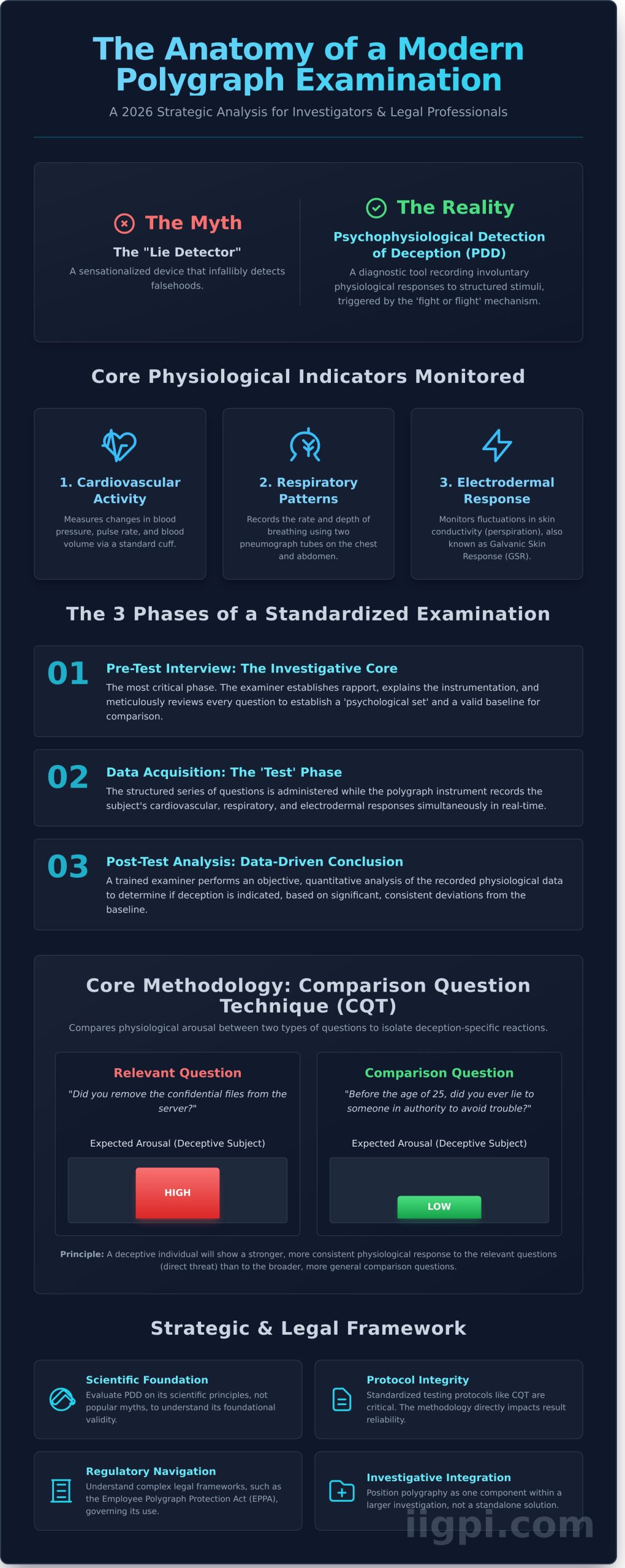
The term ‘lie detector test’ is a pervasive misnomer that fundamentally misrepresents the intricate process of Psychophysiological Detection of Deception (PDD). Contrary to popular depiction, a polygraph instrument does not detect lies; rather, it records involuntary physiological responses to a structured series of questions. The theoretical basis of this methodology posits that the cognitive load and emotional stress associated with deception elicit measurable changes within the autonomic nervous system (ANS). The evolution of this instrumentation from rudimentary 20th-century prototypes to the sophisticated, multi-channel digital systems utilized in 2026 reflects a continuous effort to refine data acquisition and analysis, a history detailed in this comprehensive Polygraph overview.
At the core of a modern polygraph examination is the simultaneous monitoring of several physiological data streams. A trained examiner analyzes these channels for significant deviations from an established baseline. The primary indicators include:
- Cardiovascular Activity: Changes in blood pressure, pulse rate, and blood volume are measured, often through a standard blood pressure cuff.
- Respiratory Patterns: Two pneumograph tubes placed around the chest and abdomen record the rate and depth of breathing.
- Electrodermal Response: Also known as galvanic skin response, this measures fluctuations in the electrical conductivity of the skin, which is directly correlated with perspiration.
Defining the Psychophysiological Mechanism
The physiological reactions monitored during a polygraph examination are manifestations of the ‘fight or flight’ response, an evolutionary survival mechanism. When a person perceives a significant threat, such as being caught in a high-stakes deception, the ANS triggers these involuntary changes. A critical element for examiners is differentiating the general anxiety of being tested from deception-specific reactions, a process aided by observing the Orienting Response (OR), which is the subject’s initial reaction to a novel stimulus. Fundamentally, polygraphy is a standardized method of measuring and recording physiological arousal as it relates to specific verbal and written stimuli within a controlled environment.
The Pre-Test Interview: The Investigative Core
Arguably the most critical phase of the entire process is the pre-test interview, which serves as the investigative and psychological foundation for the examination. During this extensive dialogue, the examiner establishes a rapport with the subject, explains the instrumentation, and meticulously reviews every question that will be asked. This review ensures the examinee possesses a complete and unambiguous understanding of the semantic boundaries of each query, thereby eliminating confusion as a source of physiological response. This protocol is essential for establishing the ‘psychological set,’ a state wherein the examinee’s attention and anxiety are focused exclusively on the relevant questions, providing a valid baseline against which to measure subsequent reactions.
Methodological Protocols in Modern Deception Detection
The efficacy and reliability of any psychophysiological detection of deception (PDD) examination are fundamentally contingent upon the strict adherence to standardized methodological protocols. The evolution of the modern lie detector test represents a deliberate transition from a subjective art to a data-driven science, where procedural integrity is paramount. This framework is built upon three core pillars: the implementation of validated testing formats, the maintenance of a controlled examination environment to mitigate external artifacts, and the objective, quantitative analysis of physiological data. Central to this process is the role of the examiner, who must function not as an interrogator but as a neutral clinical professional tasked with the dispassionate administration of the test and collection of data.
The Comparison Question Technique (CQT)
The CQT remains a dominant methodology in field polygraphy, operating on the principle of differential psychological arousal. Its logic involves comparing an examinee’s physiological responses to relevant questions (e.g., “Did you remove the confidential files from the server?”) against their responses to broader, more general control questions (e.g., “Prior to this year, have you ever divulged a secret you promised to keep?”). The underlying theory posits that a deceptive individual will exhibit a more pronounced physiological reaction to the relevant questions due to a direct fear of detection. In contrast, a truthful individual is expected to react more strongly to the control questions. Advanced statistical probability models, projected for widespread standardization by 2026, now interpret these results to provide a probabilistic score of deception, moving beyond a simplistic binary outcome.
Digital Instrumentation and Algorithmic Scoring
The contemporary polygraph examination is characterized by its reliance on sophisticated digital instrumentation and computational analysis. The integration of AI-driven scoring systems represents a significant advancement, designed to reduce the potential for human examiner bias and standardize the interpretation of complex physiological data. Modern polygraph instruments utilize an array of high-fidelity sensors to capture and quantify micro-fluctuations in electrodermal activity, respiratory patterns, and cardiovascular metrics, including pulse rate and blood pressure. To ensure the integrity of the examination, the entire process-from the pre-test interview to the final data acquisition-is digitally recorded and encrypted, creating an immutable and verifiable record that reinforces procedural transparency and accountability. This level of rigor is critical, particularly as it pertains to the complex standards governing the legal admissibility of polygraph evidence in various judicial systems.
The Scientific Discourse: Validity, Reliability, and the Pseudoscience Critique
The credibility of polygraph testing has been the subject of intense academic and policy debate for decades, a discourse significantly shaped by the 2003 National Academy of Sciences (NAS) report. This seminal review concluded that while polygraphy was more accurate than chance, its scientific foundation was weak, particularly for screening applications. This critique necessitates a clear distinction between the instrument’s validity-its empirical accuracy in identifying deception-and its utility, which refers to its practical value in eliciting confessions or narrowing investigative fields. For policymakers and legal scholars, understanding this distinction is paramount to evaluating the appropriate role of the polygraph in governance and security.
Analyzing the Accuracy Debate
Proponents of modern polygraphy cite an extensive body of peer-reviewed research suggesting that when specific, validated testing techniques are employed by a certified examiner, accuracy rates can range between 80% and 90%. However, the potential for error, particularly ‘false positives,’ remains a significant concern. These inconclusive or erroneous results can be precipitated by factors unrelated to deception, such as clinical anxiety disorders, cardiovascular conditions, or even the examinee’s misunderstanding of a question. At its core, polygraphy measures physiological arousal, not the moral concept of a ‘lie’. This fundamental limitation is central to the ongoing debate within the psychological community regarding the scientific validity of the polygraph, as there is no single physiological response uniquely associated with deception.
Countermeasures and Detection Sophistication
A primary critique leveled against the lie detector test involves the potential for examinees to employ countermeasures to manipulate the results. These tactics are broadly categorized as:
- Physical Countermeasures: Inducing pain or muscle tension (e.g., biting the tongue, contracting muscles) during control questions to artificially inflate physiological responses.
- Mental Countermeasures: Employing cognitive strategies, such as complex mathematical calculations or recalling emotionally charged events, to disrupt the baseline physiological data.
However, the technological sophistication of modern Psychophysiological Detection of Deception (PDD) instruments has advanced considerably to address these vulnerabilities. Contemporary systems are equipped with highly sensitive motion sensors and seat activity pads designed to detect the subtle muscle contractions and movements characteristic of physical countermeasures. As instrumentation and analytical algorithms continue to evolve into 2026, the probability of successfully deceiving a professionally administered examination becomes increasingly improbable, reinforcing the instrument’s utility in high-stakes settings.
Regulatory Frameworks and Legal Admissibility in the United States
The jurisprudence surrounding the use of polygraph examinations in the United States is multifaceted, governed by a combination of federal statutes and state-level judicial precedents. The legal standing of any lie detector test is highly contingent upon its context-whether in employment, criminal proceedings, or civil litigation-creating a complex regulatory environment that demands careful navigation.
The Employee Polygraph Protection Act (EPPA)
Promulgated in 1988, the EPPA establishes a general prohibition against the use of polygraphs for pre-employment screening and during the course of employment by most private-sector employers. However, the act delineates critical exemptions for certain industries and situations, including:
- Government contractors engaged in national security and intelligence functions.
- Businesses providing armored car services or other security functions involving sensitive assets.
- Companies involved in the manufacturing or distribution of controlled substances.
Furthermore, the ‘Ongoing Investigation’ exemption permits testing current employees, but only under stringent protocols requiring reasonable suspicion related to a specific incident of economic loss or injury, such as theft or embezzlement.
Admissibility and the Courtroom
In the judicial arena, the admissibility of polygraph results is severely restricted. Most federal and state courts exclude polygraph evidence in criminal trials due to its failure to meet the scientific reliability standards established by precedents like the Daubert Standard. This standard requires that expert testimony be based on scientifically valid reasoning, a threshold that polygraphy has historically struggled to cross. In jurisdictions like New York State, the results of a lie detector test are almost universally inadmissible in criminal proceedings, though limited discretionary use may arise in civil or administrative contexts.
A notable exception is the stipulated polygraph exam, where both prosecution and defense agree in advance to admit the results as evidence, regardless of the outcome. Beyond the traditional courtroom, polygraphs serve specific administrative functions, such as in post-conviction sex offender testing (PCSOT) and parole monitoring, where they are used as a tool for supervision and risk assessment rather than for evidentiary purposes. Similarly, private investigators may employ polygraphs to guide inquiries and potentially exonerate individuals before formal charges are filed.
Strategic Integration: Polygraphy within Comprehensive Investigations
The ultimate efficacy of polygraphy is realized not when it is employed as a singular, dispositive solution, but when it is integrated as a strategic component within a comprehensive, multilateral investigative framework. For over three decades, the International Investigative Group has honed its methodology in the complex environs of New York City, positioning the polygraph as a sophisticated tool to corroborate evidence, narrow the scope of an inquiry, and guide subsequent investigative actions. A professionally administered lie detector test serves to augment, not replace, traditional investigative techniques, providing critical data points that can decisively pivot the direction of a complex case.
This strategic application has proven instrumental in numerous high-stakes scenarios, from resolving multi-million dollar insurance fraud schemes to untangling complex corporate embezzlement cases where documentary evidence was either ambiguous or intentionally obfuscated. Central to this success, however, is an unwavering commitment to the ethical imperative. Every examination is conducted with profound respect for the examinee’s rights and legal standing, ensuring that the pursuit of objective truth never compromises procedural integrity or fairness. This foundational balance is fundamental to the defensibility and ultimate value of the results obtained.
Corporate and Insurance Applications
In the corporate sphere, voluntary polygraph examinations are highly effective for resolving sensitive internal matters, such as intellectual property theft or persistent inventory shrinkage, with the necessary discretion and precision. For insurance carriers facing potentially fraudulent claims, polygraphy offers a structured methodology to assess the veracity of high-value submissions related to burglary, arson, or other staged events, thereby mitigating significant financial exposure. These applications represent a specialized facet within a broader strategic approach, as detailed in our Definitive Guide to Corporate Investigations.
The IIGP Standard of Excellence
IIGP distinguishes its polygraph services by adhering to an uncompromising standard of excellence. We exclusively employ former senior law enforcement professionals as certified examiners, whose extensive careers in interrogation and evidence analysis bring unparalleled depth to each assessment. This expertise is supported by our global network of agents, which ensures that this high standard for any lie detector test is uniformly applied across diverse international jurisdictions. To evaluate how polygraphy can be integrated into your case, we invite you to consult with the International Investigative Group.
Polygraphy in 2026: A Concluding Assessment
The discourse surrounding polygraphy reveals a discipline of considerable complexity, where scientific validity and legal admissibility are perpetually debated. As we have explored, its efficacy is not inherent but is contingent upon rigorous methodological protocols and the proficiency of the examiner, moving far beyond the simplistic public perception of a mere lie detector test. The strategic integration of polygraph examinations within a comprehensive investigative framework, rather than as a standalone solution, remains the most prudent application for discerning truth in high-stakes scenarios. This nuanced understanding is paramount for any entity considering its use in 2026 and beyond.
For organizations requiring unparalleled expertise in deception detection, our institute offers a definitive resource. Drawing upon over 30 years of investigative excellence and led by distinguished former law enforcement professionals, our ‘Think Tank’ approach provides global solutions to complex cases. We invite you to Contact our NYC headquarters to schedule a professional polygraph consultation to discuss how our specialized services can fortify your investigative and security objectives. Securing clarity in critical matters is an achievable goal with the right strategic partner.
Frequently Asked Questions
Is a lie detector test admissible in a New York court of law?
The admissibility of polygraph examination results in New York State courts is severely restricted, as they are generally deemed to fail the Frye standard for scientific evidence. While stipulations between parties might occasionally permit their introduction for limited purposes, the judiciary overwhelmingly views the methodology as lacking the requisite scientific consensus for evidentiary reliability in criminal or civil proceedings. This position reflects a long-standing judicial skepticism regarding the technology’s validity and forensic application in a courtroom setting.
Can an employer force me to take a polygraph test under the EPPA?
The federal Employee Polygraph Protection Act of 1988 (EPPA) establishes a comprehensive prohibition against most private-sector employers using polygraph tests for pre-employment screening or during the course of employment. However, the Act delineates specific exemptions, including for federal, state, and local government employees. It also permits testing under narrow conditions, such as for private firms providing security services or during an ongoing investigation into economic loss or injury to an employer’s business.
How accurate are modern digital polygraph tests in 2026?
Proponents of modern digital polygraphy, as projected for 2026, often cite accuracy rates between 87% and 95% under controlled, specific-issue testing conditions. Nevertheless, these figures remain the subject of significant academic and legal debate. Critics, including the National Academy of Sciences, assert that such high accuracy rates are not consistently reproducible in real-world scenarios and that the underlying psychophysiological theory remains contested, with no conclusive evidence that technological advancements have overcome fundamental limitations.
What happens if I ‘fail’ a polygraph test due to high anxiety?
A ‘failure’ on a polygraph test is not determined by the mere presence of anxiety, a condition examiners anticipate in all subjects. A certified polygraph examiner is trained to establish a physiological baseline during a comprehensive pre-test interview, utilizing control and irrelevant questions to differentiate general nervous tension from the specific, timely, and consistent physiological reactions associated with deception. An inconclusive result is more probable than a false positive if baseline readings are too erratic to interpret accurately.
Are there specific medical conditions that prevent someone from taking a polygraph?
Certain medical and psychological conditions can preclude an individual from undergoing a polygraph examination due to their potential to invalidate the physiological data collected. These contraindications include serious cardiovascular conditions, such as uncontrolled hypertension or arrhythmia, severe respiratory illnesses, and certain neurological disorders. Furthermore, individuals under the influence of specific psychoactive medications, such as central nervous system depressants or stimulants, are typically deemed unsuitable for testing as these substances can artificially alter physiological responses.
How long does a professional polygraph examination typically take?
A professional polygraph examination is a comprehensive process that typically requires between two and four hours to complete. This duration is allocated across three distinct phases: the pre-test interview, where the questions are reviewed and a baseline is established; the in-test phase, which involves the actual data collection while attached to the instrument; and the post-test analysis, during which the examiner interprets the physiological charts and may conduct a follow-up discussion with the examinee.
Can a polygraph test be used for matrimonial or infidelity investigations?
Polygraph examinations are frequently utilized within the private sphere for matrimonial and infidelity investigations, where parties voluntarily agree to the process to resolve disputes or verify fidelity. While the results of such a test hold no formal legal standing in family court proceedings, they are often employed as a tool for personal clarity or as a mechanism to rebuild trust between partners. The application in these civil matters is entirely consensual and distinct from its use in criminal or employment contexts.
What is the difference between a polygraph and a voice stress analysis (VSA)?
The fundamental distinction between a polygraph and a Voice Stress Analysis (VSA) lies in their methodologies for detecting deception. A polygraph simultaneously measures and records multiple physiological indices-including cardiovascular, respiratory, and electrodermal activity-via direct physical sensors. In contrast, VSA purports to detect deception by analyzing micro-tremors in the human voice. The scientific community has granted significantly more, albeit contested, validity to polygraphy, whereas VSA is widely considered to lack empirical support.
