
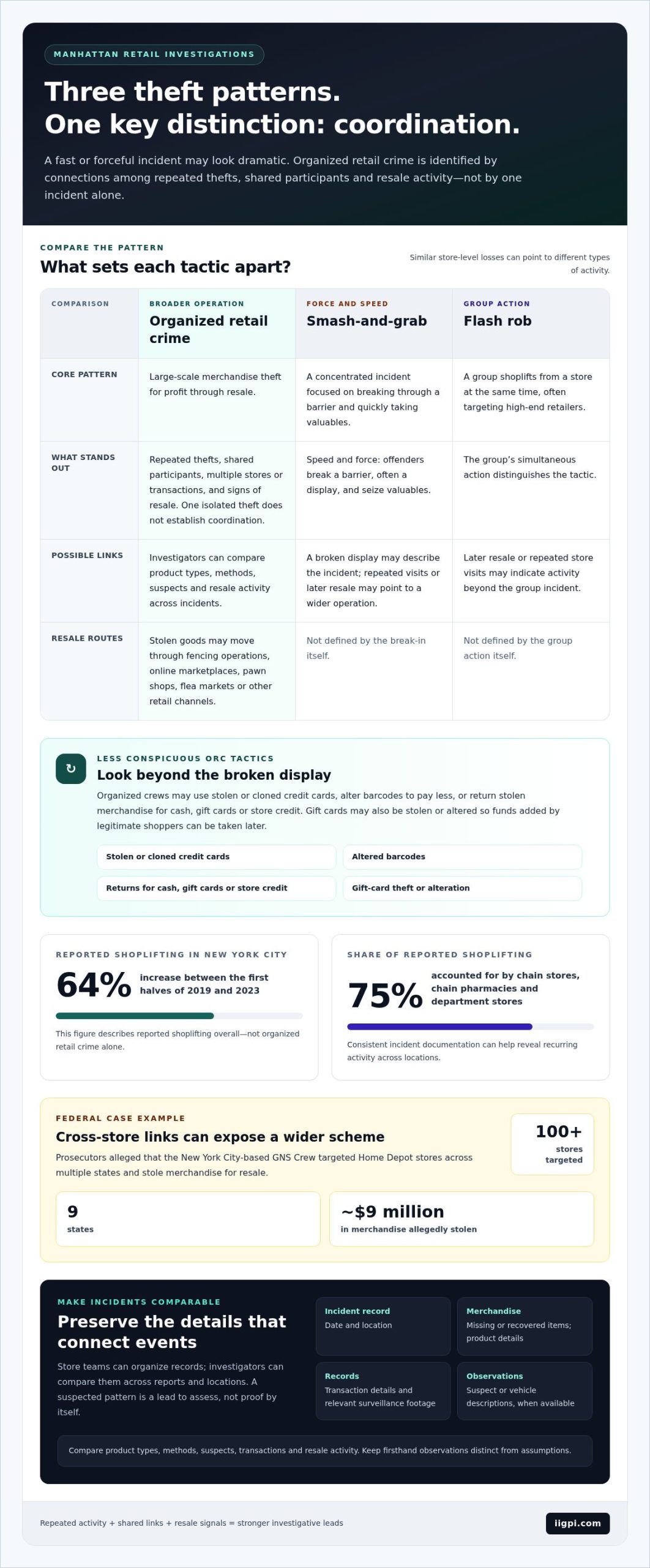
Organized retail crime involves coordinated theft for resale, not simply the speed or force of a single incident. An organized retail crime investigation in Manhattan looks for connections among repeated thefts, the people involved, and the channels used to resell stolen goods. Smash-and-grab theft involves breaking through a barrier to take valuables quickly, while a flash rob involves a group shoplifting from a store at the same time.
These crimes can look similar to retailers: merchandise disappears, staff may face intimidation, and the immediate loss can obscure whether incidents are connected. The distinction matters because evidence of repeated activity and resale may point to a broader operation rather than an isolated event.
This article explains how organized retail theft differs from smash-and-grab and flash-rob crimes, and how investigators can connect store-level evidence to wider patterns. It also covers how retailers and police contribute information and coordinate investigations to identify possible resale routes and clarify suspected tactics in Manhattan.
Key Takeaways
- Look for repeated thefts, shared participants, and resale activity to distinguish a coordinated operation from a one-time store incident.
- Preserve incident records, transaction details, and relevant surveillance footage so investigators can compare events across locations.
- Retailers can strengthen an investigation by organizing evidence and sharing recurring patterns with law enforcement.
- New York charges and penalties depend on the conduct and the applicable offense; understand how the alleged acts shape the legal classification.
- Corporate investigations can help businesses examine suspected internal or external theft patterns, while law enforcement handles criminal investigations.
How organized retail theft differs from smash-and-grab and flash-rob crimes
Retailers can distinguish organized retail crime from ordinary shoplifting by looking for connections among repeated thefts, shared participants, and resale activity. One isolated theft does not establish coordination. Recurring patterns across stores or transactions can provide stronger investigative leads.
Organized retail theft is the large-scale theft of merchandise for profit through resale. Participants may target multiple stores, then move stolen goods through fencing operations, online marketplaces, pawn shops, flea markets, or other retail channels. Investigators can compare product types, methods, suspects, and resale activity to find connections that a single store incident may conceal.
By contrast, smash-and-grab theft centers on speed and force: offenders break a barrier, often a display, and seize valuables. A 2014 smash-and-grab robbery at a Cartier store on East 52nd Street illustrates this concentrated method. A flash rob involves a group shoplifting from a store at the same time, often targeting high-end retailers. The group’s simultaneous action distinguishes the tactic, while evidence of later resale or repeated store visits may point to a wider operation.
Current methods may be less conspicuous than a broken display or a large group entering together. Organized crews may use stolen or cloned credit cards to obtain goods, alter barcodes to pay less, or return stolen merchandise for cash, gift cards, or store credit. Gift cards may also be stolen or altered so funds added by legitimate shoppers can be taken later. Retailers can compare transaction records, returns, barcode discrepancies, and product losses to identify patterns for further investigation.
New York City trends show why store-level patterns matter. Reported shoplifting incidents in the city rose 64% between the first halves of 2019 and 2023. Chain stores, chain pharmacies, and department stores accounted for 75% of reported shoplifting. These figures describe reported shoplifting overall, not organized retail crime alone, but they make consistent incident documentation valuable for detecting recurring activity.
Federal cases show how investigations can connect theft to resale across jurisdictions. Prosecutors alleged that the New York City-based GNS Crew targeted more than 100 Home Depot stores across nine states and stole roughly $9 million in merchandise. The investigation lasted 2½ years and resulted in charges against 13 people last December. In another federal case, a New York man was sentenced to prison for stealing $200k in products from Home Depot and Lowe’s. These examples show how repeated store losses, cross-location links, and resale evidence can help distinguish a coordinated scheme from an isolated theft.
Investigative resources and police-retailer collaboration
Organized retail theft investigations often involve local law enforcement and retail industry personnel. Store teams can provide incident reports, transaction records, product details, and surveillance footage. Police can compare those records with other reports and pursue investigative leads. In a Manhattan organized retail crime investigation, coordination helps connect separate store events without treating a suspected pattern as proof by itself.
Retailers can make their information more useful by recording each incident consistently. Document the date and location, list missing or recovered merchandise, preserve relevant video, and record vehicle or suspect descriptions when available. Investigators can compare these details across stores, identify recurring methods, and assess whether losses may connect to a common resale route. Clear records also separate firsthand observations from assumptions.
The NYPD has said it coordinates with transit officers to catch shoplifters fleeing through subway stations. This cooperation can link a store’s account of an incident with information about a possible escape route. Retailers should promptly share relevant location and timing details with responding officers and avoid direct confrontation that could create further danger.
Manhattan also has a local business coordination channel. The Manhattan District Attorney’s Office created the Manhattan Small Business Alliance in 2022 to help reduce shoplifting and commercial robberies. For retailers, participation in local information-sharing efforts can make recurring patterns visible beyond one storefront. A single business may document an event; combined reports can help identify repeated targeting across a district.
More complex cases can involve law enforcement at several levels. The FBI works with private-sector partners and federal, state, and local law enforcement on cases that meet the federal prosecution threshold. The FBI also receives organized retail theft tips through its tip line, 1-800-225-5324. The Combating Organized Retail Crime Act would establish an Organized Retail and Supply Chain Crime Coordination Center for information sharing among federal, state, and local agencies. That proposal reflects the investigative need to connect evidence across jurisdictions.
A monthslong investigation into a ring accused of stealing millions in cosmetics from Ulta stores and reselling them on Amazon illustrates how investigators may pursue these connections. Retail loss records, product information, and resale activity can help determine whether separate incidents form one operation. Retailers contribute evidence and operational knowledge, while police determine investigative steps and law enforcement agencies coordinate as a case expands. This division of roles can create a clearer account of suspected theft and resale activity.
What is organized retail crime under New York law?
Organized retail crime describes coordinated merchandise theft for financial gain, but the label itself is not a criminal charge. In New York cases, prosecutors may charge conduct under applicable offenses when supported by evidence. A Manhattan case involving Rehana’s Cosmetics illustrates how alleged resale of stolen goods can become central to a prosecution.
Two New Yorkers were charged in Manhattan with possessing stolen goods and reselling them through the business. Bibi Rehana Khan, 54, and Aaron Khan, 40, were each charged with one count of criminal possession of stolen property in the first, second, and third degrees. The allegations concerned possessing more than $1 million in stolen goods for resale through their Midtown Manhattan business.
The alleged merchandise trail supplied context for those charges. About $212,000 of the products allegedly resold by Rehana’s Cosmetics had been stolen from Macy’s. Investigators recovered property filling 450 medium cardboard boxes. The store allegedly contained hundreds of boxes of products not typically found in a beauty store, an inventory detail relevant to examining whether goods came from legitimate supply channels.
For retailers, the distinction is practical: evidence should document both the suspected theft and any connection to possession or resale. Keep records identifying merchandise, dates, locations, and transactions, then preserve materials that may link separate incidents. A recurring pattern can help investigators assess whether thefts connect to a resale operation, while charges depend on the alleged conduct and evidence developed.
Federal law is a separate layer. The Combating Organized Retail Crime Act of 2023 provides for federal charges when organized retail theft reaches or exceeds $5,000 in cumulative value within a 12-month timeframe. That federal threshold should not be confused with the New York charges in the Manhattan case. The two frameworks address different legal routes, and the federal threshold does not, by itself, define a New York offense.
“Organized retail crime” is best understood as an investigative description of coordinated theft and resale, not a substitute for identifying the charged offense. In Manhattan, the Rehana’s Cosmetics allegations show prosecutors focusing on criminal possession of stolen property. The alleged store inventory, claimed Macy’s losses, and quantity recovered helped describe the suspected resale activity.
Retailers documenting a suspected operation can organize information around three questions: what property disappeared, where and when it was taken, and how investigators might trace its later possession or sale. Product identifiers and inventory records, for example, can be compared with recovered goods. Transaction records may help establish when merchandise entered a resale channel. These steps build a clearer evidentiary picture without treating suspicion as a legal conclusion.
Ultimately, New York prosecutions turn on the alleged acts and the charges brought, while a federal case may involve the separate $5,000 cumulative-value threshold. The Manhattan defendants’ charges show how stolen-property possession can feature in a retail-theft prosecution. Retailers should therefore preserve evidence that connects specific goods to specific events and suspected resale activity.
What evidence should retailers preserve for an organized retail crime investigation?
Start a separate incident record for each suspected theft. Include the date, time, store location, affected department, and staff member who reported it. Identify missing products by description, SKU, quantity, and recorded value. If staff observed a vehicle or repeated visits, record those details as observations, not conclusions. A consistent format helps investigators compare incidents across Manhattan locations.
Preserve original surveillance footage from relevant cameras, including entrances, sales floors, checkout areas, and loading points. Record the camera locations and the time range exported, then retain the original files and a working copy. Note any gaps or clock discrepancies. A short clip may omit a suspect’s arrival, route through the store, or exit; surrounding footage can provide that context.
Collect transaction and inventory records related directly to the suspected loss. These may include:
- Point-of-sale logs showing purchases, voids, or unusual transaction patterns.
- Return records documenting merchandise exchanged for cash, gift cards, or store credit.
- Inventory counts, receiving records, and product identifiers that establish stock movement.
- Gift-card activation or balance records relevant to suspected tampering.
- Barcode or price records that help explain a mismatch at checkout.
For each export, note who retrieved it, when, and which system produced it. Keep source files unchanged, restrict access, and document any transfer to investigators. These steps help show where a record came from and whether it changed after collection. If the retailer uses several systems, preserve the matching store, register, and transaction identifiers.
Employee accounts can clarify details that video or system records cannot show. Ask witnesses to write separate, factual notes while events remain clear. Record what each person saw or heard, where they stood, and which details they recognized independently. For example, distinguish a direct observation of a concealed item from a later conclusion based on inventory. Avoid combining several employees’ recollections into one account.
Organize evidence by incident, then create a cross-incident index of dates, products, methods, and locations. If separate Manhattan stores report the same product type or similar transaction behavior, the index can help investigators identify connections. Keep the individual records as well as the comparison sheet, so a pattern does not replace the source material.
Report immediate danger to 911. For non-emergency suspected theft, share the incident records and preserved evidence with law enforcement through the appropriate reporting process. Retailers should avoid confronting suspected offenders or altering records to strengthen a theory. A clear chronology, original files, and specific product details provide a more reliable basis for further investigation.
What are the penalties for organized retail crime and related offenses in New York?
New York penalties depend on the offense charged and the case’s outcome, not simply on the label “organized retail crime.” In Manhattan, two defendants connected to the alleged Rehana’s Cosmetics fencing operation faced criminal-possession-of-stolen-property counts in the first, second, and third degrees. Those charges show how the alleged conduct was framed legally, but an indictment is not a conviction or sentence.
The degree charged matters because it identifies the specific offense prosecutors allege. Retailers should distinguish the value of missing goods from the legal result: recorded losses may inform an investigation, while prosecutors determine charges based on evidence and applicable law. A retailer’s inventory total alone does not establish guilt or determine a final penalty.
Federal exposure follows a separate framework. The Combating Organized Retail Crime Act of 2023 provides for federal charges when organized retail theft reaches or exceeds $5,000 in cumulative value within a 12-month timeframe. That threshold concerns federal charges; it does not state a sentence, replace New York charges, or mean every case meeting the value threshold produces a conviction.
For a Manhattan business, the practical distinction is between a suspected scheme, a filed charge, and a court-imposed penalty. The Rehana’s Cosmetics case involved allegations of stolen goods held for resale, while the defendants faced specified possession counts. The alleged resale operation and the charged offenses are separate facts; neither should be described as a final finding of guilt.
To assess potential consequences in a particular case, identify the exact offense and degree in the charging documents, then distinguish that charge from any federal allegation. Next, separate alleged facts from findings made through the court process. This helps prevent a reported merchandise value or federal threshold from being mistaken for a guaranteed penalty.
Retailers can support accurate case assessment by preserving itemized loss records, transaction data, and evidence connecting goods to specific incidents. These records may help establish the alleged property and its movement, as illustrated by the Rehana’s Cosmetics allegations. They do not determine the charge or sentence. Prosecutors select charges, and the court process determines the outcome under applicable law.
Accordingly, no single penalty applies to every organized retail theft allegation in New York. The relevant factors include the specific offense charged, its degree, the allegations supported by evidence, and whether the case proceeds under state or federal law. The $5,000 federal threshold is a charging rule stated in the Combating Organized Retail Crime Act of 2023, not a sentencing schedule.
International Investigative Group: Corporate Investigations
International Investigative Group conducts Corporate Investigations for businesses examining suspected theft, recurring inventory losses, or concerns that extend beyond a single store incident. Its Theft Investigations can help organizations clarify suspected property losses, while Surveillance Services may be relevant when observation is part of the investigative need. These services complement, rather than replace, police investigation and prosecution.
Consider a private investigation when a business needs an independent review of suspected losses or related concerns, particularly when records indicate a pattern that warrants further inquiry. The appropriate investigative approach depends on the questions and evidence involved. Contact International Investigative Group to discuss your business’s investigation needs, or visit iigpi.com.
Set a Clear Direction for Your Next Step
A suspected pattern of retail theft calls for a deliberate decision about what the business needs to establish next. Identify the operational question, assign responsibility for preserving relevant records, and separate investigative objectives from immediate store-security needs. This gives an organized retail crime investigation in Manhattan a defined business context and keeps internal review focused.
International Investigative Group offers Corporate Investigations and Insurance Investigations for businesses addressing investigative and claim-related concerns, as well as Security and Armed Guards for security needs. These services have distinct purposes, so the next step depends on whether the priority is examining suspected conduct, reviewing an insurance matter, or strengthening on-site protection.
For a confidential discussion of your organization’s investigative needs, contact International Investigative Group. A clear objective is a practical starting point for informed decisions.
Frequently Asked Questions
Which NYPD units investigate organized retail crime in Manhattan?
Local NYPD personnel investigate reported retail theft, with additional coordination when cases involve other jurisdictions or transit routes. The available information identifies NYPD coordination with transit officers but doesn’t name a specific Manhattan unit dedicated to organized retail crime. Retailers should report incidents to the NYPD and share the location, timing, and relevant observations so appropriate personnel can assess them.
How do Manhattan retailers report organized retail theft to the NYPD?
Report an incident directly to the NYPD, and call 911 if anyone faces immediate danger. Provide the store address, incident time, suspected items, and any immediate safety concerns. For a suspected pattern, explain how incidents may connect and identify the locations involved. Keep a record of what was reported and when, so the business can follow up with consistent information.
What are the latest organized retail theft statistics for Manhattan and New York City?
Reported shoplifting incidents in New York City increased 64% between the first halves of 2019 and 2023. Reports of crime within New York City Business Improvement Districts rose 5.3% year over year. These figures cover citywide reporting, not a Manhattan-only count of organized retail theft. Retailers assessing a particular Manhattan district should distinguish local incident records from broader city trends.
Which Manhattan agencies or retail associations help businesses prevent organized retail crime?
The Manhattan District Attorney’s Office created the Manhattan Small Business Alliance in 2022 to help reduce shoplifting and commercial robberies. The National Supermarket Association tracks incidents reported by its 200 New York members, supporting information-sharing among participating businesses. Retailers can use these channels to communicate recurring concerns and prevention needs, while reporting specific suspected crimes to law enforcement.
What steps should a Manhattan retailer take after a coordinated theft?
First, address immediate safety concerns and call 911 if anyone is in danger. Then secure relevant store records, notify the appropriate manager, and report the incident to NYPD. Record the affected merchandise and separate firsthand staff observations from assumptions. If other locations report related incidents, compare dates and product details, then share the potential connection with investigators without treating a suspected pattern as proof.