
What if a consequential risk in a promising deal is information that never appears in the data room? For due diligence for private equity firms nyc, financial models and legal review are essential, but they may not resolve questions about beneficial ownership, executive relationships, reputation, or how a target operates in practice. Incomplete or inconsistent disclosures can leave investment teams weighing material uncertainties as a transaction advances.
Independent investigative due diligence can complement a firm’s financial, legal, and commercial advisers by examining people, entities, reputational concerns, assets, and potential inconsistencies. It does not replace professional advice or guarantee that every risk will be found. Instead, it provides another evidence-based perspective before an investment decision is made. This guide explains what New York private equity teams may investigate, when corporate investigations can add value, and how to set a proportionate, discreet scope for a transaction. It also explains how findings can help decision-makers identify red flags and determine which questions warrant further review.
Key Takeaways
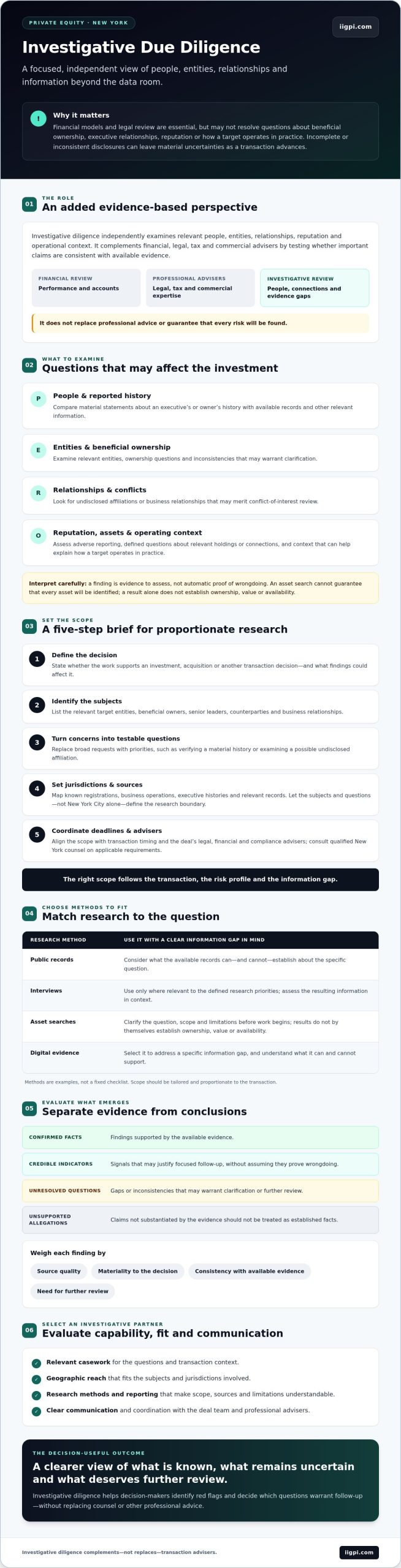
- Investigative diligence complements financial, legal, tax, and commercial reviews by examining people, entities, relationships, reputation, and operational context.
- For due diligence for private equity firms nyc, define the decision, subjects, research questions, jurisdictions, and deadlines before setting the scope.
- Match research methods to specific information gaps, and understand what public records, interviews, asset searches, and digital evidence can and cannot establish.
- Assess findings by separating confirmed facts from credible indicators, unresolved questions, and unsupported allegations, then weigh source quality and materiality.
- Evaluate an investigative partner’s relevant casework, geographic reach, research methods, reporting practices, and communication. Verify applicable requirements with qualified New York counsel.
What due diligence for private equity firms in NYC should uncover
Investigative due diligence is the independent examination of people, entities, relationships, reputation, and relevant operational context to assess material questions that could affect a private equity transaction. For due diligence for private equity firms nyc, it adds an investigative perspective to the deal team’s existing review rather than replacing it. Financial analysis evaluates performance and accounts, while tax, legal, and commercial advisers address their respective areas of expertise. Investigative work focuses on whether important claims about a target and its associated parties are consistent with available evidence.
The broader concept of Due diligence informs transaction review, but investigative scope should be tailored to the decision at hand. A buyout, minority investment, or acquisition may raise different questions. The appropriate work depends on the transaction, the available information, the risk profile, and guidance from the deal’s professional advisers.
Which risks can investigative due diligence help assess?
Research may identify undisclosed affiliations, inconsistencies in an executive’s or owner’s reported history, adverse reporting, or relationships that warrant conflict-of-interest review. Background investigations can test material statements by comparing them with available records and other relevant information. A finding should be assessed as evidence, not treated as automatic proof of wrongdoing.
Asset research can help examine a defined question about a person or entity, such as whether available information indicates relevant holdings or connections. The research question and sources matter: an asset search cannot guarantee that every asset will be identified, and a result alone does not establish ownership, value, or availability. Clarify the scope and limitations before the work begins.
Where investigative research fits in a New York deal
In a New York transaction, investigators can complement counsel, accountants, compliance teams, and commercial diligence providers by pursuing specific questions that document review may leave unresolved. For example, if information about a key counterparty appears inconsistent, targeted background research may help the investment team decide whether to request clarification or pursue further review. Counsel remains responsible for legal advice. Investigative findings can inform that advice, but cannot replace it.
New York City may be the deal’s center of activity, but it should not define the research boundary by itself. A target, executive, beneficial owner, or relevant record may have connections elsewhere in the United States or internationally, so the jurisdictional scope should follow the subjects and questions. Where indicators raise concerns about possible misconduct, teams can consult a corporate fraud investigation guide and coordinate next steps with qualified counsel. A focused scope helps distinguish material leads from issues that do not bear on the investment decision.
How to scope private equity due diligence in New York
A focused scope begins with the investment decision, not a generic checklist. For due diligence for private equity firms nyc, the aim is to direct research toward material exposures and information gaps while coordinating with the deal’s legal, financial, and compliance advisers. A broader overview of due diligence can help frame the overall review, while investigative work addresses questions about people, relationships, and information that call for independent examination.
Set research questions, subjects, and boundaries
Use a defined sequence to commission proportionate research:
- Define the decision. Specify whether the work supports an investment, acquisition, or another transaction decision, and identify what findings could affect it.
- Identify the subjects. List target entities, beneficial owners, senior leaders, counterparties, and business relationships relevant to the concerns raised.
- Translate concerns into questions. Replace broad requests such as “check the executive” with testable priorities, such as verifying a material history or examining a potential undisclosed affiliation.
- Set jurisdictions and sources. Map known entity registrations, business operations, executive histories, and other relevant connections. A New York link does not mean every subject or record is local. Connections across states or borders may call for a wider scope.
- Agree on deadlines and controls. Set reporting milestones, confidentiality expectations, authorization, permitted sources, and escalation contacts before research begins.
Prioritize according to deal exposure and information gaps, rather than relying on a fixed checklist. If an ownership structure is unclear, ownership-related questions may deserve early attention. If executive disclosures conflict with source material, the scope can focus on those discrepancies. Counsel should guide legal questions, permissible methods, and transaction-specific compliance requirements.
Coordinate sources and professional advisers
Public records and documents supplied during diligence can generate useful leads, but a single record rarely answers every question. Researchers should consider context, identity matching, recency, and corroboration, then communicate relevant findings in a form counsel and financial advisers can assess alongside their own analysis. Investigative findings do not replace legal, accounting, or commercial conclusions.
If initial work raises a credible concern about suspected misconduct, consult counsel before expanding the inquiry and consider the corporate fraud investigation guide as a separate reference. To discuss a focused investigative due diligence scope, review International Investigative Group corporate investigation resources.
What investigative methods add value beyond standard deal diligence?
Standard deal materials provide an essential starting point, but they may not resolve whether a person has been correctly identified, an account is current, or conflicting statements have a credible explanation. In due diligence for private equity firms nyc, select investigative methods to answer defined questions, then corroborate and interpret findings in context. Public records can reveal leads, but a record alone may not establish identity, intent, or the full circumstances behind an event.
Methods serve different purposes and have distinct limitations. None should be treated as conclusive in isolation.
| Investigative question | Suitable method | What it may reveal | Limitation |
|---|---|---|---|
| Do an executive’s or owner’s reported history and affiliations appear consistent? | Background and public-record research | Potentially relevant business affiliations, litigation indicators, or discrepancies for further review | Similar names, incomplete records, and outdated information can lead to mistaken or incomplete conclusions. |
| Does a specific account of events need clarification? | Interviews, where appropriate | Additional context, explanations, or leads to corroborating sources | Accounts may be incomplete or conflicting and require independent verification. |
| Is there a defined question about a person’s or entity’s assets? | Scoped asset research | Information relevant to the stated transaction question | It cannot guarantee that every asset will be located or independently establish ownership, value, or availability. |
| Do relevant devices or records require specialist examination? | Computer forensics | Digital evidence within the authorized scope of a review | Findings depend on the material available, the scope, and appropriate interpretation. They do not by themselves prove misconduct. |
When background and reputational research is useful
Background research may help examine executives, owners, counterparties, business affiliations, litigation indicators, and adverse reporting. A search result is not automatically a verified fact. Allegations, outdated reporting, and uncorroborated online claims require careful qualification. Researchers should distinguish people and entities with similar names and check that a source relates to the correct jurisdiction, time period, and subject before drawing conclusions.
When asset searches or computer forensics may be relevant
Asset research is most useful when it addresses a defined transaction concern and remains within an authorized, lawful scope. Computer forensics may be appropriate when relevant devices or records require specialist examination. The scope and available evidence shape what can be concluded. For more technical background, readers can consult a computer forensics guide. Digital review is not necessary or appropriate for every deal.
How NYC private equity teams can evaluate findings and manage diligence risk
A finding should inform a decision only to the extent that its source, reliability, and relevance can be assessed. For due diligence for private equity firms nyc, teams can classify each item as a confirmed fact, a credible indicator requiring further review, an unresolved question, or an unsupported allegation. This framework helps prevent an unverified report from being treated as established fact, while ensuring that material uncertainties are not mistaken for cleared issues.
Assess evidence quality before acting on a red flag
For each finding, trace the conclusion to its source material and assess whether the information is current, relevant to the transaction, and independently corroborated. Confirm that identities, entities, and timelines match the subject under review. For example, a dated report about a person with a similar name may justify a verification step, but it should not be attributed to an executive without reliable identity matching. Reporting should also state what the evidence does not establish.
Separate investigative observations from legal conclusions and investment recommendations. Investigators can document sources, discrepancies, and limitations. Counsel can assess legal questions, while the investment team determines materiality in light of the transaction. A useful review asks whether the information could affect the decision, whether further corroboration is practicable, and whether an unresolved issue should be escalated or monitored.
Protect confidentiality and keep deal decisions proportionate
Before sensitive research begins, agree how findings will be delivered, stored, and shared. Identify authorized recipients and escalation contacts, and limit circulation to those who need the information for the transaction. If a finding raises a potential legal issue, dispute, or question about permissible use, coordinate next steps with transaction counsel rather than making assumptions about applicable New York requirements.
Escalation should be proportionate to the evidence and potential deal impact. A verified material discrepancy may warrant prompt review by counsel and the investment committee. An uncorroborated allegation may call for careful validation before it influences the process. This disciplined approach preserves context and keeps uncertainty distinct from fact. For further context on investigator roles, review the private investigator overview.
Choosing an NYC investigative partner for private equity due diligence
Selecting an investigative partner requires more than confirming that a firm conducts background research. For due diligence for private equity firms nyc, assess whether the provider can translate a transaction concern into a defined scope, explain the basis and limits of its methods, and communicate findings in a form the deal team can evaluate alongside advice from its other professionals.
Questions to ask before engaging an investigative firm
Before authorizing work, ask how the firm will approach the specific diligence question and what evidence it expects to examine. Clarify how it verifies identities, handles conflicting or incomplete information, and distinguishes documented findings from unconfirmed leads. Ask how research limitations will be recorded so the team understands what a report can and cannot support.
Also confirm the proposed methods and jurisdictions, confidentiality arrangements, reporting format, deadlines, and primary points of contact. Ask about relevant corporate investigation experience and how the firm coordinates with transaction counsel when questions arise. Verify the provider’s current licensing and applicable New York requirements with qualified counsel. A provider-selection discussion is not legal guidance.
How IIG can complement a private equity diligence team
International Investigative Group is based in New York City and offers corporate investigations and due diligence, as well as background investigations, asset searches, and computer forensics. These services can complement a private equity team’s existing advisers by addressing defined investigative questions about people, entities, relationships, or information gaps. The firm has a global network of agents, which may be relevant when a transaction has connections beyond New York. This does not mean the firm operates international branch offices.
International Investigative Group reports more than 30 years of experience and over 10,000 cases solved. A prospective client can ask how the firm would scope a particular matter, which sources and methods may be appropriate, and how uncertainties would be communicated. Investigative work can inform a decision, but it cannot guarantee that every risk will be identified or prevent investment losses.
To discuss a defined diligence question, contact IIG about investigative due diligence and outline the transaction context, subjects, information gaps, and timing considerations.
Make the Next Deal Decision with Greater Clarity
Investigative diligence can extend a transaction review beyond financial and legal documents by examining people, entities, relationships, reputation, and specific information gaps. Its value depends on a proportionate scope, careful corroboration, and clear distinctions between confirmed facts, credible indicators, and unresolved questions. For due diligence for private equity firms nyc, these practices help teams evaluate potential risks without treating an investigation as a substitute for professional advice or a guarantee against loss.
International Investigative Group is a New York City-based private investigation firm offering corporate investigations and due diligence. Its investigative services can help deal teams examine defined questions that remain after other diligence workstreams.
For a focused discussion about investigative questions in your transaction, discuss investigative due diligence for your transaction.
Frequently Asked Questions
What does due diligence for a private equity firm include?
Private equity due diligence assesses whether a proposed investment aligns with the firm’s expectations and risk tolerance. It commonly includes financial, tax, legal, commercial, and operational review, with investigative research added when questions about people, ownership, relationships, reputation, or assets remain. The scope depends on the deal and the information available. In NYC transactions, due diligence for private equity firms nyc may also examine subjects and records connected to other jurisdictions.
Why would a private equity firm hire an investigator in NYC?
A private equity firm may engage an investigator to independently examine material questions that document review alone has not resolved, such as an executive’s reported history, a beneficial owner’s affiliations, or inconsistencies in information supplied by a counterparty. An NYC-based investigator may be relevant to a New York-centered transaction, while the research scope can extend to other jurisdictions when the subjects or records require it. Findings can complement, but not replace, advice from deal professionals.
How is investigative due diligence different from financial due diligence?
Financial due diligence assesses financial information, such as reported performance, accounts, and earnings. Investigative due diligence focuses on people, entities, relationships, reputation, and other defined questions that may affect a transaction. For example, financial review may analyze a target’s revenue, while investigative research may examine whether a key executive’s disclosed affiliations appear consistent with available sources. Both can inform investment decisions, but neither should be treated as a substitute for the other.
Can public records alone provide sufficient private equity due diligence?
Public records can provide valuable leads, but they may not establish identity, context, recency, or the meaning of a reported event. Similar names can be confused, records may be incomplete, and a single filing may not resolve conflicting accounts. Depending on the question, teams may need corroboration through additional source material or other appropriate methods. Report findings with their evidentiary basis and limitations rather than treating them as conclusive on their own.
What red flags should private equity firms investigate before an acquisition?
Potential red flags include inconsistencies in an executive’s or owner’s stated history, undisclosed affiliations, possible conflicts of interest, adverse reporting, unclear ownership information, or discrepancies across target disclosures and available records. These are prompts for verification, not proof of misconduct. Teams should assess identity, source reliability, recency, corroboration, and transaction relevance before escalating a concern. Qualified counsel should guide legal questions and decisions about how to respond to a finding.
How long does investigative due diligence take for a private equity deal?
There is no fixed timeline for investigative due diligence. Duration depends on the questions, number of subjects, jurisdictions, available records, and transaction deadlines. Agree on priorities, reporting milestones, and escalation contacts with the investigative provider and deal advisers at the outset. If new questions arise or the scope changes, revisit the plan with the deal team so the work remains focused on the investment decision.
Is investigative due diligence a substitute for legal or financial diligence?
No. Investigative due diligence complements rather than replaces legal, financial, tax, or commercial review. Investigators can research defined questions and document findings, sources, and limitations. Counsel and other professional advisers assess matters within their respective expertise. For example, investigative research may identify a discrepancy that warrants legal review or further financial analysis. Coordinating these workstreams helps the investment team assess issues in context without treating investigative findings as legal conclusions or investment recommendations.