
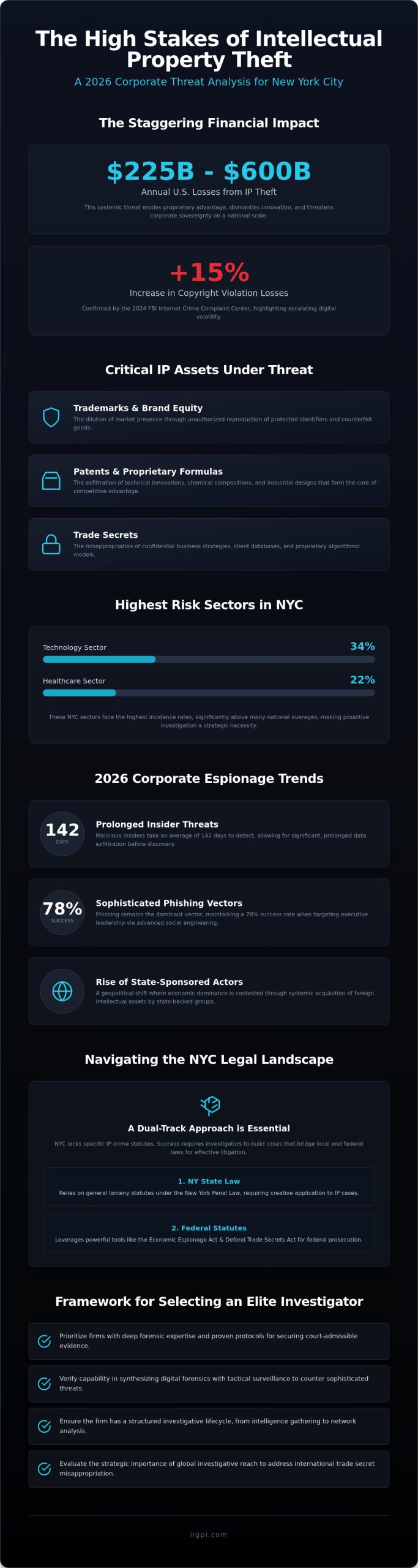
With annual domestic losses attributed to intellectual property theft now estimated between $225 billion and $600 billion, the erosion of proprietary advantage has evolved from a localized risk into a systemic threat to corporate sovereignty. The 2024 FBI Internet Crime Complaint Center findings corroborate this volatility, noting a 15% increase in losses related to copyright violations. Organizations operating within the high-stakes environment of New York City recognize that the unauthorized dissemination of trade secrets or the proliferation of counterfeit goods can dismantle decades of institutional innovation within weeks. Selecting a premier intellectual property theft investigation firm nyc is no longer a peripheral administrative task; it’s a core strategic imperative for safeguarding global market positions.
This comprehensive 2026 selection guide provides an authoritative framework for evaluating and selecting an elite investigative partner to mitigate corporate espionage and trade secret misappropriation effectively. We acknowledge the profound difficulty in securing court-admissible evidence while facing sophisticated insider threats and global distribution networks. This analysis previews the critical synthesis of advanced digital forensics, former law enforcement expertise, and tactical surveillance required to navigate the jurisdictional complexities of the New York Penal Law and federal statutes. Readers will gain the analytical tools necessary to identify firms capable of transforming abstract vulnerabilities into actionable intelligence and definitive legal resolution.
Key Takeaways
- Identify the systemic vulnerabilities within the New York corporate landscape and the critical taxonomy of intellectual property assets requiring protection.
- Establish a robust framework for evaluating an intellectual property theft investigation firm nyc by prioritizing forensic expertise and court-admissible evidence protocols.
- Comprehend the multi-disciplinary synthesis of digital forensics and tactical surveillance essential for identifying unauthorized data exfiltration.
- Analyze the lifecycle of an elite investigation, ensuring a structured progression from initial intelligence gathering to comprehensive network analysis.
- Evaluate the strategic importance of global investigative reach in addressing the international dimensions of modern trade secret misappropriation.
The Escalation of Intellectual Property Theft in the New York Corporate Ecosystem
The concentration of intellectual capital within the New York financial and technological sectors has transformed proprietary data into the primary currency of institutional power. As global markets become increasingly digitized, the escalation of intellectual property theft represents a fundamental threat to corporate valuation and competitive advantage. This taxonomy of infringement encompasses several critical domains that require rigorous oversight:
- Trademarks and Brand Equity: The dilution of market presence through the unauthorized reproduction of protected identifiers.
- Patents and Proprietary Formulas: The exfiltration of technical innovations, chemical compositions, and industrial designs.
- Trade Secrets: The misappropriation of confidential business strategies, algorithmic models, and high-value client databases.
The transition from traditional physical document theft to sophisticated digital exfiltration has introduced unprecedented systemic risks. Research indicates that approximately 38% of global firms experienced IP theft or infringement within a single twelve-month period. For organizations in the NYC technology and healthcare sectors, which face the highest incidence rates at 34% and 22% respectively, the long-term erosion of market position is catastrophic. Engaging an elite intellectual property theft investigation firm nyc is essential to mitigate these vulnerabilities before they manifest as irreversible losses in institutional valuation.
The Legal Landscape: NYC Jurisdictional Nuances
New York’s legal framework presents unique challenges, as the state lacks specific statutes for intellectual property crimes, relying instead on general larceny laws under the New York Penal Law. Consequently, successful mitigation often necessitates a dual-track approach involving federal statutes like the Economic Espionage Act and the Defend Trade Secrets Act. An expert intellectual property theft investigation firm nyc plays a pivotal role in this ecosystem by securing court-admissible evidence that bridges the gap between internal discovery and criminal referral. NYC remains a primary target for international espionage due to its role as a global nexus for capital and innovation, requiring investigators to possess deep familiarity with both local jurisdictional nuances and federal evidentiary standards. Firms like International Investigative Group provide the forensic rigor necessary to support complex civil litigation in these high-stakes environments.
Current Trends in Corporate Espionage (2026)
Specialized Investigative Methodologies: Synthesizing Digital Forensics and Tactical Surveillance
Advanced Computer Forensics in IP Matters
Advanced computer forensics plays a decisive role in recovering fragmented data and analyzing the provenance of stolen digital assets. Modern IP theft frequently involves sophisticated obfuscation techniques, including the use of encrypted messaging platforms and the strategic deletion of exfiltration logs. Specialist investigators utilize Computer Forensics for Corporate Investigations to scrutinize server logs and establish a definitive timeline of unauthorized access. These critical evaluation criteria for forensic rigor are essential when presenting findings to federal prosecutors or civil courts.
Tactical Surveillance and Undercover Operations
Despite the dominance of digital attack vectors, the physical components of IP theft remain a critical vulnerability for illicit actors. Implementing a Professional Surveillance Services Guide allows organizations to identify clandestine manufacturing sites or distribution hubs within the New York metropolitan area. Undercover operations, including controlled “buys” of suspected counterfeit goods, serve to establish the chain of custody and verify trademark infringement in real-time. This “boots-on-the-ground” approach complements cyber-intelligence by providing visual and physical proof of misappropriation that digital records alone can’t provide.
The efficacy of these methodologies depends on their seamless integration. Tracing a digital “fingerprint” to a specific physical location requires a level of coordination found only in an elite intellectual property theft investigation firm nyc with deep operational roots. For entities requiring this level of sophistication, engaging with a firm like International Investigative Group ensures that every facet of the investigation adheres to the highest standards of forensic integrity and tactical precision.
Critical Evaluation Criteria for Selecting an IP Theft Investigation Firm in NYC
Selecting an elite intellectual property theft investigation firm nyc requires a discerning analysis of institutional pedigree and technical rigor. While many boutique agencies offer localized surveillance, the complexity of modern trade secret misappropriation demands a partner capable of navigating the high-stakes environment of corporate litigation. Decision-makers must prioritize firms that demonstrate a synthesis of investigative intuition and forensic precision. This selection process is not merely an administrative exercise; it’s a strategic safeguard for an organization’s most valuable intangible assets.
Institutional Credibility and Experience
A firm’s history in the New York metropolitan area serves as a primary indicator of its operational efficacy. Organizations should seek institutions founded by former law enforcement professionals, as this background ensures an innate understanding of the evidentiary standards required for criminal referrals and civil proceedings. For instance, International Investigative Group leverages over 30 years of local NYC history and a track record of solving over 10,000 cases globally. This experience includes managing complex matters such as $120 million bank fraud investigations, which demonstrates the level of sophistication necessary to confront elite corporate espionage actors. Credibility is established through decades of successful outcomes, not just technical certifications.
Forensic Standards and Reporting
The utility of any investigative finding is entirely dependent on its court-admissibility. An elite intellectual property theft investigation firm nyc must adhere to stringent chain of custody protocols to ensure that digital and physical evidence remains untainted. This rigor aligns with the standards set by the National Intellectual Property Rights Coordination Center, which emphasizes the necessity of collaborative, high-standard enforcement. Beyond the collection of data, the ability to provide expert witness testimony is a critical differentiator. Objective, detailed reporting serves as the foundation for executive review and enables external legal counsel to build a robust case for litigation. If a firm’s reporting cannot withstand the scrutiny of a federal judge, its investigative efforts are effectively nullified.
Global Reach and Strategic Alignment
Modern IP theft rarely remains confined within municipal borders. A significant portion of misappropriation involves international actors, making a global network of agents a mandatory requirement for any NYC-based firm. The capacity to trace stolen assets across multiple jurisdictions transforms a local investigation into a comprehensive global recovery effort. Furthermore, the chosen firm must demonstrate strategic alignment with the client’s external legal team. This interface ensures that investigative initiatives directly support the broader litigation strategy, providing a seamless transition from intelligence gathering to legal resolution. Choosing a firm that operates at this level of macro-scale analysis is essential for mitigating the systemic risks posed by global counterfeit networks.
The Lifecycle of a Sophisticated Intellectual Property Investigation
The operational efficacy of an elite intellectual property theft investigation firm nyc is defined by a rigorous, four-phase methodology that transforms raw suspicion into verified, actionable intelligence. This lifecycle avoids the pitfalls of ad-hoc detection by adopting an institutionalized framework designed to withstand the highest levels of judicial scrutiny. A structured approach is mandatory for preserving the integrity of proprietary assets while maintaining corporate stability. Each phase builds upon the previous to ensure that the final evidentiary package is both technically sound and contextually complete.
Strategic Intelligence and Scoping
Phase 1 initiates with a meticulous risk assessment to establish the parameters of the exfiltration event and identify specific threat actors. Developing a non-disruptive investigative plan is essential during this stage; it’s critical that the pursuit of truth doesn’t alert malicious insiders or compromise the firm’s operational continuity. This preliminary scoping phase aligns with the principles found in The Definitive Guide to Corporate Fraud Investigation, which emphasizes the necessity of preserving the element of surprise. By defining the taxonomy of the assets at risk early, investigators can tailor their forensic tools to the specific digital or physical vulnerabilities identified.
Phase 2 transitions the inquiry into the technical domain of network analysis and digital forensics. Investigators scrutinize unauthorized access points and metadata to reconstruct the sequence of misappropriation across encrypted communications and server logs. Simultaneously, Phase 3 commences tactical field operations, where the investigation moves from digital environments to the physical world. This includes covert surveillance of distribution nodes and the identification of illicit manufacturing facilities within the NYC metropolitan area. The synthesis of these two phases provides a comprehensive view of the infringement lifecycle, from the initial data breach to the commercialization of stolen ideas.
Evidence Synthesis and Court Readiness
Phase 4 focuses on the final synthesis, documentation, and legal support required for a successful resolution. Maintaining a pristine chain of custody for all digital and physical evidence is non-negotiable. If the evidence isn’t handled with forensic rigor from the moment of collection, it won’t survive the scrutiny of a federal judge. Elite firms don’t just hand over a file; they provide a definitive roadmap for litigation. This transition from investigative findings to an actionable legal strategy ensures that the organization is prepared for civil seizure orders or criminal prosecution.
The final objective of this lifecycle is to restore institutional sovereignty. For entities requiring a structured response to proprietary breaches, consult with the specialists at International Investigative Group to secure your institutional assets. Engaging a premier intellectual property theft investigation firm nyc ensures that your investigation is conducted with the professional gravity required to achieve a definitive legal outcome.
International Investigative Group: A Paradigm of Global Intelligence and Local NYC Expertise
International Investigative Group (IIG) represents the institutional pinnacle of specialized inquiry, functioning as the definitive intellectual property theft investigation firm nyc for entities requiring elite tactical and intellectual rigor. Founded by former law enforcement professionals, the firm transcends the limitations of conventional detective agencies by operating as a research-driven institution with over 30 years of operational history in the New York metropolitan area. This extensive tenure has facilitated the successful resolution of over 10,000 complex cases, including the mitigation of high-stakes bank fraud exceeding $120 million. The organization’s foundational expertise ensures that every investigative initiative is conducted with the forensic precision necessary for absolute court-admissibility.
Comprehensive Corporate Solutions
The firm’s value proposition is centered on the seamless integration of multi-disciplinary functions, including advanced computer forensics, asset searches, and comprehensive due diligence. This holistic approach allows NYC’s premier legal and financial institutions to address proprietary breaches within a broader framework of corporate risk management. By synthesizing digital evidence with traditional investigative techniques, IIG provides a robust defense against the sophisticated methods employed by modern economic actors. The depth of this institutional knowledge is particularly relevant for organizations facing systemic threats that require more than a localized response. It’s this capacity for high-value fraud mitigation that has solidified the firm’s reputation among global decision-makers.
Global Reach, Local Impact
In an era of borderless economic activity, the capacity to trace misappropriated intellectual assets across international jurisdictions is a strategic necessity. IIG leverages an extensive global network of agents, allowing for a seamless transition from Manhattan-based surveillance to international asset recovery. This macro-level perspective ensures that NYC firms aren’t constrained by geographic boundaries when pursuing justice for trade secret theft. The ability to coordinate investigations across every major global market positions the firm as a critical partner for organizations with international footprints. For those seeking a confidential assessment of their current vulnerabilities, consulting with International Investigative Group provides access to the world-class intelligence required to protect institutional sovereignty.
Safeguarding Institutional Sovereignty in an Era of Global Misappropriation
The preservation of proprietary advantage within the New York corporate ecosystem necessitates a transition from reactive security measures to a proactive, research-driven investigative paradigm. Identifying the digital fingerprints of exfiltration while verifying the physical distribution of counterfeit assets requires a sophisticated synthesis of computer forensics and tactical field operations. Selecting an elite intellectual property theft investigation firm nyc isn’t merely a tactical choice; it’s a strategic necessity for maintaining institutional valuation and competitive dominance in a volatile global market.
Organizations must prioritize partners that possess a foundation in law enforcement and a demonstrated capacity for managing cross-border complexities through an extensive global network. With over 30 years of localized NYC expertise and a record of solving more than 10,000 cases, International Investigative Group provides the intellectual and tactical rigor required to navigate these high-stakes challenges. Adopting a structured investigative lifecycle ensures that your firm can transform abstract vulnerabilities into definitive legal resolution and institutional security. Secure Your Intellectual Assets with the Elite NYC Investigative Firm to ensure your proprietary innovations remain protected and your market position remains unassailable.
Frequently Asked Questions
What are the primary indicators that my NYC firm is a victim of intellectual property theft?
Primary indicators include the sudden appearance of identical products in emerging markets and the unexplained loss of high-value competitive bids to rivals. Organizations often observe anomalous network traffic originating from internal workstations or a precipitous decline in institutional valuation following the departure of key technical personnel. These disruptions suggest that proprietary formulas or trade secrets have been exfiltrated for unauthorized commercial use.
How does a private investigation firm ensure evidence is admissible in NYC courts?
Ensuring evidence remains admissible involves the rigorous application of forensic protocols and the maintenance of a comprehensive chain of custody. Specialist firms utilize verified technical methodologies that align with the evidentiary standards of the New York Penal Law. By documenting every stage of the investigative lifecycle, investigators provide a pristine record that withstands the scrutiny of federal judges and defense counsel during litigation.
What is the difference between a cyber security firm and an IP theft investigation firm?
Cybersecurity entities prioritize the implementation of defensive software and network hardening to prevent unauthorized access. Conversely, an intellectual property theft investigation firm nyc focuses on attribution, the recovery of stolen assets, and the generation of court-admissible intelligence through tactical surveillance. While cybersecurity is a preventative measure, investigative firms provide the tactical rigor required for legal recovery and institutional resolution after a breach occurs.
Can an investigation firm help recover trade secrets that have been moved overseas?
Recovery of trade secrets exfiltrated across international borders is achievable through the deployment of a global agent network. These operatives conduct cross-jurisdictional tracing to identify illicit distribution hubs and facilitate legal recovery efforts in foreign markets. This macro-level approach ensures that NYC firms aren’t constrained by geographic boundaries when pursuing justice for the systemic misappropriation of their intellectual capital.
How long does a typical intellectual property theft investigation take in NYC?
The duration of a sophisticated inquiry is contingent upon the complexity of the exfiltration event and the geographic distribution of the actors involved. While preliminary intelligence gathering and risk assessment may conclude within several weeks, comprehensive network analysis and tactical field operations often require months. This measured rhythm is necessary to ensure the collection of definitive evidence that can support high-stakes corporate litigation.
Is it possible to conduct an IP theft investigation without alerting the suspect?
Conducting an inquiry without alerting the target is a standard operational requirement achieved through non-disruptive computer forensics and covert tactical surveillance. Maintaining institutional stability during the intelligence-gathering phase is essential to prevent the suspect from destroying evidence or accelerating data exfiltration. This element of surprise allows an intellectual property theft investigation firm nyc to secure critical data before the perpetrator can implement obfuscation techniques.
What role does computer forensics play in identifying an internal IP thief?
Computer forensics serves as the primary mechanism for attribution by scrutinizing metadata, server logs, and encrypted communications to identify internal misappropriation. This technical rigor allows investigators to reconstruct the digital timeline of a breach with absolute precision, even if files have been deleted or encrypted. Such findings are essential for establishing the intent and scope of the theft during subsequent legal proceedings.
How should a legal team integrate a private investigator into their IP protection strategy?
Legal teams should integrate private investigators at the inception of a suspected breach to ensure that all evidence is collected in a manner that supports the broader litigation strategy. This collaboration facilitates the seamless transition from investigative findings to civil seizure orders or criminal referrals. By involving investigators early, counsel can ensure that the technical data gathered aligns perfectly with the requirements of federal and state statutes.