
What if the deal documents are accurate but still leave important questions unanswered? A search for “mergers and acquisitions due diligence investigator nyc” often starts with a concern about whether a target’s principals, ownership, and business relationships stand up to scrutiny beyond the records provided for review. Investigative due diligence can examine whether those records align with other available information.
Financial and legal reviews are essential, but they may not answer every question about reputation, affiliations, or reported business history. A focused investigation can complement those reviews by examining relevant people and companies, with research coordinated across local or international sources where appropriate.
This 2026 guide explains what an investigative due diligence professional may assess before an acquisition, how the work can complement financial and legal analysis, and what to discuss when defining an engagement. It also offers a framework for evaluating a New York City firm’s corporate investigation experience, so decision-makers can identify relevant reputational, operational, and relationship questions before closing.
Key Takeaways
- A mergers and acquisitions due diligence investigator nyc can assess whether information about principals, companies, and business relationships aligns with available evidence.
- Defining the deal questions and scope helps focus research on buyer priorities and transaction milestones.
- Potential inquiries may involve people, entities, relationships, reputation, and assets. A question or inconsistency is not proof of wrongdoing.
- Compare investigators by corporate experience, geographic reach, communication, research scope, and reporting.
- International Investigative Group has corporate investigation experience and a global network of agents. Neither guarantees a particular finding.
What an M&A Due Diligence Investigator in NYC Examines
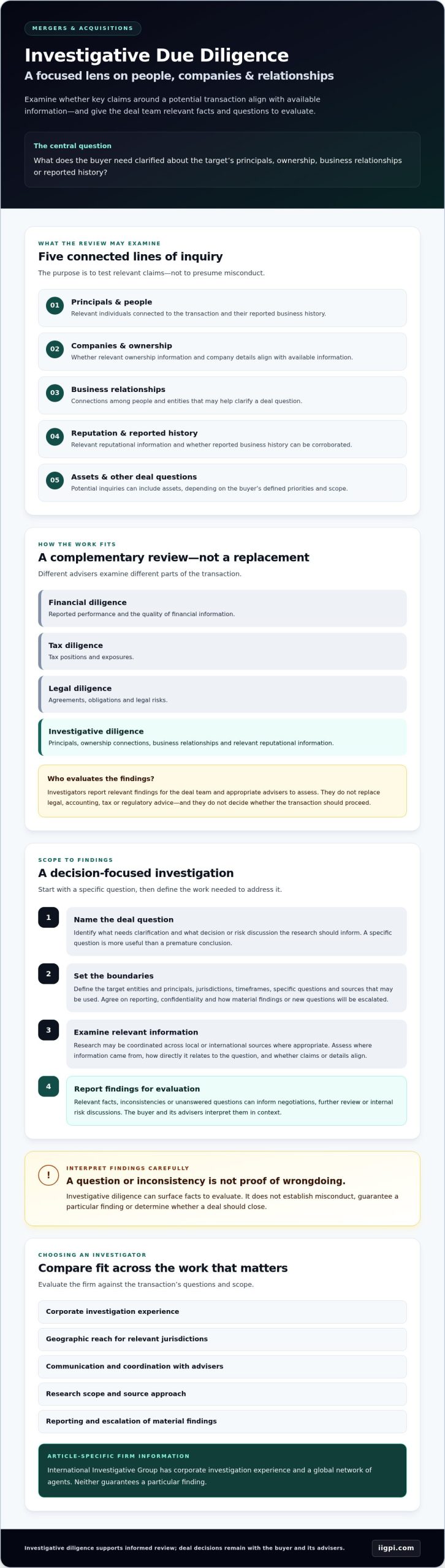
Investigative due diligence examines people, companies, relationships, and reputation to assess whether claims surrounding a potential transaction align with available information. It complements the broader due diligence process by addressing questions that financial statements and transaction documents may not answer on their own.
Financial diligence examines reported performance and the quality of financial information. Tax diligence considers tax positions and exposures, while legal diligence reviews agreements, obligations, and legal risks. Investigative work may look at a company’s principals, ownership connections, business relationships, and relevant reputational information. Its purpose is not to presume misconduct, but to identify facts, inconsistencies, or unanswered questions for the deal team to evaluate.
For a buyer searching for a “mergers and acquisitions due diligence investigator nyc,” the key question is what additional information an investigation may help clarify. Findings can inform negotiations, further review, or internal risk discussions, but they do not determine whether a transaction should proceed. That decision belongs to the buyer and its advisers.
How investigative diligence complements deal advisers
Each adviser brings a different perspective. Accountants may assess a discrepancy in reported revenue, attorneys may identify an unclear ownership representation, and a deal team may notice that a principal’s account differs from the transaction materials. An investigator can examine a defined factual question and report relevant findings for the appropriate adviser to assess. Investigators do not replace legal, accounting, tax, or regulatory advice.
A useful referral point is a specific question, not a premature conclusion. For example, a named entity may appear in a relationship that was not disclosed, ownership details may seem incomplete, or a principal’s reported business history may need clarification. The buyer should identify the concern and consult its advisers about what additional information would be useful before authorizing research.
When a buyer may need an NYC investigator
Consider a hypothetical acquisition involving principals unfamiliar to the buyer, layered ownership, or business relationships spanning multiple countries. The deal team may want to understand who is connected to the target, whether key representations can be corroborated, or whether a reputational question merits closer review. These are questions to investigate, not evidence of wrongdoing.
Before engaging a mergers and acquisitions due diligence investigator nyc, define the decision the research should inform, the people or entities in scope, the concern to examine, and any known geographic connections. A precise scope keeps research relevant to the transaction and helps advisers interpret findings without treating them as a substitute for their own analysis.
How NYC M&A Investigative Due Diligence Moves from Scope to Findings
A useful investigation begins with a decision, not an unrestricted search. The buyer and advisers identify what needs clarification, set boundaries for the inquiry, and agree on how information will be evaluated and reported. This keeps the work tied to deal priorities rather than producing findings with no clear bearing on the transaction.
Setting the investigative scope before research begins
Before research starts, identify the target entities and principals, relevant jurisdictions, specific questions, and timeframes in scope. Agree on the sources that may be used, the report format, confidentiality expectations, and how material findings or new questions will be escalated. Counsel and other advisers can help align the investigative scope with the transaction’s broader review.
A practical scope might ask whether a principal’s stated business affiliations can be corroborated or whether a particular entity appears in relevant ownership information. It should distinguish those questions from matters assigned to accountants or attorneys. For a mergers and acquisitions due diligence investigator nyc, identify the transaction milestones that affect which questions are most important to resolve, whether diligence occurs before or after executing a letter of intent as discussed by Versailles Group. These priorities guide the work but do not guarantee completion by a particular date.
From source review to a decision-useful report
Research is only useful when information is evaluated carefully. Investigators should consider where information came from, how directly it relates to the question, and whether independent information supports or conflicts with it. A single record or attributed statement may warrant follow-up, but should not automatically be treated as conclusive. Corroboration helps show whether a claim is supported by independent sources rather than resting on one account.
When information conflicts, the report should show the discrepancy and explain what remains unresolved. A decision-useful deliverable can distinguish among:
- Documented facts: Information supported by a cited record or other identified source.
- Attributed statements: Claims linked to the person or source that made them.
- Analytical observations: Relevant patterns or inconsistencies, clearly identified as analysis.
- Open questions: Matters that available information has not resolved.
This separation helps the authorized deal team assess findings alongside financial, legal, and operational analysis. It also helps advisers decide whether a discrepancy calls for further review, a revised question, or no action. Buyers considering corporate investigation services can use this process as a basis for discussing scope and reporting expectations with a New York City firm.
Which Risks Can an NYC M&A Investigator Assess?
An investigation may examine questions about a target’s principals, entities, business relationships, reputation, and assets. The specific inquiry depends on the buyer’s concerns, agreed scope, available sources, and relevant jurisdictions. These categories describe areas to assess, not indications that a person or company has acted improperly. A record match or allegation requires context and corroboration before it can support a conclusion.
Principals, ownership, affiliations, and reputation
For principals, relevant questions may concern identity, professional history, prior business affiliations, or connections to other entities. Research may also look for public-record information that helps clarify ownership or a reported relationship. Incomplete records, people with similar names, and unverified allegations can create misleading impressions. Findings should distinguish a confirmed identity or documented fact from a possible match or unverified claim.
Business relationships may merit attention when an undisclosed connection could affect the buyer’s understanding of the target. The significance of a relationship depends on context. Its existence alone does not establish a conflict or other concern. If the deal team has questions about suspected fraud, the corporate fraud investigation guide offers further context on that distinct area of inquiry.
Financial indicators, assets, and digital evidence
Investigative questions about financial indicators may include whether available information points to a potentially undisclosed business interest or an inconsistency that warrants review. Asset research may help clarify reported ownership or identify information relevant to the buyer’s assessment of exposure. Such findings are investigative information for the deal team and its advisers to evaluate, not an independent legal or accounting determination.
Digital evidence may be relevant when the buyer has a specific, authorized question involving electronic information. The appropriate scope depends on the concern and on what information can properly be accessed and examined. For an overview of that discipline, consult the computer forensics guide.
For buyers considering a mergers and acquisitions due diligence investigator nyc, the practical question is not simply which risks can be named, but which can be meaningfully examined within the engagement. Source access and jurisdiction affect what can be established. Some questions may remain unresolved, particularly when records are incomplete or information falls outside the agreed scope. A careful report should make those limits clear and separate supported findings from interpretation and open questions.
How to Evaluate an M&A Due Diligence Investigator in New York City
Choosing a firm for a transaction requires more than confirming that it conducts investigations. Assess whether its corporate experience, geographic reach, communication practices, and reporting approach fit the questions and jurisdictions involved. Compare how each investigator would work with the deal team, what the engagement would produce, and what limits may affect the inquiry.
Questions to ask before retaining an investigator
Ask about experience with comparable corporate assignments, while recognizing that confidentiality may prevent discussion of specific cases. Clarify which entities, principals, locations, and questions the proposed scope covers, which sources may be consulted, and what form the deliverable will take. Agree on communication expectations, who may receive reports, how sensitive information will be handled, and how unexpected or material findings will be escalated. A firm should be able to explain these arrangements without promising a particular result.
Geographic reach matters when ownership or business relationships cross borders. Ask how research across relevant locations would be coordinated and what jurisdictional limits could affect the inquiry. If a concern emerges outside the agreed scope, establish whether the investigator will pause for authorization or seek direction from the designated contact before proceeding.
Assessing evidence quality and professional boundaries
Ask how information will be sourced, corroborated, documented, and qualified in the report. The investigator should be able to explain how the work distinguishes documented information from attributed statements, analytical observations, and unresolved questions. Buyers can use the private investigator overview for broader context on investigative roles, then assess how a proposed engagement fits their transaction.
Professional boundaries should be explicit. Investigative services can provide information for a deal team to consider, but they do not replace legal opinions, accounting audits, or law-enforcement functions. Discuss jurisdiction-specific limitations before authorizing work, and verify applicable New York requirements through authoritative sources or qualified counsel rather than relying solely on an investigator’s general explanation.
For buyers comparing a mergers and acquisitions due diligence investigator nyc, a written scope and clear reporting expectations make proposals easier to assess side by side. Consider how each firm addresses confidentiality, source limitations, and escalation, not just its stated experience. To discuss corporate investigative due diligence, review International Investigative Group’s services.
Engaging International Investigative Group for NYC M&A Due Diligence
International Investigative Group is a New York City private investigation firm that offers corporate investigations, including due diligence. For buyers assessing a mergers and acquisitions due diligence investigator nyc, the firm’s corporate investigation work may be relevant to questions involving principals, corporate relationships, or research across locations.
The firm has more than 30 years of experience, has solved more than 10,000 cases, and has a global network of agents. These details describe the firm’s background, not what a particular engagement will uncover or whether a transaction will succeed. Buyers should discuss whether the firm’s experience and proposed scope fit their specific diligence questions.
What to prepare for an initial discussion
A focused conversation can clarify the transaction questions, potential scope, and appropriate next steps. Prepare the target’s names and known entities, the transaction’s current stage, and the unanswered questions you want the investigation to address. It may also help to identify relevant jurisdictions, deal milestones, existing advisers, and internal decision-makers who may need to review findings.
Share only information appropriate for an initial discussion. Before sending highly sensitive documents, agree on how they will be handled and clarify who is authorized to receive or review them. Setting these boundaries helps define the proposed research without disclosing material beyond the necessary participants.
Turning findings into informed deal decisions
Investigative findings may help a buyer identify questions for its attorneys, accountants, or internal deal team. For example, a reported relationship or ownership detail that cannot be corroborated may prompt advisers to request clarification or assess the issue within their own review. Findings provide information for decision-making; buyers and their counsel remain responsible for transaction and legal decisions.
Before work begins, confirm the agreed scope, report format, communication and escalation arrangements, confidentiality expectations, and engagement terms. If the inquiry may involve more than one jurisdiction, discuss relevant limitations and coordination needs in advance. Clear expectations help the authorized deal team understand what the work is intended to address and how results will be presented.
Buyers considering corporate investigative due diligence in New York City can discuss their transaction questions with International Investigative Group and determine whether a defined scope may help address them.
Make Due Diligence a Deliberate Part of the Deal
Investigative due diligence can complement financial, legal, and operational reviews by examining whether information about principals, ownership, relationships, and reputation aligns with available evidence. Its value depends on a clear scope, careful corroboration, and reporting that separates documented facts from interpretation and unresolved questions.
When evaluating a mergers and acquisitions due diligence investigator nyc, assess corporate investigation experience, geographic reach, communication practices, source evaluation, and proposed deliverables. Findings can help a deal team identify matters for further review, but buyers and their advisers remain responsible for transaction decisions.
International Investigative Group is based in New York City and has a global network of agents. The firm also has more than 30 years of experience and has solved more than 10,000 cases. A discussion about your transaction can clarify whether investigative due diligence fits your questions and what next steps may be appropriate.
Discuss your M&A investigative due diligence needs with International Investigative Group.
Frequently Asked Questions
What does an M&A due diligence investigator look for?
An M&A due diligence investigator examines relevant questions about a target’s principals, entities, ownership connections, business relationships, reputation, and potential assets. The buyer’s concerns and agreed scope determine the inquiry. For example, research might assess whether a principal’s reported business affiliations can be corroborated. A match, allegation, or inconsistency is not proof of wrongdoing. Findings should distinguish documented information from interpretation and unresolved questions.
When should a buyer hire an investigator for acquisition due diligence?
A buyer may engage an investigator when specific questions about principals, ownership, affiliations, or business history remain unanswered during transaction review. This may be useful when key individuals are unfamiliar to the deal team, ownership structures are complex, or relevant relationships cross jurisdictions. Define the concern and the decision it may inform before authorizing research. An investigator’s findings can guide further review, but do not determine whether the buyer should proceed.
How is investigative due diligence different from financial due diligence?
Investigative due diligence focuses on people, companies, relationships, and relevant reputational indicators. Financial due diligence assesses financial information, performance, and related exposures. The work can complement each other: an investigator may examine a question about a principal’s reported business affiliations, while the financial team evaluates the target’s records and their implications for the transaction. Neither review replaces the other, and each should stay within its professional scope.
Can an NYC investigator conduct due diligence on an international company?
An NYC investigator may coordinate research concerning an international company, but what can be established depends on the agreed scope, relevant jurisdictions, source access, and local limitations. International Investigative Group has a global network of agents, which may support research coordination across locations. Discuss the countries involved, available sources, and jurisdiction-specific constraints in advance. International reach does not guarantee that every question can be answered.
How do I evaluate a mergers and acquisitions due diligence investigator in NYC?
Evaluate a mergers and acquisitions due diligence investigator nyc by asking about relevant corporate investigation experience, geographic reach, proposed scope, sources, corroboration, confidentiality, communication, and reporting. Ask how the firm handles conflicting information and escalates unexpected findings, without requesting confidential details about other clients. Confirm who may receive reports and what limitations may affect the inquiry. Verify applicable New York requirements through authoritative sources or qualified counsel.
Does an investigative due diligence report replace advice from an attorney?
No. An investigative report provides information for the buyer and its advisers to assess. It is not a legal opinion and does not replace advice from an attorney. Counsel evaluates legal rights, obligations, and transaction implications, while accountants and other advisers address their respective areas. If a report identifies an inconsistency or unanswered question, the deal team can refer it to the appropriate adviser. Buyers and their counsel make the transaction and legal decisions.