
U.S. enterprises currently suffer an estimated $50 billion in annual losses due to internal theft, a figure that underscores the systemic vulnerability of modern corporate architectures. When unexplained capital loss occurs, the immediate necessity for robust internal theft investigation procedures becomes a matter of institutional survival rather than mere administrative concern. It’s a reality that the erosion of internal trust is often more damaging than the fiscal deficit itself. This article demonstrates how elite polygraph examinations, conducted under the specialized expertise of Dan Ribacoff and the International Investigative Group (IIGPI), serve as a decisive instrument in resolving complex fraud.
By integrating advanced forensic methodology with a deep understanding of the Employee Polygraph Protection Act (EPPA), organizations can identify perpetrators with high confidence while maintaining strict legal compliance. We’ll examine the rigorous standards established by the American Polygraph Association, including the 90% accuracy threshold required for evidentiary examinations. Our analysis provides a comprehensive overview of how these sophisticated diagnostic tools facilitate asset recovery and establish a formidable deterrent against future malfeasance. Readers will gain an intellectual framework for navigating the complexities of internal security and the strategic application of truth verification technology.
Key Takeaways
- Analyze how Dan Ribacoff’s adherence to American Polygraph Association standards and his experience with over 10,000 cases transforms polygraphy into a rigorous forensic discipline.
- Identify the specific legal requirements of the Employee Polygraph Protection Act, focusing on the “Ongoing Loss” exception to ensure that internal theft investigation procedures remain compliant and defensible.
- Explore the strategic synergy between digital forensics, surveillance, and polygraphy to establish the “reasonable suspicion” necessary for effective corporate investigations.
- Discover why leading NYC law firms and global corporations utilize elite investigative protocols to recover stolen assets and mitigate the erosion of internal trust.
- Understand the critical role of specialized examiner training in achieving the evidentiary-grade accuracy required for high-stakes corporate decision-making.
The Strategic Role of Polygraph Testing in Addressing Corporate Theft
The fiscal impact of internal malfeasance is staggering. U.S. enterprises currently face an estimated $50 billion in annual losses due to workplace theft. These figures demand more than passive monitoring; they require a proactive architectural response. Organizations must implement rigorous internal theft investigation procedures that transcend basic accounting or superficial background checks. The corporate polygraph serves as a primary diagnostic instrument within this framework. It provides a structured, forensic methodology for asset protection and institutional security. It isn’t merely a reactive measure. It’s a strategic necessity for maintaining the fiscal health of a global enterprise.
Professional discourse often replaces the colloquial “lie detector” with the more precise term: psychophysiological veracity examinations. This nomenclature reflects the scientific rigor inherent in the process. By monitoring autonomic nervous system responses through specialized sensors, examiners identify significant deviations from physiological baselines. This intellectual approach elevates the investigation from subjective suspicion to empirical analysis. It also creates a profound psychological deterrent. Employees who understand that the organization possesses the sophisticated means to verify truth are statistically less likely to engage in fraudulent activities. The deterrent effect is a cornerstone of comprehensive risk management.
The Anatomy of Internal Corporate Fraud
Internal fraud manifests through diverse and often overlapping vectors. Inventory shrinkage and intellectual property theft represent significant risks to competitive advantage. Financial embezzlement often eludes standard audits because sophisticated actors can manipulate digital trails. Traditional surveillance systems frequently capture the physical act but fail to identify the underlying orchestrator or the full extent of the conspiracy. Polygraphy remains the most efficient mechanism for narrowing a pool of potential suspects during a crisis. It bridges the gap between data-driven anomalies and human testimony. Under the Employee Polygraph Protection Act (EPPA), specific legal protocols allow for this focused inquiry during ongoing loss investigations. This legal framework ensures that the rights of the innocent are preserved while the guilty are identified.
IIGPI’s Legacy in Global Asset Recovery
Success in high-stakes recovery requires a synthesis of law enforcement rigor and private sector agility. IIGPI, under the direction of Dan Ribacoff, has established a benchmark with the $8.1 million Hudson Truck Robbery recovery. This achievement underscores the efficacy of integrating polygraphy into broader investigative strategies. The firm utilizes a global network of specialized agents to corroborate findings and execute recoveries across jurisdictions. This extensive infrastructure ensures that internal theft investigation procedures are supported by actionable intelligence rather than mere conjecture. By leveraging these elite resources, corporations can secure their institutional integrity and recover significant capital assets. The firm’s history of solving complex cases provides a foundation of credibility that few others can match.
The Forensic Methodology of Dan Ribacoff: Elevating Polygraphy to a Science
The efficacy of modern internal theft investigation procedures depends heavily on the technical proficiency and ethical standards of the lead examiner. Dan Ribacoff has conducted over 10,000 examinations across a distinguished thirty-year career. He has successfully transitioned the rigorous protocols of law enforcement into the specialized theater of corporate investigations. This methodological evolution isn’t merely a change in venue; it represents an elevation of polygraphy into a structured forensic science. By applying high-level diagnostic standards to corporate environments, Ribacoff provides a level of certainty that traditional management audits cannot replicate.
Precision in truth verification requires more than basic equipment. It demands a deep understanding of human physiology and psychological triggers. Ribacoff’s approach utilizes advanced instrumentation that captures data with surgical accuracy. This ensures that every examination is a reflection of empirical reality rather than subjective interpretation. The transition from legacy investigative techniques to these scientifically grounded methods allows corporations to address internal fraud with the same rigor found in high-level geopolitical intelligence operations.
The Preceptor Advantage in High-Stakes Testing
Dan Ribacoff holds the prestigious status of a preceptor within the American Polygraph Association (APA) community. A preceptor isn’t just an examiner; they’re an elite instructor authorized to mentor and certify other professionals. This status reflects a mastery of chart analysis developed through training under industry legends like Gene Sandacz. It ensures that the interpretation of physiological data remains objective and defensible. Ribacoff’s findings are frequently utilized as expert testimony in both State and Federal court matters. This level of judicial scrutiny requires a commitment to procedural perfection that exceeds standard industry benchmarks. It’s this elite pedigree that allows IIGPI to provide definitive results in the most complex corporate cases.
A Multi-Disciplinary Approach to Veracity
A truly scientific approach integrates multiple disciplines to ensure accuracy. Before the sensors are ever applied, Ribacoff utilizes behavioral analysis and statement profiling during the pre-test interview. This phase identifies linguistic anomalies and non-verbal cues that inform the subsequent examination. While scientific evidence suggests that polygraph tests are highly accurate when conducted by experts, the transition from legacy analog systems to modern computerized instrumentation has significantly enhanced data precision. These digital systems capture minute physiological fluctuations with far greater sensitivity than their mechanical predecessors. Objectivity is further fortified through standardized scoring and peer-reviewed chart analysis. This multi-layered verification process ensures that every result is rooted in empirical data. Organizations seeking to implement these elite polygraph testing services can rely on this scientific framework to resolve internal disputes with absolute clarity.
Navigating the Legal Landscape: The Employee Polygraph Protection Act (EPPA)
The regulatory framework governing truth verification within private industry is defined primarily by the Employee Polygraph Protection Act (EPPA) of 1988. This federal mandate establishes stringent parameters that corporations must navigate to avoid significant civil liabilities, which can reach up to $10,000 per violation as of 2026. Integrating these legal requirements into standard internal theft investigation procedures is essential for maintaining institutional defensibility. While the act generally prohibits the use of lie detector tests for pre-employment screening or random testing, it provides a critical legal gateway known as the “Ongoing Loss” exception. This provision allows for the targeted application of polygraphy when an employer is conducting an investigation into a specific incident involving economic loss or injury to the business.
Adherence to the EPPA requires meticulous documentation and the coordination of internal security teams with expert examiners. It’s often necessary for legal counsel to oversee the preparation of the “Notice to Employee,” a document that outlines the specific incident under investigation and the basis for the examination request. This statement must clearly articulate the “reasonable suspicion” that justifies the inquiry. By partnering with IIGPI, corporations ensure that their investigative actions are corroborated by a forensic methodology that respects federal protections. This high-level alignment between legal strategy and investigative rigor minimizes the risk of litigation while maximizing the potential for asset recovery.
Compliance Requirements for Private Sector Testing
Execution of a legally defensible polygraph examination involves a tripartite burden of proof. First, the organization must establish a specific incident of economic loss, such as inventory shrinkage, theft of trade secrets, or financial embezzlement. Second, the employer must demonstrate that the employee in question had “access” to the property or assets that are the subject of the investigation. Finally, the corporation must document “reasonable suspicion” that transcends mere access. This could include behavioral anomalies, contradictory statements, or physical evidence. IIGPI assists clients in auditing these internal theft investigation procedures to ensure each step meets the rigorous standards required by the Department of Labor.
Rights of the Examinee and Employer Liabilities
The EPPA guarantees several fundamental rights to the examinee that an employer cannot abridge without facing legal consequences. An employee retains the right to refuse the test, and while this refusal may inform the broader investigation, it cannot serve as the sole basis for termination or disciplinary action. A mandatory 48-hour written notice period must precede the examination, providing the individual sufficient time to consult with legal counsel. IIGPI ensures that all examinations are conducted with the highest ethical standards, maintaining a sober and impartial environment. By strictly following these notification protocols and respecting the examinee’s rights, an organization protects itself from claims of coercion or wrongful termination while pursuing the truth.
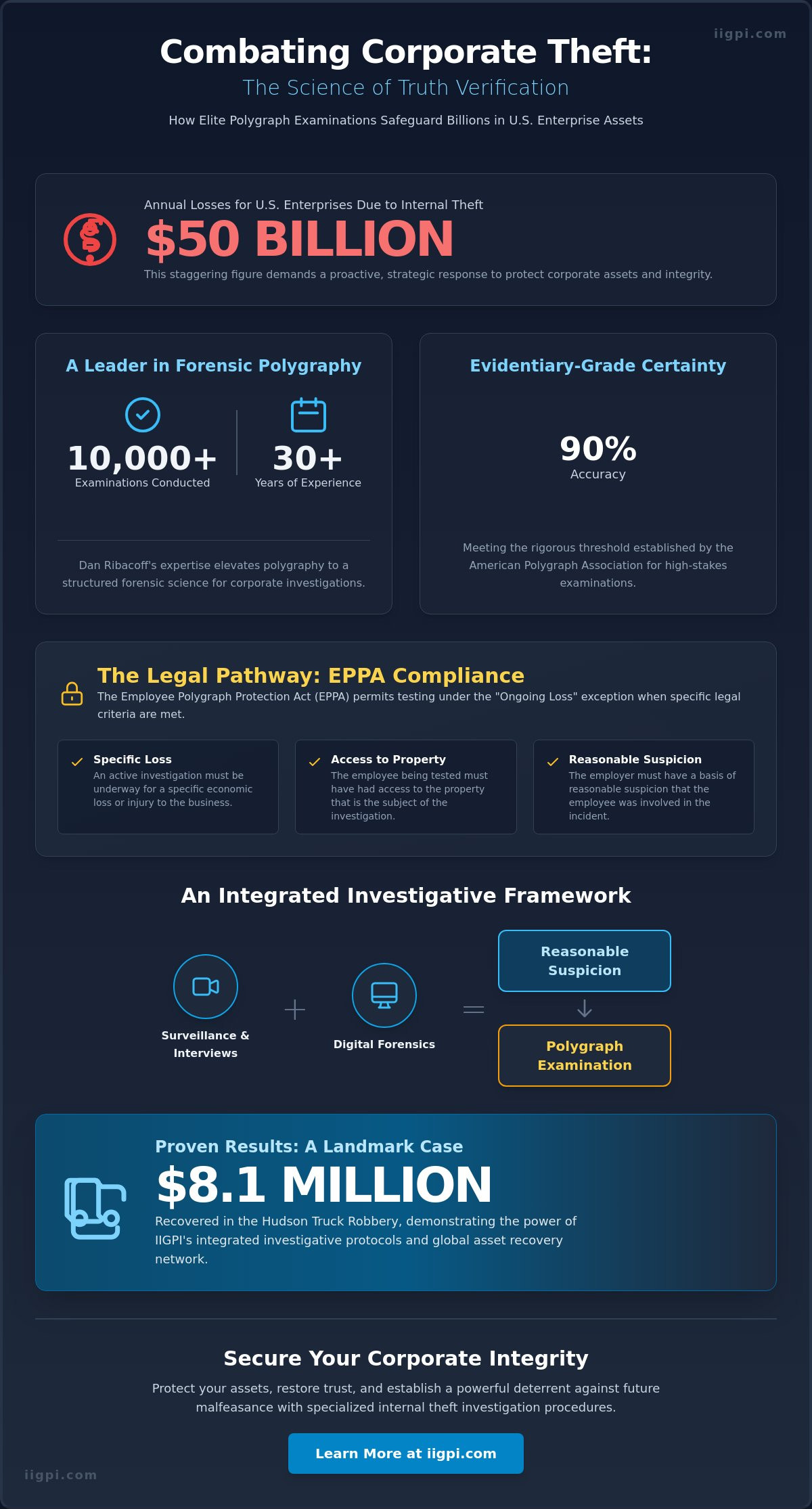
Integrating Lie Detector Tests into a Comprehensive Investigative Framework
Corporate intelligence requires a multi-modal architecture where disparate forensic disciplines converge to provide a singular, verified narrative. Just as international security councils rely on multi-source intelligence to verify geopolitical threats, modern corporate entities must adopt a unified forensic stance. Effective internal theft investigation procedures don’t treat polygraphy as an isolated event; instead, they utilize it as the final corroborative layer in a broader investigative framework. This integration ensures that the physiological data captured during an examination is contextualized by empirical evidence gathered through digital analysis and physical observation. By centralizing the investigative lead, IIGPI eliminates information silos that often allow sophisticated internal actors to exploit organizational blind spots.
Computer Forensics and the Digital Paper Trail
Digital environments provide a persistent record of intent and action. Identifying unauthorized data access or anomalous financial transfers prior to the polygraph interview allows examiners to develop highly specific control questions. This digital evidence serves as a baseline for veracity testing, forcing the examinee to reconcile their testimony with the immutable record of their online activity. For organizations requiring deeper technical insight into these processes, IIGPI’s computer forensics services offer the necessary sophistication to recover deleted metadata and trace illicit encrypted communications. This synergy between human and digital forensics creates a comprehensive evidentiary profile that is difficult to challenge in a legal or corporate setting.
The Role of Professional Surveillance
Professional surveillance acts as the primary mechanism for establishing the reasonable suspicion required for EPPA compliance. By establishing behavioral patterns that suggest internal collusion or unauthorized asset movement, investigators gather the necessary justification for subsequent veracity testing. The transition from overt clandestine monitoring to internal veracity testing must be seamless and legally documented. Our professional surveillance guide details the tactical context needed to observe suspects without compromising the integrity of the broader investigation. This observational data often provides the critical leverage needed during the pre-test interview phase of internal theft investigation procedures.
A prime example of this multi-modal efficacy occurred when IIGPI resolved a $12 million fraudulent burglary claim. By integrating surveillance, digital forensics, and elite polygraph examinations, the firm identified the internal orchestrators who had fabricated physical evidence to deceive insurance adjusters. The centralized management of these diverse tools allowed for the rapid cross-verification of conflicting data points. Organizations facing similar high-value risks should consult with IIGPI to implement elite corporate investigations that secure their assets and institutional reputation.
Securing Corporate Integrity with IIGPI’s Elite Investigative Protocols
The preservation of institutional integrity within the global marketplace necessitates a partnership with investigative entities that possess both technical mastery and a historical legacy of success. NYC’s most prestigious law firms and multinational corporations consistently engage Dan Ribacoff and the International Investigative Group (IIGPI) to manage their most sensitive internal crises. This institutional preference is rooted in the firm’s unrivaled experience, exemplified by the 10,000 cases benchmark. This significant volume of casework represents over three decades of refined forensic application in high-value asset recovery and truth verification. IIGPI operates as a premier intelligence forum, offering a global reach that allows for the execution of complex polygraphs and internal theft investigation procedures across diverse international jurisdictions. Within these high-stakes environments, discretion and absolute confidentiality serve as the fundamental cornerstone of every corporate partnership; this ensures that sensitive organizational data remains protected from public or competitor scrutiny.
The IIGPI Advantage: Law Enforcement Heritage
Superior investigative outcomes are often the direct result of a formal law enforcement heritage. IIGPI’s leadership brings a background in traditional police and government agency protocols, which translates to a level of investigative rigor that is rarely found in the purely private sector. This expertise is critical when a corporate matter transitions into a criminal case, requiring seamless coordination with public authorities. The firm maintains a meticulous chain of custody for all evidence, ensuring that findings are robust enough to withstand the scrutiny of Federal court proceedings. This commitment to procedural perfection guarantees that every investigation is conducted with the intellectual depth and authority necessary for high-level decision-making. It’s this fusion of public-sector discipline and private-sector agility that defines our investigative standard.
Initiating a Corporate Theft Investigation
Fortifying Institutional Integrity Through Forensic Excellence
The integration of forensic veracity testing into a broader security architecture represents the pinnacle of modern risk management. By aligning internal theft investigation procedures with the scientific rigor of the American Polygraph Association and the legal mandates of the Employee Polygraph Protection Act, organizations can effectively mitigate the systemic threat of internal fraud. The transition from suspicion to empirical certainty requires the expertise of a preceptor-level examiner who understands the nuanced intersections of human physiology and digital evidence. It’s a strategic necessity that transcends basic auditing to provide definitive resolution for complex corporate losses.
Dan Ribacoff and the International Investigative Group offer an unrivaled pedigree, characterized by over 30 years of investigative excellence and more than 10,000 successfully resolved cases. This legacy of success has earned recognition in prestigious global forums, including features in The New York Times and The Wall Street Journal. For high-level decision-makers, the choice of an investigative partner is a strategic determination that impacts the long-term stability of the enterprise. We invite you to secure your organization’s assets with an elite investigation by IIGPI and establish a deterrent against future malfeasance. The restoration of institutional trust is an achievable objective when supported by elite forensic methodology. For those interested in specialized professional services and training that promote a culture of transparency, learn more about Indestructible Project.
Frequently Asked Questions
Is a lie detector test for corporate theft legal in New York?
Lie detector tests for corporate theft are legal in New York when conducted in strict adherence to federal and state mandates. While New York labor laws provide significant protections, they don’t supersede the federal “ongoing loss” exemption which allows private employers to investigate specific economic injuries. Organizations must ensure that their internal theft investigation procedures include the required 48-hour notice and a signed statement articulating the reasonable suspicion that justifies the inquiry.
Can an employee be fired for refusing a polygraph test?
An employee cannot be terminated solely for refusing to submit to a polygraph examination under the Employee Polygraph Protection Act. Federal law mandates that refusal may not serve as the primary basis for adverse employment actions; however, an employer may proceed with disciplinary measures if independent evidence corroborates the suspicion of malfeasance. The refusal is a protected right that requires the organization to rely on broader forensic findings rather than a single point of non-compliance.
How accurate are Dan Ribacoff’s polygraph examinations for theft cases?
Dan Ribacoff’s examinations adhere to American Polygraph Association (APA) standards, which require techniques to demonstrate an average accuracy rate of 90% or greater for evidentiary purposes. His methodology utilizes advanced computerized instrumentation to monitor autonomic responses with surgical precision. By integrating these examinations into comprehensive internal theft investigation procedures, IIGPI provides a level of technical reliability that is recognized by elite law firms and international corporations.
What is the Employee Polygraph Protection Act (EPPA) and how does it apply?
The Employee Polygraph Protection Act of 1988 is the primary federal statute regulating the administration of lie detector tests in the private sector. It generally prohibits the use of such devices for pre-employment screening but grants a specific exemption for ongoing investigations into economic loss or injury to the business. This application is subject to rigorous procedural requirements, including the documentation of the employee’s access to the missing assets and the formal establishment of reasonable suspicion.
What happens if an employee fails a polygraph test during an investigation?
If an employee fails a polygraph examination, the employer is prohibited from taking adverse action based exclusively on that result. The EPPA requires that the test findings be treated as a corroborative element within a larger evidentiary framework. Decisions regarding termination or asset recovery must be supported by additional documentation, such as surveillance footage, digital forensic trails, or witness testimony, to ensure the legal defensibility of the organization’s actions and minimize liability.
How much does a professional corporate lie detector test cost?
The fiscal commitment for a professional corporate polygraph examination varies based on the complexity of the case and the examiner’s specialized expertise. While national industry averages for single-issue private examinations typically range between $500 and $2,500, corporate entities should prioritize the examiner’s credentials and adherence to APA standards over baseline costs. IIGPI provides customized investigative protocols that reflect the scale of the corporate loss and the forensic depth required to resolve the matter.
Can polygraph results be used in a corporate court case?
The admissibility of polygraph results in corporate court cases depends upon the jurisdiction and the specific legal standards applied, such as the Daubert or Frye tests. While federal courts may allow such evidence at the discretion of the judge, many state courts often require prior stipulation by both parties. Regardless of courtroom admissibility, the results serve as a powerful internal tool for asset recovery and for narrowing the scope of suspicion during complex fraud inquiries.
What is the difference between a screening test and a specific incident polygraph?
A screening test is a broad assessment often used for pre-employment, whereas a specific incident polygraph focuses on a singular event of economic loss. The EPPA strictly prohibits most private employers from conducting screening examinations, making the specific incident polygraph the only legal gateway for corporate investigations. This distinction is vital for ensuring that internal security measures remain compliant with federal civil rights protections while effectively addressing inventory shrinkage or embezzlement.