The common perception of the polygraph as a mystical “lie detector” machine is a fundamental mischaracterization of what is, in reality, a sophisticated forensic discipline of physiological data interpretation. You likely harbor valid skepticism regarding the accuracy of such examinations, perhaps fueled by the sensationalized portrayals found in popular media that frequently diverge from the rigorous standards of legitimate forensic science. This article provides an authoritative examination of the lie detector test through the professional lens of Dan Ribacoff, whose decades of investigative experience and APA-trained expertise offer a necessary correction to prevailing public misconceptions.
Readers will gain an analytical understanding of the physiological basis of polygraphy, moving beyond the superficiality of televised dramatizations to examine the forensic-grade protocols maintained by the International Investigative Group. We will explore the critical role of the examiner in chart interpretation, the impact of the 87% to 95% accuracy rates documented in recent meta-analyses, and the complex landscape of legal admissibility under evolving standards. By the conclusion of this discourse, the distinction between anecdotal observation and scientific investigative strategy will be definitively established, providing clarity for those navigating high-stakes corporate or legal environments.
Key Takeaways
- Understand the physiological foundations of the polygraph as a multi-channel forensic instrument that monitors autonomic nervous system responses to psychological stimuli.
- Learn the mandatory three-phase methodological protocol required to transform raw physiological data into an authoritative investigative finding.
- Evaluate the significance of professional accreditation through the lens of a lie detector test by Dan Ribacoff, whose APA-trained expertise ensures the highest standards of forensic integrity.
- Discover how advanced forensic sensors effectively neutralize common myths regarding physical countermeasures and the impact of examinee anxiety on result accuracy.
- Assess the strategic integration of polygraphy within broader investigative frameworks to resolve critical disputes in corporate and matrimonial settings.
The Physiological Foundations of the Lie Detector Test
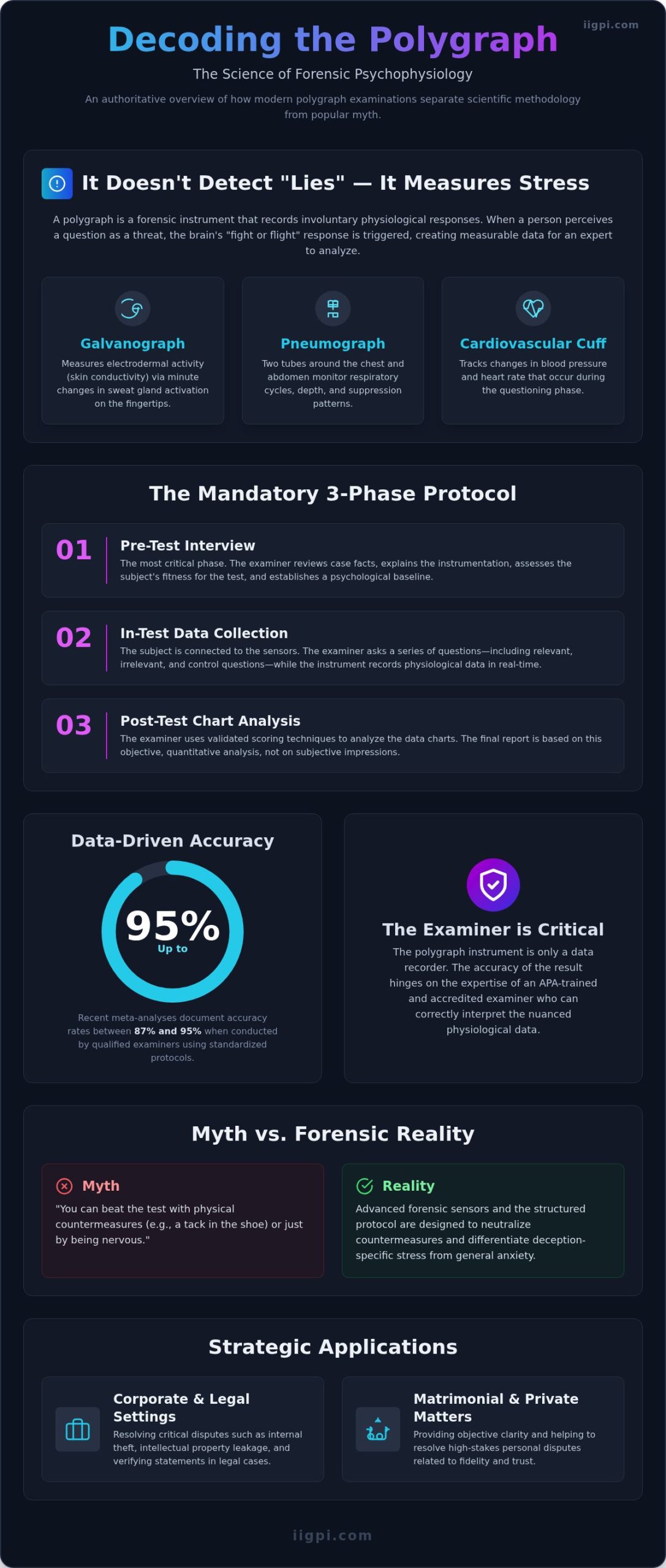
Within the rigorous framework of forensic psychophysiology, the instrument colloquially termed a lie detector test, Dan Ribacoff emphasizes, represents a sophisticated multi-channel diagnostic tool designed to record involuntary autonomic nervous system (ANS) responses. It’s essential to recognize that the device doesn’t detect deception directly; instead, it monitors the physiological correlates of psychological stress. When an examinee perceives a specific question as a threat to their well-being or social standing, the brain initiates the “fight or flight” response. This primal evolutionary mechanism manifests through measurable biological shifts that an expert examiner can identify. For those seeking a broader historical context on these developments, Wikipedia’s overview of the polygraph offers a comprehensive summary of the instrument’s evolution and the scientific scrutiny it has faced throughout the 20th and 21st centuries.
The Role of the Autonomic Nervous System
The sympathetic nervous system serves as the primary driver of the measurable changes observed during a forensic examination. When an individual attempts to deceive, the cognitive load and associated anxiety trigger the release of adrenaline, leading to increased sweat gland activity and respiratory alterations. The professional protocols at International Investigative Group involve the use of several specialized sensors:
- The Galvanograph: This component measures electrodermal activity, specifically skin conductivity, which fluctuates in response to minute changes in moisture levels on the fingertips.
- Pneumograph Tubes: Placed around the chest and abdomen, these sensors monitor respiratory suppression, cycles, and depth.
- Cardiovascular Cuffs: These track changes in blood pressure and heart rate that occur during the questioning phase.
These sensors capture the subtle “catch” in a breath or the shallowing of respiratory patterns that often accompany the stress of providing a false statement. By recording these channels simultaneously, the examiner creates a comprehensive physiological profile of the subject’s responses.
Data Quantization and Chart Analysis
Modern investigations have transitioned from traditional analog ink-on-paper systems to advanced digital polygraph platforms. These digital systems convert continuous physiological signals into discrete numerical values, which allows for more granular quantization of the data. This transition has significantly enhanced the ability of examiners to perform objective chart analysis. Achieving judicial-grade accuracy requires a strictly controlled environment to minimize external “noise” such as ambient sound or temperature fluctuations. Such variables could otherwise contaminate the physiological data and lead to inconclusive results. This institutional rigor ensures that the resulting charts reflect the examinee’s internal psychological state rather than external environmental factors, providing a reliable foundation for the final investigative report.
The Methodological Protocol: How a Forensic Polygraph is Conducted
Adherence to a rigorous methodological protocol is what distinguishes a forensic examination from a mere interrogation. For a professional lie detector test, Dan Ribacoff utilizes a mandatory three-phase structure designed to ensure the highest degree of diagnostic accuracy. This structured approach, encompassing the pre-test interview, the in-test data collection, and the post-test analysis, is essential for mitigating the psychological variables that can otherwise skew physiological data. Without this sequence, the raw data lacks the necessary context for accurate interpretation.
Phase I: The Pre-Test Interview
The initial phase is perhaps the most critical for establishing the “psychological set” of the examinee. During this period, the examiner reviews the case facts and explains the instrumentation in detail to ensure the subject fully comprehends the technology. This phase serves a dual purpose: it allows the examiner to assess whether the subject is physically and mentally fit for testing while fulfilling the legal and ethical requirements for voluntary consent. It’s during this stage that the examiner clarifies all questions to be asked, ensuring there are no surprises that might trigger a startle response unrelated to deception.
Phase II: The Examination and In-Test Data Collection
Once the sensors are attached, the examiner proceeds with the formulated question sets. These include “Relevant” questions, which address the core issue under investigation, and “Comparison” questions, which provide a physiological baseline for the subject’s response to non-relevant stress. Questions are strictly limited to “Yes” or “No” responses to eliminate cognitive artifacts that arise from verbal elaboration. Despite ongoing debates within the psychological community regarding the scientific validity of polygraph tests, the use of repeated question sets ensures that physiological responses are consistent across multiple charts. This repetition is vital for filtering out random physiological noise.
Phase III: Numerical Scoring and Results Delivery
The final phase involves the application of objective numerical scoring systems, such as the Utah or Federal 7-position scales. These systems allow the examiner to quantify the differences in physiological reactivity between relevant and comparison questions. The resulting data leads to one of three formal conclusions: Deception Indicated (DI), No Deception Indicated (NDI), or Inconclusive (INC). A formal forensic report is then prepared for the client, providing a definitive record of the findings. For organizations requiring this level of analytical precision, engaging a certified polygraph examiner ensures that the results meet professional standards of integrity and investigative rigor.
Myth-Busting: Debunking Misconceptions About Polygraph Accuracy
The prevailing discourse regarding the fallibility of the polygraph is frequently contaminated by anecdotal myths and sensationalized media representations that fail to account for the rigor of modern forensic science. For a professional lie detector test, Dan Ribacoff asserts that the distinction between a valid diagnostic procedure and an entertainment-style “TV test” lies in the application of validated protocols and advanced sensor technology. While popular culture suggests that specific personality types or physical maneuvers can circumvent the instrument, empirical evidence and decades of investigative experience suggest otherwise. Accuracy remains the priority. This institutional rigor ensures that the resulting data reflects physiological truth rather than a manufactured performance.
Can You “Beat” a Lie Detector Test?
The archaic “tack in the shoe” myth assumes that an examiner cannot distinguish between random physiological spikes and the specific signatures of deception. Modern forensic environments utilize specialized movement sensors and pressure-sensitive seat pads to detect even the most subtle physical countermeasures. Pharmacological attempts to suppress the autonomic nervous system are similarly identified during the pre-test interview or through the analysis of flattened chart patterns that deviate from a subject’s natural baseline. Efforts to manipulate the outcome through physical or chemical means almost universally result in an “Inconclusive” finding rather than a successful deception because the integrity of the physiological data becomes compromised.
The Fallacy of the “Nervous” Examinee
A frequent concern among subjects involves the potential for general anxiety to be misidentified as a deceptive response. Forensic psychophysiologists account for this through the concept of habituation, where the subject acclimates to the testing environment during the pre-test phase. Examiners often conduct “Stimulation Tests” to demonstrate the instrument’s sensitivity to the examinee, which simultaneously serves to stabilize their baseline. General anxiety produces a diffuse physiological signature, whereas the fear of detection triggers a specific, localized reaction in response to relevant stimuli. Expert interpretation filters out the background noise of situational stress.
The biological reality is that even individuals with psychopathic traits or “natural liars” possess an autonomic nervous system that responds to the internal threat of detection. This perspective aligns with the U.S. Department of Justice on Polygraphs, which emphasizes the instrument’s utility as a specialized investigative tool when administered under strict professional standards. For high-stakes scenarios, the technical expertise provided by the International Investigative Group ensures that these common misconceptions are neutralized through scientific methodology. This objective approach provides the intellectual depth required for serious global discourse on investigative integrity.
Dan Ribacoff: A Legacy of Expertise in Polygraphy and Investigations
The professional legacy of Dan Ribacoff is inextricably linked to the evolution of modern forensic polygraphy. As the founder of the International Investigative Group, Ribacoff has spent over 30 years refining the application of physiological data in legal and corporate contexts. His foundational training under the late Gene Sandacz provided a rigorous introduction to the field, which he later augmented through APA-accredited education. This pedigree ensures that every lie detector test, Dan Ribacoff oversees adheres to the most stringent evidentiary standards. His expertise is frequently sought in high-stakes environments, including 18b and Federal Court matters, where the precision of investigative findings is of paramount importance. He has successfully navigated the complexities of global systems, establishing a reputation for intellectual rigor and unwavering investigative integrity.
Academic and Professional Credentials
Ribacoff’s institutional standing is reinforced by his active memberships in prestigious organizations such as the American Polygraph Association. Beyond standard investigative protocols, he holds specialized certifications in Advanced Post-Conviction Sex Offender Testing, a discipline requiring an exceptional level of clinical accuracy. His influence extends into the pedagogical realm, where he has contributed to the training of the next generation of forensic investigators. This commitment to professional development underscores his position as a primary architect of modern investigative standards. He has handled over 10,000 cases globally, proving his ability to manage large scale challenges with a sober and analytical focus.
Media Influence and Public Discourse
The global reach of the International Investigative Group is evidenced by Ribacoff’s frequent appearances in elite publications, including the Wall Street Journal and The New York Times. These media engagements serve as a platform for public discourse, allowing him to educate a broader audience on the scientific realities of forensic examinations. By bridging the gap between specialized science and public understanding, he has become a leading authority in the field. The firm’s diverse portfolio ranges from corporate fraud to complex matrimonial disputes. For those requiring a definitive resolution to sensitive inquiries, the International Investigative Group homepage provides comprehensive details on the firm’s global service offerings. The organization remains a research-driven entity, focused on providing systemic solutions to emerging global challenges.
Individuals and organizations seeking to leverage this elite level of forensic expertise should schedule a consultation with the International Investigative Group to discuss their specific investigative requirements and strategic objectives.
Integrating Polygraphy into Comprehensive Investigative Frameworks
The professional application of a lie detector test, Dan Ribacoff maintains, is most effective when situated within a broader investigative matrix rather than as an isolated diagnostic event. Within the complex architecture of global risk management, the polygraph serves as a critical catalyst for truth, providing physiological clarity that complements traditional forensic methodologies. By integrating psychophysiological data with surveillance, digital forensics, and deep-background analysis, the International Investigative Group offers a multi-dimensional view of investigative integrity. This systemic approach is essential for high-level decision-makers who require definitive resolutions to high-stakes disputes. Results speak for themselves. The firm’s global network of agents ensures that these rigorous standards are maintained across international jurisdictions, positioning the organization as an elite provider of truth verification services.
Corporate and Insurance Applications
In the corporate sector, the polygraph acts as a sophisticated deterrent and a tool for internal resolution. It’s particularly effective in verifying claims of internal theft and embezzlement where physical evidence may be circumstantial or absent. These examinations often provide the necessary leverage to recover assets or identify systemic vulnerabilities within an organization’s security framework. These protocols are also frequently utilized to support insurance fraud investigation services, where the objective is to mitigate risk and identify fraudulent activity before significant specie loss occurs. For sensitive security positions, pre-employment screening remains a vital institutional safeguard, ensuring that individuals in positions of high trust meet the necessary standards of integrity and psychological stability. This research-driven focus on organizational health remains a core mission of the firm.
Domestic and Personal Legal Matters
The application of forensic polygraphy extends into the personal and domestic spheres, where it serves to resolve contested claims in matrimonial and child custody cases. These situations often involve high emotional stakes and complex interpersonal dynamics that require a sober, analytical approach. The use of polygraphy in these contexts works alongside established personal detective protocols to establish a factual baseline for legal proceedings. By providing a scientific foundation for domestic intelligence, the firm assists clients in navigating sensitive disputes with intellectual depth and objective clarity. This commitment to forensic rigor provides a sense of gravitas to personal investigations, ensuring that findings are admissible and authoritative. Organizations and individuals requiring this elite level of investigative precision are encouraged to engage with the International Investigative Group to secure a definitive resolution to their inquiries.
Securing Investigative Integrity through Forensic Rigor
The transition from anecdotal skepticism to forensic certainty requires a profound appreciation for the biological and methodological complexities inherent in modern psychophysiology. This examination has established that the efficacy of a lie detector test, Dan Ribacoff maintains, is predicated upon a rigorous three-phase protocol and the objective quantization of autonomic nervous system responses. By neutralizing common misconceptions through advanced sensor technology and clinical expertise, elite practitioners achieve the judicial-grade accuracy necessary for high-stakes corporate and personal legal matters. The International Investigative Group remains at the vanguard of global discourse, utilizing its expansive network to provide systemic solutions to the most challenging investigative inquiries. With 30+ years of forensic experience and over 10,000 cases successfully resolved, the organization offers an elite framework for truth verification that surpasses standard industry practices. Those who require definitive clarity in complex environments are encouraged to Consult with Dan Ribacoff and the International Investigative Group for Expert Polygraph Services. Establishing a factual baseline is the essential first step toward resolving critical disputes with intellectual depth and institutional authority.
Frequently Asked Questions
Is a lie detector test admissible in a court of law?
Admissibility is contingent upon the specific jurisdiction and the prevailing legal standards, such as the Daubert or Frye criteria. While polygraph results are frequently inadmissible in many U.S. criminal proceedings, New Mexico remains the singular state that routinely admits such evidence. In other jurisdictions, results may be entered into evidence through a prior stipulation between the parties. The analytical findings provided by Dan Ribacoff are primarily utilized as a sophisticated investigative tool to guide legal strategy.
How long does a professional polygraph examination typically take?
A comprehensive forensic polygraph examination generally requires a duration of two to three hours to ensure procedural integrity. This timeframe encompasses the essential pre-test interview, the systematic collection of physiological data across multiple charts, and the subsequent numerical analysis of the results. Rushing this diagnostic process compromises the validity of the data. Every lie detector test, Dan Ribacoff facilitates, prioritizes precision over speed, providing the depth required for complex global investigations.
Can medications or medical conditions affect the results of a lie detector test?
Pharmacological agents and specific physiological conditions can potentially modulate autonomic responses, though they rarely facilitate the successful circumvention of a professional examination. Examiners at International Investigative Group evaluate the subject’s medical history and current medication regimen during the pre-test phase to account for these variables. Certain conditions might produce flattened charts or erratic baselines, which are identified as anomalies during the quantization process. Transparency regarding health status is vital for maintaining the diagnostic accuracy of the forensic findings.
What is the accuracy rate of a polygraph test administered by Dan Ribacoff?
Meta-analyses conducted by the American Polygraph Association indicate that single-issue examinations administered by expert examiners achieve an accuracy rate between 87% and 95%. This high degree of precision is a direct result of the rigorous methodological protocols and advanced digital instrumentation utilized by Dan Ribacoff. While no forensic tool is infallible, the combination of professional accreditation and decades of investigative experience ensures that the resulting interpretations meet the highest standards of institutional reliability.
How should I prepare for a lie detector test at IIG?
Preparation for a forensic examination requires the subject to prioritize physiological stability and psychological transparency. It’s recommended that examinees obtain sufficient rest, maintain their standard dietary habits, and avoid excessive stimulants like caffeine before the appointment. During the pre-test interview, complete honesty regarding the case facts is essential for establishing an accurate baseline. This collaborative approach ensures that the physiological sensors capture the subject’s true autonomic state without the interference of situational fatigue or external stress.
What happens if a polygraph result is “Inconclusive”?
An “Inconclusive” result signifies that the collected physiological data didn’t deviate sufficiently from the baseline to support a definitive finding of deception or truthfulness. This outcome often occurs when a subject employs physical countermeasures or when situational anxiety contaminates the autonomic signals. It doesn’t imply a failure of the technology but rather an insufficiency of quantifiable evidence. In such instances, a re-test may be scheduled after a suitable period to ensure that environmental or psychological variables are neutralized.
Can an employer force an employee to take a lie detector test?
The Employee Polygraph Protection Act (EPPA) strictly prohibits most private employers from requiring an employee to undergo a lie detector test, Dan Ribacoff notes, as a condition of employment. There are specific exemptions for government agencies, security firms, and pharmaceutical manufacturers. Private entities may only request a test during an ongoing investigation into economic loss, provided they adhere to rigorous federal guidelines. Understanding these legal frameworks is essential for both corporate decision-makers and individual employees navigating workplace investigations.
Are polygraph tests conducted by Dan Ribacoff confidential?
Confidentiality is a foundational principle of the investigative protocols maintained by Dan Ribacoff and the International Investigative Group. All examination results and associated case data are treated as sensitive intellectual property, shared exclusively with the client or their designated legal representatives. This commitment to privacy is essential for maintaining the integrity of high-stakes corporate and personal investigations. The firm operates with a level of discretion that mirrors elite international forums, ensuring that sensitive information remains protected from unauthorized disclosure.