
What if a suspicious lease discrepancy reflects a documentation error or civil dispute rather than fraud? In New York City, acting on an assumption can complicate an already difficult situation. A careful approach to investigating commercial lease fraud NYC starts by separating verifiable facts from allegations, including questions about a lessor’s identity, authority, property ownership, or representations.
It’s reasonable to want clear answers quickly, especially when lease records, payment communications, or digital files could be changed or lost. This guide explains how to identify warning signs worth checking, preserve relevant records, and frame a focused investigative question. It also covers when independent verification or professional investigative support may be appropriate.
You’ll learn how to organize documents and communications, assess discrepancies in context, and consider options such as due diligence, corporate investigations, computer forensics, or surveillance when relevant and proportionate. The goal is a disciplined evidentiary process: establish what can be confirmed, document what remains uncertain, and choose a responsible next step.
Key Takeaways
- Distinguish possible deception from ordinary disagreements about repairs, rent, lease terms, or performance before drawing conclusions.
- When investigating commercial lease fraud nyc, build a dated chronology that connects each disputed representation to its source, recipient, and business impact.
- Compare document review, public-record research, attorney-directed inquiries, and independent investigation based on the question, available evidence, sensitivity, and expertise required.
- Define a confidential case file and investigative scope, including relevant parties, dates, locations, and acceptable methods.
- Consider corporate investigations, due diligence, or computer forensics when independent verification is insufficient and the methods fit the matter.
What Counts as Commercial Lease Fraud in NYC, and What Does Not?
A discrepancy in a commercial lease can justify closer examination, but it doesn’t establish fraud by itself. Suspected lease fraud generally involves a material misrepresentation or concealment connected to negotiating, signing, or performing a lease. The central question is whether someone knowingly used intentional deception to induce another party to act, rather than whether a transaction simply produced an unfavorable outcome. Whether specific conduct meets a legal standard depends on the facts and should be assessed with qualified legal counsel.
In New York City, a commercial transaction may involve landlords, brokers, property owners, agents, and sublessors. That can make it difficult to determine who made a particular representation and whether they had authority to make it. Treat warning signs as leads to verify, not proof of wrongdoing or grounds for public accusations. A disciplined approach to investigating commercial lease fraud nyc begins with comparing records and identifying exactly what remains uncertain.
Which commercial lease warning signs deserve verification?
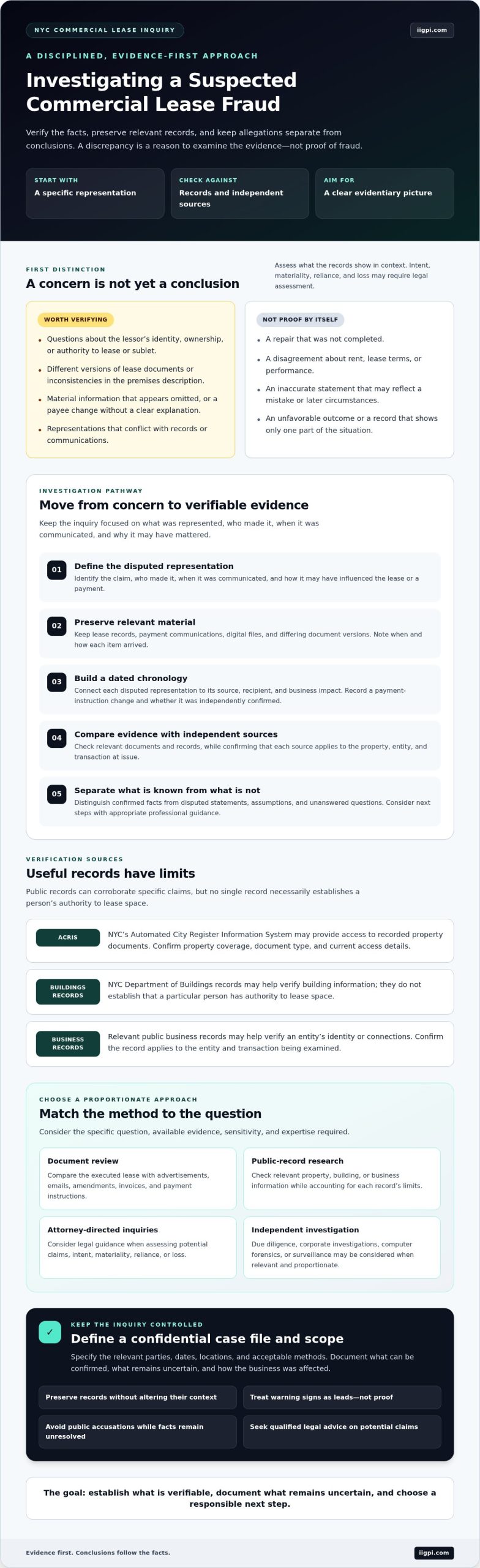
Start with claims about the lessor’s identity, ownership, authority to lease the premises, or right to sublet. Then compare the executed lease with advertisements, emails, amendments, invoices, and payment instructions. Note inconsistencies in the premises description, material information that appears to have been omitted, documents that differ across versions, or a payee change without a clear explanation.
Record each discrepancy without assuming why it occurred. For example, if payment instructions name a different recipient from the signed lease, preserve both versions and note when and how each arrived. The change may have an ordinary explanation, but independent confirmation may be warranted before relying on the new instructions.
When is a lease problem not necessarily fraud?
A landlord’s failure to complete a repair, a disagreement about rent, or competing interpretations of a lease term may raise a contract or performance issue without establishing fraud. Breach, negligence, inaccurate statements, and fraud are not interchangeable conclusions. Even a statement that proves inaccurate may have resulted from a mistake, later circumstances, or a genuine disagreement about its meaning.
Questions of intent, materiality, reliance, and resulting loss can be central to a legal assessment. Their application depends on the evidence and circumstances. Document what was represented, who communicated it, when it occurred, what records conflict with it, and how the business was affected. Avoid publicly labeling a party’s conduct while the facts remain unresolved, and seek legal advice about potential claims and appropriate next steps.
How to Investigate Suspected Commercial Lease Fraud in NYC
A useful inquiry moves from a defined concern to verifiable records rather than treating every inconsistency as proof. Identify the specific representation in question, who made it, when it was communicated, and why it may have influenced the lease or a payment. Then preserve relevant material, check the claim against independent sources, document discrepancies, and assess next steps with appropriate professional guidance. This gives investigating commercial lease fraud NYC a clear evidentiary focus.
Create a dated chronology connecting each representation to its source, recipient, and business consequence. Separate independently confirmed facts from disputed statements, assumptions, and unanswered questions. For example, note the date a payment instruction changed, who sent it, and whether the change was independently confirmed. Don’t state that it was fraudulent unless the evidence supports that conclusion.
How can NYC property and business records help verify representations?
Public records can corroborate specific claims, but they don’t answer every question. NYC’s Automated City Register Information System (ACRIS) may provide access to recorded property documents. Confirm that the property and document type are covered, and check current access details. NYC Department of Buildings records may help verify building information, but they don’t establish that a particular person has authority to lease space. Checking relevant public business records may help verify an entity’s identity or connections, but confirm that the record applies to the entity and transaction at issue.
A record showing a property connection, business registration, or building detail is one piece of evidence, not a complete conclusion about lease authority. Likewise, a clause that may violate NYC laws raises a legal question, but that alone doesn’t establish intentional deception.
How should you preserve lease-fraud evidence?
Retain original leases and drafts, disclosures, payment records, messages, and attachments in their native formats when available. Avoid editing source files or relying only on screenshots when the original email or document can be preserved. For each item, record its date, custodian, source, collection method, and any known changes. Organize copies so reviewers can distinguish original material from working notes.
Limit access to people who need the records, particularly if the file contains sensitive personal or business information. Before taking intrusive steps, contacting third parties in a way that could affect the inquiry, or making decisions that may affect rights or evidence, consult qualified counsel. When records or independent verification remain insufficient, a corporate investigations inquiry through International Investigative Group may help organize factual questions and examine available information within a defined scope.
Which Investigation Approach Fits a NYC Commercial Lease Concern?
The right approach depends on what you need to establish, what evidence is available, how sensitive the matter is, and what expertise the question requires. A routine discrepancy in payment records may call for a focused internal review. Uncertainty about a lessor’s identity or a document’s history may call for independent verification. When investigating commercial lease fraud nyc, match the method to the question instead of expanding the inquiry without a clear purpose.
- Internal document review: Useful for accessible lease files, straightforward timeline questions, or reconciling invoices and payments.
- Public-record research: Can help check recorded property documents or business information, but records may not resolve authority, intent, or disputed communications.
- Attorney-directed inquiry: Appropriate when potential legal claims, tenant rights, litigation strategy, or sensitive evidence collection may be involved.
- Independent investigation: May help when identities, affiliations, representations, or relevant records require verification beyond the parties’ own files.
When is an internal review or counsel-led inquiry appropriate?
Begin internally when the question can be answered from records the business already holds, such as whether a payment matched an invoice or which lease version was signed. Involve qualified counsel if the review may affect legal claims, rights, or litigation strategy, or if evidence collection could be intrusive. An investigator’s involvement alone doesn’t make an inquiry privileged. Counsel can advise on the appropriate structure and protections.
When might an independent investigator add value?
Outside support may be useful when independent verification is needed to examine a person’s identity, business affiliations, documented representations, or connections relevant to the transaction. Corporate investigations and due diligence can complement internal, accounting, and legal review, but investigators gather information. They don’t provide legal advice or determine liability. Confirm the investigator’s applicable authorization and agree on a defined scope before work begins.
Specialist methods should address a specific question. Computer forensics may be relevant when digital records require careful handling or analysis. Consider surveillance only if a defined issue justifies it and counsel confirms that the proposed use is lawful and proportionate. Neither method is a default response to a lease disagreement.
Before selecting an approach, specify the question, relevant dates, available records, urgency, sensitivity, and expertise required. A narrow scope helps prevent unnecessary collection and makes findings easier to evaluate. Independent investigative work can supplement, rather than replace, the business, accounting, or legal assessment needed to decide what the evidence means and what steps may follow.
What Should You Do Before and During a Lease-Fraud Inquiry?
Before expanding an inquiry, assemble a confidential case file that gives reviewers a reliable account of the transaction without presenting suspicions as established facts. Include the lease and relevant amendments, a dated timeline, the names and roles of key parties, the specific statements or documents in dispute, and any known business losses. Keep source records intact, and separate confirmed information from assumptions and questions that still need answers.
Define the inquiry in writing. State what you need to establish, which dates and locations matter, what evidence is available, and which methods are acceptable. A narrow scope helps keep the work relevant and proportionate. Protect ordinary business operations, and avoid confrontations, unauthorized access to accounts or devices, impersonation, or public allegations that could escalate the dispute or affect evidence. Document significant decisions and coordinate with counsel if legal rights or proceedings may be involved.
What information should you provide to an investigator?
Prepare a concise factual brief covering the transaction, parties, premises, relevant dates, and specific inconsistencies. Provide copies of available records, such as leases, communications, payment documents, or advertisements, while retaining originals and noting each item’s source. Identify urgent preservation concerns, privacy sensitivities, and any existing counsel, claims, or proceedings. This gives an investigator the context needed to understand the question without treating an allegation as a conclusion.
How can you evaluate investigative scope and reporting?
Request a written scope that identifies the questions to be answered, proposed methods, expected deliverables, and communication arrangements. Ask how records and digital evidence will be collected, documented, stored, and reported, and how access to confidential material will be limited. Before engagement, verify applicable New York licensing requirements and the investigator’s authorization for the proposed work. Confirm requirements rather than assuming them.
During the inquiry, keep a record of scope changes, new information, and decisions about next steps. If the evidence raises a legal question, refer it to counsel rather than asking an investigator to decide liability or provide legal advice. A professional investigation can organize factual inquiries when independent verification is needed, but findings don’t guarantee a particular legal result.
If independent verification may help clarify a defined lease concern, discuss corporate investigations as one possible investigative option.
How Can a NYC Corporate Investigator Support a Commercial Lease Inquiry?
A corporate investigator can help address defined factual questions that remain unresolved after reviewing the parties’ available records and public information. Depending on the agreed scope, this may include verifying identities and affiliations, examining documented representations, or identifying relevant business connections. The purpose is to gather and organize information, not to determine legal liability or replace advice from counsel.
For a disciplined approach to investigating commercial lease fraud nyc, ask how findings will distinguish verified facts from inference and unresolved questions. Reports should identify the sources and handling of relevant evidence so readers can assess where information came from and what it does, and does not, establish. Investigative findings can inform a broader review, but they don’t guarantee a particular legal outcome or determine whether evidence will be admissible.
What should you assess when selecting a commercial investigation firm?
Evaluate experience relevant to corporate investigations, the investigator’s applicable New York authorization, proposed methods, and reporting practices. Ask how the firm will document evidence provenance, separate confirmed information from assumptions, and communicate limitations or unanswered questions. Before work begins, agree on scope, confidentiality practices, reporting expectations, and how the inquiry will coordinate with your legal counsel if needed.
A clear engagement connects each proposed method to a specific question. Broad requests to “find out what happened” are harder to assess than a defined inquiry into whether a named representative had a documented connection to a business or whether a particular representation can be independently corroborated.
What can International Investigative Group contribute?
International Investigative Group is a New York City private investigation firm with corporate investigation capabilities that include due diligence, financial fraud inquiries, surveillance, and computer forensics. Which capabilities, if any, are appropriate depends on the facts and agreed scope. Due diligence may assist with independent verification; computer forensics may be relevant when digital evidence requires specialist analysis; surveillance should be considered only when it addresses a defined question and is lawful and proportionate.
Before engagement, confirm the investigator’s current authorization and discuss how the inquiry will be documented and coordinated with counsel. A measured assessment can clarify whether independent investigative support fits the concern or whether another form of review is better suited to the question.
To discuss whether a defined lease concern may benefit from independent support, discuss a commercial investigation.
Move Forward With a Clear, Evidence-Led Plan
A sound inquiry distinguishes verifiable facts from assumptions and follows the evidence without treating a discrepancy as proof of fraud. Preserve relevant records, build a dated chronology, and define the question you need answered. If legal rights or proceedings may be involved, coordinate next steps with qualified counsel.
When investigating commercial lease fraud nyc, independent support may be appropriate if identity, business connections, or representations remain unclear after an initial review. International Investigative Group reports more than 30 years of experience and over 10,000 cases solved. Its corporate investigation capabilities may help organize factual inquiries, but findings don’t guarantee a legal outcome or replace legal advice.
If you have a defined concern and want to assess whether independent investigative support fits, discuss a commercial investigation. A measured, well-documented next step can help you move forward with greater clarity.
Frequently Asked Questions
What are common warning signs of commercial lease fraud in NYC?
Warning signs include conflicting claims about a lessor’s identity or authority, unexplained changes to payment instructions, and material differences between the signed lease and earlier communications. Inconsistent premises descriptions, altered document versions, or omitted information may also warrant verification. None proves fraud on its own. Compare each concern with original records, note who provided the information and when, and seek independent confirmation before making accusations or taking consequential action.
How can I verify who owns or controls a commercial property in New York City?
Start with recorded property documents available through New York City’s Automated City Register Information System, or ACRIS, and confirm that the records cover the property and document type you need. Relevant business records may help identify an entity or its connections. NYC Department of Buildings information can provide building details, but it doesn’t establish a person’s authority to lease space. Treat each record as one source, and consult counsel if ownership or leasing authority remains disputed.
Can a private investigator investigate suspected commercial lease fraud?
Yes. A private investigator may conduct a defined factual inquiry, such as checking identities, affiliations, documented representations, or relevant business connections. Corporate investigations, due diligence, and, where appropriate, computer forensics may help when records or independent verification are insufficient. Investigators gather information; they don’t provide legal advice or determine liability. Before engagement, confirm applicable New York authorization, agree on methods and scope, and coordinate with counsel if legal rights or proceedings may be involved.
What records should I preserve if I suspect lease fraud?
Preserve the signed lease, drafts, amendments, disclosures, advertisements, invoices, payment records, emails, messages, and attachments that relate to the concern. Keep original digital files in their native formats when possible, avoid editing them, and record their source, custodian, collection date, and any known changes. Maintain a dated chronology connecting statements to their sources and business consequences. Limit access to sensitive records and ask counsel about evidence handling if litigation or personal information is involved.
Is a misleading statement in a commercial lease automatically fraud?
No. An inaccurate or misleading statement doesn’t automatically establish fraud; it may reflect a mistake, negligence, a later change, or a contract dispute. A legal assessment may depend on issues such as intent, materiality, reliance, and resulting loss, considered in the specific circumstances. Preserve the statement and related records, note what actions followed, and avoid publicly accusing a party while facts remain uncertain. Consult qualified counsel about whether the evidence supports a legal claim.
When should a business hire an investigator for a commercial lease dispute?
Consider independent investigative support when a specific question remains unanswered after reviewing available records, particularly if identities, affiliations, representations, or business connections require verification. An investigator may help organize factual inquiries, but should not replace counsel, accounting review, or internal analysis. Define the question, relevant dates, acceptable methods, and reporting expectations before work begins. For investigating commercial lease fraud nyc, also confirm the investigator’s applicable authorization and discuss coordination with counsel where appropriate.
Can digital records help investigate a commercial lease fraud concern?
Yes. Emails, attachments, electronic lease drafts, payment messages, and document histories may help establish what was communicated, when it changed, and who received it. Preserve original files and avoid altering or accessing accounts or devices without authorization. If digital evidence requires specialist handling or analysis, computer forensics may be appropriate within a defined, lawful scope. Record how material was collected, protect sensitive information, and ask counsel how digital evidence should be managed if proceedings may follow.